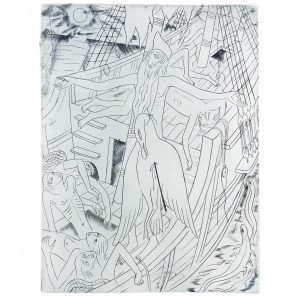
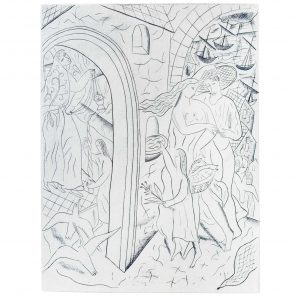
Samuel Taylor Coleridge – The Rime Of The Ancient Mariner I – Original Copper Engraving By David Jones
Jones, David & Coleridge, Samuel Taylor
£295.00
Availability: In stock
Product Description
Samuel Taylor Coleridge – The Rime Of The Ancient Mariner I – Original Copper Engraving By David Jones
Artist: David Jones
Price: £295.00
Publisher: Douglas Cleverdon, Bristol
Publication date: 1929
Format: Original copper engraving
Condition: Very fine condition, not previously framed
Sheet Size: 13.7cm x 17.5cm
Edition Number: 436/460: Unsigned as issued.
The Rime Of The Ancient Mariner: A Brief Description
The Rime of the Ancient Mariner is one of the most famous and enduring poems by Samuel Taylor Coleridge, first published in 1798 as part of Lyrical Ballads. The poem is a masterful narrative that weaves together themes of sin, punishment, redemption, and the supernatural, making it a foundational work in the English Romantic tradition. It is structured in seven parts and written in a ballad form, using archaic language and a haunting, musical rhythm to captivate the reader.
Plot Summary
The poem begins with a frame narrative: an old mariner stops a wedding guest, detaining him with a “glittering eye” and compelling him to listen to his tale. Reluctantly, the guest is drawn in, and the mariner begins to recount the story of his fateful sea voyage. The ship had set sail on a joyful journey but was soon driven southward into an icy, desolate region by a fierce storm. It is here that the crew encounters an albatross, which they welcome as a good omen. The bird appears to bring favourable winds, and the crew begins to regard it as a symbol of divine providence.
However, in an impulsive and senseless act, the mariner shoots the albatross with his crossbow, bringing a curse upon the ship. The killing of the bird is symbolic of humankind’s disrespect for nature, and the consequences are immediate. The weather turns harsh, and the ship becomes stranded in a windless, stagnant sea. The crew suffers immensely from thirst and despair, surrounded by an ocean described in vivid, otherworldly imagery: “Water, water, everywhere, / Nor any drop to drink.” The mariner’s crewmates blame him for their misfortune and hang the dead albatross around his neck as a mark of his guilt and shame.
The supernatural elements of the poem intensify as ghostly visions appear. A spectral ship, manned by Death and “Life-in-Death,” approaches. The two figures gamble for the souls of the mariner and his crew, with Life-in-Death winning the mariner’s life. One by one, the crew members die, leaving the mariner alone, cursed to witness their corpses and to bear the weight of his sin in utter isolation. His torment is worsened by the sense of desolation and the horrifying sights of the sea, described with grotesque and surreal imagery.
In his profound solitude, the mariner experiences a spiritual awakening. As he watches the beautiful, phosphorescent sea creatures dancing in the water, he begins to appreciate the beauty of God’s creation and unconsciously blesses the creatures, an act that symbolises the beginning of his redemption. The albatross falls from his neck, and the curse begins to lift. However, the mariner’s journey is far from over. Supernatural forces, including angelic spirits, guide the ship home, and he is finally rescued. Yet, the mariner is forever changed and burdened with the need to retell his story as a form of penance, wandering the earth to teach others to respect all living things.
Themes and Symbolism
The Rime of the Ancient Mariner explores several key themes, the most prominent being sin, penance, and redemption. The mariner’s impulsive act of killing the albatross represents humanity’s disruption of the natural order, and the subsequent suffering serves as a divine punishment. The poem reflects Romantic ideals, especially the reverence for nature and the belief that all living things are connected.
The albatross itself is a powerful symbol, embodying innocence, divine will, and the natural world’s sacredness. When the mariner kills it, he upsets the balance between humanity and nature, bringing spiritual consequences. The supernatural elements—such as the ghostly ship, Life-in-Death, and the spirits that guide the mariner’s ship—underscore the poem’s mystical atmosphere and the idea that unseen forces govern the world.
The theme of isolation is also central to the poem, as the mariner’s punishment is not just physical but deeply psychological and spiritual. His suffering and subsequent enlightenment highlight the importance of recognising the beauty and sanctity of creation. The mariner’s final lesson, which he imparts to the wedding guest, is a simple but powerful one: “He prayeth best, who loveth best / All things both great and small; / For the dear God who loveth us, / He made and loveth all.”
Literary Style
Coleridge’s use of language in The Rime of the Ancient Mariner is rich and evocative, combining archaic diction with vivid and haunting imagery. The poem’s musical quality is enhanced by its varied meter, frequent use of internal rhyme, and repetition, creating a hypnotic effect that draws readers into the narrative. The ballad form lends a timeless and oral quality to the story, echoing the traditions of ancient mariner tales and oral folklore.
The poem also incorporates Christian allegory, drawing parallels between the mariner’s journey and the spiritual journey of a soul seeking redemption. Coleridge’s ability to blend the physical and metaphysical realms makes the poem a work of profound depth, one that continues to captivate and inspire readers.
David Jones: A Short Biography
David Jones (1895–1974) was a renowned British artist, poet, and essayist, celebrated for his significant contributions to both visual and literary art in the 20th century. His work spans painting, engraving, poetry, and literary criticism, and he is often associated with the Modernist movement. Jones’s art and writing are deeply infused with themes of mythology, history, religion, and the trauma of war.
Early Life and Education
David Jones was born on November 1, 1895, in Brockley, Kent, to a Welsh father and an English mother. His Welsh heritage had a lasting impact on his creative output, as he often drew on Welsh history and culture. From a young age, Jones exhibited a passion for drawing, leading him to study at the Camberwell School of Art between 1909 and 1915. His formal training instilled a foundation in traditional and modern artistic techniques.
World War I Experience
The outbreak of World War I interrupted his art studies. In 1915, Jones enlisted in the Royal Welch Fusiliers and served on the Western Front until 1918. His experiences in the trenches left an indelible mark on him, profoundly influencing his later artwork and poetry. These harrowing experiences provided the inspiration for his epic poem In Parenthesis (1937), which vividly captures the camaraderie, suffering, and spiritual significance of life on the battlefield. In Parenthesis was widely praised and even recognised by T.S. Eliot as a “work of genius.”
Art and the Ditchling Community
After the war, Jones returned to his artistic pursuits, joining the Guild of St Joseph and St Dominic in Ditchling, Sussex, an artistic and religious community led by the sculptor and engraver Eric Gill. During this period, he converted to Roman Catholicism in 1921, and his faith became a recurring theme in his art and writing. The influence of the community’s emphasis on craftsmanship and spiritual values is evident in his meticulously detailed engravings and calligraphic inscriptions.
Artistic Achievements
David Jones excelled in various artistic media, including painting, wood and copper engraving, and watercolour. His watercolours are known for their luminous quality and often depict landscapes, seascapes, and scenes infused with historical and mythological references. His engravings are celebrated for their intricate detail, combining traditional techniques with a modern sensibility. Many of his works, such as his illustrations for The Rime of the Ancient Mariner, demonstrate his ability to blend text and image, imbuing both with deeper symbolic meanings.
Jones’s art often reflects his fascination with history, Christian iconography, and the natural world, as well as his interest in the intersection of the spiritual and the temporal. He had a unique ability to imbue his works with a profound sense of mystery and sacredness.
Literary Contributions
In addition to In Parenthesis, Jones wrote The Anathemata (1952), a dense and ambitious poetic work that explores themes of history, myth, and religion. The poem reflects his complex worldview, in which the sacred and the historical are intertwined. The Anathemata is considered a challenging but richly rewarding text, full of allusions to classical mythology, Christian theology, and British history.
Jones also produced numerous essays and writings on art and culture. His prose and poetry are known for their intricate structure, erudite references, and meditative tone, reflecting his deep engagement with cultural, historical, and religious themes.
Later Life and Legacy
In his later years, Jones suffered from poor health and mental anguish, including depression and the effects of his war trauma. He lived in relative seclusion in Harrow and later in Highgate, London, where he continued to write and create art with the support of friends and admirers. Despite his struggles, his influence on both the literary and artistic worlds grew. He died on October 28, 1974, in Harrow.
David Jones’s legacy is that of a uniquely multifaceted artist whose work continues to captivate and challenge audiences. His ability to merge visual art and poetry into a unified, symbolic vision remains a subject of study and admiration. He is celebrated for the depth and complexity of his vision, and his works remain essential reading and viewing for anyone interested in the convergence of art, literature, and spirituality.
Samuel Taylor Coleridge: A Short Biography
Samuel Taylor Coleridge (1772–1834) was a key figure in English Romanticism, celebrated for his poetry, literary criticism, and philosophical writings. He was born on October 21, 1772, in Ottery St Mary, Devon, England, as the youngest of ten children in the family of Reverend John Coleridge, a well-educated vicar and schoolmaster. After his father’s death in 1781, Coleridge was sent to Christ’s Hospital School in London, where he developed a lifelong passion for literature and the classics.
Coleridge went on to study at Jesus College, Cambridge, beginning in 1791. He was an exceptional student, but his time at Cambridge was turbulent. He struggled with debts, fell into a depression, and left without completing his degree. During this period, he was inspired by the ideas of the French Revolution and began forming radical political and philosophical beliefs. In 1794, he became friends with the poet Robert Southey, and together they developed a utopian plan called “Pantisocracy,” envisioning a communal society in America. Though this idea never came to fruition, it marked an early attempt at social and political reform.
In 1795, Coleridge married Sara Fricker, but the marriage was largely unhappy, exacerbated by Coleridge’s financial troubles and growing dependence on opium, which he initially used to alleviate chronic pain and anxiety. Around this time, Coleridge met William Wordsworth, with whom he formed a significant and creatively fruitful partnership. Their collaboration resulted in the publication of Lyrical Ballads in 1798, a ground-breaking collection that signalled the dawn of the Romantic era. Coleridge’s contributions to the volume, particularly The Rime of the Ancient Mariner, were marked by an imaginative engagement with the supernatural and a rich use of language that was both archaic and musical.
The same year, Coleridge and Wordsworth travelled to Germany, where Coleridge immersed himself in German philosophy, especially the works of Immanuel Kant and Friedrich Schiller. This intellectual journey influenced his later philosophical writings and critical theories. Upon returning to England, Coleridge lived in the Lake District near Wordsworth, but their friendship began to deteriorate over time, strained by Coleridge’s addiction to opium and increasing feelings of inadequacy and jealousy.
In the early 19th century, Coleridge’s health and mental stability declined. His dependence on opium worsened, affecting his productivity and relationships. Despite his struggles, he continued to write some of his most profound poetry, including Kubla Khan and Christabel, though both remained unfinished and were published posthumously. Kubla Khan, inspired by an opium-induced dream, became one of his most famous works, renowned for its exotic imagery and lyrical beauty.
Coleridge also made substantial contributions to literary criticism. His work Biographia Literaria (1817) is a significant piece of literary theory, where he articulates his philosophy of poetry and introduces concepts like the “willing suspension of disbelief.” He explored the nature of the imagination, distinguishing between “primary” and “secondary” imagination, which became foundational ideas in literary and aesthetic studies.
Despite his personal challenges, Coleridge’s intellectual and poetic legacy grew. In his later years, he found some stability living in Highgate, London, at the home of Dr. James Gillman, who helped him manage his opium addiction. There, Coleridge continued to write, lecture, and engage with a circle of intellectuals and younger poets who admired his genius. He died on July 25, 1834, at the age of 61, and was buried in St. Michael’s Church, Highgate.
Coleridge’s influence on English literature and philosophy is profound. He helped shape Romantic poetry and thought, and his exploration of imagination, nature, and the supernatural continues to inspire readers and scholars. His friendship and collaboration with Wordsworth were pivotal in establishing the Romantic movement, and his critical writings laid the groundwork for modern literary theory.
Copper Engraving: A Brief Description
Copper engraving is a traditional printmaking technique that has been used for centuries, renowned for its precision and the ability to produce highly detailed images. This method involves incising or carving an image onto a smooth copper plate using a sharp tool called a burin. The plate itself is usually highly polished to ensure a crisp and clear impression.
The process begins with the artist sketching a design directly onto the plate or transferring a drawing to the surface. Using the burin, the artist meticulously cuts into the copper, creating fine grooves. The depth and thickness of these lines determine the darkness and shading in the final print; deeper cuts hold more ink and produce bolder lines, while shallow lines result in lighter, more delicate strokes. Artists often work with varying levels of pressure and cross-hatching techniques to create different textures, tones, and gradients, allowing for great detail and a wide range of effects.
Once the engraving is complete, the next step is to ink the plate. The entire surface is covered with a thick ink, which is then carefully wiped away, leaving ink only in the incised lines. The plate is then placed on a press, and a damp piece of paper is laid over it. The press applies significant pressure, forcing the paper into the grooves of the plate to pick up the ink, resulting in a detailed and reversed image of the original engraving.
The final print showcases the remarkable clarity and detail that copper engraving is known for, with a crispness that is difficult to achieve with other printmaking methods. This technique is especially celebrated for its ability to render delicate lines, intricate patterns, and subtle gradations of tone. Historically, copper engraving has been used to produce everything from fine art prints to detailed maps and book illustrations, and it remains a revered method in the world of printmaking.
SHOP WITH CONFIDENCE AT HORNSEYS
At Hornseys, we are dedicated to offering items that uphold the highest standards of quality and authenticity. Our collection of artwork is carefully curated to ensure that each item we offer is authentic, collated, and complete.
Here’s what sets us apart:
- Authenticity and Provenance: Each print is researched and verified for authenticity, guaranteeing that you receive a genuine signature from the artist.
- Expert Curation: We wholly own all our artworks. We trust our taste and have invested heavily in it. We have confidence in all artwork that we offer for sale.
- Customer Satisfaction: We strive to provide an exceptional customer experience, from detailed descriptions and provenance to secure and prompt delivery of your purchase.
- Returns Policy: We offer an unconditional guarantee on every item. If, however, you wish to make a return, artworks may be sent back to us within fourteen days of receipt for whatever reason. We request that we are notified in advance if you wish to do so. They must be returned to us in the same condition as they were sent for a full refund.
OUR COMMITMENT TO QUALITY AND SERVICE
Understanding the value and rarity of these items, we ensure that every aspect of your purchase meets the highest standards of quality and service. This includes:
- Free Expedited, Tracked, and Insured Delivery within the UK: Ensuring that your artwork arrives safely and promptly.
- Fully-Insured Worldwide Delivery: Offering peace of mind for international collectors with reliable and secure shipping options.
EXPLORE OUR COLLECTION
Visit Hornseys today to explore our stock of David Jones’ engravings and other artworks. Whether you are an avid collector or looking for a special gift, our selection offers something truly unique. Located since 1976 in Ripon in the picturesque Yorkshire Dales, we are recognised as a destination gallery for tastefully curated artwork, design, and fine books.
Related products

Samuel Taylor Coleridge – The Rime Of The Ancient Mariner VI – Original Copper Engraving By David Jones
£295.00Jones, David & Coleridge, Samuel Taylor
Samuel Taylor Coleridge – The Rime Of The Ancient Mariner VII – Original Copper Engraving By David Jones
£295.00Jones, David & Coleridge, Samuel Taylor
Samuel Taylor Coleridge – The Rime Of The Ancient Mariner II – Original Copper Engraving By David Jones
£295.00Jones, David & Coleridge, Samuel Taylor
Samuel Taylor Coleridge – The Rime Of The Ancient Mariner III – Original Copper Engraving By David Jones
£295.00Jones, David & Coleridge, Samuel Taylor

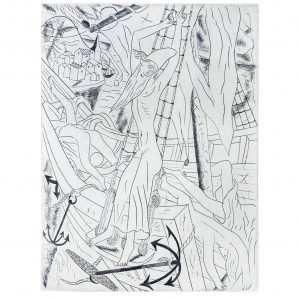

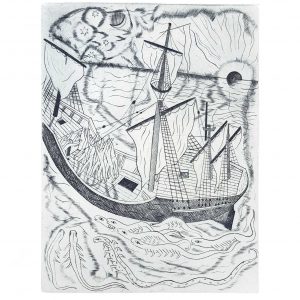
You may also like…
Samuel Taylor Coleridge – The Rime Of The Ancient Mariner V – Original Copper Engraving By David Jones
£295.00Jones, David & Coleridge, Samuel Taylor
Samuel Taylor Coleridge – The Rime Of The Ancient Mariner VIII – Original Copper Engraving By David Jones
£295.00Jones, David & Coleridge, Samuel Taylor
Samuel Taylor Coleridge – The Rime Of The Ancient Mariner VI – Original Copper Engraving By David Jones
£295.00Jones, David & Coleridge, Samuel Taylor