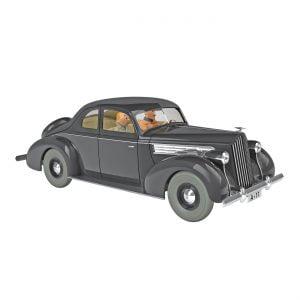
The Soviet Amilcar Model Car: 29909
Tintin New Model Cars 1/24 Scale
£125.00
Out of stock
Product Description
The Soviet Amilcar Model Car: 29909
A Collector’s Gem at Hornseys
Back in 2008 when Moulinsart created a range of diecast 1/43 scale model cars, their collaborator was Editions Atlas. All seventy of the models were from the adventures of Tintin. Hergé’s evident love of cars, real or imagined, came to life in this product range. This fine new series of diecast model cars by Moulinsart are from a collaboration with Hachette. At 1/24 scale, they are twice the size and highly detailed with nothing being missed from Hergé’s masterful pen strokes.
At Hornseys we take pride in offering exceptional collectibles that resonate with fans and collectors alike. Among our distinguished selection of Tintin Vehicles Scale 1:24 models, the Soviet Amilcar Model Car is the ninth in this recent series of vehicles produced by Hachette and Moulinsart celebrating Hergé’s classic stories.
Size: 20.5cm x 7cm x 7cm. From ‘Tintin au Pays des Soviets’. Material: Painted metal with resin and plastic. Comes in a perspex case in an outer box with accompanying brochure in French and English. Brand new. Mint condition. UPC Barcode: 2990900000003 SKU 29909
The Soviet Amilcar: A Brief Description
The so-called “Soviet Amilcar” is a term often used to describe a curious and rare breed of light Soviet automobiles that bore stylistic and engineering resemblances to early French cyclecars—specifically those made by the Amilcar company, which was active in France during the interwar period. While not a direct copy, the Soviet counterpart reflected the broader influence of European automotive design on Soviet-era experimentation in the 1920s and 1930s, a time when the USSR was still defining its industrial and engineering identity.
Design and Aesthetic
Visually, the Soviet Amilcar was a compact, open-top two-seater, marked by its low-slung body, minimalist cockpit, and exposed mechanicals. The bodywork was often crafted from lightweight metal or even wood-and-canvas combinations, given material shortages and the priority placed on functionality over luxury. Its streamlined bonnet, wire-spoked wheels, and upright windscreen conveyed a sense of sporting agility, echoing the design language of the original Amilcar CGS or similar French cyclecars of the era.
The cabin was stark and functional—no-frills, with bare metal or timber interiors and rudimentary instrumentation. Steering was mechanical and direct, with minimal suspension damping. Although it lacked the refinement of its Western counterparts, the Soviet version demonstrated impressive ingenuity given the constraints of the time.
Engineering and Performance
Mechanically, the Soviet Amilcar was equipped with a small-capacity four-cylinder engine—typically between 1.0 and 1.3 litres—mated to a manual gearbox. The power output was modest, usually in the range of 20 to 30 horsepower, but the car’s lightweight construction allowed for relatively brisk acceleration and nimble handling on unpaved roads.
Unlike the mass-produced cars of later Soviet decades, such vehicles were often hand-assembled in limited quantities, sometimes even built from a mix of domestically produced parts and salvaged components. The drivetrain was simple and rugged, designed for ease of repair rather than outright performance. Drum brakes, leaf-spring suspension, and rear-wheel drive were standard.
Context and Significance
The Soviet Amilcar occupies an intriguing niche in motoring history. It was not a mass-market product but rather a reflection of early Soviet attempts to develop personal transportation for engineers, government officials, or technical enthusiasts. These vehicles were sometimes the result of experimental workshops or educational institutions, rather than centralised factories.
Their rarity today owes to their limited production and the fragility of their construction. Many were lost to time, war, or repurposing, with only a handful surviving in museums or private collections. Nonetheless, the Soviet Amilcar stands as a testament to the adaptability and resourcefulness of early Soviet engineers who, faced with limited resources and a young industrial base, sought to create something approximating the modern motor car.
Legacy
While it never became a household vehicle, the Soviet Amilcar contributed to the broader narrative of automotive development in the USSR. It served as a stepping stone between pre-revolutionary vehicles—often imported or aristocratic in nature—and the later, mass-produced models like the GAZ-A or Moskvitch series that would become familiar symbols of Soviet mobility.
Today, the Soviet Amilcar is regarded with a sense of nostalgic curiosity. It represents a fascinating intersection of aspiration, ingenuity, and the influence of Western design on an isolated and ideologically distinct industrial landscape.
Why Choose Hornseys?
At Hornseys, we are dedicated to providing products that meet the highest standards of quality and authenticity. Our commitment to customer satisfaction is reflected in our comprehensive range of services:
- Free Expedited, Tracked, and Insured Delivery within the UK: Ensuring your collectible arrives safely and promptly.
- Fully-Insured Worldwide Delivery: Offering peace of mind for international collectors.
Explore Tintin at Hornseys
Visit Hornseys to discover our exceptional collection of Tintin Vehicles Scale 1:24 models. Whether you are a long-time fan or a new enthusiast, our range offers something for everyone. All of these items can be viewed at our Ripon gallery in the heart of the Yorkshire Dales.
Related products


You may also like…

King Muskar’s Packard – Model Car – 29928 – La Packard De Muskar XII – 1/24 Scale
£95.00Tintin New Model Cars 1/24 Scale by Hergé & Editions Moulinsart