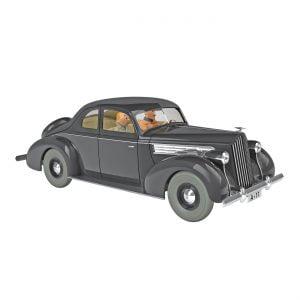
The Thompson’s 2CV – Model Car – 29908 – La 2CV Des Dupondt – 1/24 Scale – First Edition – 2019
Tintin New Model Cars 1/24 Scale by Hergé & Editions Moulinsart
£225.00
Availability: In stock
Product Description
The Thompson’s 2CV – Model Car – 29908 – La 2CV Des Dupondt – 1/24 Scale – First Edition – 2019
Author: Hergé & Editions Moulinsart
Price: £225.00
Manufacturer: Editions Moulinsart
Format: Original pictorial wrappers with car on plinth in perspex case
Condition: New. In excellent condition. Model car and book are both unopened
Edition: First Edition
Date: 2019
Description:
The scarce first edition of this model, dated 2019 in the booklet, which sold out very quickly. Size: 20.5cm x 7cm x 7cm. From ‘The Calculus Affair’. Material: Painted metal with resin and plastic. Comes in a perspex case in an outer box with accompanying brochure in French and English. Brand new. Mint condition. UPC: 29908
The Calculus Affair: A Brief Account
The Calculus Affair (L’Affaire Tournesol, 1956) is widely regarded as one of the finest and most perfectly constructed stories in The Adventures of Tintin. It marks the full maturity of Hergé’s craft: a work of elegant storytelling, political tension, and emotional depth. Combining espionage, humour, science fiction, and Cold War intrigue, it places Professor Calculus (Tryphon Tournesol) at the heart of a dangerous international conflict — and reveals a darker, more sophisticated Tintin universe.
Overview and Themes
At its core, The Calculus Affair is an espionage thriller, heavily influenced by the geopolitical atmosphere of the early Cold War. Its themes include:
- The ethics of scientific discovery
- The manipulation of science for military ends
- Totalitarian secrecy and surveillance
- Friendship and loyalty under pressure
The tone is sharper and more serious than earlier Tintin books, yet Hergé’s trademark humour, clarity, and precision remain fully intact.
Plot Summary
The story begins at Marlinspike Hall, with mysterious disturbances: shattered windows, broken glassware, and unexplained ultrasonic shocks. Professor Calculus, working on a new invention, seems oblivious to the chaos he is causing. He reveals he is developing a high-frequency ultrasonic weapon, capable of shattering glass — and, in stronger form, disabling machines or destroying military installations.
Two rival nations — the Syldavian monarchy and its authoritarian neighbour, Borduria — rapidly learn of Calculus’s invention and attempt to secure it for themselves. When Calculus travels to Geneva for a scientific conference, he is kidnapped. Tintin, Captain Haddock, and Snowy set off to rescue him.
Their journey takes them first to Switzerland, with its atmospheric Alpine lakes and towns, then deeper into Borduria, a thinly-veiled satire of mid-century Eastern-bloc dictatorships. Borduria is grim, militarised, and tightly controlled, ruled by the moustachioed dictator Marshal Kûrvi-Tasch, whose image adorns buildings, armoured vehicles, and even furniture.
Tintin and Haddock infiltrate Borduria through a mixture of disguise, quick thinking, and daring escapes. They encounter Colonel Sponsz, a ruthless yet comically pompous secret police chief whose vanity blinds him to Tintin’s manoeuvres. After a dramatic chase through the capital city of Szohôd, they rescue Calculus from a heavily guarded research institute and escape by car, lorry, and eventually aircraft.
The professor remains blissfully unaware of his own importance throughout, believing that everyone is merely being “helpful” — a brilliant comic contrast to the high-stakes espionage surrounding him.
Setting and Atmosphere
The settings in The Calculus Affair are among the richest in the Tintin canon.
Switzerland
Hergé’s precise rendering of Swiss railways, Alpine roads, and lakeside towns reflects his meticulous research. The scenes in Geneva and Nyon carry a crisp realism that grounds the story’s more adventurous elements.
Borduria
Borduria is one of Hergé’s most striking fictional creations.
- It is a regimented police state, visually echoing elements of Nazi Germany, Fascist Italy, and Stalinist Eastern Europe.
- Propaganda posters cover the walls; soldiers and secret agents fill the streets; fear permeates daily life.
- Its architecture and design — angular buildings, heavy interiors, brutish vehicles — reflect both menace and absurdity.
The combination of humour and menace is masterfully judged.
Character Highlights
Tintin
Tintin is at his calm, investigative best — resourceful, composed, and morally resolute. His quick wit and agility drive the narrative.
Captain Haddock
Haddock provides emotional weight and comic brilliance. His frustration with the Bordurian language, his exasperation at Calculus’s hearing loss, and his inventive insults add warmth and humour to the story.
Professor Calculus
Central to the plot, Calculus is both victim and genius. His gentle nature and obliviousness contrast sharply with the military ambitions surrounding him. He is a symbol of science as purity, threatened by politics.
Colonel Sponsz
A wonderfully drawn villain — vain, ambitious, and absurd — he embodies the dangers and follies of authoritarian bureaucracy.
Artistic Excellence
The Calculus Affair is often cited as one of the greatest achievements of the ligne claire style.
- Crisp linework
- Atmospheric use of light and shadow
- Perfect panel composition
- Detailed architecture and vehicles
The nighttime scenes — the storm at Marlinspike, the chase through wet streets, the clandestine border crossings — demonstrate Hergé’s cinematic skill. The pacing is impeccable: moments of tension, silence, and humour alternate with fluid precision.
Moral and Philosophical Dimensions
This is one of Hergé’s clearest statements about the misuse of science. Calculus invents an ultrasonic device with peaceful intentions — yet instantly becomes a pawn in a global power struggle. The book warns that:
- Science without conscience is dangerous
- Totalitarianism corrupts innovation
- Friendship and loyalty are the antidotes to political cynicism
At its heart, the story is not just about espionage — it is about the inherent dignity of the individual in a world eager to turn knowledge into power.
Legacy and Influence
The Calculus Affair is frequently cited by Tintin scholars and enthusiasts as one of Hergé’s finest works. It marks the high point of the post-war Tintin era and demonstrates a perfect balance of:
- political sophistication
- humour
- emotional depth
- visual mastery
Its influence extends into modern comic storytelling, espionage fiction, and even discussions about scientific ethics.
Conclusion
The Calculus Affair stands as one of the most complete and compelling Tintin adventures ever created.
It is a masterclass in narrative economy, atmosphere, and character interplay.
It fuses Cold War intrigue with human warmth, scientific ethics with humour, and meticulous realism with imaginative invention.
Above all, it presents Tintin at his most heroic not through violence, but through intelligence, courage, and loyalty — values that define the enduring legacy of Hergé’s work.
The Citroën 2CV: A Brief History
The Citroën 2CV (Deux Chevaux), produced from 1948 to 1990, is one of the most iconic and beloved cars in European motoring history. Modest, ingenious, and unmistakably French, it became a symbol of practicality, rural independence, and democratic mobility — a car designed not to impress, but to serve. Its enduring charm lies in its combination of engineering brilliance, frugality, and cultural character.
Origins and Design Philosophy
The 2CV was conceived in the 1930s under the guidance of Pierre-Jules Boulanger, then Vice President of Citroën. Its design brief was famously radical:
A car capable of carrying four adults and 50 kg of potatoes, at 60 km/h, across a ploughed field, without breaking any eggs inside.
It had to be cheap, reliable, simple to maintain, and suitable for rural France, where farmers still relied on horses and bicycles.
War delayed its launch, and early prototypes were hidden from German forces, but the car finally appeared at the 1948 Paris Motor Show. Crowds laughed at its looks — corrugated tin panels, hammock seats, and a tiny engine — but demand quickly outstripped supply. The car was brilliantly practical: light, economical, and engineered for rough tracks, muddy lanes, and uneven farmland.
Engineering and Innovation
Despite its simplicity, the 2CV was full of clever solutions:
Suspension
The most celebrated feature: a long-travel, interconnected suspension system that allowed the car to glide over ruts and potholes with ease. It was so supple that the vehicle could keep all four wheels on the ground even during extreme body roll.
Engine
- Air-cooled flat twin
- Typically ranging from 375 cc to 602 cc
- Small, but astonishingly durable and easy to repair
The air-cooled system meant no radiator, no coolant leaks, and reliable running in harsh conditions.
Body and Structure
- Lightweight steel frame
- Removable canvas roof
- Simple, modular interior, often compared to a rural kitchen table
Everything was designed for ease of maintenance. Farmers could strip and reassemble major components with basic tools.
Driving Experience
The 2CV’s driving character was unique:
- A leisurely top speed, but a feeling of surprising agility
- Extremely soft suspension, causing dramatic body lean yet superb traction
- Light steering and simple controls
- A gearchange via a distinctive “umbrella handle” lever protruding from the dashboard
It wasn’t fast, but it was joyful — a car that encouraged gentle travel, conviviality, and appreciation of the countryside.
Cultural Status and Variants
The 2CV became a cultural icon across Europe, Africa, and South America. Students, farmers, artists, and travellers adopted it as a symbol of freedom and thrift.
Variations included:
- 2CV Fourgonnette (van) — beloved by tradesmen
- Dyane — a modernised spin-off
- Méhari — a plastic-bodied 4×4 cousin
- Charleston edition — with retro styling
The 2CV also appeared in numerous films, including For Your Eyes Only in the James Bond franchise, where it became a surprising action hero.
In The Adventures of Tintin
Hergé drew the Citroën 2CV with affectionate accuracy. It appears memorably in The Calculus Affair, where the bumbling detectives Thomson and Thompson pursue Tintin in a 2CV. The choice was perfect: a car that embodied European post-war modesty and practical charm. Hergé’s clear-line drawing captures the car’s boxy innocence and gentle absurdity.
Legacy
By the time production ended in 1990, over five million 2CVs (including vans) had been built. Today it remains a byword for:
- Simplicity
- Durability
- Rural freedom
- French national character
Collectors adore it, restorers cherish it, and aficionados celebrate it as one of the most brilliantly conceived cars ever made.
Conclusion
The Citroën 2CV is far more than a modest post-war utility vehicle. It is a triumph of human-centred engineering — reliable, charming, economical, and designed with deep respect for the needs of ordinary people. Its place in motoring history is assured not through speed or luxury, but through thoughtful design, longevity, and the quiet joy it brings to those who drive it.
Why Buy from Us?
At Hornseys, we are committed to offering items that meet the highest standards of quality and authenticity. Our collection of objects and rare books are carefully curated to ensure each edition is a valuable piece of bibliographical history. Here’s what sets us apart:
- Authenticity and Provenance: Each item is meticulously researched and verified for authenticity and collation.
- Expert Curation: Our selection process focuses on significance, condition, and rarity, resulting in a collection that is both diverse and distinguished.
- Customer Satisfaction: We aim to provide an exceptional customer experience, from detailed descriptions to secure and prompt delivery of your purchase.
- Returns Policy: We offer an unconditional guarantee on every item. If you wish to return an item, it may be sent back to us within fourteen days of receipt. Please notify us in advance if you wish to do so. The item must be returned in the same condition as it was sent for a full refund.
Cataloguer: Daniel Hornsey
Daniel Hornsey has specialised in fine and rare books, ephemera, and collectors’ editions for over thirty years. As a long-standing member of the antiquarian book trade, he has advised private collectors, curated catalogues, and sourced works for leading dealers, libraries and institutions across the world.
His fascination with Hergé’s work — especially ‘The Adventures of Tintin’ — began in childhood. Daniel recalls reading Tintin in original European editions and quickly recognising that these were not merely children’s books, but finely illustrated narratives crafted with artistic depth and wit.
As noted by the Musée Hergé in Louvain-la-Neuve, Hergé’s ‘ligne claire’ style has influenced generations of European comic artists and his original drawings and paintings command very high prices with his painting of ‘The Blue Lotus’ jar fetching £2.8m at auction in 2021.
By presenting these works through Hornseys’, he hopes to contribute to the continued appreciation of one of the 20th century’s most influential illustrators, helping new generations discover the artistry and legacy of Hergé.
Hornseys’ exhibit regularly at book and map fairs in London and throughout the UK and as long-established specialists in fine books, maps, prints and ephemera, Hornseys maintains full professional membership of the Provincial Booksellers Fairs Association (PBFA). The PBFA is one of the most respected trade bodies in the rare and antiquarian book world, with strict standards of expertise, authenticity and ethical trading. Our verified member listing can be viewed here: Hornseys – PBFA Member Profile.
Related products

Captain Haddock’s Convertible – The Lincoln Zephyr – Model Car – 29902 – La Décapotable du Capitaine Haddock – 1/24 Scale – First Edition
£225.00Tintin New Model Cars 1/24 Scale by Hergé & Editions Moulinsart


You may also like…
King Muskar’s Packard – Model Car – 29928 – La Packard De Muskar XII – 1/24 Scale
£95.00Tintin New Model Cars 1/24 Scale by Hergé & Editions Moulinsart
Mr Cutts The Butcher’s Van – Model Car – 29913 – La Camionette Sanzot – 1/24 Scale
£245.00Tintin New Model Cars 1/24 Scale by Hergé & Editions Moulinsart
The Blue Jeep – Model Car – 29904 – La Jeep Bleue – 1/24 Scale – First Edition – 2019
£245.00Tintin New Model Cars 1/24 Scale by Hergé & Editions Moulinsart
The Ford Model T – Model Car – 29905 – La Ford T – 1/24 Scale – First Edition
£195.00Tintin New Model Cars 1/24 Scale by Hergé & Editions Moulinsart