Winnie-the-Pooh – A. A. Milne – First Edition, 1926 – Third-Issue Dustwrapper – E. H. Shepard
Milne, A. A & Shepard, Ernest H
£2,000.00
Availability: In stock
Product Description
Winnie-the-Pooh – A. A. Milne – First Edition, 1926 – Third-Issue Dustwrapper – E. H. Shepard
Author: A. A. Milne (Alan Alexander Milne)
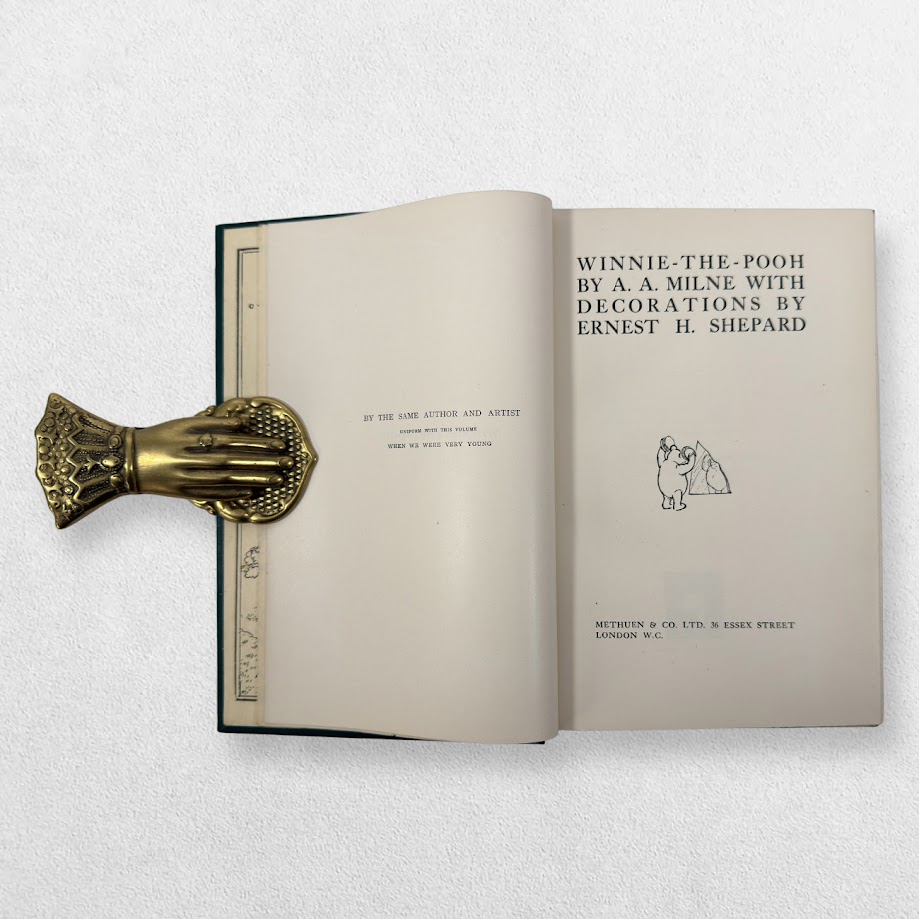
Title: Winnie-the-Pooh
Illustrator: Ernest H. Shepard
Publisher: Methuen & Co. Ltd., London
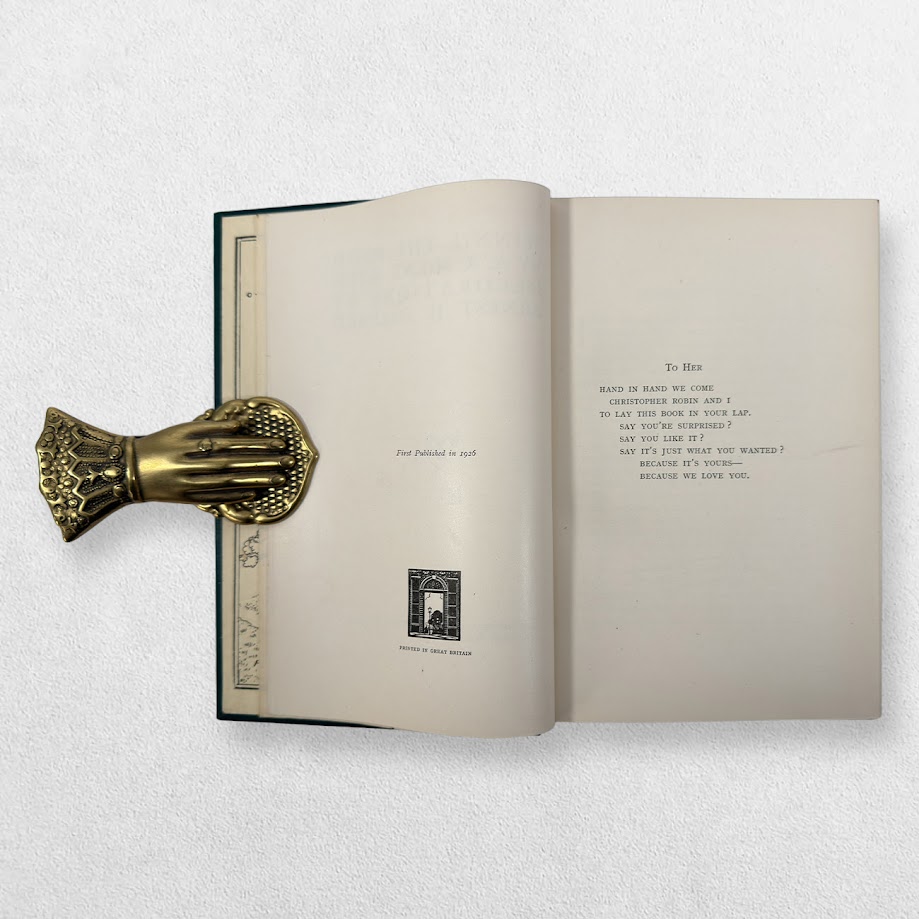
Date: 1926
Edition: First Edition
Format: Octavo
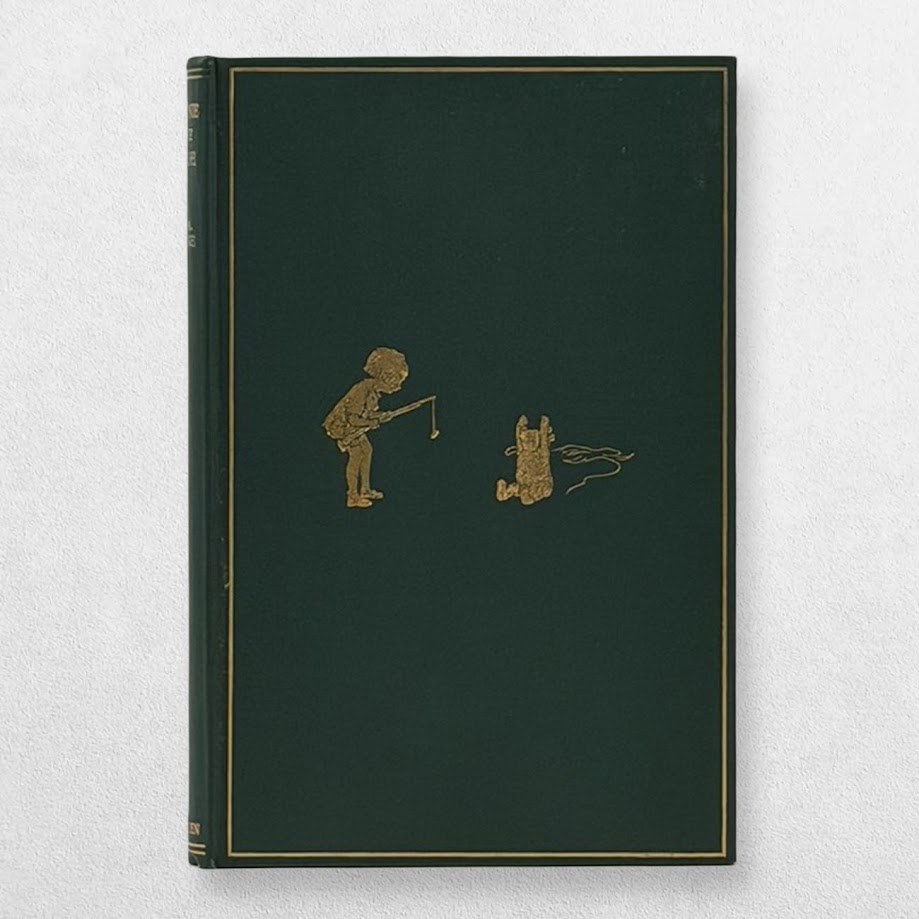
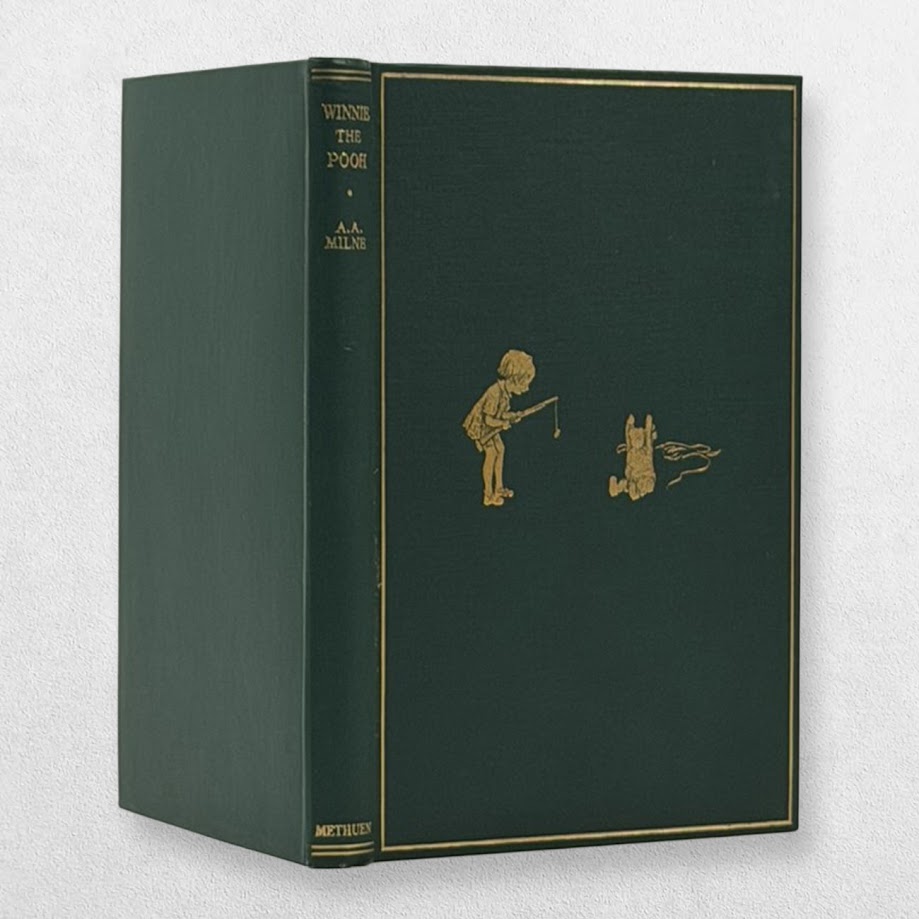
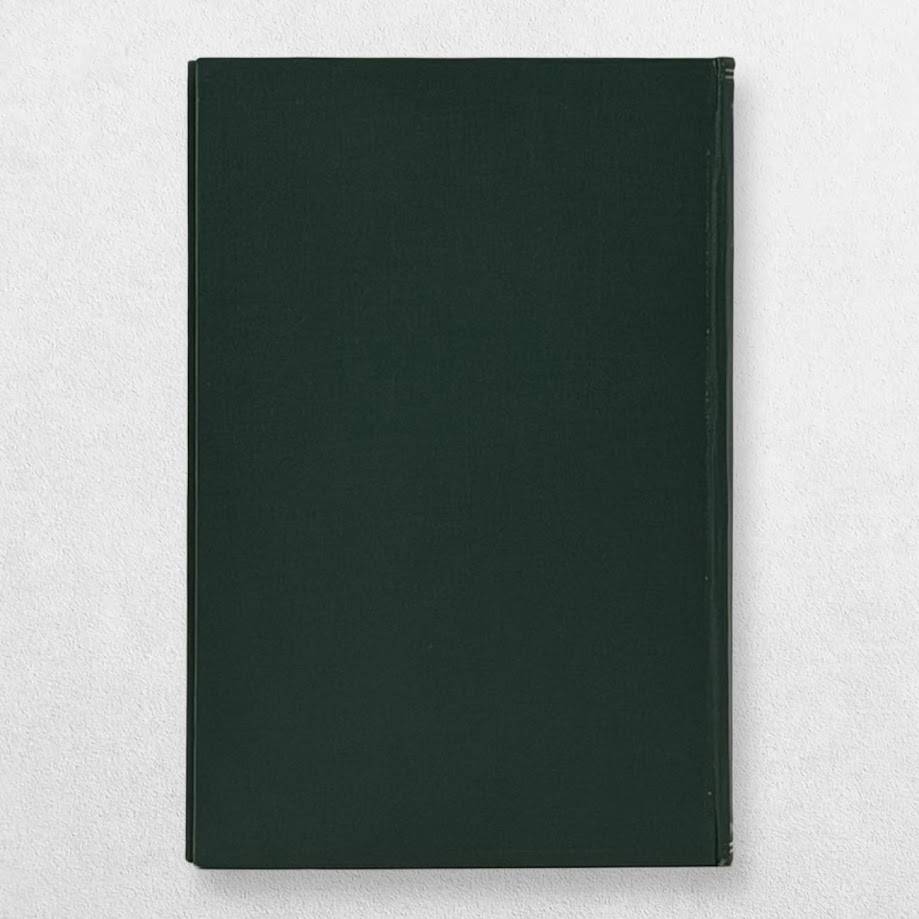
Binding: Original Publisher’s Green Cloth, Decorated and Lettered in Gilt
Page Edges: Top Edge Gilt
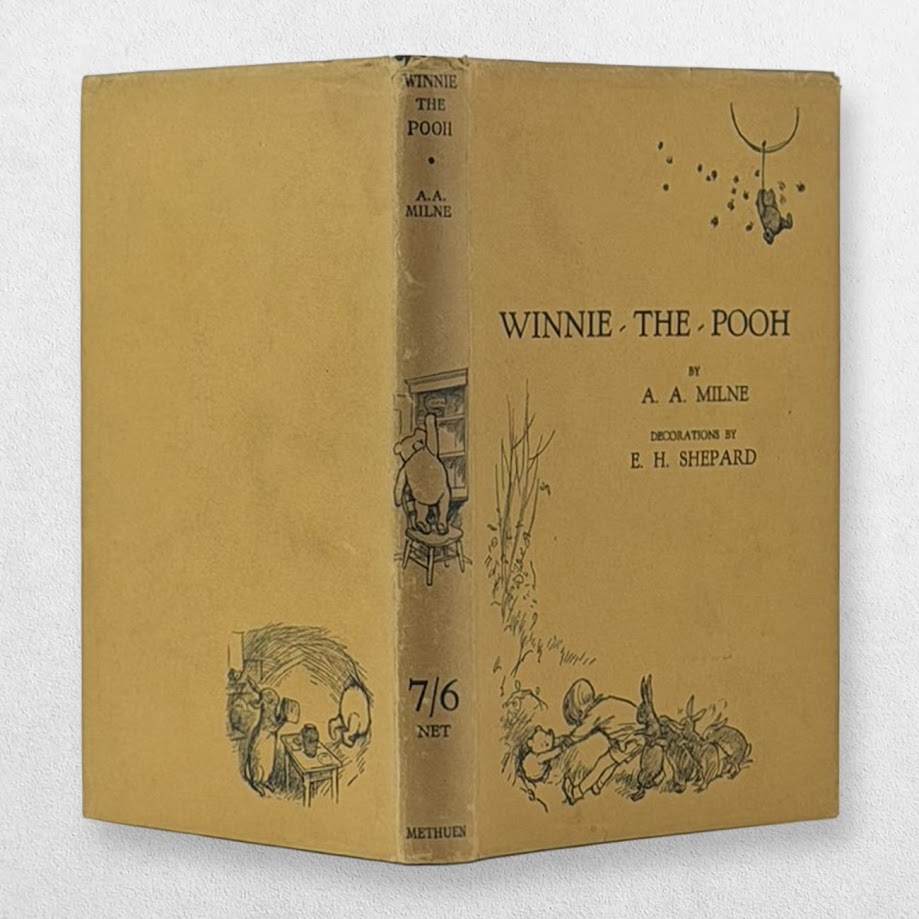
Dustwrapper: Original Third-Issue Dustwrapper, Priced 7/6 Net
Condition: Very Near Fine in Near Fine Dustwrapper
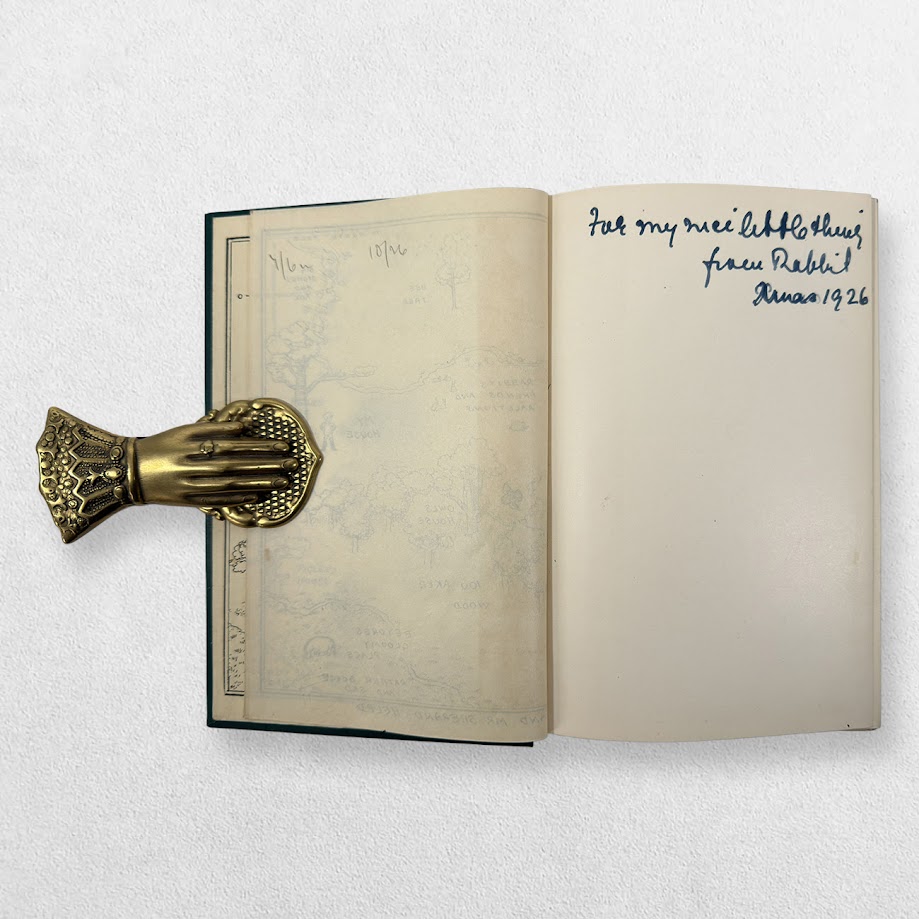
Provenance: Contemporary Christmas 1926 Presentation Inscription
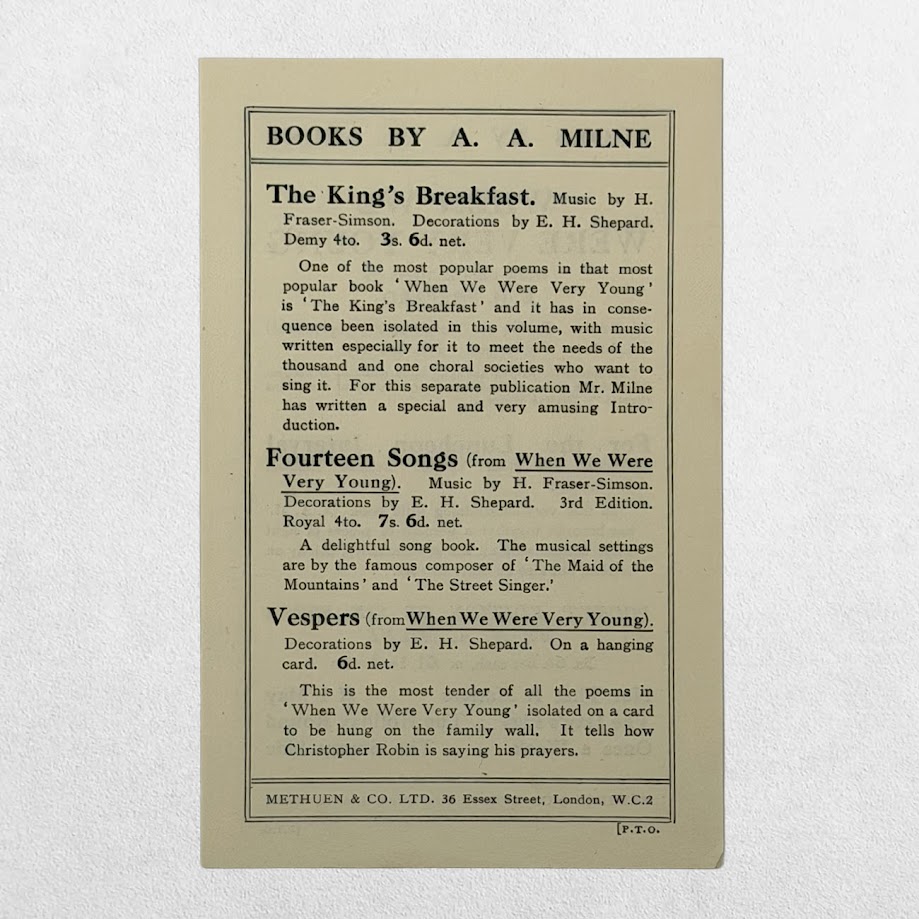
Additional Material: Contemporary Promotional Insert for When We Were Very Young
Stock Number: 004205
Description
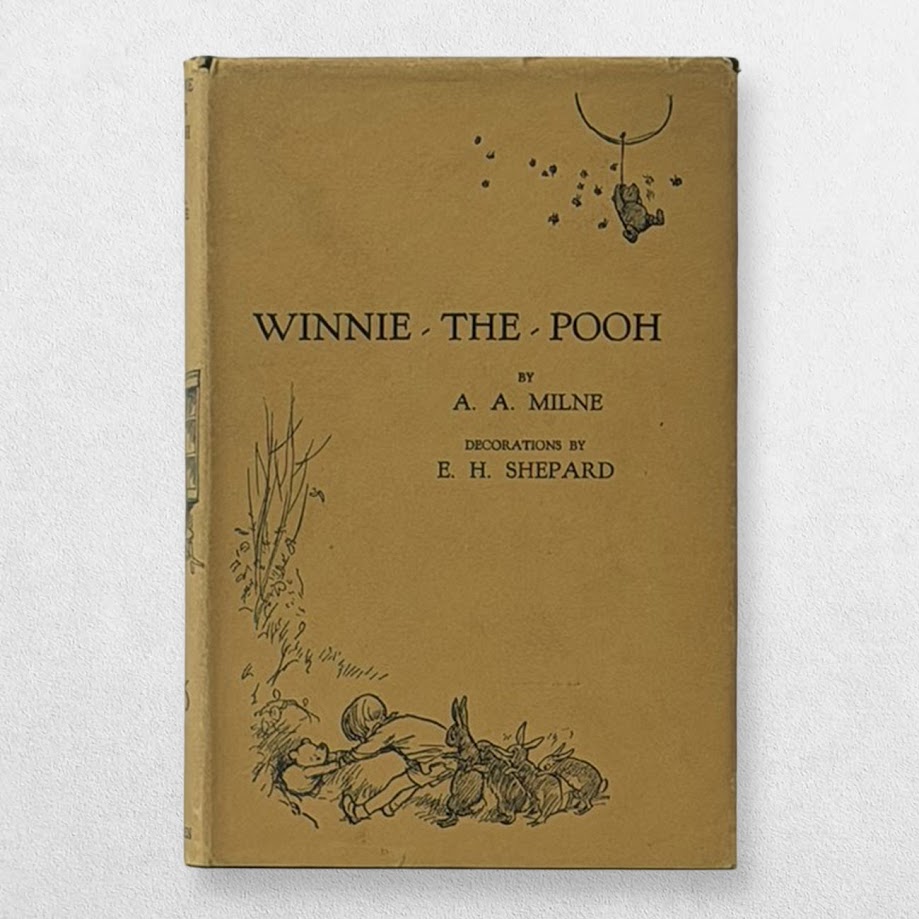
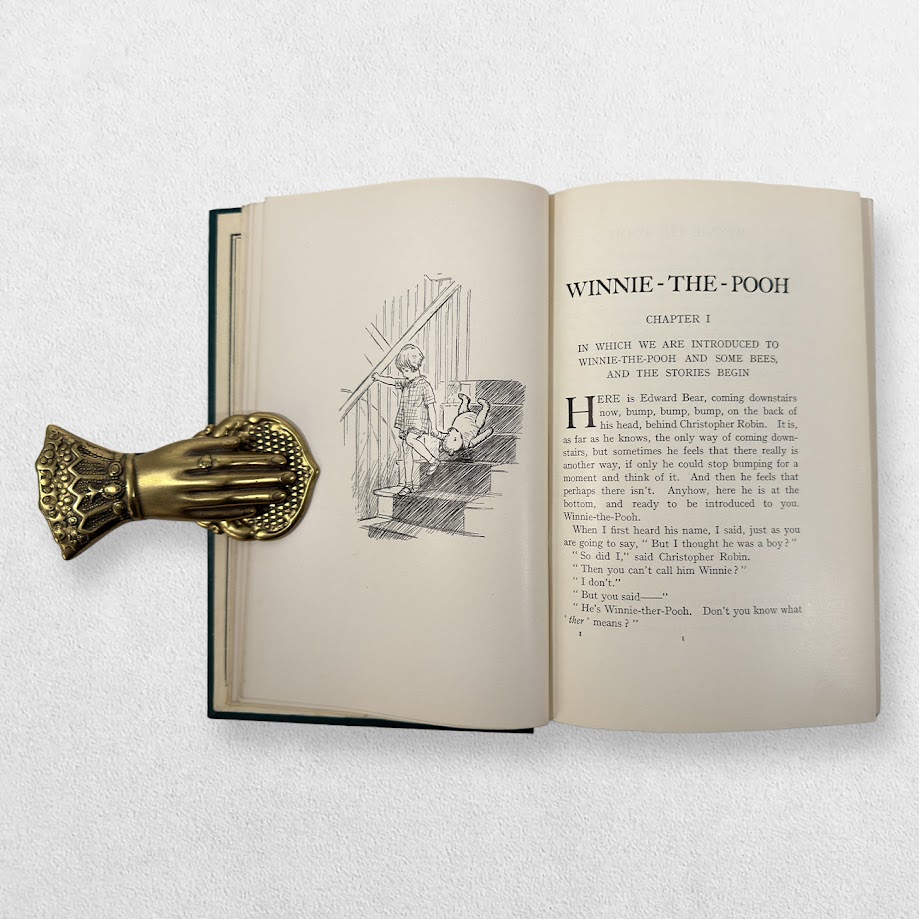
An exceptionally attractive first edition, first impression of Winnie-the-Pooh, A. A. Milne’s celebrated children’s classic, published by Methuen in October 1926, with the original illustrations by Ernest H. Shepard. Retaining an original third-issue pictorial dustwrapper, this is a particularly beautiful copy of one of the most important and enduring works of twentieth-century British children’s literature. The book is remarkably well preserved in its original publisher’s green cloth, with gilt lettering to the spine and a delightful gilt illustration of Christopher Robin and Winnie-the-Pooh to the upper board, enclosed within a decorative gilt border. The top edge is gilt. The binding remains exceptionally fresh, while the illustrated dustwrapper, featuring Shepard’s charming drawings, is in lovely near fine condition.
An especially appealing feature is the contemporary Christmas presentation inscription to the front blank, reading:
‘For my nice little thing from Rabbit Xmas 1926’
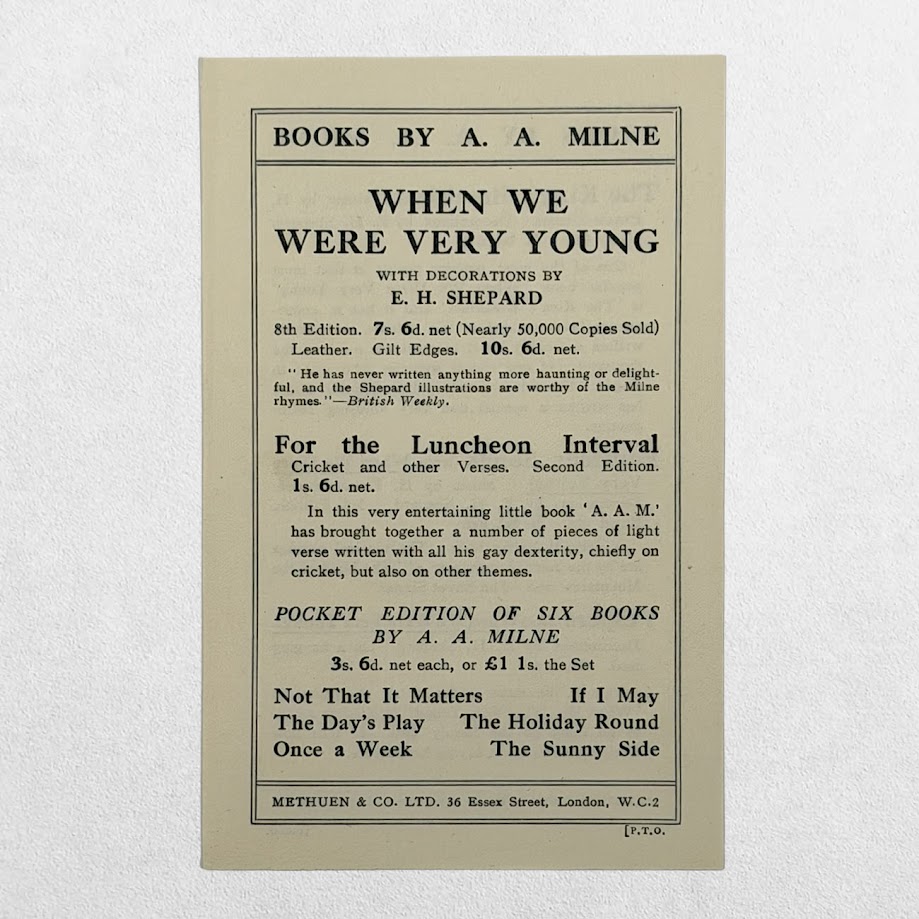
Dated to the book’s original year of publication, this affectionate inscription provides a delightful contemporary association. The use of ‘Rabbit’ as the giver’s name is particularly charming in a book featuring one of the most recognisable rabbits in children’s literature. A contemporary promotional insert advertising Milne’s earlier collection of children’s verse, When We Were Very Young, is also loosely inserted.
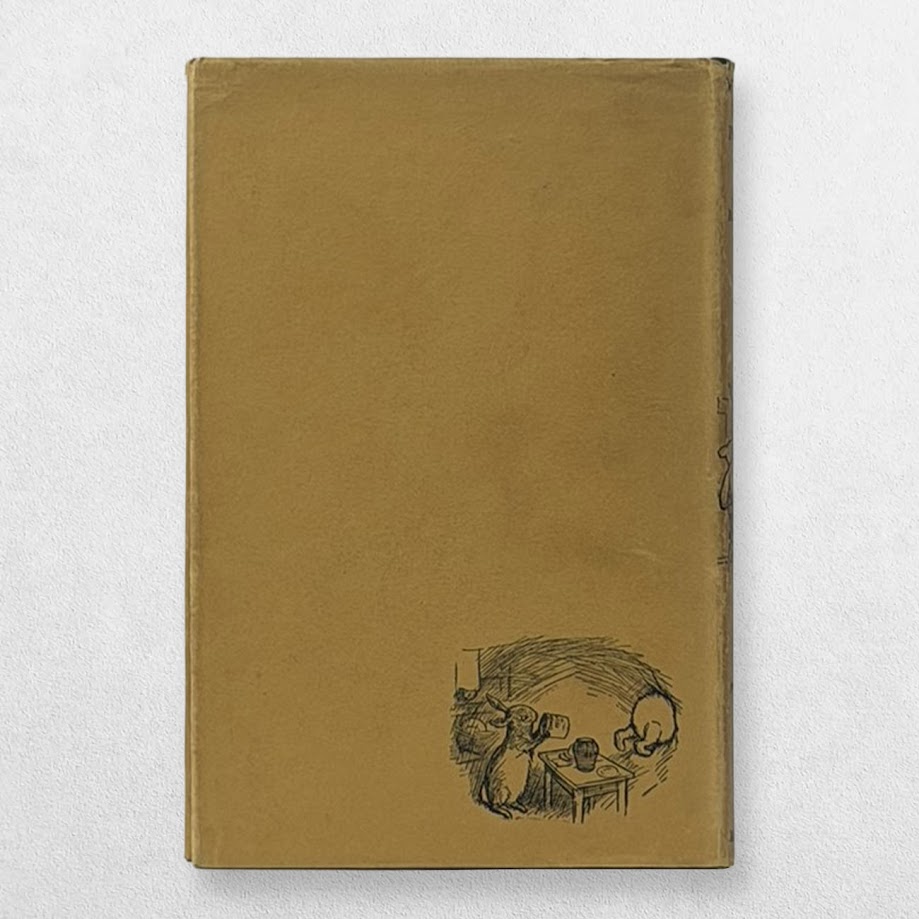
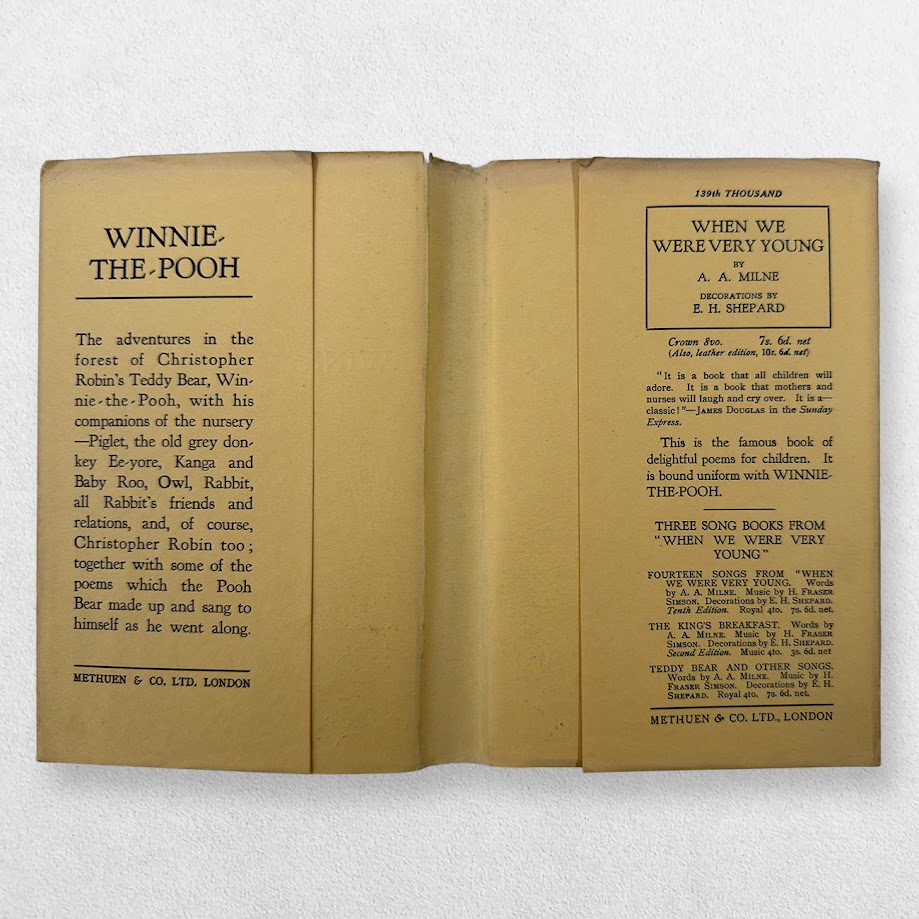
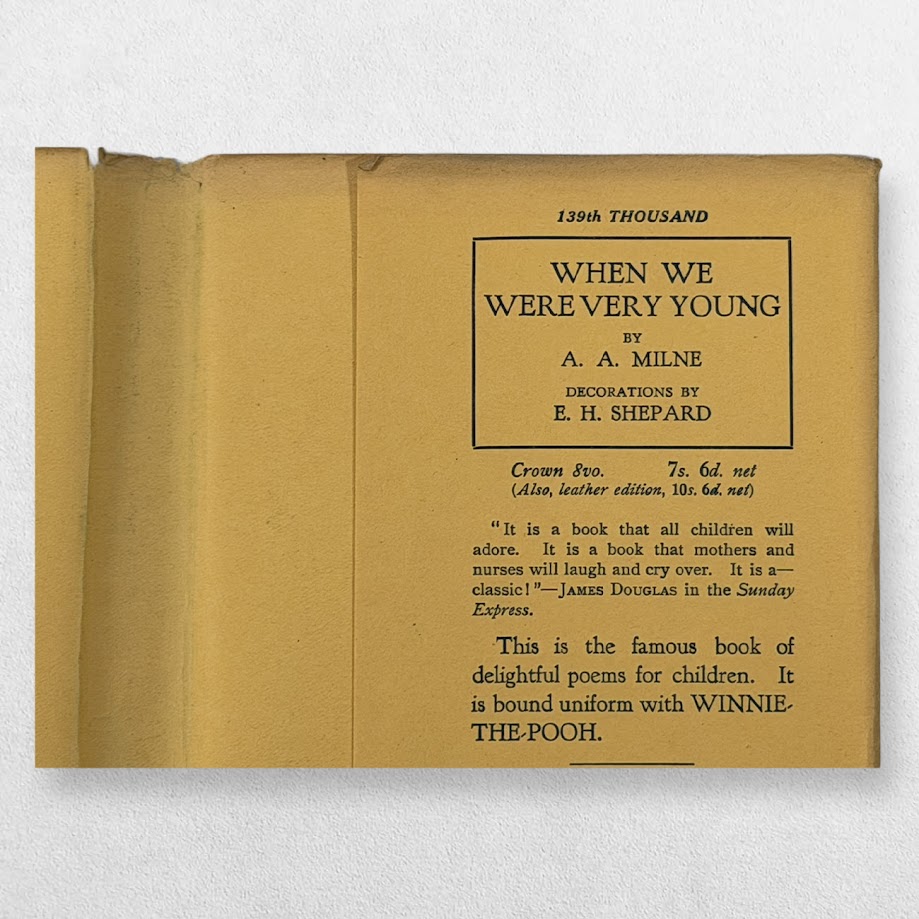
The dustwrapper is the third issue, identified by the ‘139th Thousand’ advertisement for When We Were Very Young on the rear flap, rather than the ‘117th Thousand’ or ‘129th Thousand’ appearing on the preceding issues. The wrapper otherwise retains the original design and illustrations of the first-issue dustwrapper.
A wonderful copy of the original 1926 first edition, combining exceptionally fresh condition, an attractive early dustwrapper, contemporary provenance and surviving publishing ephemera.
A. A. Milne and the Creation of Winnie-the-Pooh
Alan Alexander Milne (1882–1956) was already an accomplished and successful literary figure before the appearance of Winnie-the-Pooh. Born in London and educated at Westminster School and Trinity College, Cambridge, Milne established his reputation as a playwright, novelist, essayist and humorous contributor to Punch magazine. His literary career encompassed plays, fiction, journalism and poetry, but it was his writing for children that ultimately secured his international reputation. In 1924, Methuen published When We Were Very Young, a collection of children’s verse illustrated by Ernest H. Shepard. Its success established the creative partnership that would produce some of the most famous books in the history of children’s literature. The inspiration for Winnie-the-Pooh came from the childhood toys of Milne’s son, Christopher Robin Milne (1920–1996). Christopher Robin’s teddy bear, originally known as Edward Bear, acquired the name Winnie after Winnipeg, a Canadian black bear brought to Britain during the First World War and subsequently kept at London Zoo. The name Pooh came from a swan encountered by Christopher Robin. The fictional setting was inspired by Ashdown Forest in East Sussex, near the Milne family’s country home at Cotchford Farm, Hartfield. Its woods, tracks and open spaces provided the landscape that became the Hundred Acre Wood, one of the most familiar settings in British children’s literature. Milne transformed his son’s toys and imaginative games into a collection of stories populated by characters possessing remarkably distinct and convincing personalities. Although Winnie-the-Pooh had appeared in Milne’s work before 1926, the publication of Winnie-the-Pooh established the character and his companions in the form that would bring them enduring international fame.
The First Winnie-the-Pooh Book
Published on 14 October 1926, Winnie-the-Pooh contains ten stories describing the adventures of Pooh, Christopher Robin and their companions in the Hundred Acre Wood. The book begins with Pooh’s unsuccessful attempt to obtain honey from a bees’ nest, an adventure that establishes his enthusiasm for food, his ingenious but frequently unsuccessful schemes, and his close relationship with Christopher Robin. Other episodes introduce Piglet, Eeyore, Rabbit, Owl, Kanga and Roo, creating the fictional community that would become familiar to generations of readers. Among the best-known adventures are Pooh’s visit to Rabbit’s house, where an enthusiastic meal leaves him temporarily trapped in the doorway; the expedition to discover the North Pole; the search for Eeyore’s missing tail; and the party arranged in Pooh’s honour. Milne’s storytelling combines gentle comedy with subtle observations about friendship, loyalty, anxiety, self-importance and the nature of childhood. Each character possesses an immediately recognisable personality. Pooh is thoughtful, occasionally bewildered and frequently hungry. Piglet is nervous but courageous. Eeyore is habitually gloomy, Rabbit is practical and self-important, and Christopher Robin provides the reassurance and affection around which their small world revolves. The book’s exceptional achievement lies in its ability to appeal equally to children and adults. Milne captures the particular logic of childhood without condescension, employing understated humour and an affectionate understanding of human behaviour. The result is a work that has retained its literary appeal for a century.
Ernest H. Shepard and the Original Illustrations
An essential element of the book’s importance is the contribution of Ernest Howard Shepard (1879–1976), whose original pen-and-ink illustrations established the enduring appearance of Winnie-the-Pooh and his companions. Shepard studied at the Royal Academy Schools and developed a distinguished career as an illustrator and cartoonist. He became particularly well known for his work for Punch and subsequently illustrated numerous important literary works, including Kenneth Grahame’s The Wind in the Willows in 1931. His collaboration with Milne began with When We Were Very Young in 1924 and developed into one of the most celebrated partnerships between author and illustrator in British publishing. Shepard’s drawings for Winnie-the-Pooh are characterised by their extraordinary delicacy, economy of line and ability to communicate personality through gesture and expression. His representations of Christopher Robin and the woodland animals combine close observation with imaginative sensitivity, capturing their distinctive characteristics without overwhelming the simplicity of Milne’s prose. Shepard visited Ashdown Forest, and his illustrations reflect the landscape that inspired the setting of the stories. His original depiction of Pooh, with his familiar rounded figure and expressive movements, became the definitive visual interpretation of the character for early readers. The illustrations are of particular importance to collectors because they represent the original appearance of Pooh and his companions, before subsequent adaptations introduced alternative interpretations.
The collaboration between A. A. Milne and E. H. Shepard remains one of the defining achievements of twentieth-century British illustrated children’s literature.
First Edition and the Third-Issue Dustwrapper
The present copy is the first edition, first impression of Winnie-the-Pooh, published by Methuen in 1926, retaining its original publisher’s binding and an exceptionally well-preserved example of the early pictorial dustwrapper. Shepard’s original wrapper design incorporates charming illustrations of the principal characters, including the familiar scene of Christopher Robin and the woodland animals on the front panel, Pooh suspended beneath a balloon, and further drawings on the spine and rear panel. The original published price of 7/6 net is retained on the spine. The earliest dustwrappers can be distinguished by the changing advertisement for Milne’s When We Were Very Young on the rear flap. Three early issues have been identified through the successive statements of the number of copies printed:
- First issue: ‘117th Thousand’
- Second issue: ‘129th Thousand’
- Third issue: ‘139th Thousand’
The present example is the third-issue dustwrapper, carrying the ‘139th Thousand’ statement. Apart from the revised advertisement, the wrapper is identical in design to the first issue, retaining the original illustrations, typography and published price. This is an important bibliographical distinction. The book itself remains the 1926 first edition; the later issue relates solely to the dustwrapper.
The Dating of the Third-Issue Dustwrapper
The ‘139th Thousand’ advertisement corresponds to the fifteenth edition of When We Were Very Young, dated January 1927. The preceding fourteenth edition appeared in November 1926, placing the preparation of these successive printings close to the important Christmas bookselling season. It is therefore possible that Methuen had already printed or prepared dustwrappers advertising the forthcoming 139th thousand before Christmas 1926, although the precise printing date of the third-issue Winnie-the-Pooh wrapper has not been established. This chronology is of particular interest in relation to the present copy, which bears a contemporary presentation inscription dated Christmas 1926. The wrapper also precedes later advertising states referring to subsequent titles in the series, including Now We Are Six, published in 1927. Original dustwrappers from this early period are particularly desirable because they were frequently discarded or damaged, and copies surviving in such attractive condition are increasingly difficult to obtain.
The third-issue identification is fully acknowledged and has been taken into account in the pricing.
A Charming Christmas 1926 Presentation Inscription
A particularly engaging feature of this copy is the contemporary presentation inscription written in ink at the top of the front blank:
‘For my nice little thing from Rabbit Xmas 1926’
The inscription dates the book to its original Christmas season, only a little over two months after its first publication. Its affectionate wording provides a personal connection with the period in which Winnie-the-Pooh first appeared. The giver’s use of the name ‘Rabbit’ is especially appealing in a book in which Rabbit plays such an important role. Whether this represents a private nickname or a deliberate reference to Milne’s character cannot be established, but the association is undeniably charming. Unlike an ordinary ownership inscription, the message provides evidence of the book’s presentation as a Christmas gift in the year of publication. A contemporary promotional insert for When We Were Very Young is also loosely inserted, providing an additional connection with Methuen’s early promotion of Milne’s children’s books. Such ephemeral material is often lost or discarded, and its survival alongside a beautifully preserved copy is a further attractive feature.
Literary Significance and Collectability
Winnie-the-Pooh occupies an exceptional position in the history of twentieth-century children’s literature. Its combination of memorable characters, original storytelling, understated humour and sympathetic illustrations established a fictional world that has remained continuously popular since its original publication. Pooh, Piglet, Eeyore, Christopher Robin and their companions have become internationally recognised characters whose personalities and adventures remain familiar to successive generations of readers. For collectors, the original 1926 Methuen first edition represents the first publication of the complete Winnie-the-Pooh book and a major landmark in British literary and publishing history.
Condition
First Edition, First Impression, 1926. Octavo. Original publisher’s green cloth, lettered and pictorially decorated in gilt. Top edge gilt. Original third-issue dustwrapper, priced 7/6 net.
A charming contemporary ink inscription to the top of the front blank reads ‘For my nice little thing from Rabbit Xmas 1926’. The pages and Ernest H. Shepard’s original illustrations are exceptionally nice and clean. The binding remains firm and tight, with the original green cloth beautifully preserved, the gilt decoration bright and fresh, and only very minor rubbing to the base of the spine.
The book is in very near fine condition overall.
The original dustwrapper is slightly dusty, with very minor rubbing and a few small nicks, together with a couple of very short and unobtrusive closed tears. Nevertheless, it remains exceptionally attractive and is in lovely near fine condition overall. The wrapper is the third issue, identified by the ‘139th Thousand’ statement in the advertisement for When We Were Very Young on the rear flap, rather than the ‘117th Thousand’ or ‘129th Thousand’ of the preceding issues. The original design, illustrations and published price remain unchanged. The issue distinction is fully acknowledged and reflected in the pricing. A contemporary promotional insert for When We Were Very Young is loosely inserted.
A lovely and exceptionally well-preserved copy of the 1926 first edition of Winnie-the-Pooh, retaining a beautiful original third-issue dustwrapper, an affectionate Christmas 1926 inscription and surviving contemporary promotional material. Scarce in this condition.
Stock Number: 004205
Why Buy from Hornseys?
At Hornseys, we specialise in carefully selected children’s books, illustrated books and books for readers of all ages, ranging from much-loved classics and collectable first editions to signed copies, finely illustrated works and unusual titles that are increasingly difficult to find. Every book is individually examined, researched and described before being offered for sale.
Our aim is to provide collectors, readers and gift buyers with clear, accurate information about each book’s edition, condition and bibliographical significance.
- Authenticity and Bibliographical Accuracy: Every book is carefully checked for edition, issue, completeness and relevant points of identification. Where appropriate, signatures, inscriptions, dustwrappers, illustrations and other distinguishing features are researched and described in detail.
- Carefully Selected Stock: Our collection includes classic children’s literature, picture books, illustrated books, juvenile fiction, first and early editions, signed books and other collectable works suitable for children, adults and lifelong collectors. We select books for their quality, interest, condition, scarcity and enduring appeal.
- Detailed Condition Reports: Condition is assessed individually and described as accurately as possible. We record significant faults as well as important features such as original dustwrappers, illustrations, inscriptions and provenance, helping buyers make informed purchasing decisions.
- Established Experience: Hornseys has been dealing in books, art and collectables since 1976. Our Ripon gallery in North Yorkshire reflects nearly fifty years of experience in handling and researching unusual, decorative and collectable material.
- Customer Service and Secure Delivery: We take care over every stage of a purchase, from answering questions and providing further information to careful packing and prompt, secure dispatch.
- Unconditional Returns: Every item is offered with our unconditional guarantee. Books may be returned within fourteen days of receipt for any reason, provided that we are notified in advance and the book is returned in the same condition in which it was supplied. A full refund will then be issued.
Books for Children, Collectors and the Young at Heart
Our stock ranges from traditional children’s classics and beautifully illustrated books to modern favourites, scarce editions and books whose appeal extends well beyond childhood. Whether you are building a collection, replacing a treasured childhood book, searching for a first edition or choosing a distinctive gift, we aim to offer books with lasting interest and character.
Hornseys has welcomed book lovers, collectors and visitors to Ripon since 1976.
Thank you for looking at our collection.
Related products


You may also like…

Jan Pieńkowski — Haunted House — First UK Edition, 1979, Inscribed by the Artist
£150.00Pieńkowski, Jan
René Goscinny & Albert Uderzo — Asterix in Corsica — First UK Edition, 1979
£95.00Goscinny, René & Uderzo, Albert
Kay Thompson’s Eloise — First Reprint of the First UK Edition, 1957
£30.00Thompson, Kay & Knight, Hilary