
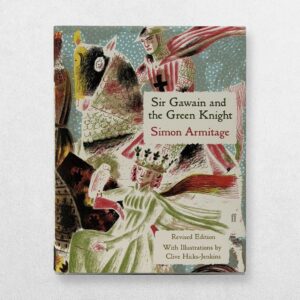
Sarah Parvin’s copy of the illustrated edition of ‘Sir Gawain’ signed by Simon Armitage and the artist
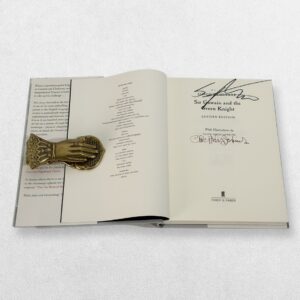
Images: © Clive Hicks-Jenkins. Courtesy Sarah Parvin Archive.
Introduction
Printmaking is inherently collaborative. The relationship between artist and printmaker has long been central to the medium’s development, supported by publishers, galleries and institutions. Less frequently examined is the role of the intermediary: the individual who identifies connections, initiates collaborations, and shapes the conditions under which a project takes form.
The archive of Sarah Parvin (known as The Curious One), who died suddenly in April 2024, provides a detailed case study of such a role. Her involvement in the Sir Gawain and the Green Knight print series (2015–2018), a collaboration between Clive Hicks-Jenkins and Dan Bugg of Penfold Press, offers an opportunity to consider how facilitation operates within contemporary printmaking—and how it is later recorded.
Crucially, Parvin’s role cannot be separated from the wider project she was developing at the time: The Curious One. This was not simply an online persona, but a structured curatorial and strategic platform through which she sought to reframe how audiences encounter, understand, and ultimately acquire contemporary art.
Facilitation and Print Culture
The history of printmaking includes numerous figures whose contributions lie outside the act of making but are nevertheless structurally important. Publishers such as Tériade and Ambroise Vollard, and later curatorial figures such as Margaret Lambert, played decisive roles in shaping projects, audiences, and networks. These roles have often been occupied by women, particularly in the late 20th and early 21st centuries, where the boundaries between curator, producer, and promoter have become increasingly fluid.
‘The Green Knight Arrives’: Sarah Parvin’s printer’s proof without border
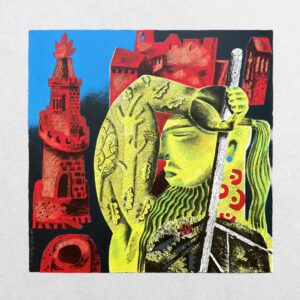
Image: © Clive Hicks-Jenkins. Courtesy Sarah Parvin Archive.
In many cases, their contributions are acknowledged at the point of production but become less visible in subsequent accounts.
What distinguishes Sarah Parvin within this lineage is that she operated at a moment of transition—from traditional, physically anchored networks of galleries and publishers to digitally mediated systems of visibility and influence. Her work sits at the intersection of these two worlds.
Sarah Parvin: A Digital Intermediary
Sarah Parvin operated within this lineage, albeit through emerging digital platforms. Through her Pinterest presence (thecurious1), she curated a substantial audience around British art and printmaking with over 300,000 followers.
Maquette designed for ‘The Curious One’ by the artist
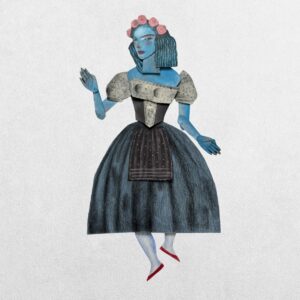
Image: © Clive Hicks-Jenkins. Courtesy Sarah Parvin Archive.
Her activity combined:
- thematic curation
- audience-building
- narrative framing
alongside a professional background in PR, branding, and marketing spanning over twenty years, working with brands including Burberry, Selfridges, Harvey Nichols, Jo Malone, The White Company and Martha Stewart.
Her Pinterest boards functioned not as casual collections of images, but as structured curatorial environments. Each board operated as a form of digital exhibition: grouping artists, images, and ideas into coherent visual narratives that encouraged comparison, discovery, and sustained engagement.
This activity placed her in a position of considerable influence. At a time when many galleries were still adapting to digital platforms, Parvin had already established a large, visually literate audience whose attention could be directed, shaped, and mobilised. Her Pinterest audience included artists working within the field; available evidence indicates that this audience extended to include artists such as Clive Hicks-Jenkins.
At the time of the Gawain project, she was developing The Curious One as a platform integrating content, community, and commerce—anticipating models that have since become more widely established within the digital art economy.
‘The Travails’ inscribed ‘For Sarah’ by the artist
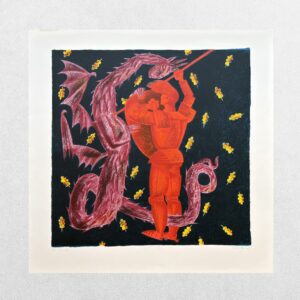
Image: © Clive Hicks-Jenkins. Courtesy Sarah Parvin Archive.
Her stated approach—building audience before introducing commercial activity—reflects a sophisticated understanding of long-term cultural positioning. Rather than treating sales as the starting point, she prioritised narrative, trust, and engagement as the foundation upon which a sustainable model could be built.
The Gawain Collaboration
The Sir Gawain and the Green Knight series comprises fourteen screenprints based on Simon Armitage’s translation of the medieval poem. The project brought together an artist with an established visual language and a printmaker with the technical capacity to realise it at scale.
Contemporaneous public statements from 2015 describe Parvin’s role in initiating this collaboration.
“I’ll hold back from sharing with you the aspects I’ll be illustrating because Dan and I want there to be the element of surprise as each new print is editioned and launched. I recently showed the completed list of fourteen titles to Dan and to Sarah Parvin. (Sarah was the moving force behind this project, coming up with the idea and then teaming Dan and me.) With the ‘list’ agreed and signed off by all concerned, I’ve started a workbook to begin building the images.
Dan and I will shortly be producing Man Slain by a Tiger, a print inspired by Tipu’s Tiger/ The Death of Munrow that we’re using as a dry-run for the Gawain series. After that, the great work will begin.”
Colour proof of ‘Man Slain by a Tiger’ inscribed ‘For Sarah’ by the artist
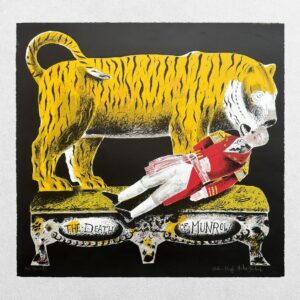
Image: © Clive Hicks-Jenkins. Courtesy Sarah Parvin Archive.
The artist wrote:
“Sarah, your energy and enthusiasm fired this project… it quite simply wouldn’t have happened… You are the ‘matchmaker’!”
He further clarified:
“I must say that when Sarah mentioned the idea of a Gawain print, and then marched off to visit Dan Bugg and suggest that he and I work together…”
adding:
“Sarah, working her magic. I just went where she led!”
and described her as:
“the moving force behind this project, coming up with the idea and then teaming Dan and me”
These statements indicate a role extending beyond introduction into:
- proposing the collaboration
- initiating contact
- shaping early direction
Within this context, Parvin’s actions can be understood as part of a broader strategic framework linked to The Curious One. The identification of the Gawain subject, the pairing of artist and printmaker, and the early discussions around presentation and audience were not isolated decisions, but aligned with her wider intention to build a curated ecosystem around contemporary printmaking.
Archival correspondence from the same period shows Parvin contributing to:
- marketing strategy
- launch planning
- audience positioning
- and potential financial structuring of the project
including offering models through which she would share risk and invest in the success of the series.
These proposals reflect not only enthusiasm, but professional expertise—drawing directly on her background in branding and marketing, and reinforcing her role as an active participant in the project’s formation.
Later published interviews provide additional insight into how the collaboration has subsequently been described by its participants.
In an interview included in the later catalogue, the printmaker states:
“Thankfully, a mutual friend, the late Sarah Parvin, introduced us and that allowed me to discuss printmaking with him.”
He continues by describing the project as evolving through shared decision-making:
“Initially, we planned to make a single print… but pretty quickly, we concluded that it would be much more interesting to explore it over a series of prints.”
Within this account, the emphasis is placed on collaboration, trust, and the organic development of the project following the initial introduction.
In parallel, the artist’s own reflections within the same publication frame the series primarily in terms of his long-standing engagement with narrative painting and his intention to produce a coherent sequence of works:
“the intention from the beginning was to make 14 sequential prints that would tell the story”
Here, the conceptual framework of the project is presented as emerging from within the artist’s own practice, with less explicit reference to the role of facilitation in its initial formation.
Taken together, these later accounts place greater emphasis on the internal development of the project and on the collaborative dynamic between artist and printmaker, while positioning Parvin’s role more narrowly in terms of introduction.
Material Acknowledgement
The material record reinforces this position.
Prints from Parvin’s collection are inscribed:
“For Sarah”
Such acknowledgements suggest that her role was recognised within the working dynamics of the project at the time of its production.
They further indicate that her contribution was understood, at that time, as materially connected to the project’s initiation.
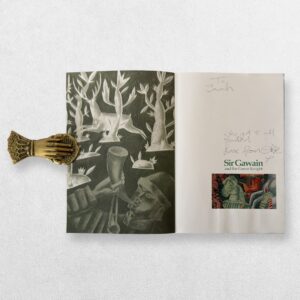
Exhibition catalogue inscribed ‘To Sarah, who got it all started, Love from Clive x’
Image: © Clive Hicks-Jenkins. Courtesy Sarah Parvin Archive.
‘The Green Knight’s Head Lives’ inscribed ‘For Sarah’ by the artist
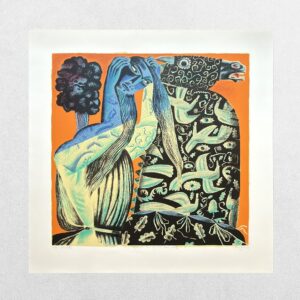
Image: © Clive Hicks-Jenkins. Courtesy Sarah Parvin Archive.
Dan Bugg letter to Sarah Parvin regarding technical aspects of two prints (c.2016) Reproduced from the Sarah Parvin archive
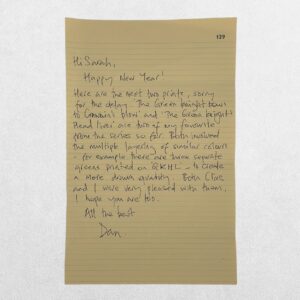
Correspondence reproduced for archival, research, and critical purposes. Copyright remains with the author.
Shifts in Emphasis
Subsequent accounts of the collaboration place a more limited emphasis on Parvin’s involvement, tending to frame her role primarily as that of an introducer.
When set alongside:
- contemporaneous public statements
• documented correspondence
• and material inscriptions
a shift in emphasis becomes apparent.
A further refinement can be observed in the published catalogue texts themselves.
The original exhibition catalogue (MOMA Machynlleth, 2018) states:
“Sarah Parvin of The Curious One suggested that we might work on a project together and introduced us to one another.”
In the enlarged edition of the catalogue (2025), this becomes:
“Sarah Parvin of The Curious One suggested that we might work together”
This revision removes both the reference to a specific project and the explicit acknowledgement that she introduced the artist and printmaker.
The effect of this change is to narrow the scope of attribution, shifting from a defined and active role—encompassing both conceptual initiation and practical facilitation—to a more generalised formulation.
A similar pattern can be observed in later interview material published in connection with the enlarged catalogue. While acknowledging that Sarah Parvin introduced the artist and printmaker, these accounts place primary emphasis on the subsequent development of the project as a collaborative process between the two practitioners.
The printmaker describes the project as evolving from an initial idea into a more ambitious series through shared decision-making, while the artist frames the work within the broader trajectory of his own practice and longstanding engagement with narrative.
When read alongside earlier public statements and archival material, these later accounts reflect a shift in emphasis from initiation and facilitation towards execution and collaboration.
No inference is made here as to intent; the observations relate solely to documented differences between contemporaneous records and later accounts.
‘The Green Knight Bows To Gawain’s Blow’ inscribed ‘For Sarah’ by the artist
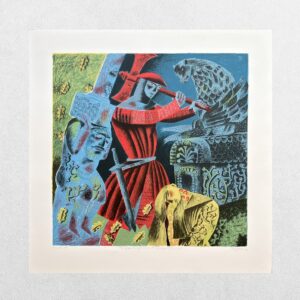
Image: © Clive Hicks-Jenkins. Courtesy Sarah Parvin Archive.
‘The Three Hunts’ inscribed ‘For Sarah’ by the artist
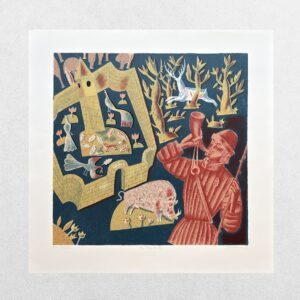
Image: © Clive Hicks-Jenkins. Courtesy Sarah Parvin Archive.
In addition, certain early public references to her role, originally published in 2015, are presented in edited form in their current online iteration. On June 23rd 2015 Hicks-Jenkins wrote the following on his Artlog in the correspondence section below his article:
“Sarah… Your plans for this are ambitious, but hey, between us all perhaps we’ll find a way. Let’s see what unfolds here. Stranger things have been known.”
following this up with:
“This is one of those projects that somehow came from left of field… and we have Miss Sarah to thank for that… but it also feels long in gestation and ripe to go.”
Archived copies allow for direct comparison and demonstrate that aspects of her contribution were publicly more explicitly acknowledged at the time.
Such divergence is not unusual. The contributions of intermediaries—particularly those operating outside formal institutional roles—are often less stable in retrospective accounts.
In Parvin’s case, this instability is compounded by the fact that her work was primarily digital and relational rather than object-based. While the prints remain, and the artist’s name remains attached to them, the structures that enabled their creation are less immediately visible unless supported by documentary evidence.
Taken together, these variations across public statements, published texts, and archival material demonstrate that the description of Parvin’s role has not been fixed, but has evolved over time. This analysis is based on documented material and comparison of sources, and does not seek to attribute motive.
Artist’s proof of ‘The Green Chapel’ inscribed ‘For Sarah’ by the artist
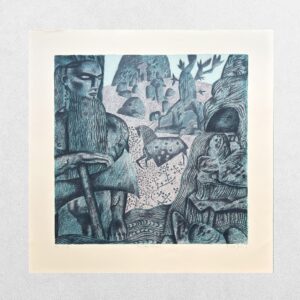
Image: © Clive Hicks-Jenkins. Courtesy Sarah Parvin Archive.
Facilitation as Agency
Parvin’s involvement raises a broader question: how should facilitation be understood within printmaking?
Her contributions—identifying collaborators, shaping structure, and developing audience strategy—operated at a formative stage of the project. While distinct from the act of making, they influenced how the work came into being and how it was positioned.
Her work through The Curious One demonstrates that facilitation can operate simultaneously across multiple levels:
- conceptual (identifying themes and connections)
- relational (bringing individuals together)
- strategic (shaping audience and market context)
In this sense, facilitation can be understood as a form of agency that sits adjacent to authorship: not producing the work itself, but enabling the conditions of its production.
‘The Temptations’ inscribed ‘For Sarah’ by the artist
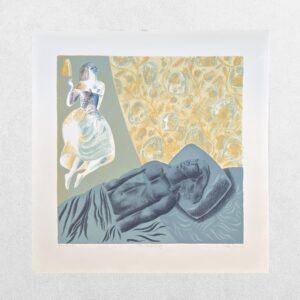
Image: © Clive Hicks-Jenkins. Courtesy Sarah Parvin Archive.
Reception and Afterlife
Despite the ambition and coherence of the Sir Gawain and the Green Knight series—fourteen prints conceived as a unified body of work—the project has not, to date, achieved the level of sustained critical or commercial recognition that might reasonably have been anticipated.
Only one print from the edition has sold out, and the series as a whole remains under-recognised relative to its scale, subject matter, and the reputations of those involved.
It would be reductive to attribute this to any single factor. However, the archive indicates that the early stages of the project involved a coordinated approach to:
- audience development
• narrative framing
• and long-term positioning
all of which are typically central to the success of print series of this kind.
The diminishing visibility of the facilitative role within later accounts raises the question of whether its partial displacement may also be relevant to how the project was subsequently sustained and communicated over time.
Any such relationship should be understood as speculative rather than causal in nature.
This is not to suggest direct causation, but rather to observe that the conditions under which a project is initiated—particularly where they involve active mediation between artist, printmaker, and audience—can remain significant beyond its initial realisation.
Right of Reply
The artist and printmaker were offered the opportunity to comment on the material presented here.
The artist did not respond.
The printmaker responded but did not grant permission for his comments to be published and indicated that he did not wish to engage further.
‘Gawain Staunches The Wound To His Neck’ inscribed ‘For Sarah’ by the artist
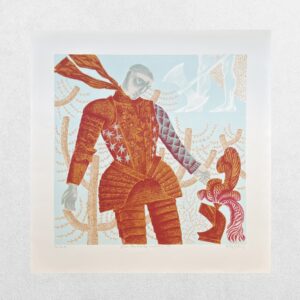
Image: © Clive Hicks-Jenkins. Courtesy Sarah Parvin Archive.
Conclusion
The Sarah Parvin archive provides a detailed account of facilitation in action within contemporary printmaking.
‘Morgan Le Fey’ inscribed ‘For Sarah’ by the artist
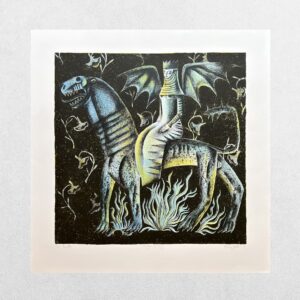
Image: © Clive Hicks-Jenkins. Courtesy Sarah Parvin Archive.
It demonstrates that:
- collaborations are often initiated through intermediary roles
- such roles can shape both structure and reception
- and their contribution, while sometimes informally defined, is materially significant
Recognising these roles allows for a more complete understanding not only of how print projects are conceived, but how they endure—or fail to achieve the recognition they merit—over time.
In the case of Sarah Parvin, The Curious One provides a framework through which her contribution can be more fully understood: not as incidental, but as part of a broader, forward-looking model of cultural production that anticipated many of the dynamics now central to the digital art world.
‘The Stain Of Sin’ inscribed ‘For Sarah’ by the artist
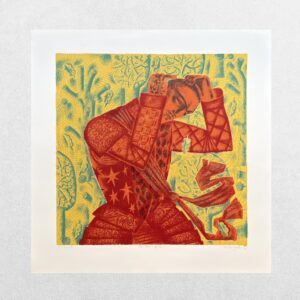
Image: © Clive Hicks-Jenkins. Courtesy Sarah Parvin Archive.
All material reproduced from items held in the Sarah Parvin archive. Images are presented in connection with the documentation, research, and sale of the works depicted. Copyright remains with the artist and relevant rights holders.