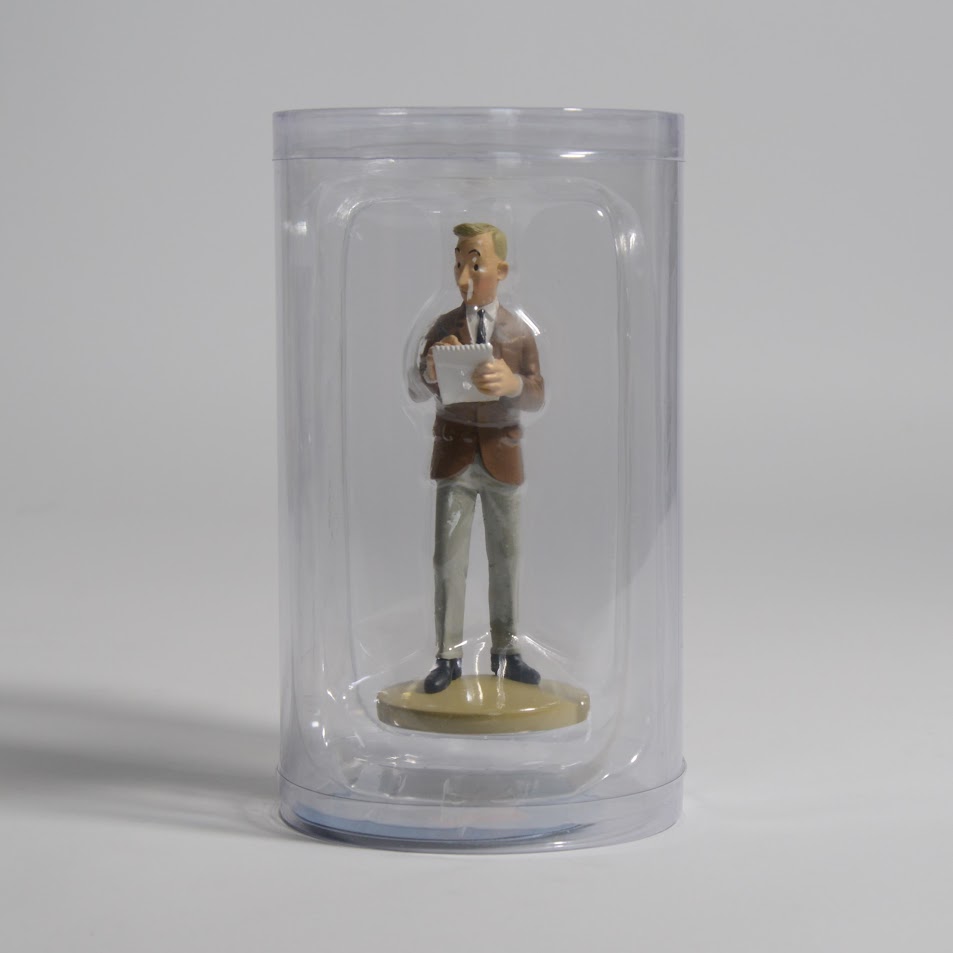
42204 Hergé Reporter – Figurine Resine 12cm – Hergé Reporter
Author: Hergé
Price: £45.00 including UK postage
Publisher: Moulinsart
Format: Resin in original cello tube packaging
Condition: Brand new
Size: 18.5cm including packaging
Hergé: A Brief Biography
Georges Remi, known universally by his pen name Hergé, was one of the most influential European cartoonists of the twentieth century. His creation of The Adventures of Tintin established a benchmark in visual storytelling, and his distinctive ligne claire style became synonymous with clarity, elegance, and precision in comic art. Hergé’s work not only shaped the Franco-Belgian comic tradition but also left a lasting mark on global popular culture.
Early Life and Education
Hergé was born Georges Prosper Remi on 22 May 1907 in Etterbeek, a suburb of Brussels, Belgium. His upbringing was modest, in a conservative, Catholic, middle-class household. From an early age, he demonstrated a keen eye for detail and a natural flair for drawing. His first sketches, often of boy scouts and nature scenes, appeared in the magazines of his scouting group, where he signed his drawings with his initials reversed—“R.G.”—which later became “Hergé” when pronounced in French.
His formative years in the Boy Scouts of Belgium profoundly shaped his moral outlook and storytelling style. The scouting movement’s ideals—courage, curiosity, and moral uprightness—would later inform the character of Tintin, the clean-cut, indefatigable young reporter who embodies youthful decency and adventurous spirit.
Early Career and the Birth of Tintin
After finishing school, Remi joined the conservative Catholic newspaper Le Vingtième Siècle as an illustrator. There he came under the mentorship of Abbé Norbert Wallez, the paper’s editor, who recognised the young artist’s talent and ideological reliability. In 1928, Wallez appointed him to edit Le Petit Vingtième, a weekly supplement for children.
It was within this supplement that Tintin first appeared. The debut story, Tintin in the Land of the Soviets (1929–1930), introduced readers to the intrepid reporter and his loyal fox terrier, Milou (known as Snowy in English). The tale was overtly anti-Communist and propagandistic, reflecting the political climate of the time rather than the artist’s own matured outlook. Nevertheless, the strip’s popularity was immediate and overwhelming, establishing Tintin as a national sensation.
Artistic Development and the Emergence of the Ligne Claire
Hergé’s style evolved rapidly throughout the 1930s. Works such as Tintin in America (1931–32), The Blue Lotus (1934–35), and The Black Island (1937–38) demonstrated increasing sophistication in both draughtsmanship and narrative structure. Under the influence of Chinese art student Zhang Chongren, whom he befriended during the creation of The Blue Lotus, Hergé adopted a more thoughtful, documentary approach to storytelling—researching backgrounds, costumes, and cultural details meticulously.
This period also saw the refinement of his celebrated ligne claire (“clear line”) technique: strong, uniform outlines combined with flat colour, minimal shading, and precise composition. This style not only enhanced legibility but also conveyed an almost architectural sense of order and elegance. It would come to define Hergé’s visual identity and influence generations of artists across Europe and beyond.
War Years and Controversy
The outbreak of the Second World War profoundly disrupted Hergé’s life and career. During the German occupation of Belgium, he continued producing Tintin stories for Le Soir, a newspaper controlled by the occupying authorities. This association later drew criticism and suspicion of collaboration, though Hergé himself insisted that his work remained apolitical during those years.
Despite the difficult context, the period produced several enduring classics, including The Crab with the Golden Claws (1941), The Secret of the Unicorn (1942), and Red Rackham’s Treasure (1943). These stories deepened Tintin’s world, introducing beloved characters such as Captain Haddock and Professor Calculus (Professeur Tournesol in French).
After the liberation of Belgium in 1944, Hergé faced professional scrutiny. He was briefly banned from publishing, but support from admirers and fellow artists allowed him to resume his work within a few years.
Post-war Renewal and the Golden Age
In 1946, Hergé helped found Tintin magazine, giving him creative independence and a new platform for his work. This era produced some of his most accomplished albums, including Destination Moon (1953), Explorers on the Moon (1954), The Calculus Affair (1956), and The Red Sea Sharks (1958).
These works display Hergé’s mastery of pacing, structure, and visual storytelling. His meticulous research and perfectionist standards were legendary—he kept extensive reference files, studied photographic sources, and redrew pages repeatedly until they met his ideal of clarity.
Yet success came at a cost. Hergé’s obsessive attention to detail often left him exhausted. In the early 1950s he suffered a period of severe depression, during which he temporarily suspended work on Tintin in Tibet. That book, published in 1960, became one of his most personal works—a meditation on loyalty, friendship, and spiritual endurance.
Later Years and Personal Evolution
As his fame grew internationally, Hergé became increasingly reflective about his creation and his own artistic limitations. He explored psychological and philosophical themes in later works such as The Castafiore Emerald (1963) and Flight 714 (1968), while maintaining the precision of his visual craft.
In his private life, he underwent considerable change. His marriage to Germaine Kieckens, which had lasted since 1932, broke down, and in 1977 he married Fanny Vlamynck, his long-time assistant. His later years were spent balancing global acclaim with the burdens of his reputation.
Hergé was a passionate collector of modern art, and he became increasingly fascinated by abstraction and colour theory—an interest reflected in his wish to move beyond Tintin, though his public and publishers rarely allowed it.
Death and Legacy
Hergé died in Brussels on 3 March 1983, aged seventy-five. He left the final Tintin adventure, Tintin and Alph-Art, unfinished; it was posthumously published in sketch form.
His legacy is vast. Hergé transformed the comic strip into a serious artistic medium through a combination of visual discipline, moral clarity, and narrative sophistication. His influence can be traced in the works of numerous European artists, as well as in contemporary cinema, graphic design, and illustration.
More than four decades after his death, The Adventures of Tintin continues to be translated into scores of languages and remains in print worldwide. Hergé’s work endures because it transcends its origins—melding adventure, humour, and humanism into a timeless vision of the modern world seen through the clear, curious eyes of a young reporter and his faithful dog.
In Summary
Hergé’s career embodies the evolution of European comic art from simple entertainment to refined narrative art form. His discipline, imagination, and moral curiosity shaped Tintin into a universal figure—a boy who travels the world, confronts injustice, and reflects the aspirations of his creator. Through this blend of artistry and conscience, Hergé secured his place not only in the history of comics but in the broader cultural heritage of the twentieth century.
Why Buy from Us?
At Hornseys, we are committed to offering items that meet the highest standards of quality and authenticity. Our collection of objects and rare books are carefully curated to ensure each edition is a valuable piece of bibliographical history. Here’s what sets us apart:
- Authenticity and Provenance: Each item is meticulously researched and verified for authenticity and collation.
- Expert Curation: Our selection process focuses on significance, condition, and rarity, resulting in a collection that is both diverse and distinguished.
- Customer Satisfaction: We aim to provide an exceptional customer experience, from detailed descriptions to secure and prompt delivery of your purchase.
- Returns Policy: We offer an unconditional guarantee on every item. If you wish to return an item, it may be sent back to us within fourteen days of receipt. Please notify us in advance if you wish to do so. The item must be returned in the same condition as it was sent for a full refund.
Cataloguer: Daniel Hornsey
Daniel Hornsey has specialised in fine and rare books, ephemera, and collectors’ editions for over thirty years. As a long-standing member of the antiquarian book trade, he has advised private collectors, curated catalogues, and sourced works for leading dealers, libraries and institutions across the world.
Hornseys’ exhibit regularly at book and map fairs in London and throughout the UK and are members of the Provincial Booksellers Fairs Association, the PBFA.
His fascination with Hergé’s work — especially ‘The Adventures of Tintin’ — began in childhood. Daniel recalls reading Tintin in original European editions and quickly recognising that these were not merely children’s books, but finely illustrated narratives crafted with artistic depth and wit.
As noted by the Musée Hergé in Louvain-la-Neuve, Hergé’s ‘ligne claire’ style has influenced generations of European comic artists and his original drawings and paintings command very high prices with his painting of ‘The Blue Lotus’ jar fetching £2.8m at auction in 2021.
By presenting these works through Hornseys’, he hopes to contribute to the continued appreciation of one of the 20th century’s most influential illustrators, helping new generations discover the artistry and legacy of Hergé.