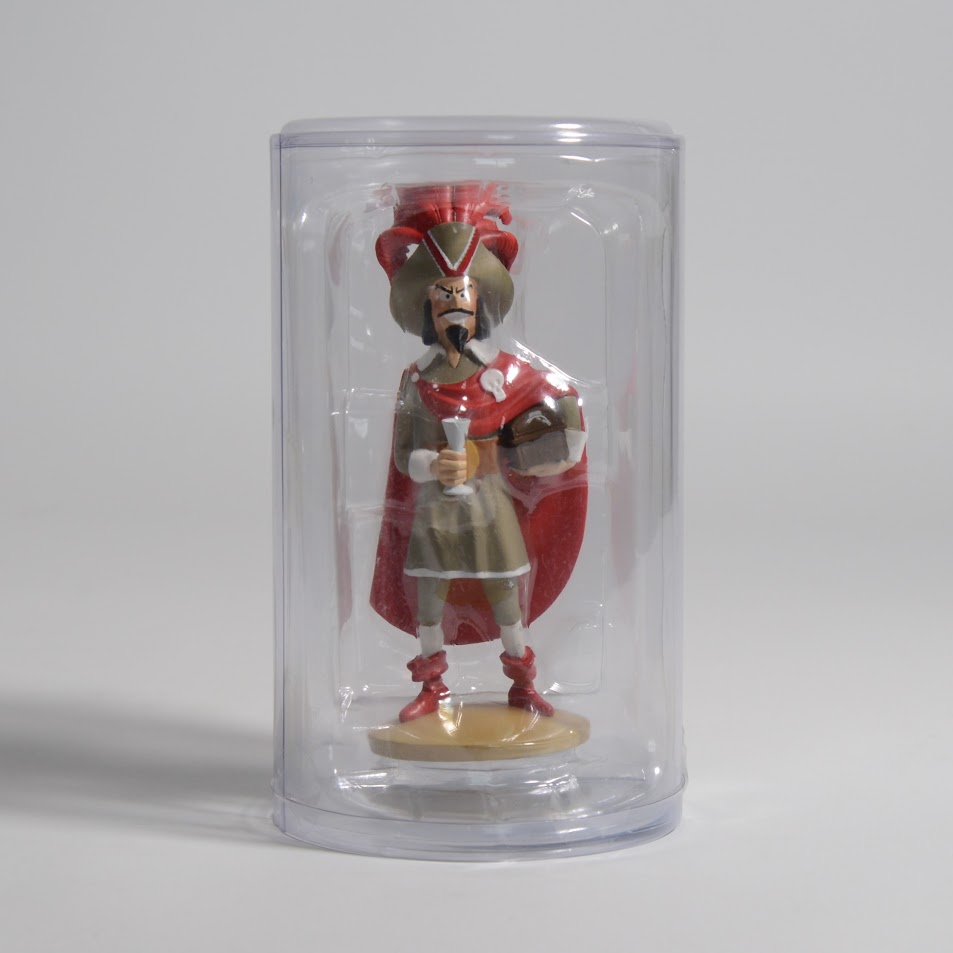
42239 Rackham Le Rouge – Figurine Resine 12cm – Red Rackham
Hergé & Moulinsart
£65.00
Availability: In stock
Product Description
42239 Rackham Le Rouge – Figurine Resine 12cm – Red Rackham
Author: Hergé
Price: £65.00 including UK postage
Publisher: Moulinsart
Format: Resin in original cello tube packaging
Condition: Brand new
Size: 18.5cm including packaging
Red Rackham: A Brief Biography
Red Rackham is the notorious seventeenth-century pirate introduced in Hergé’s The Secret of the Unicorn (Le Secret de la Licorne, 1943) and Red Rackham’s Treasure (Le Trésor de Rackham le Rouge, 1944). Though he appears only briefly in the Tintin canon, his presence dominates both stories — not as a living antagonist, but as a haunting legend whose legacy drives the action. Red Rackham is a figure of myth and menace, symbolising greed, adventure, and the dark romance of the sea. His story binds together the Haddock family’s past and present, providing the historical foundation for Captain Haddock’s modern character. Through Rackham, Hergé evokes the allure of buried treasure and the moral lessons hidden within the pursuit of it.
Character Overview
- Full Name: Red Rackham (French: Rackham le Rouge)
- Occupation: Pirate captain
- Nationality: English or French (unspecified, but European)
- Era: Seventeenth century
- Ship: The Unicorn
- Adversary: Sir Francis Haddock (ancestor of Captain Haddock)
- Appearance: Red hair and beard, dressed in typical seventeenth-century naval attire, armed with sword and pistols
- First Appearance: The Secret of the Unicorn (Le Secret de la Licorne, 1943)
Red Rackham’s name and character immediately conjure images of the Golden Age of Piracy — ruthless men of the sea driven by greed and bloodlust. Hergé crafts him as a quintessential pirate — cunning, daring, and treacherous — but also gives his legend a symbolic role far beyond his brief historical existence.
Origins and Historical Context
Within Tintin’s fictional universe, Red Rackham was a fearsome pirate who plundered the Caribbean in the seventeenth century. He is remembered chiefly for his final confrontation with Sir Francis Haddock, captain of The Unicorn and ancestor of Captain Archibald Haddock. Rackham and his crew attacked The Unicorn to seize its treasure. After fierce combat, Sir Francis outwitted the pirates, destroyed the ship to keep the treasure out of their hands, and escaped. Red Rackham, according to the tale, met his death at Sir Francis’s sword — a fittingly dramatic end for a man of infamy. The treasure of The Unicorn, sunk with the ship, becomes the central mystery of The Secret of the Unicorn and Red Rackham’s Treasure, linking past and present through genealogy, memory, and moral inheritance.
Symbolism and Character Function
- The Phantom Antagonist
Red Rackham never appears as a living character in the modern Tintin stories. Instead, he is a ghostly presence — a shadow of the past whose legend drives Tintin and Captain Haddock’s quest. This narrative device gives Rackham a mythic quality: he is the embodiment of adventure itself, a symbol of the eternal lure of buried treasure and the moral dangers it entails. Hergé’s storytelling transforms Rackham from a historical figure into a legend — a haunting echo of humanity’s greed and heroism.
- The Mirror of Captain Haddock
Red Rackham’s most important function is to serve as a mirror image of Captain Haddock, his descendant. Where Rackham represents greed, violence, and selfish ambition, Haddock embodies redemption, loyalty, and honour. The two men share physical and temperamental traits — fiery tempers, seafaring instincts, and a taste for adventure — but stand on opposite moral planes. Through their contrast, Hergé explores the theme of inheritance: that the past need not dictate one’s destiny. By confronting the legend of Red Rackham, Captain Haddock symbolically redeems his family name.
- The Treasure as Metaphor
The treasure of Red Rackham is more than gold — it represents self-discovery. The quest to find it leads Tintin and Haddock to Marlinspike Hall, the ancestral home of the Haddock family, symbolising continuity, belonging, and identity. Thus, the pirate’s hoard becomes a moral rather than material reward. In uncovering Rackham’s secret, Tintin and Haddock reclaim their past and restore moral order.
Appearance and Artistic Depiction
Hergé’s portrayal of Red Rackham is deliberately iconic. He is drawn with flaming red hair and beard, fierce eyes, and a cutlass in hand — a striking image of the archetypal pirate. His costume includes a plumed hat, sashes, and pistols, reflecting Hergé’s meticulous research into seventeenth-century maritime life. Despite appearing only in flashback sequences, his image lingers throughout the two albums. Hergé uses strong contrasts and bold lines to convey menace and charisma — Rackham is not merely a villain but a force of nature. The artist’s “ligne claire” style gives Rackham a timeless clarity; his figure stands at the intersection of history, myth, and imagination.
Thematic Analysis
- Greed and Its Consequences
Red Rackham’s defining trait is avarice. His lust for wealth drives him to murder and piracy, yet his greed ensures his downfall. Like many of Hergé’s villains, he is undone by his own obsession — a recurring moral pattern in Tintin’s world. Through Rackham’s fate, Hergé reinforces the idea that moral integrity, not treasure, is the true reward of adventure.
- The Romanticism of the Sea
Rackham also personifies the romantic fascination with piracy and exploration. Hergé’s depiction balances realism with romanticism: while Rackham is brutal, he is also charismatic — a figure of wild freedom who represents the untamed spirit of the sea. This tension between fascination and fear runs throughout The Secret of the Unicorn and Red Rackham’s Treasure, reflecting humanity’s enduring attraction to danger and mystery.
- Legacy and Redemption
Red Rackham’s story serves as a moral backdrop for Captain Haddock’s evolution. The discovery of Marlinspike Hall — built upon the Haddock lineage — symbolises the transformation of a cursed inheritance into a noble legacy. Where Rackham’s treasure was born of greed, Haddock’s inheritance becomes a foundation for friendship, loyalty, and adventure.
Psychological and Literary Reading
Red Rackham functions as both character and myth. He is a projection of the human fascination with forbidden wealth — the archetypal “shadow” figure in Jungian terms, embodying the darker impulses that Tintin and Haddock must confront. Hergé uses Rackham to test his protagonists morally. Tintin’s integrity and Haddock’s humility stand as correctives to Rackham’s corruption. The quest for treasure becomes a moral trial — a test of values rather than cunning. The psychological contrast between the living and the legendary provides one of the richest layers of meaning in Hergé’s middle-period work.
Moral Dimension
In The Adventures of Tintin, justice is never arbitrary — evil carries its own punishment. Red Rackham’s violent end, at the hands of Sir Francis Haddock, exemplifies this moral symmetry. Yet Hergé refrains from moralising overtly. Rackham is not depicted as a one-dimensional villain but as part of a world driven by greed, courage, and ambition — the same qualities, tempered by virtue, that define heroes like Tintin. The redemption of the Haddock line through the rediscovery of Rackham’s treasure underscores Hergé’s belief in personal transformation and moral continuity.
Cultural and Artistic Legacy
Red Rackham remains one of Hergé’s most enduring creations, even though he appears only fleetingly. His name, image, and myth continue to resonate in Tintin adaptations, from animated series to Steven Spielberg’s 2011 film The Adventures of Tintin: The Secret of the Unicorn, where Rackham’s story is dramatically expanded. The very phrase Red Rackham’s Treasure has entered popular culture as shorthand for hidden wealth and adventure. Hergé’s depiction of Rackham helped to shape the modern visual vocabulary of pirates — predating and influencing later portrayals in film, television, and literature.
Summary of Key Points
- Name: Red Rackham (Rackham le Rouge)
- Occupation: Pirate captain
- Era: Seventeenth century
- Ship: The Unicorn
- Enemy: Sir Francis Haddock
- First Appearance: The Secret of the Unicorn (Le Secret de la Licorne, 1943)
- Symbolism: Greed, legacy, adventure, and redemption
- Moral Role: Embodies the destructive power of avarice and the allure of myth
- Connection: Ancestor’s foe and moral counterpoint to Captain Haddock
Conclusion
Red Rackham, though a figure from Tintin’s distant past, exerts an immense influence over the moral and narrative structure of the series. His legend unites history and present, darkness and light, corruption and redemption. Through him, Hergé transforms a classic adventure motif — the search for buried treasure — into a meditation on human ambition and moral inheritance. In reclaiming the Haddock family legacy from Rackham’s shadow, Tintin and Captain Haddock symbolically restore honour to courage, friendship, and decency — proving, once again, that the greatest treasure lies not in gold, but in the integrity of the human spirit.
Why Buy from Us?
At Hornseys, we are committed to offering items that meet the highest standards of quality and authenticity. Our collection of objects and rare books are carefully curated to ensure each edition is a valuable piece of bibliographical history. Here’s what sets us apart:
- Authenticity and Provenance: Each item is meticulously researched and verified for authenticity and collation.
- Expert Curation: Our selection process focuses on significance, condition, and rarity, resulting in a collection that is both diverse and distinguished.
- Customer Satisfaction: We aim to provide an exceptional customer experience, from detailed descriptions to secure and prompt delivery of your purchase.
- Returns Policy: We offer an unconditional guarantee on every item. If you wish to return an item, it may be sent back to us within fourteen days of receipt. Please notify us in advance if you wish to do so. The item must be returned in the same condition as it was sent for a full refund.
Cataloguer: Daniel Hornsey
Daniel Hornsey has specialised in fine and rare books, ephemera, and collectors’ editions for over thirty years. As a long-standing member of the antiquarian book trade, he has advised private collectors, curated catalogues, and sourced works for leading dealers, libraries and institutions across the world.
Hornseys’ exhibit regularly at book and map fairs in London and throughout the UK and are members of the Provincial Booksellers Fairs Association, the PBFA.
His fascination with Hergé’s work — especially ‘The Adventures of Tintin’ — began in childhood. Daniel recalls reading Tintin in original European editions and quickly recognising that these were not merely children’s books, but finely illustrated narratives crafted with artistic depth and wit.
As noted by the Musée Hergé in Louvain-la-Neuve, Hergé’s ‘ligne claire’ style has influenced generations of European comic artists and his original drawings and paintings command very high prices with his painting of ‘The Blue Lotus’ jar fetching £2.8m at auction in 2021.
By presenting these works through Hornseys’, he hopes to contribute to the continued appreciation of one of the 20th century’s most influential illustrators, helping new generations discover the artistry and legacy of Hergé.
Related products

42200 HADDOCK COSMONAUTE – FIGURINE RESINE 12CM – HADDOCK ASTRONAUT – 12CM RESIN FIGURE
£32.00HERGÉ & MOULINSART
42233 – ALLAN PROVOQUE HADDOCK – FIGURINE RESINE 12CM – ALLAN PROVOKES HADDOCK – 12CM RESIN FIGURE
£32.00HERGÉ & MOULINSART


You may also like…
42229 Tintin En Scaphandre Marin – Figurine Resine 12cm – Tintin In A Diving Suit
£32.00Hergé & Moulinsart
Tintin In A Lunar Spacesuit – Figurines Tintin La Collection Officielle – 7 – Tintin En Scaphandre Lunaire
£55.00Hergé & Editions Moulinsart
Snowy Carries His Bone – Figurines Tintin La Collection Officielle – 6 – Milou Promène Son Os
£60.00Hergé & Editions Moulinsart
Thomson Looking Awkward – Figurines Tintin La Collection Officielle – 4 – Dupond Engoncé
£40.00Hergé & Editions Moulinsart
Haddock Doubtful – Figurines Tintin La Collection Officielle – 2 – Haddock Dubitatif
£40.00Hergé & Editions Moulinsart
Tintin In Trenchcoat – Figurines Tintin La Collection Officielle – 1 – Tintin En Trench-Coat
£75.00Hergé & Editions Moulinsart
42186 TINTIN COSMONAUTE – FIGURINE RESINE 12CM – TINTIN ASTRONAUT – 12CM RESIN FIGURE
£32.00HERGÉ & MOULINSART
42193 TINTIN DESERT – FIGURINE RESINE 12CM – TINTIN IN THE DESERT – 12CM RESIN FIGURE
£32.00HERGÉ & MOULINSART