
ANGELUS DE UBALDIS – LECTURA SUPER PRIMA PARTE DIGESTI VETERIS – RENAISSANCE RED & BLACK TITLE PAGE – JOHANN AUGUSTIN PHILIPP GESNER PRESENTATION COPY – 1534
Angelus De Ubaldis
£395.00
Availability: In stock
Product Description
ANGELUS DE UBALDIS – LECTURA SUPER PRIMA PARTE DIGESTI VETERIS – RENAISSANCE RED & BLACK TITLE PAGE – JOHANN AUGUSTIN PHILIPP GESNER PRESENTATION COPY – 1534
Description
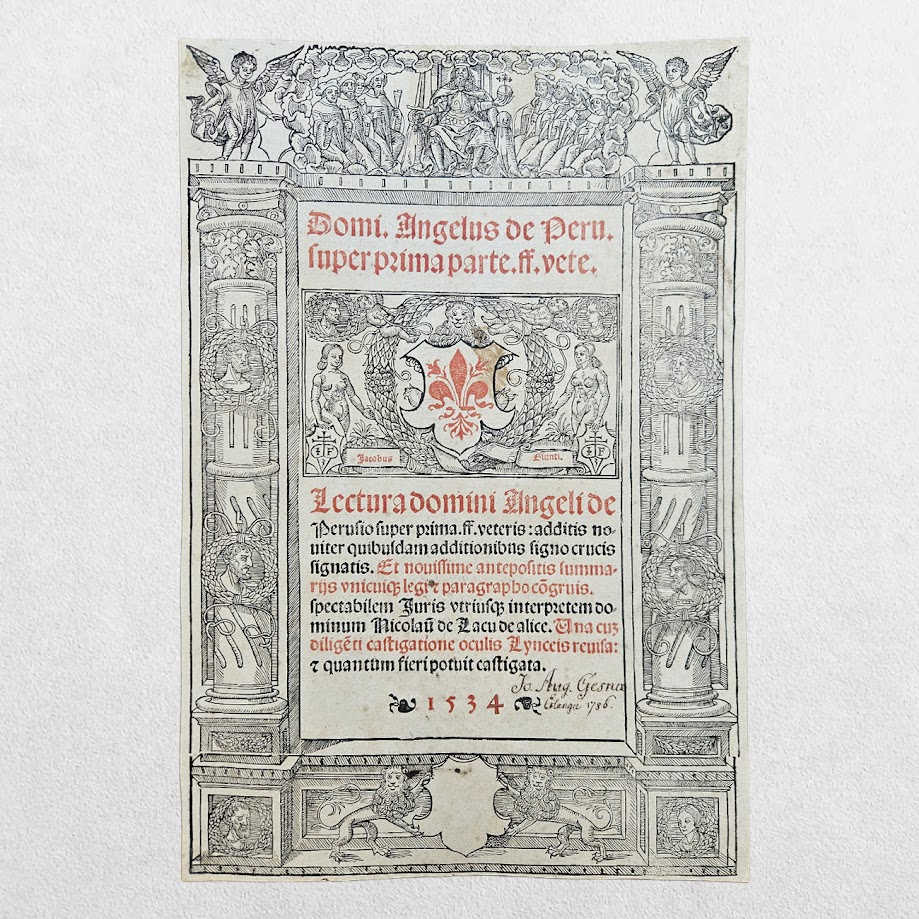
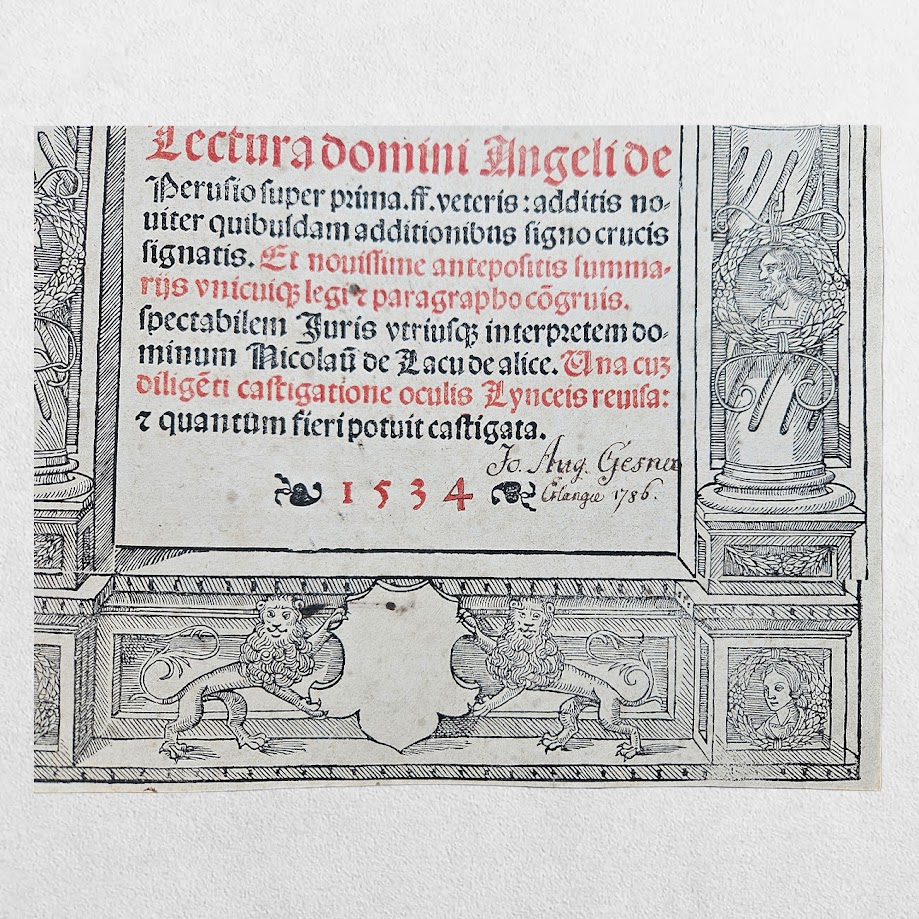
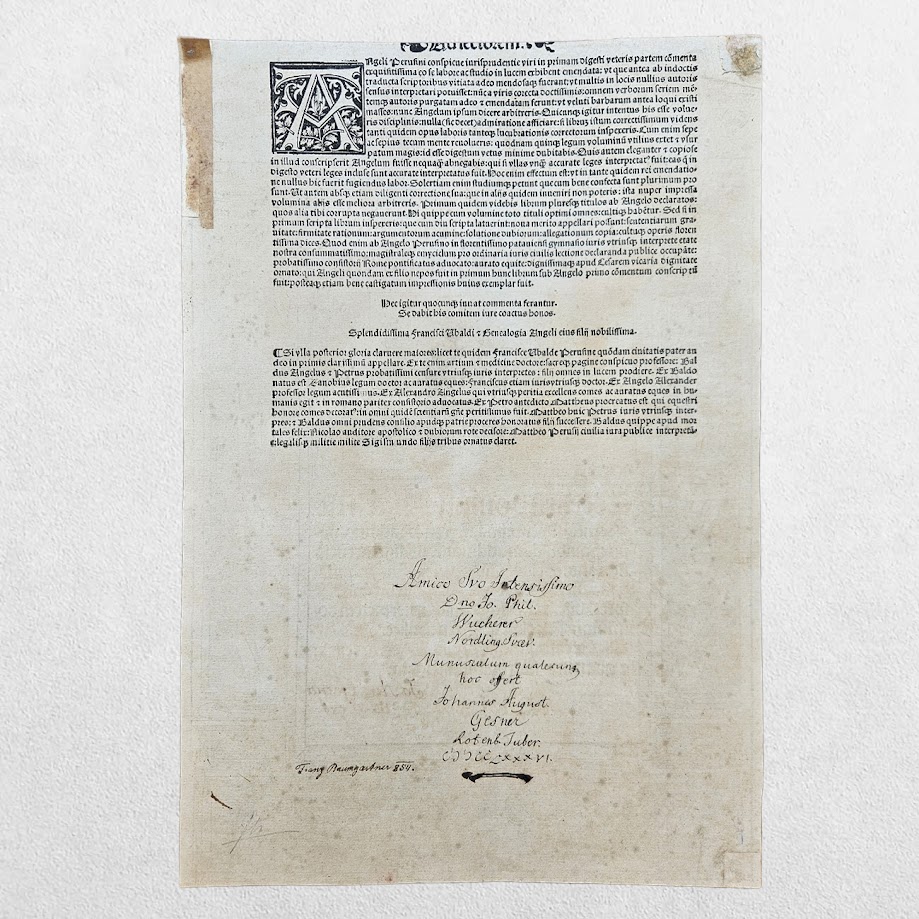
A highly decorative and historically significant original Renaissance title leaf from Angelus de Ubaldis of Perugia, Lectura domini Angeli de Perusio super prima parte ff. veteris, printed in 1534, a substantial legal commentary upon the first part of the Digestum Vetus of Justinian. The title is printed in exceptionally attractive red and black letterpress and surrounded by a monumental architectural woodcut border of considerable complexity. Across the upper register an enthroned ruler, holding the insignia of authority, is flanked by groups of attendant or supplicating figures beneath clouds, with winged angels occupying the outer corners. Massive Renaissance columns form the lateral borders, their shafts incorporating ornamental foliage, portrait medallions, military trophies, weapons and further classical decoration. At the centre is an elaborate woodcut device in which winged figures support a wreath and shield bearing a large fleur-de-lis printed in red, accompanied by standing female figures and smaller emblematic devices. The lower architectural register is supported by two facing lions and terminates in portrait medallions at either corner. The combined imagery of sovereignty, law, civic authority, classical ornament and heraldic symbolism forms an exceptionally imposing setting for one of the major works of the medieval Roman-law tradition. The title itself reads in abbreviated form Domi. Angelus de Peru. super prima parte ff. vete. and Lectura domini Angeli de Perusio super prima ff. veteris, recording an augmented and corrected edition of the commentary of Angelus de Ubaldis (c.1327–1407), the distinguished Perugian jurist and member of the celebrated Ubaldi family of medieval legal scholars. His commentaries belong to the great tradition of the post-glossators or commentators whose interpretation of the recovered corpus of Roman law profoundly influenced legal teaching and practice throughout late-medieval and Renaissance Europe. The verso retains the beginning of the introductory text, printed in Latin and headed by a large ornamental initial, followed by material concerning Franciscus de Ubaldis and the genealogy of Angelus and his distinguished family.
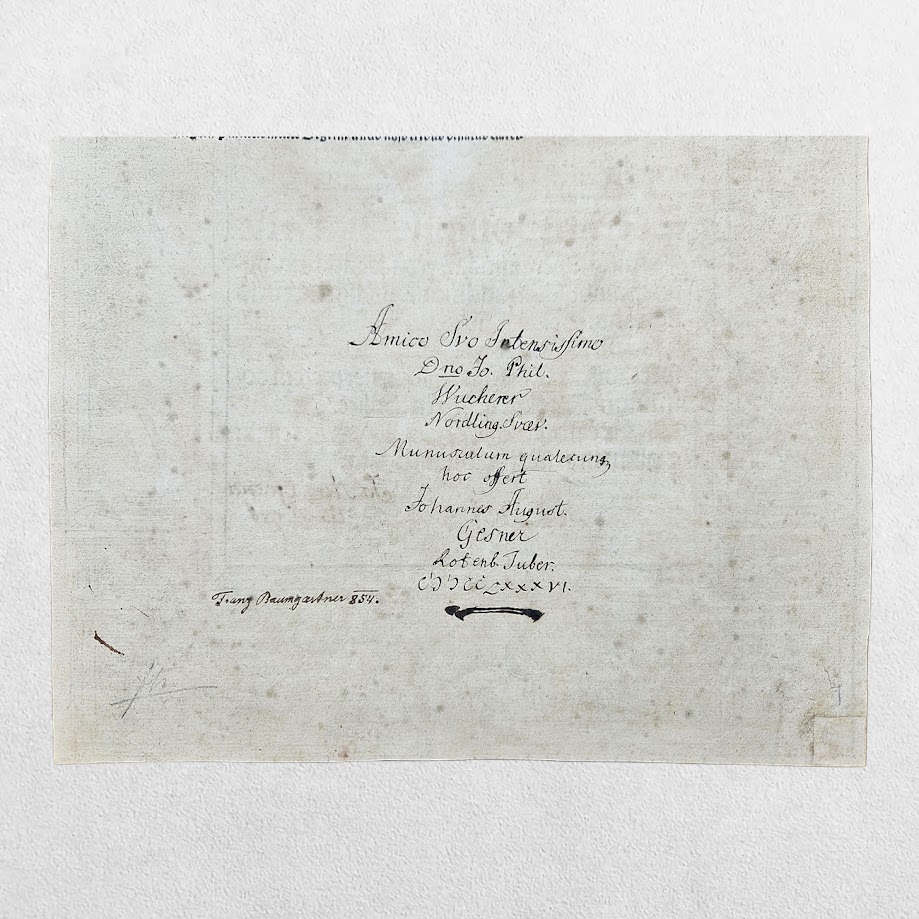
Of exceptional additional interest is the leaf’s eighteenth-century scholarly provenance. At the foot of the title is the contemporary ownership/presentation notation “Jo. Aug. Gesner … 1786”, while the verso carries a substantial manuscript presentation inscription in Latin from Johann Augustin Philipp Gesner (1738–1801) to his friend Johann Philipp Wucherer (1765–1822) of Nördlingen, dated 1786 and signed by Gesner at Rothenburg ob der Tauber. The inscription begins “Amico suo integerrissimo Dno Jo. Phil. Wucherero…” and continues “Munusculum qualecunque hoc offert Johannes August. Gesner, Rotenb. Tubar., MDCCLXXXVI” — approximately, “To his most worthy friend Johann Philipp Wucherer … Johannes August Gesner of Rothenburg ob der Tauber offers this little gift, such as it is, 1786.” This establishes the leaf as a documented presentation piece rather than merely an anonymously disbound title page.
Gesner was an important German physician, medical author and natural philosopher of the Enlightenment. Born at Rothenburg ob der Tauber in 1738, he studied medicine at Erlangen and Göttingen and subsequently practised at Rothenburg and Nördlingen before returning to his native city. He became a member of the German Academy of Sciences Leopoldina, and published widely on medicine and natural history. His particular historical importance lies in his pioneering investigation of acquired disorders of language. In the second volume of his Sammlung von Beobachtungen aus der Arzneygelahrheit und Naturkunde, Gesner discussed what he termed “Sprachamnesie” — language amnesia, analysing disturbances of naming, speech, reading and writing in a manner which historians of neurology now recognise as an important early contribution to the scientific study of aphasia. Arthur L. Benton devoted a substantial study in Medical History to Gesner’s work, placing him amongst the significant early investigators of aphasic disorders. His medical writings therefore occupy an acknowledged position in the pre-nineteenth-century history of neurology and neuropsychology. The recipient, Johann Philipp Wucherer of Nördlingen, was himself associated with the learned and civic culture of the city; contemporary biographical records identify him as a law student who subsequently became Stadtrichter, or city judge, at Nördlingen, and later an Oberappellationsgerichtsrat. The presentation of an early Roman-law title page by an important physician and natural philosopher to a young legal scholar who would enter the judiciary is therefore especially appropriate.
The leaf was subsequently in another collection, with a further nineteenth-century manuscript notation to the verso, before appearing at Dominic Winter Auctioneers, 5 November 2025, lot 298, where it was chosen as the principal named item in a group of approximately thirty-two early printed title pages and leaves. Dominic Winter described it as Domi. Angelus de Peru, 1534, with the title printed in red and black within an elaborate woodcut border. An exceptional conjunction of Renaissance legal printing, monumental woodcut book decoration and distinguished eighteenth-century medical and legal provenance.
Condition
Very good condition overall for an original title leaf approaching five centuries old. The red and black printing remains notably strong and fresh, with excellent definition throughout the elaborate architectural woodcut border and central fleur-de-lis device. Some expected age-toning, light spotting and minor marking are present, together with slight marginal and handling wear. Small old paper repairs or reinforcements are visible to the verso at the upper corners/margins. The manuscript inscriptions remain clear and legible. The printed composition is substantially complete and presents extremely well. Please examine the photographs carefully, as they form an important part of the condition description.
Author
Angelus de Ubaldis (Angelo degli Ubaldi / Angelus de Perusio), c.1327–1407.
Title
Lectura domini Angeli de Perusio super prima parte ff. veteris.
Subject
Roman law; Justinian’s Digestum Vetus; medieval and Renaissance jurisprudence; legal commentary.
Place
Lyon, attribution traditionally given with some bibliographical caution.
Date
1534.
Format
Original single title leaf.
Sheet Size
35.4 × 24.1 cm.
Printing
Letterpress printed in red and black with an extensive Renaissance architectural woodcut border and central woodcut device.
Language
Latin.
Provenance
Johann Augustin Philipp Gesner (1738–1801), German physician, medical writer, member of the Leopoldina and pioneering investigator of aphasia; presented by him at Rothenburg ob der Tauber in 1786 to Johann Philipp Wucherer (1765–1822) of Nördlingen, later city judge and Oberappellationsgerichtsrat. Further nineteenth-century ownership notation to verso. Subsequently sold as the principal named item in Dominic Winter Auctioneers, 5 November 2025, lot 298, within a group of early printed title pages and leaves.
Historical Importance
A particularly unusual survival in which an important Renaissance legal title page can be traced through the intellectual networks of the German Enlightenment. Gesner’s presentation inscription transforms the leaf from an attractive piece of sixteenth-century typography into an identifiable historical object associated with a physician now recognised as one of the early pioneers in the scientific investigation of acquired language disorders.
Authentication
Handled, inspected and researched in-house. Original sixteenth-century printed title leaf with eighteenth-century manuscript presentation inscription; not a later reproduction.
Why buy from us?
At Hornseys, we are committed to offering items that meet the highest standards of quality and authenticity. Our book collection is meticulously curated to ensure that each edition is a valuable and authentic piece of bibliographical history. Here’s what sets us apart:
- Authenticity and Provenance: Every book is researched, collated, and verified for authenticity.
- Expert Curation: Each book is selected with a keen eye for significance, condition, and rarity, ensuring a collection that is both diverse and distinguished.
- Customer Satisfaction: We strive to provide an exceptional customer experience, from detailed descriptions and provenance to secure and prompt delivery of your purchase.
- Returns Policy: We offer an unconditional guarantee on every item. If you wish to make a return, books may be sent back to us within fourteen days of receipt for any reason. We request advance notification of returns, and books must be returned in the same condition as sent for a full refund.
Explore Our Collection:
Visit Hornseys to explore our fine collection of rare and signed books. Whether you are an avid collector or looking for a special gift, our selection offers something truly unique. Located in the picturesque Yorkshire Dales, our Ripon gallery has been a haven for book lovers, art enthusiasts, and collectors since 1976.
Related products

The Mediterranean Shore: Travels In Lawrence Durrell Country: Signed By The Artist
£125.00Hogarth, Paul with introduction and commentary by Durrell, Lawrence
Diurnes – Decoupage Et Photographies – First Edition – 1962
£7,250.00Picasso, Pablo & Villers, André




![HORTUS SANITATIS [ORTUS SANITATIS] - DE AVIBUS - HARPY, SWALLOW, GYRFALCON AND IBIS - ORIGINAL INCUNABLE WOODCUT LEAF - STRASBOURG, JOHANN PRÜSS - NOT AFTER 21 OCTOBER 1497](https://hornseys.com/wp-content/uploads/2026/08/003988_1-300x300.jpg)


