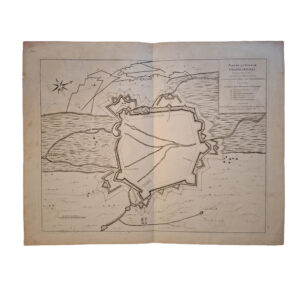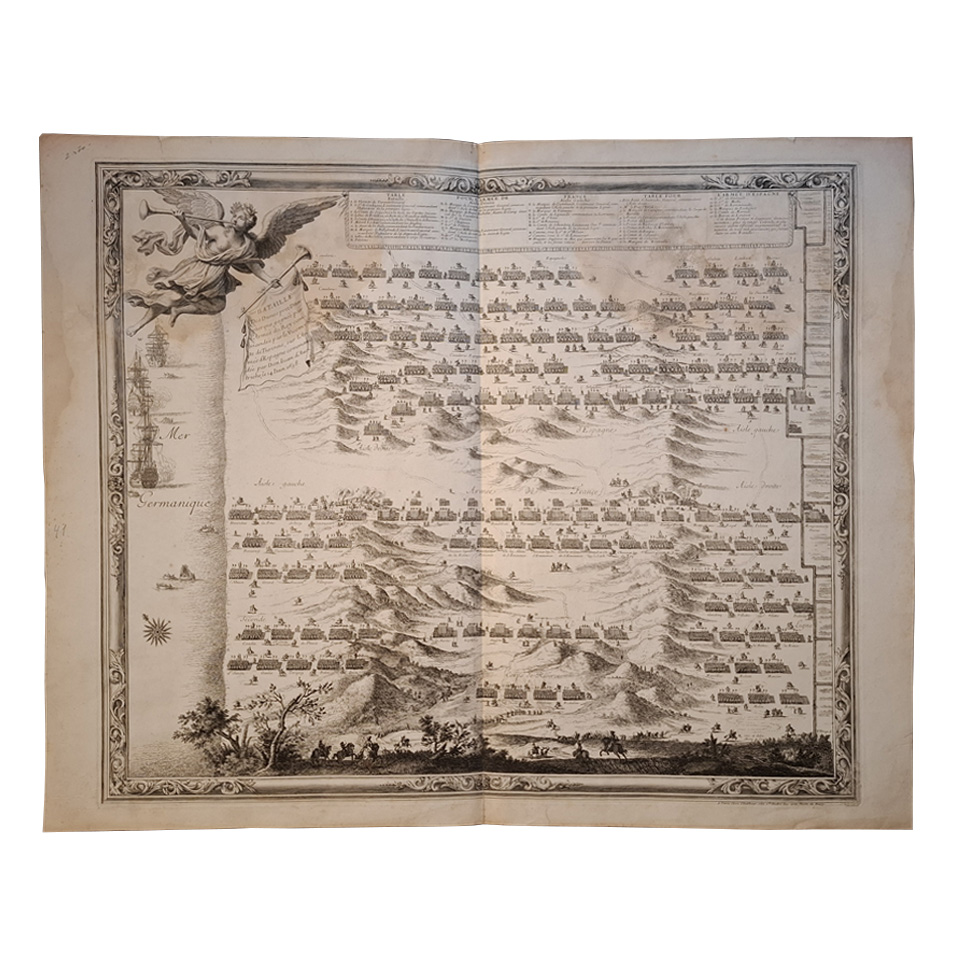
BATAILLE DES DUNES PRÈS DE DUNQUERQUE GAGNÉE PAR L’ARMÉE DU ROI COMMANDÉE PAR LE VICOMTE DE TURENNE SUR L’ARMÉE D’ESPAGNE COMMANDÉE PAR DON JUAN D’AUTRICHE LE 14 JUIN 1658
De Chattillon, Louis & Cochin, Nicolas
£100.00
Availability: In stock
Product Description
BATAILLE DES DUNES PRÈS DE DUNQUERQUE GAGNÉE PAR L’ARMÉE DU ROI COMMANDÉE PAR LE VICOMTE DE TURENNE SUR L’ARMÉE D’ESPAGNE COMMANDÉE PAR DON JUAN D’AUTRICHE LE 14 JUIN 1658
Artist: Louis De Chattillon & Nicolas Cochin (engraves)
Publisher: Paris, France
Price: £100 (post-free in the UK)
Publication Date: c.1695
Edition: 1st edition
Format: Copper engraving
Condition: In good condition, unframed
Sheet Size: 61.1cm x 48.4cm
Condition:
A good, strong impression. Original central fold line. Age toning to the paper and some staining to the upper section and lower margin which is more visible to the reverse. In good condition overall. Scarce.
Location: Map Drawer C: FS: Folder M2000 002570
Louis de Chattillon
Louis de Chattillon (17th century) was a French painter and engraver active during the Baroque period. Renowned for his skill in both artistic disciplines, he specialised in allegorical and historical scenes. His engravings often accompanied important historical or literary works, showcasing a fine attention to detail and composition. Chattillon collaborated with prominent artists and engravers of his time, contributing to the visual culture of 17th-century France.
Nicolas Cochin
Nicolas Cochin (1610–1686) was a celebrated French engraver and designer, known for his precise and intricate line work. He contributed extensively to the artistic and publishing worlds, creating illustrations for books, maps, and standalone prints. Cochin’s works often depicted religious, mythological, and historical subjects, demonstrating his mastery of classical themes. His contributions significantly influenced French engraving, and his legacy continued through his artistic descendants, including his son, Charles-Nicolas Cochin.
The Battle of The Dunes Near Dunkirk, 1658: A Short History
The Battle of the Dunes, fought on 14 June 1658, was a decisive military engagement during the final stages of the Franco-Spanish War (1635–1659). This conflict was part of a broader struggle for dominance in Europe, with France seeking to curb Spanish power. The battle, fought near Dunkirk on the sandy dunes along the North Sea, resulted in a significant victory for France, solidifying its position as a major European power.
Background and Context
The battle arose from France’s efforts to capture Dunkirk, a key strategic port on the North Sea controlled by Spain. Dunkirk was essential for securing trade routes and asserting naval dominance in the region. France’s alliance with England, under the Protectorate of Oliver Cromwell, played a critical role in this campaign. The English provided naval support and additional troops, adding strength to the French offensive.
The Spanish forces, led by Don Juan of Austria and supported by English Royalist exiles under James, Duke of York, sought to defend Dunkirk and maintain Spain’s waning influence in northern Europe.
Forces Involved
- French Army
- Commanded by the renowned general Henri de La Tour d’Auvergne, Vicomte de Turenne, the French army numbered approximately 15,000 soldiers, including infantry, cavalry, and artillery.
- The French forces were well-supplied and strategically positioned, benefiting from Turenne’s leadership and innovative tactics.
- Spanish Army
- The Spanish army, commanded by Don Juan of Austria, consisted of about 14,000 troops, including Spanish regulars, Walloon regiments, and English Royalist exiles.
- Despite their experience and determination, the Spanish troops were at a disadvantage due to their reliance on outdated tactics and limited supplies.
- Allied English Troops
- England contributed 6,000 soldiers and a naval fleet to the French effort. This support was pivotal in securing control of the coastline and cutting off Spanish reinforcements.
The Battlefield
The battle took place on the sandy dunes near Dunkirk, a challenging environment for both sides. The dunes provided natural defensive positions but also limited mobility for cavalry and artillery. The proximity of the North Sea added an element of unpredictability, as the tides and winds could affect both land and naval operations.
The Course of the Battle
- Initial Positions
- The French army occupied high ground on the dunes, giving them a tactical advantage. Turenne positioned his forces to maximise their defensive capabilities while preparing for an offensive push.
- Engagement Begins
- Early in the battle, French artillery bombarded Spanish positions, causing significant casualties and weakening the morale of the Spanish troops.
- The Spanish attempted to outflank the French by advancing along the dunes, but the challenging terrain slowed their progress.
- Turning Point
- Turenne’s strategic deployment of infantry and cavalry proved decisive. French soldiers, supported by English troops, launched a coordinated assault on the Spanish centre, breaking through their lines.
- Simultaneously, the English fleet, under Admiral Edward Montagu, blockaded Dunkirk, preventing reinforcements or retreat by sea.
- Spanish Collapse
- The Spanish forces, overwhelmed and demoralised, began to retreat. Many soldiers were either captured or killed as the French pursued them relentlessly.
- Don Juan of Austria and James, Duke of York, managed to escape but could not rally their troops.
Aftermath and Consequences
- Capture of Dunkirk
- Following the battle, Dunkirk surrendered to the French and was handed over to the English as part of the alliance agreement. This strengthened England’s position in Europe and bolstered French-English relations.
- Strategic Victory
- The Battle of the Dunes marked the beginning of the end for Spain’s dominance in Europe. It confirmed France’s ascendancy under Louis XIV, who would go on to consolidate his power as the “Sun King.”
- Impact on the Franco-Spanish War
- The victory hastened the conclusion of the war, culminating in the Treaty of the Pyrenees in 1659. This treaty redrew the map of Europe, granting France significant territorial gains.
Legacy
The Battle of the Dunes is remembered as a triumph of military strategy and a testament to Turenne’s brilliance as a general. It showcased the effectiveness of combined land and naval operations and underscored the importance of alliances in shaping European conflicts.
The battle also symbolised a turning point in the decline of the Spanish Empire and the rise of France as Europe’s dominant power. Its significance extends beyond military history, reflecting the shifting dynamics of politics, strategy, and diplomacy in the 17th century.
SHOP WITH CONFIDENCE AT HORNSEYS
At Hornseys, we are dedicated to offering items that uphold the highest standards of quality and authenticity. Our collection of artwork is carefully curated to ensure that each item we offer is authentic, collated, and complete.
Here’s what sets us apart:
- Authenticity and Provenance: Each map is researched and verified for authenticity.
- Expert Curation: We entirely own all our artworks. We trust our taste and have invested heavily in it. We have confidence in all artwork that we offer for sale.
- Customer Satisfaction: We strive to provide an exceptional customer experience, from detailed descriptions and provenance to secure and prompt delivery of your purchase.
- Returns Policy: We offer an unconditional guarantee on every item. If, however, you wish to make a return, artworks may be sent back to us within fourteen days of receipt for whatever reason. We request that we are notified in advance if you wish to do so. They must be returned to us in the same condition as they were sent for a full refund.
OUR COMMITMENT TO QUALITY AND SERVICE
Understanding the value and rarity of these items, we ensure that every aspect of your purchase meets the highest standards of quality and service. This includes:
- Free Expedited, Tracked, and Insured Delivery within the UK: Ensuring that your artwork arrives safely and promptly.
- Fully-Insured Worldwide Delivery: Offering peace of mind for international collectors with reliable and secure shipping options.
EXPLORE OUR COLLECTION
Visit Hornseys today to explore our fine collection of maps and other artworks. Whether you are an avid collector or looking for a special gift, our selection offers something truly unique. Located since 1976 in Ripon in the picturesque Yorkshire Dales, we are recognized as a destination gallery for tastefully curated artwork, rare maps, design, and fine books.
Related products

SCOTIA REGNUM CUM INSULIS ADJACENTIBUS ROBERTUS GORDONIUS A STRALOCH DESCRIPSIT – ORIGINAL COPPER ENGRAVED MAP PUBLISHED BY JOAN BLAEU
£650.00Blaeu, Joan & Gordon, Robert
Mediterranean Sea: Mappa Maris Mediterranei Fluxus Currentes Et Naturum Motionum Explicans
£350.00Kircher (Athanasius)


You may also like…
ANTIQUORUM AFRICAE EPISCOPA TUUM GEOGRAPHIA DESCRIPTIO – 1640 – NORTHERN AFRICA
£95.00Tavernier, Melchior