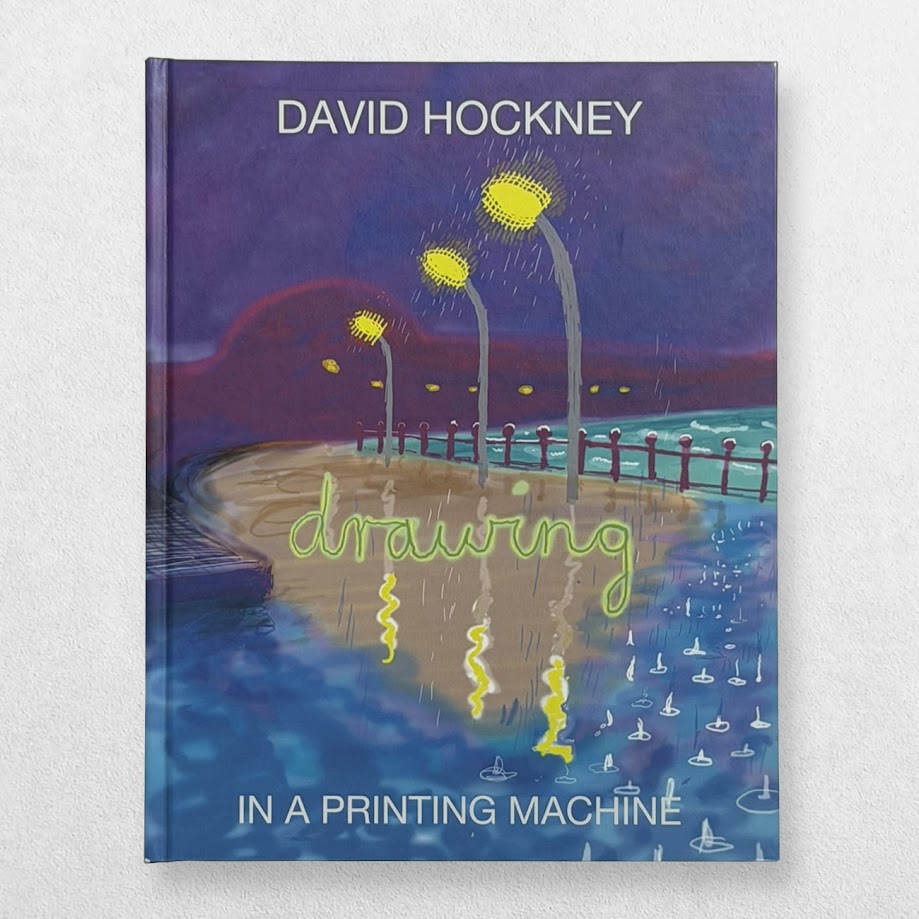
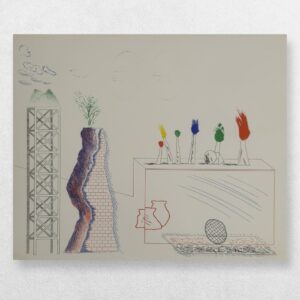
David Hockney – In A Printing Machine – London 1 May – 11 July 2009
Artist: Hockney, David
Publisher: Annely Juda
Price: £30 including postage in the UK
Publication Date: 2009
Edition: First edition
Size: Quarto
Condition: Fine
Condition:
The hardcover catalogue of the exhibition held at Annely Juda Gallery. Illustrated throughout in colour. A fine copy.
David Hockney – In A Printing Machine: A Brief Overview
London, 1 May – 11 July 2009
Context and Curatorial Premise
In a Printing Machine (2009), presented at Annely Juda Fine Art, marked a pivotal moment in David Hockney’s late-career engagement with printmaking. The exhibition took its title from Hockney’s own description of his working process—suggesting both immersion and authorship within the mechanical systems of reproduction.
Rather than treating printmaking as secondary to painting, the exhibition asserted it as a primary site of innovation, foregrounding Hockney’s sustained investigation into how images are constructed, layered, and disseminated.
The show coincided with, and in many respects extended, the publication of the major print catalogue raisonné David Hockney Prints 1954–77, situating the exhibition within a longer historical trajectory of his graphic practice.
Structure of the Exhibition
- Multi-Plate Etchings and Lithographs: Complex Image Construction
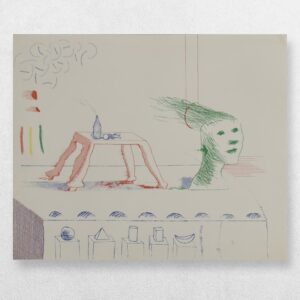
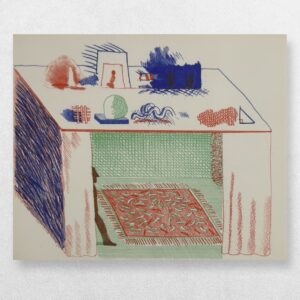
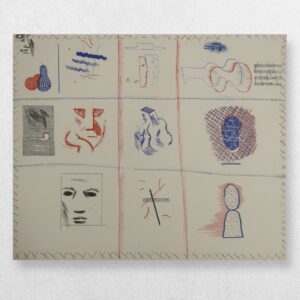
At the core of the exhibition were large-scale prints produced through multi-plate etching and lithographic processes, often involving numerous colour separations.
Key technical features included:
- Layered plate systems: Individual colour plates were printed sequentially, requiring exacting registration.
- Hybrid techniques: Hockney combined etching, aquatint, and lithography to achieve tonal and textural variation.
- Deliberate artificiality: Colour was often non-naturalistic, emphasising the constructed nature of the image.
These works demonstrate Hockney’s deep technical fluency. Unlike traditional printmakers who aim for seamless illusion, Hockney frequently allowed the mechanics of printmaking—edges, overlaps, and colour shifts—to remain visible, reinforcing the idea of the image as an assembled object.
- Yorkshire Landscapes: Reframing Place Through Print
The exhibition also included prints based on the Yorkshire landscape, a subject that would soon dominate Hockney’s practice.
These works:
- Translate direct observation into highly mediated graphic form
- Use bold contour lines and planar colour rather than atmospheric modelling
- Emphasise structure over naturalism, often simplifying forms into rhythmic patterns
This approach situates Hockney within a lineage that includes modernist printmakers such as Picasso, while also anticipating the more expansive treatment of landscape in his later paintings and digital works.
- Photographic and Digital Integration
Although primarily focused on traditional printmaking, the exhibition revealed Hockney’s increasing interest in photographic and digital technologies:
- Some works incorporated photographic reference material
- Others explored computer-assisted colour separation and composition
This hybridisation reflects a broader methodological shift: printmaking becomes not just a reproductive medium, but a site of synthesis between analogue and digital processes.
Thematic and Conceptual Analysis
Printmaking as Primary Practice
A central argument of the exhibition is that printmaking is not subordinate to painting. Instead, it is a generative discipline in its own right, capable of producing complex, original works.
The Artist “Inside” the Machine
The title encapsulates Hockney’s conceptual position: he is not external to the printing process but embedded within it. This reflects:
- A rejection of passive reproduction
- An embrace of mechanical collaboration
- A focus on process as authorship
Multiplicity and Seriality
Printmaking inherently involves multiples, and Hockney exploits this:
- Variations between editions become meaningful
- Repetition is used as a tool for exploration
- The notion of a singular “original” is destabilised
Dialogue with Art History
The works engage with earlier traditions:
- Picasso’s experimental printmaking
- Matisse’s use of line and colour
- British landscape traditions, refracted through modernist abstraction
Technical Authority and Craft
From a technical perspective, the exhibition demonstrated exceptional mastery:
- Precise plate registration across complex compositions
- Sophisticated understanding of ink behaviour and paper interaction
- Willingness to push processes beyond conventional limits
Hockney worked closely with master printers, yet maintained direct control over aesthetic decisions—ensuring that technical execution remained aligned with artistic intent.
Critical Reception and Market Position
Critically, the exhibition reinforced Hockney’s reputation as one of the most important living printmakers:
- Praised for technical ambition and inventiveness
- Recognised as a significant extension of his graphic oeuvre
From a market perspective:
- Large-scale editioned prints attracted strong collector interest
- The exhibition contributed to a reassessment of printmaking as a serious, high-value medium within contemporary art
Significance within Hockney’s Oeuvre
In a Printing Machine occupies a crucial position in Hockney’s career:
- It consolidates decades of engagement with printmaking
- It anticipates his subsequent move into digital drawing (iPhone/iPad works from 2009 onwards)
- It bridges analogue and digital methodologies
Importantly, the exhibition demonstrates that Hockney’s practice is not medium-specific but concept-driven, with each medium selected for its capacity to extend his investigation into perception and image-making.
Why buy from us?
At Hornseys, we are committed to offering items that meet the highest standards of quality and authenticity. Our book collection is meticulously curated to ensure that each edition is a valuable and authentic piece of bibliographical history. Here’s what sets us apart:
- Authenticity and Provenance: Every book is researched, collated, and verified for authenticity.
- Expert Curation: Each book is selected with a keen eye for significance, condition, and rarity, ensuring a collection that is both diverse and distinguished.
- Customer Satisfaction: We strive to provide an exceptional customer experience, from detailed descriptions and provenance to secure and prompt delivery of your purchase.
- Returns Policy: We offer an unconditional guarantee on every item. If you wish to make a return, books may be sent back to us within fourteen days of receipt for any reason. We request advance notification of returns, and books must be returned in the same condition as sent for a full refund.
Explore Our Collection:
Established in 1976, Hornseys’ is a family business based in Ripon. We buy and sell rare and signed books, artwork, maps, furnishings, bruins, ‘The Adventures of Tintin’ and many other carefully curated items. We exhibit regularly at London book-fairs. We sell to leading dealers and clients throughout the world. Authenticity is guaranteed on all our products. Postage is free in the UK and we also offer fully-insured and tracked worldwide shipping.