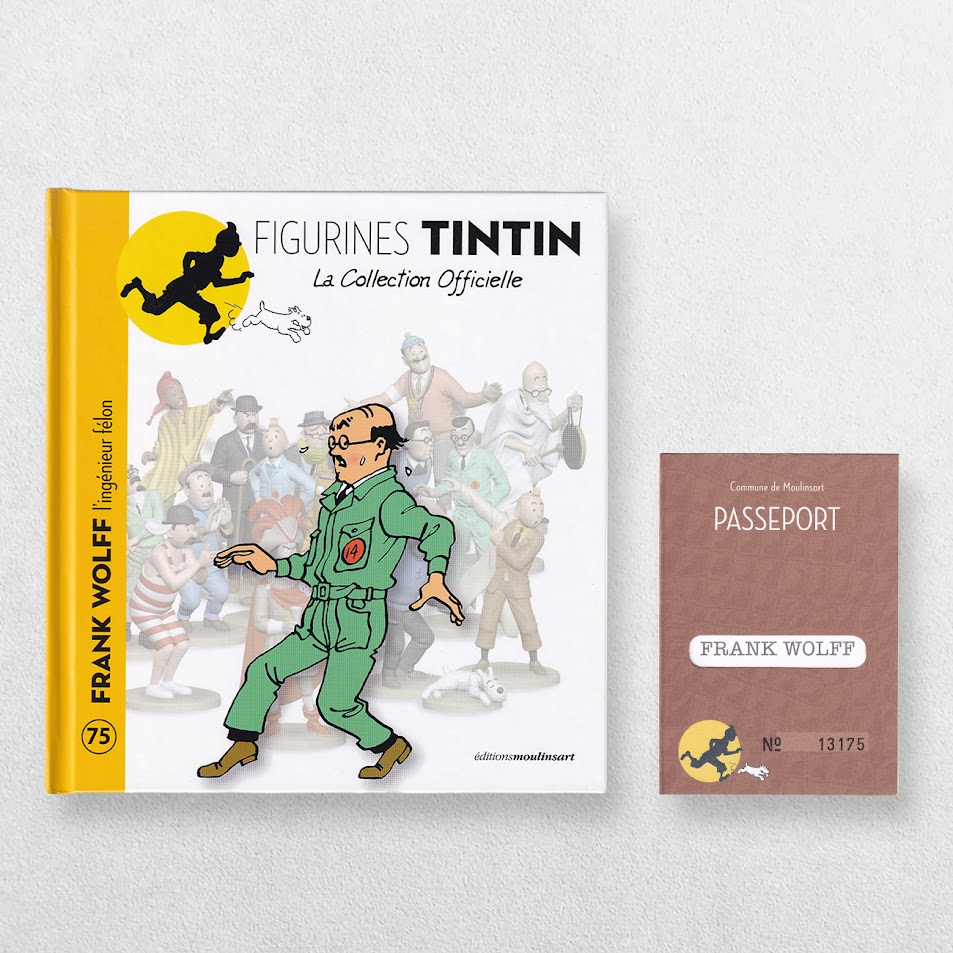
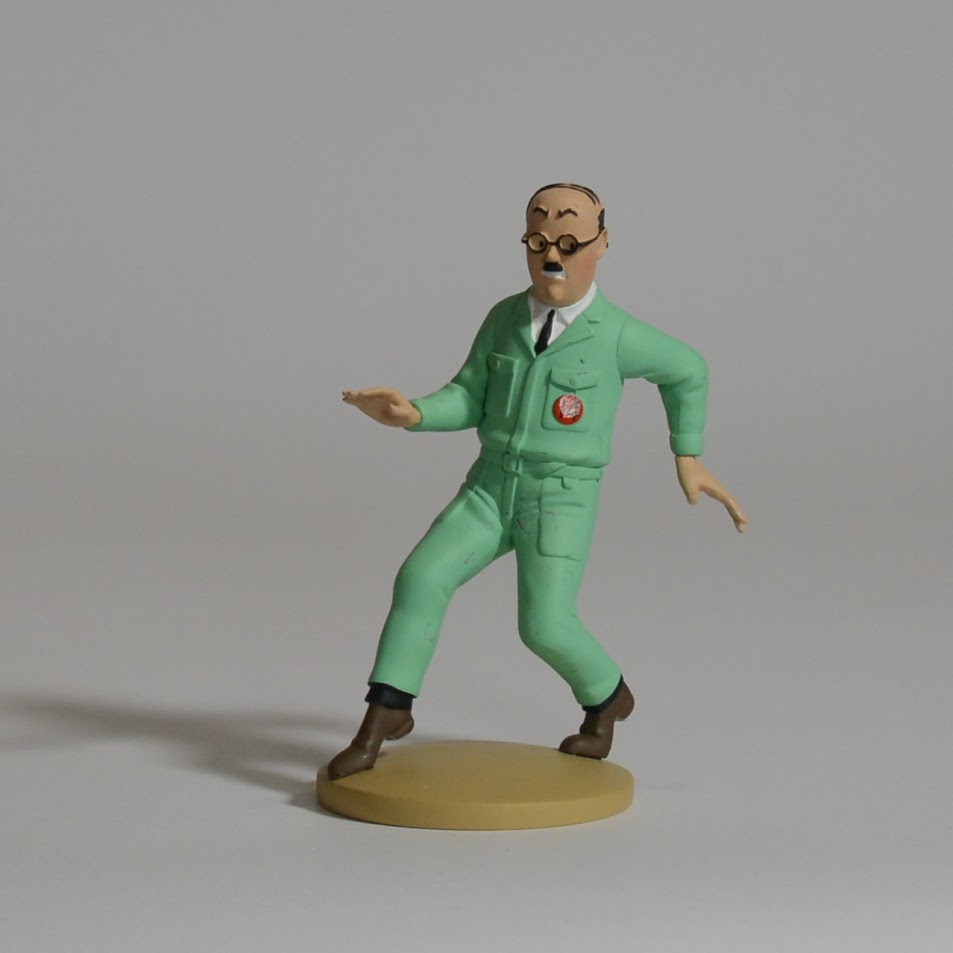
Frank Wolff The Treacherous Engineer – Figurines Tintin La Collection Officielle – 75 – Frank Wolff L’Ingénieur Félon
Author: Hergé & Editions Moulinsart
Price: £45.00
Publisher: Editions Moulinsart
Publication date: 2014
Format: Original pictorial boards with passport and figurine
Condition: In near fine condition
Illustrations: Illustrated throughout
Description:
Original pictorial boards. Includes passport loosely inserted. Text in French. Includes the accompanying figurine. One from the collection of 111 books and figurines. Very slight wear. In very near fine, clean condition overall.
Frank Wolff: A Short Biography
Frank Wolff is a central supporting character in Hergé’s Explorers on the Moon (On a marché sur la Lune, 1954) and Destination Moon (Objectif Lune, 1953). A brilliant but troubled scientist, Wolff is a rare example of genuine psychological depth in The Adventures of Tintin. His character introduces moral conflict, guilt, and redemption into a series more often governed by clear distinctions between good and evil.
Wolff’s story represents Hergé’s mature period, when the artist began exploring inner turmoil and ethical ambiguity. Through him, Hergé examines the pressures of scientific progress, the burden of conscience, and the human capacity for atonement.
Character Overview
- Full Name: Professor Frank Wolff
- Occupation: Physicist and engineer
- Affiliation: Sprodj Atomic Research Centre, Syldavia
- Nationality: Presumed German or Central European
- First Appearance: Destination Moon (Objectif Lune, 1953)
- Final Appearance: Explorers on the Moon (On a marché sur la Lune, 1954)
- Associated Characters: Professor Calculus (Cuthbert Calculus), Tintin, Captain Haddock, Colonel Boris Jorgen
- Personality Traits: Intelligent, conscientious, secretive, guilt-ridden, ultimately self-sacrificing
Background and Introduction
Frank Wolff is introduced as one of Professor Calculus’s key collaborators at the Sprodj Atomic Research Centre in Syldavia, where work is underway on an ambitious project: the construction of a nuclear-powered rocket capable of reaching the Moon.
From the outset, Wolff appears as a quiet, diligent, and likeable figure — a man of intellect and modesty who treats Tintin and Captain Haddock with warmth and respect. His scientific expertise, particularly in astrophysics and nuclear propulsion, makes him indispensable to the Moon expedition.
However, beneath his calm exterior lies a man struggling with guilt and fear — the result of a terrible mistake that will come to define his fate.
Role in the Narrative
- Destination Moon – The Visionary Engineer
In Destination Moon, Frank Wolff is portrayed as part of Professor Calculus’s trusted team. He oversees aspects of the rocket’s construction, guides Tintin and Haddock through the technical complexities of the project, and helps prepare the crew for the first manned lunar flight.
At this stage, he is a loyal and professional scientist, a figure of precision and discipline. His enthusiasm for the mission mirrors the optimism of post-war technological progress — Hergé’s reflection of the 1950s fascination with space exploration.
Wolff’s behaviour, however, hints at inner unease. His occasional hesitations and worried expressions foreshadow the secret he is concealing — a secret that will have catastrophic consequences.
- Explorers on the Moon – The Tragic Revelation
In Explorers on the Moon, Wolff’s internal struggle comes to the surface. It is revealed that he has been coerced into aiding a rival power — represented by Colonel Jorgen — who seeks to steal the rocket for espionage and military advantage.
Wolff’s betrayal is not born of malice but of blackmail. In his past, he had accumulated gambling debts and, in desperation, allowed himself to be manipulated by foreign agents. His guilt has haunted him ever since.
When Jorgen infiltrates the rocket during the Moon voyage, Wolff’s complicity is exposed. Overcome by shame and remorse, he confesses his involvement, and Hergé transforms him from a potential villain into a deeply human, tragic figure.
His remorse is sincere; he helps Tintin and Haddock regain control of the rocket and ultimately sacrifices himself to save the others.
Personality and Moral Complexity
Frank Wolff stands apart from the archetypal Tintin character because he is flawed. He embodies human weakness — the capacity to make catastrophic mistakes out of fear and temptation — and the courage to confront them with honesty.
Where Tintin represents moral certainty, and Haddock represents emotional spontaneity, Wolff represents the quiet, tormented conscience.
His qualities include:
- Intelligence and Precision: His scientific knowledge and technical competence are vital to the Moon expedition’s success.
- Integrity and Guilt: Despite his earlier betrayal, he is tormented by the weight of his wrongdoing and seeks redemption.
- Human Frailty: Wolff’s past weakness, exploited by others, reflects the vulnerability of intellect without moral strength.
- Courage and Self-Sacrifice: His final act transforms him into one of the most morally noble characters in the Tintin canon.
Thematic Analysis
- The Morality of Science
Wolff’s story reflects Hergé’s growing awareness of the ethical dilemmas surrounding scientific progress in the atomic age. The Sprodj project, powered by nuclear energy, embodies both the promise and peril of technology.
Wolff’s manipulation by spies serves as a warning: scientific discovery, if detached from moral conscience, can easily become a weapon.
His eventual repentance restores the link between intellect and morality — a theme that echoes Hergé’s broader concern with responsibility in an age of technological power.
- Redemption and Sacrifice
Wolff’s defining moment comes in his death. After helping Tintin, Haddock, and the crew reclaim control of the rocket, Wolff realises that their oxygen supply will not sustain everyone on the return journey.
In one of the most moving scenes in the entire Tintin series, Wolff silently accepts responsibility and opens the airlock, stepping into space. His final words — a calm farewell to Tintin and Haddock — reveal his inner peace at last.
This act of self-sacrifice redeems him completely. Hergé renders it not as melodrama but as a quiet, almost spiritual gesture. Wolff’s death elevates him from guilt-ridden man to tragic hero.
- Guilt and Conscience
Wolff’s psychological depth is remarkable for a Tintin story. He is driven not by greed or ambition but by remorse. Hergé presents guilt as both a punishment and a path to redemption — a human emotion that ennobles rather than destroys.
His inner conflict mirrors Hergé’s own introspective period during the early 1950s, when the artist wrestled with questions of morality, responsibility, and forgiveness.
Artistic and Psychological Representation
Hergé’s portrayal of Wolff demonstrates extraordinary emotional subtlety. The artist uses small visual cues — tired eyes, furrowed brows, nervous postures — to suggest Wolff’s mental turmoil long before his confession.
In his final appearance, floating away into space, Hergé conveys both horror and serenity through stillness and silence. The vastness of space becomes a metaphor for spiritual release — Wolff’s sins absorbed into the infinite.
It is one of the rare moments in the Tintin series where death carries emotional gravity and redemptive power.
Symbolism
Frank Wolff functions symbolically on several levels:
- The Flawed Modern Man: Brilliant yet fallible, Wolff represents the ethical struggles of post-war scientists faced with political manipulation and moral compromise.
- The Shadow of Progress: His past mistakes reflect the darker side of progress — ambition without morality, knowledge without restraint.
- Redemption through Sacrifice: His final act of selflessness transforms scientific guilt into spiritual purity, aligning him with Hergé’s recurring theme that moral integrity outweighs worldly success.
Moral and Emotional Impact
Wolff’s death marks a turning point in Hergé’s storytelling. It was one of the first times that the Tintin series confronted death directly — and compassionately. The scene stunned readers at the time, not only for its drama but for its quiet dignity.
Captain Haddock’s grief and Tintin’s solemn farewell underscore the sincerity of Wolff’s redemption. Hergé grants him the dignity of understanding — a respect rarely afforded to villains or flawed men in adventure fiction.
Psychological Interpretation
From a psychological perspective, Wolff’s narrative represents the archetype of atonement. His guilt propels him toward self-understanding; his sacrifice restores his moral balance.
Hergé’s treatment of his character reveals empathy for human weakness — a reflection of the artist’s own mid-life introspection during the creation of the Moon stories.
Through Wolff, Hergé demonstrates that the line between failure and virtue is not absolute: even those who fall may rise through conscience.
Cultural and Artistic Legacy
Frank Wolff’s story continues to resonate as one of the most emotionally mature episodes in The Adventures of Tintin. His portrayal prefigures the more psychologically nuanced characters of modern graphic novels.
In adaptations — notably the Hergé’s Adventures of Tintin animated series and radio dramatizations — Wolff’s death remains a pivotal and poignant moment.
Scholars often cite his storyline as evidence of Hergé’s evolution from light-hearted adventure toward humanist drama. His combination of intellect, guilt, and redemption places him among the most memorable figures in Tintin’s universe.
Summary
- Name: Professor Frank Wolff
- Occupation: Physicist, engineer, astronaut
- First Appearance: Destination Moon (1953)
- Final Appearance: Explorers on the Moon (1954)
- Personality: Intelligent, anxious, guilt-ridden, courageous
- Themes: Morality of science, guilt, redemption, sacrifice
- Symbolism: The conscience of modernity
- Fate: Sacrifices himself in space to save Tintin and the crew
Conclusion
Frank Wolff stands as one of Hergé’s greatest creations — a man who embodies both the brilliance and fragility of the human condition. His story transcends adventure and enters the realm of tragedy, demonstrating that moral courage can arise from the deepest guilt.
Through Wolff, Hergé achieved a synthesis of technical realism and emotional truth. His final act, stepping silently into space, remains one of the most haunting and noble moments in twentieth-century comic art — a testament to the idea that redemption, however late, is always possible.
Why Buy from Us?
At Hornseys, we are committed to offering items that meet the highest standards of quality and authenticity. Our collection of objects and rare books are carefully curated to ensure each edition is a valuable piece of bibliographical history. Here’s what sets us apart:
- Authenticity and Provenance: Each item is meticulously researched and verified for authenticity and collation.
- Expert Curation: Our selection process focuses on significance, condition, and rarity, resulting in a collection that is both diverse and distinguished.
- Customer Satisfaction: We aim to provide an exceptional customer experience, from detailed descriptions to secure and prompt delivery of your purchase.
- Returns Policy: We offer an unconditional guarantee on every item. If you wish to return an item, it may be sent back to us within fourteen days of receipt. Please notify us in advance if you wish to do so. The item must be returned in the same condition as it was sent for a full refund.
Cataloguer: Daniel Hornsey
Daniel Hornsey has specialised in fine and rare books, ephemera, and collectors’ editions for over thirty years. As a long-standing member of the antiquarian book trade, he has advised private collectors, curated catalogues, and sourced works for leading dealers, libraries and institutions across the world.
Hornseys’ exhibit regularly at book and map fairs in London and throughout the UK and are members of the Provincial Booksellers Fairs Association, the PBFA.
His fascination with Hergé’s work — especially ‘The Adventures of Tintin’ — began in childhood. Daniel recalls reading Tintin in original European editions and quickly recognising that these were not merely children’s books, but finely illustrated narratives crafted with artistic depth and wit.
As noted by the Musée Hergé in Louvain-la-Neuve, Hergé’s ‘ligne claire’ style has influenced generations of European comic artists and his original drawings and paintings command very high prices with his painting of ‘The Blue Lotus’ jar fetching £2.8m at auction in 2021.
By presenting these works through Hornseys’, he hopes to contribute to the continued appreciation of one of the 20th century’s most influential illustrators, helping new generations discover the artistry and legacy of Hergé.