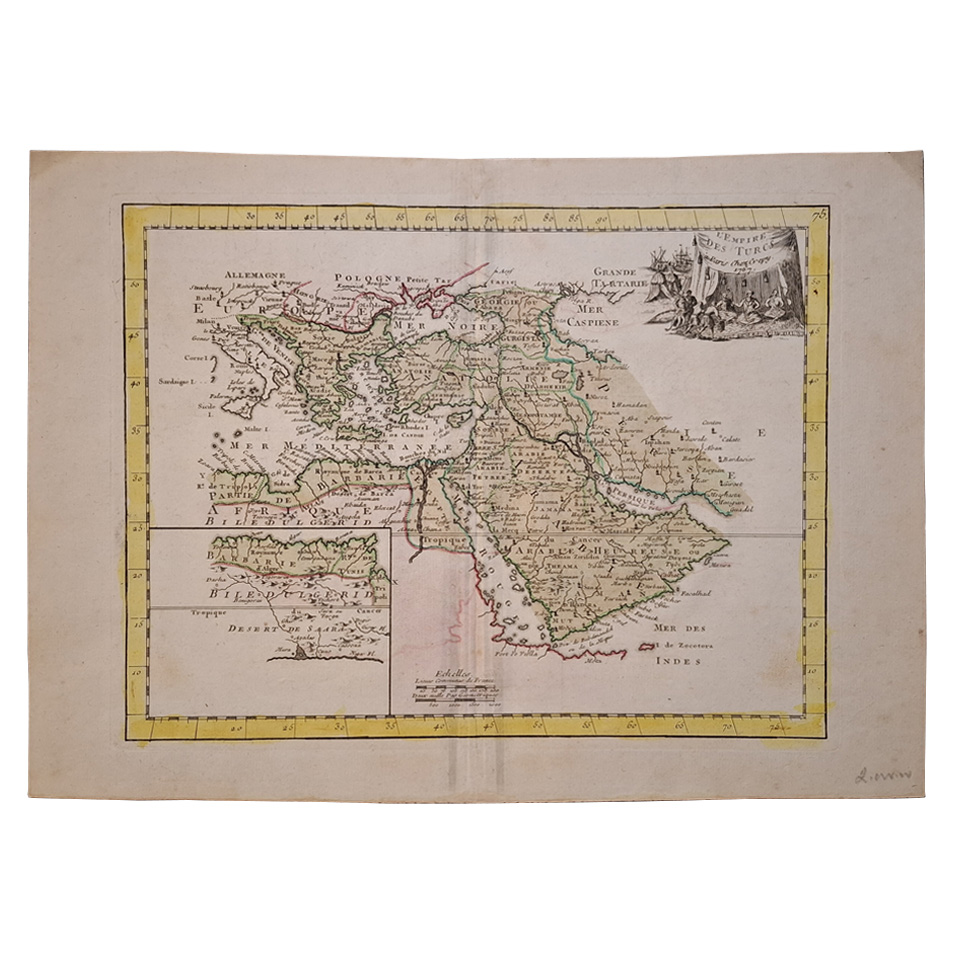
L’EMPIRE DES TURCS – ARABIA – ARABIAN PENINSULA – ARABIA DESERTA

Chez Crepy

£40.00

Availability: In stock

SKU LEMPDT1767 Categories , ,

Product Description

L’EMPIRE DES TURCS – ARABIA – ARABIAN PENINSULA – ARABIA DESERTA


Engraver: Henri Abraham Chatelain
Publisher: Chez Crepy
Price: £40
Publication Date: 1767
Edition: Not stated
Format: Original copper engraving
Condition: In near fine condition, unframed
Sheet Size: 35.2cm x 25.2cm

Condition:


Original central fold line. Minor age toning and offsetting. Later but not modern hand-colouring. In near fine condition overall. Shows the Arabian peninsula in detail. Scarce in this condition.

Location: Map Drawer C: FS: Folder M2000 002558

Chez Crepy: A Short History


Chez Crépy was a prominent publishing and engraving establishment based in Paris during the 18th century. Renowned for its contributions to cartography, art, and literature, the Crépy family played a vital role in the dissemination of knowledge and culture during the Enlightenment era. The firm was celebrated for producing high-quality maps, prints, and illustrated books that catered to the intellectual and artistic tastes of the period.

Origins and Establishment

The Crépy publishing house was founded by members of the Crépy family, who were deeply embedded in the artistic and intellectual circles of Paris. Their workshop was located in the city’s bustling publishing district, which was a hub for scholars, artists, and merchants. This advantageous location allowed the firm to engage with a wide audience and establish a reputation for excellence.

Specialisations

Chez Crépy became especially well known for its work in the following areas:

  1. Cartography:
    • The firm produced detailed maps and atlases that were prized for their accuracy and artistic quality. These works often reflected the latest geographic discoveries and advancements, appealing to explorers, merchants, and intellectuals.
    • Many of their maps were embellished with decorative cartouches, intricate borders, and illustrations, blending functionality with artistic flair.
  2. Engravings and Prints:
    • Chez Crépy excelled in the production of engraved prints, including portraits, landscapes, and depictions of historical events. These engravings were often commissioned by wealthy patrons or intended for sale to collectors and connoisseurs.
    • The workshop was also known for reproducing works of art, allowing a broader audience to access the masterpieces of renowned painters and illustrators.
  3. Illustrated Books:
    • The firm published a variety of books, many of which were richly illustrated with engraved plates. These included scientific treatises, historical accounts, and literary works, contributing to the spread of Enlightenment ideals.

Artistic and Cultural Impact

The publications and prints produced by Chez Crépy were highly regarded for their precision and beauty. The firm worked closely with skilled engravers and artists, ensuring that each piece met the highest standards of craftsmanship. Their output reflected the intellectual curiosity and artistic sensibilities of 18th-century France, making significant contributions to the era’s cultural landscape.

Legacy

Chez Crépy’s work remains highly valued by historians, collectors, and enthusiasts of 18th-century art and cartography. Their maps and prints serve as important historical documents, offering insights into the geographic knowledge, artistic trends, and cultural priorities of their time. The firm’s dedication to quality and innovation established it as a leading name in the Parisian publishing world, leaving an enduring legacy in the annals of French art and publishing history.

The Middle East In The Mid 18th Century: A Brief Account


The Middle East in the mid-18th century was a region marked by political fragmentation, shifting power dynamics, and cultural vibrancy. Stretching from Anatolia and the Levant to Persia and the Arabian Peninsula, it remained a vital crossroads for trade, diplomacy, and cultural exchange. The period was one of transition, with empires in decline, emerging powers asserting themselves, and local rulers navigating an increasingly complex geopolitical landscape.

Political Landscape

  1. The Ottoman Empire:
    • The Ottoman Empire was the dominant power in much of the Middle East, controlling Anatolia, the Levant, Mesopotamia, and parts of the Arabian Peninsula. However, by the mid-18th century, the empire was experiencing a period of stagnation and decentralisation.
    • Provincial governors and local leaders, such as the Mamluks in Iraq and the Druze in Lebanon, gained increasing autonomy, often challenging Ottoman authority.
    • Despite internal struggles, the Ottomans retained control over key cities like Damascus, Baghdad, and Mecca, which remained significant centres of trade, culture, and religion.
  2. Persia:
    • Persia was undergoing a turbulent period following the collapse of the Safavid dynasty in the early 18th century. The Afghan invasion of Isfahan in 1722 and the subsequent political instability left the region fragmented.
    • By the mid-18th century, Nader Shah, founder of the Afsharid dynasty, had risen to power. His military campaigns restored Persia’s territorial integrity and briefly expanded its borders, though his reign was marked by authoritarian rule and heavy taxation.
  3. The Arabian Peninsula:
    • The Arabian Peninsula was politically fragmented, with tribal confederations and local rulers dominating its interior. The Hijaz region, including Mecca and Medina, was nominally under Ottoman control but functioned with considerable autonomy.
    • The mid-18th century saw the rise of the Wahhabi movement in Najd, led by Muhammad ibn Abd al-Wahhab and supported by the Al Saud family. This alliance would later reshape the region’s religious and political landscape.
  4. The Levant and Egypt:
    • In the Levant, local leaders such as Emir Fakhr al-Din in Lebanon wielded considerable influence, while cities like Aleppo and Beirut flourished as centres of commerce.
    • Egypt, nominally an Ottoman province, was governed by the Mamluks, who operated with significant independence. The country remained a vital part of regional trade networks, connecting the Mediterranean with the Red Sea.

Economic Activity

  • Trade: The Middle East remained a key conduit for international trade, linking Europe, Asia, and Africa. Goods such as spices, silk, coffee, and textiles passed through its ports and caravan routes.
  • Agriculture: Agriculture was the backbone of local economies, with crops like wheat, barley, and dates being cultivated. Irrigation systems in Mesopotamia and the Nile Valley supported intensive farming.
  • Urban Centres: Cities such as Istanbul, Cairo, Baghdad, and Isfahan thrived as trade hubs, attracting merchants, artisans, and scholars.

Religious and Cultural Context

  • Islamic Centres: The Middle East was a heartland of Islamic culture, with cities like Mecca, Medina, and Najaf serving as religious centres. Pilgrimage routes brought together Muslims from across the Islamic world.
  • Cultural Flourishing: Despite political challenges, the mid-18th century was a period of cultural production. Persian literature, Ottoman architecture, and Arab calligraphy flourished, reflecting the region’s rich artistic traditions.
  • Religious Reform: Movements such as Wahhabism emerged during this time, seeking to return Islam to its foundational principles and challenging existing religious practices.

Challenges and Transformations

  1. European Influence:
    • European powers, particularly Britain and France, were becoming more interested in the Middle East due to its strategic location and economic potential. This interest laid the groundwork for future colonial ambitions.
  2. Decline of Central Authority:
    • The weakening of centralised powers, such as the Ottomans and Safavids, led to a rise in local autonomy and regional conflicts.
  3. Environmental and Economic Strains:
    • Periodic droughts, famines, and population pressures placed additional strains on the region’s economies and societies.

Legacy

The mid-18th century was a transitional era for the Middle East, characterised by both challenges and resilience. While the great empires of the region faced internal and external pressures, local cultures and economies continued to thrive in many areas. This period set the stage for the transformations of the 19th century, as the region increasingly interacted with European powers and grappled with modernisation and reform.

SHOP WITH CONFIDENCE AT HORNSEYS


At Hornseys, we are dedicated to offering items that uphold the highest standards of quality and authenticity. Our collection of artwork is carefully curated to ensure that each item we offer is authentic, collated, and complete.

Here’s what sets us apart:

  • Authenticity and Provenance: Each map is researched and verified for authenticity.
  • Expert Curation: We wholly own all our artworks. We trust our taste and have invested heavily in it. We have confidence in all artwork that we offer for sale.
  • Customer Satisfaction: We strive to provide an exceptional customer experience, from detailed descriptions and provenance to secure and prompt delivery of your purchase.
  • Returns Policy: We offer an unconditional guarantee on every item. If, however, you wish to make a return, artworks may be sent back to us within fourteen days of receipt for whatever reason. We request that we are notified in advance if you wish to do so. They must be returned to us in the same condition as they were sent for a full refund.

OUR COMMITMENT TO QUALITY AND SERVICE

Understanding the value and rarity of these items, we ensure that every aspect of your purchase meets the highest standards of quality and service. This includes:

  • Free Expedited, Tracked, and Insured Delivery within the UK: Ensuring that your artwork arrives safely and promptly.
  • Fully-Insured Worldwide Delivery: Offering peace of mind for international collectors with reliable and secure shipping options.

EXPLORE OUR COLLECTION

Visit Hornseys today to explore our fine collection of maps and other artworks. Whether you are an avid collector or looking for a special gift, our selection offers something truly unique. Located since 1976 in Ripon in the picturesque Yorkshire Dales, we are recognised as a destination gallery for tastefully curated artwork, rare maps, design, and fine books.