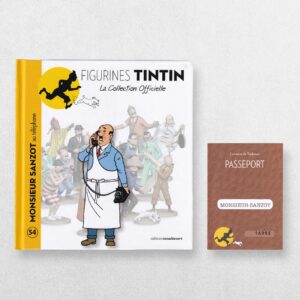
Mr Sakharine Raises His Bid – Figurines Tintin La Collection Officielle – 60 – Sakharine Surenchérit
Author: Hergé & Editions Moulinsart
Price: £70.00
Publisher: Editions Moulinsart
Publication date: 2013
Format: Original pictorial boards with passport and figurine
Condition: In near fine condition
Illustrations: Illustrated throughout
Description:
Original pictorial boards. Includes passport loosely inserted. Text in French. Includes the accompanying figurine. One from the collection of 111 books and figurines. Very slight wear. In very near fine, clean condition overall.
Mr Sakharine: A Short Biography
Mr Sakharine (originally Monsieur Sakharine in French) appears in The Secret of the Unicorn (Le Secret de la Licorne, 1943). Though a relatively minor character in the original album, he plays an important part in the narrative’s opening sequence and symbolises Hergé’s fascination with collecting, obsession, and the blurred line between innocence and suspicion.
In The Secret of the Unicorn, Mr Sakharine is a polite, somewhat eccentric art collector whose harmless passion for antiques and model ships becomes entangled in a web of mystery and intrigue surrounding Sir Francis Haddock’s ship, La Licorne.
Character Overview
Mr Sakharine is introduced as a quiet, well-dressed gentleman, bearded and bespectacled, with an air of refined eccentricity. His surname — “Sakharine” — derives from saccharine, meaning sweet, suggesting both politeness and a certain artificial charm.
Hergé drew him as the archetypal collector of the 1940s bourgeois class: urbane, enthusiastic about his hobbies, yet faintly self-important.
He is one of the participants in the opening auction and market scenes, competing for a model of La Licorne, unaware that Tintin’s identical purchase holds the key to a hidden treasure.
Role in The Secret of the Unicorn
The story begins when Tintin, browsing a street market, buys a model of an old sailing ship named La Licorne. Moments later, two men separately attempt to buy it from him — one of them is Mr Sakharine.
Sakharine’s request seems reasonable enough: he explains that he is a collector of such models and would like to acquire Tintin’s. Yet his eagerness, bordering on desperation, arouses suspicion. Tintin refuses to sell, setting off a chain of events that lead to theft, conspiracy, and the revelation of a centuries-old mystery.
As the plot unfolds, Tintin discovers that three identical models of La Licorne exist, each containing part of a coded message revealing the location of Captain Haddock’s ancestral treasure. Mr Sakharine owns one of these models — the second — while the third belongs to the villains, the Bird brothers, who are also seeking the treasure.
Although Tintin initially suspects Sakharine of being involved in the conspiracy, it is later revealed that he is entirely innocent — merely an unlucky bystander whose legitimate hobby intersects with criminal intrigue.
Personality and Traits
Mr Sakharine embodies a type that Hergé drew with both humour and sympathy: the eccentric collector.
- Polite and educated: He speaks formally, with old-fashioned courtesy.
- Passionate about antiques: His life revolves around collecting, restoration, and the preservation of maritime history.
- Inoffensive yet obsessive: His interest in his model ship borders on fixation, though never to a sinister degree.
- A figure of comic suspicion: Hergé plays on appearances — his dark glasses, beard, and intensity make him look like a villain, though he is not.
Sakharine’s character is a study in perception: he is guilty only of looking guilty.
Symbolic Meaning
Mr Sakharine’s brief role carries several layers of meaning, typical of Hergé’s storytelling precision.
- The Ambiguity of Appearances:
Hergé enjoyed misleading readers through visual suggestion. Sakharine’s sombre appearance contrasts with his benign intentions — a reminder that surface impressions can deceive. - The Collector as Mirror of the Artist:
Like Hergé himself, Sakharine is fascinated by objects, detail, and historical accuracy. He represents the aesthetic obsession that can border on mania — the impulse to catalogue, preserve, and control beauty. - A Reflection of Post-war Materialism:
The world of The Secret of the Unicorn is one of middle-class hobbies and possessions — markets, auctions, and private collections. Sakharine fits naturally into this world, embodying its civility and its quiet vanity.
Relationship with Tintin
Tintin’s encounter with Sakharine is polite but wary. Tintin, guided by instinct and habitually cautious of coincidence, finds the collector’s eagerness suspicious.
When Tintin’s model is later stolen, Sakharine becomes a prime suspect — yet Tintin’s sense of fairness leads him to investigate rather than accuse. Their eventual mutual respect reinforces Tintin’s moral consistency: he distrusts appearances and seeks truth through reason, not prejudice.
Artistic Depiction
Hergé’s rendering of Sakharine demonstrates his gift for character design through minimal means. A simple combination of beard, pince-nez glasses, and a slight stoop gives Sakharine his scholarly air. His clothing — a bowler hat, neatly cut coat, and gloves — signals refinement and restraint.
Visually, Sakharine anticipates later Hergé characters, such as Professor Calculus, in his mixture of eccentricity and dignity. The clean lines and balanced proportions of his figure give him a timeless quality, even amid the bustle of the market scenes.
Later Adaptations
In Steven Spielberg and Peter Jackson’s 2011 film adaptation, The Adventures of Tintin: The Secret of the Unicorn, Mr Sakharine is dramatically reimagined. Rather than a mild-mannered collector, he becomes the film’s principal villain — a descendant of Red Rackham, obsessed with avenging his ancestor and reclaiming the lost treasure.
This version fuses Sakharine with traits of other Tintin antagonists, notably Rastapopoulos and the Bird brothers, creating a single cinematic adversary. Though this deviates from Hergé’s original conception, it highlights the character’s latent potential for menace.
In Hergé’s canonical albums, however, Sakharine remains entirely innocent — a reminder of how appearances and reinterpretations can shift character meaning across media.
Legacy
Within the Tintin universe, Mr Sakharine stands as a minor but memorable example of Hergé’s psychological subtlety. In just a few pages, he embodies several of the artist’s recurring themes: the tension between obsession and innocence, the ambiguity of outward appearances, and the thin boundary between curiosity and greed.
He also plays an essential structural role in The Secret of the Unicorn: without his bidding at the market and his possession of a second model, Tintin might never have uncovered the mystery of Sir Francis Haddock’s treasure.
Thus, Mr Sakharine is both catalyst and counterpoint — an ordinary man inadvertently swept into an extraordinary adventure.
Summary
- Full name: Monsieur (Mr) Sakharine
- First appearance: The Secret of the Unicorn (1943)
- Occupation: Art collector and antique enthusiast
- Nationality: Presumably Belgian or French
- Traits: Polite, cultured, obsessive, visually imposing but harmless
- Role: Owner of one of the three model ships containing part of Sir Francis Haddock’s treasure map
- Symbolism: The double-edged nature of collecting — preserving history yet inviting obsession
- Film portrayal: Reimagined as the villain in The Adventures of Tintin (2011)
Conclusion
Mr Sakharine occupies a small but significant corner of Hergé’s universe. Polite, passionate, and faintly absurd, he represents the civilised face of obsession — a man who loves the past so deeply that he becomes trapped within it.
In The Secret of the Unicorn, his pursuit of a model ship mirrors Tintin’s pursuit of truth. Yet where Tintin’s curiosity liberates, Sakharine’s confines. He is not a villain, merely human — proof that in Hergé’s world, mystery and misjudgement often begin in the same place: a quiet fascination with something beautiful.
Why Buy from Us?
At Hornseys, we are committed to offering items that meet the highest standards of quality and authenticity. Our collection of objects and rare books are carefully curated to ensure each edition is a valuable piece of bibliographical history. Here’s what sets us apart:
- Authenticity and Provenance: Each item is meticulously researched and verified for authenticity and collation.
- Expert Curation: Our selection process focuses on significance, condition, and rarity, resulting in a collection that is both diverse and distinguished.
- Customer Satisfaction: We aim to provide an exceptional customer experience, from detailed descriptions to secure and prompt delivery of your purchase.
- Returns Policy: We offer an unconditional guarantee on every item. If you wish to return an item, it may be sent back to us within fourteen days of receipt. Please notify us in advance if you wish to do so. The item must be returned in the same condition as it was sent for a full refund.
Cataloguer: Daniel Hornsey
Daniel Hornsey has specialised in fine and rare books, ephemera, and collectors’ editions for over thirty years. As a long-standing member of the antiquarian book trade, he has advised private collectors, curated catalogues, and sourced works for leading dealers, libraries and institutions across the world.
Hornseys’ exhibit regularly at book and map fairs in London and throughout the UK and are members of the Provincial Booksellers Fairs Association, the PBFA.
His fascination with Hergé’s work — especially ‘The Adventures of Tintin’ — began in childhood. Daniel recalls reading Tintin in original European editions and quickly recognising that these were not merely children’s books, but finely illustrated narratives crafted with artistic depth and wit.
As noted by the Musée Hergé in Louvain-la-Neuve, Hergé’s ‘ligne claire’ style has influenced generations of European comic artists and his original drawings and paintings command very high prices with his painting of ‘The Blue Lotus’ jar fetching £2.8m at auction in 2021.
By presenting these works through Hornseys’, he hopes to contribute to the continued appreciation of one of the 20th century’s most influential illustrators, helping new generations discover the artistry and legacy of Hergé.