
New York Visitors Guide And Map Of The Greatest All-Year-Round Vacation City
New York Convention And Visitors Bureau
£40.00
Availability: In stock
Product Description
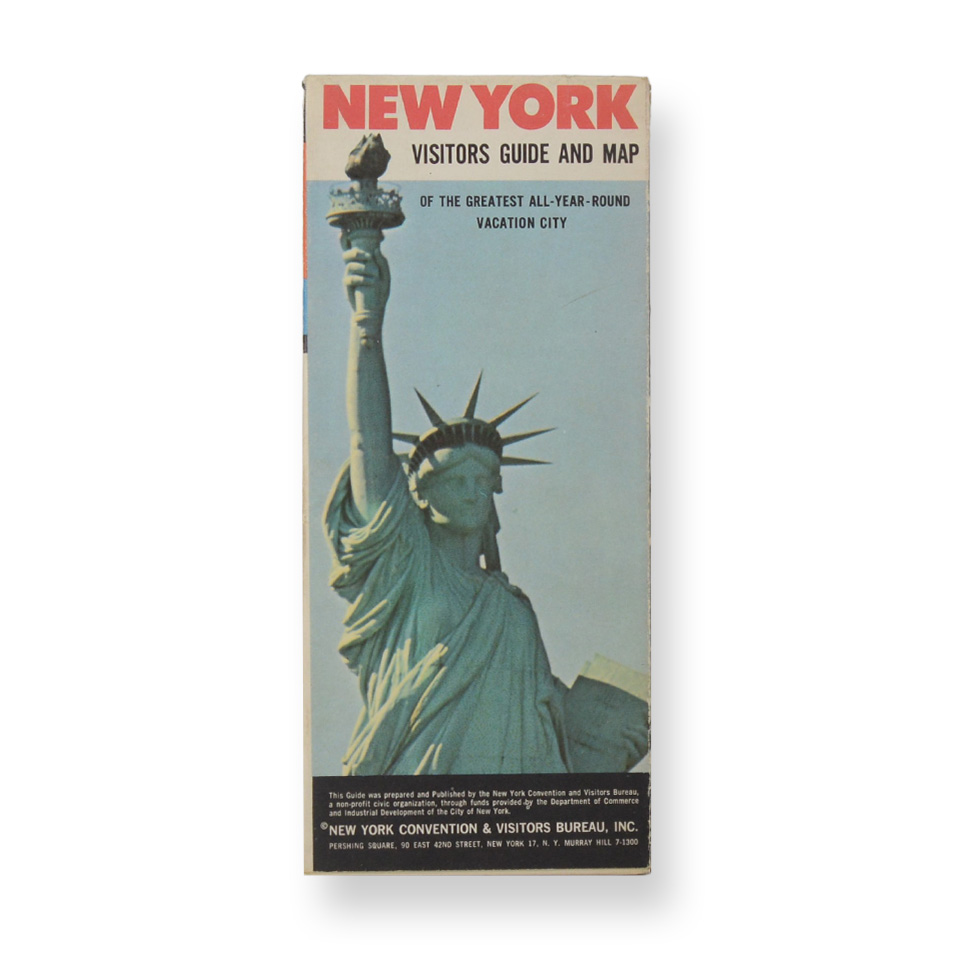
New York Visitors Guide And Map Of The Greatest All-Year-Round Vacation City
Publisher: New York Convention And Visitors Bureau
Price: £40 including postage in the UK
Publication Date: 1965
Edition: Not stated
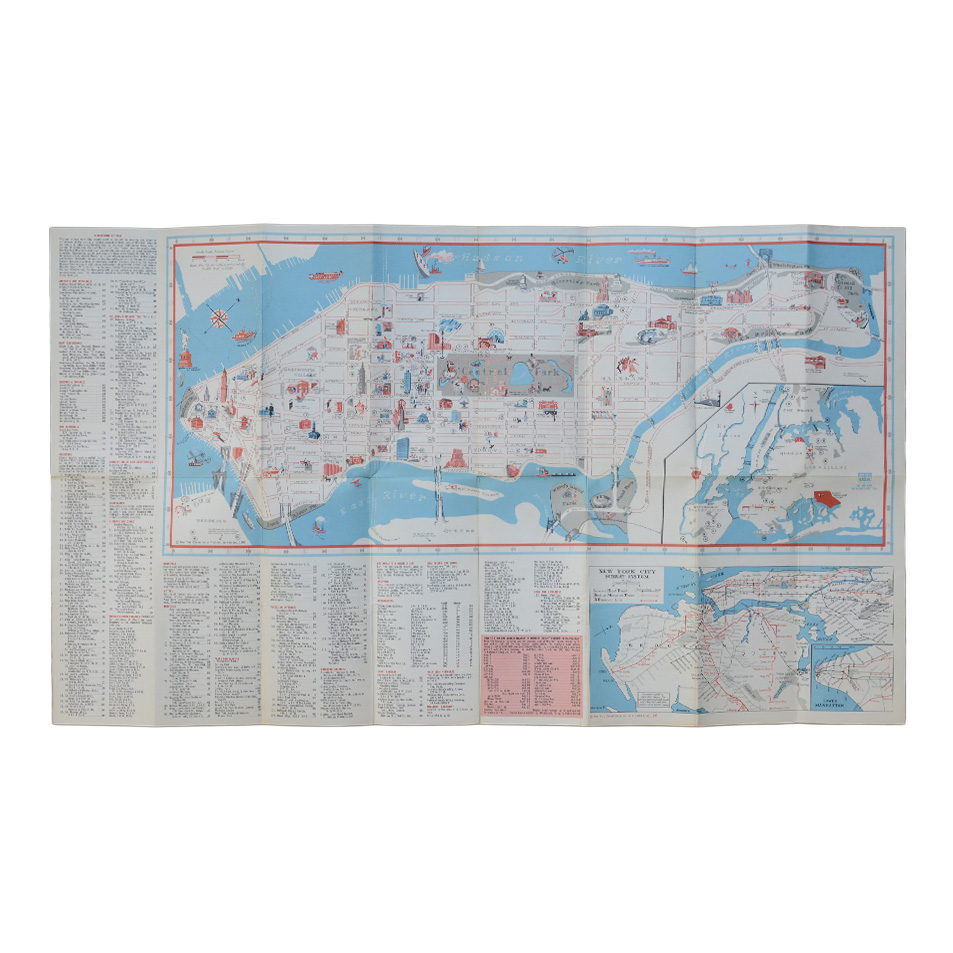
Sheet size: 75.8cm x 43.4cm
Binding: Original folding wrappers
Condition: Near fine
Condition:
Date: 1965. Folding map. Size when opened out: 75.8cm x 43.4cm. Map is bright and clean and in lovely condition. The reverse gives details of the attractions of the city along with information about ‘The Worlds Fair’ of 1964 and 1965. In near fine condition overall.
New York In 1965: A Brief Overview
In 1965, New York City stood at the midpoint of a turbulent yet culturally electric decade. It was a city of immense contrasts: artistic innovation set against urban decline; rising civil rights activism alongside political upheaval; and both extraordinary prosperity and worsening poverty. This year captures New York at a moment of profound transformation — socially, economically, and physically — as it prepared to enter the more challenging 1970s.
- Political and Administrative Context
Mayor John V. Lindsay’s Election
The key political moment of 1965 was the election of John V. Lindsay, a liberal Republican whose victory reflected a desire for reform. He campaigned on:
- Addressing racial inequality
- Improving transport and public services
- Combating corruption and bureaucratic inefficiency
Lindsay inherited a city facing significant financial and infrastructural strain.
Local Government Restructuring
1965 was also the year New York City consolidated various agencies, with expanding bureaucracy attempting to manage:
- Housing shortages
- Public health
- Traffic congestion
- Urban renewal schemes
Government institutions struggled to balance economic pressures with the needs of an increasingly diverse population.
- Demography and Social Composition
New York in 1965 was one of the world’s most populous cities, with over 7.7 million residents. Its character was defined by:
- Large African American and Puerto Rican communities, particularly in Harlem, the South Bronx, and Brooklyn
- Significant Jewish, Irish, Italian, and Greek populations, with established neighbourhoods
- A growing influx of Caribbean, Latin American, and Asian migrants
- Marked socio-economic differences between boroughs and within neighbourhoods
Segregation, though officially dismantled, persisted in housing, education, and employment.
- Civil Rights, Protest, and Social Change
1965 was a pivotal year for civil rights activism in New York:
- Rising tensions in Harlem and Bedford-Stuyvesant
- Growing support for the Civil Rights Movement, with local organisations campaigning for better housing and equal schooling
- The murder of Malcolm X in February 1965 at the Audubon Ballroom, an event that resonated globally and intensified political debate
- Activism among Puerto Rican and Latino communities challenging discrimination and poor living conditions
New York served as both a stage for national movements and a site of uniquely urban struggles.
- Economy and Work
Shifts in Industrial Employment
By 1965 the city’s traditional industrial base — including textiles, printing, and manufacturing — was beginning to decline:
- Factories moved to suburbs or the American South
- Automation reduced labour demand
- The waterfront, once a major employer, was shrinking due to containerisation and new shipping technologies
Unemployment rose in working-class neighbourhoods.
Rise of the Service and Corporate Economy
Simultaneously, New York was becoming a global financial and corporate hub:
- Wall Street grew in influence
- Madison Avenue led the advertising world
- Publishing, broadcasting, and design industries flourished
The economy was transitioning from manufacturing to services, shaping the city’s future trajectory.
- Urban Development and Infrastructure
Transportation
1965 New Yorkers navigated a city where:
- The subway system, built decades earlier, was beginning to show signs of neglect
- Traffic congestion surged with rising car ownership
- Major roadways constructed under Robert Moses cut through neighbourhoods, sparking community resistance
- John F. Kennedy Airport (renamed in 1963) was expanding into a major international hub
Transport was both a lifeline and a growing challenge.
Housing and Urban Renewal
Urban renewal, often controversial, transformed parts of the city:
- Demolition of “slum” districts dislocated thousands
- Public housing expanded, particularly in the Bronx and Brooklyn
- Gentrification was beginning faintly in Greenwich Village and parts of the Upper West Side
- The 1960s also saw early preservation battles, following the shock of Penn Station’s 1963 demolition
The built environment of 1965 New York was in constant flux.
- Culture, Art, and Intellectual Life
The Arts
New York in 1965 was a cultural superpower:
- Pop Art thrived under Andy Warhol, Roy Lichtenstein, and Claes Oldenburg
- The Beat generation influenced poetry and counterculture
- Abstract Expressionism still held sway, though being challenged by emerging movements
Neighbourhoods like SoHo, Greenwich Village, and the Lower East Side were vibrant centres for artists, musicians, and writers.
Music
1965 was a landmark year:
- Bob Dylan released Highway 61 Revisited and performed his first electric set, rupturing folk conventions
- The Beatles performed at Shea Stadium
- Jazz thrived in Harlem and the Village, with clubs hosting leading musicians
- Motown and soul music resonated across the city’s boroughs
- The seeds of later hip-hop culture were being planted in the Bronx through community gatherings and street sound systems
Cultural innovation permeated daily life.
Television and Film
New York was a national media capital, producing television networks’ flagship programmes and a growing independent film scene.
- Everyday Life and Urban Experience
New Yorkers in 1965 encountered:
- A city of noise, energy, and rapid movement, with crowded pavements, busy streets, and diverse languages
- High-rise living in Manhattan, contrasted with low-rise neighbourhoods in Brooklyn, Queens, and Staten Island
- Department stores, diners, delis, street vendors, and bustling markets
- Public parks — especially Central Park — offering respite from urban intensity
- Increasing crime rates, though far below the peaks of the 1970s
- Strong neighbourhood identities and community networks
Despite mounting social problems, many residents regarded the city as a place of opportunity and cultural richness.
- Significant Events of 1965
Key developments included:
- Blackout of 1965 (November): a major power failure affecting New York and the broader Northeast, remembered for the city’s largely calm response
- Completion of various high-rise office towers, reshaping Midtown
- Continued construction on cultural institutions such as Lincoln Center
- Ongoing protests concerning Vietnam, civil rights, and urban renewal
These events reflected a society grappling with change at multiple levels.
Conclusion
New York City in 1965 was dynamic, contradictory, and profoundly influential. It was:
- A centre of artistic revolution
- A battleground for civil rights
- A city teetering between post-war optimism and looming fiscal instability
- A global capital of finance, media, and culture
- A mosaic of communities navigating rapid social change
The year encapsulates New York not only as a place, but as a symbol of modernity, diversity, conflict, and creativity.
The Worlds Fair: A Brief Overview
The 1964–1965 New York World’s Fair, held at Flushing Meadows–Corona Park in Queens, was one of the most ambitious and memorable international exhibitions of the twentieth century. Although not officially sanctioned by the Bureau of International Expositions (BIE), it attracted over 50 million visitors and became a defining cultural event of mid-century America.
Its themes — technology, futurism, global cooperation, corporate innovation, and the promise of space-age modernity — captured the optimistic spirit of the post-war United States and showcased the complex interplay between commerce, culture, and politics in the 1960s.
- Background and Organisation
Robert Moses and the Vision for a Modern Fair
The fair was largely the creation of Robert Moses, New York’s powerful urban planner. He saw the event as:
- A means to finance and complete long-planned improvements to Flushing Meadows
- A new showcase for American technological and cultural achievement
- A way to position New York City as a global capital of innovation
However, Moses’s refusal to limit the fair to a single year and his insistence on revenue-based participation placed the event at odds with BIE regulations. As a result, many traditional fair-participants — most notably major Western European nations — declined to participate.
Dates and Structure
The fair ran in two seasons:
- First season: 22 April – 18 October 1964
- Second season: 21 April – 17 October 1965
Across its two years, the fair combined national pavilions, corporate showcases, state exhibitions, and cultural attractions.
- Overarching Themes
The official motto, “Peace Through Understanding,” reflected Cold War hopes for international cooperation.
The unofficial but widely recognised theme was the future — a future imagined through the lenses of:
- Space exploration
- Computer technology
- Modern architecture
- Industrial design
- Global mobility
- Consumer innovation
Many exhibits promised a world transformed by technological progress.
- The Unisphere — The Fair’s Icon
At the centre of the fairgrounds stood the Unisphere, a towering 12-storey stainless-steel globe designed by the United States Steel Corporation.
The Unisphere symbolised:
- The dawn of the space age
- Global interconnectedness
- American scientific leadership
It remains the most visible and enduring legacy of the fair and a landmark of Queens to this day.
- Major Pavilions and Attractions
United States Pavilion
A massive structure highlighting:
- Space programmes (Apollo missions were underway)
- Nuclear energy
- Advances in medicine, research, and engineering
- Cold War optimism and national achievement
New York State Pavilion
Designed by architect Philip Johnson, it included:
- The “Tent of Tomorrow” with a giant terrazzo map of New York State
- Three futuristic observation towers
It has become one of the fair’s most famous surviving structures.
Corporate Pavilions
These were among the fair’s greatest attractions, showcasing American consumerism at its mid-century peak.
- General Motors — “Futurama II”
A hugely popular ride predicting:
- Underwater cities
- Automated highways
- Space-age agricultural systems
- A highly engineered future world
- Ford — “Magic Skyway”
Designed partly by Walt Disney. Guests rode in actual Ford convertibles on a track system through scenes representing:
- The prehistoric world
- The dawn of humanity
- Visions of future progress
- IBM Pavilion
Designed by Eero Saarinen and Charles and Ray Eames, including the celebrated “Information Machine” and early demonstrations of computer technology.
- Bell System Pavilion
Displayed innovations in telecommunications, including touch-tone phones and satellite communication.
- Coca-Cola Pavilion — “It’s a Small World”
One of the fair’s most beloved attractions, created by Disney Imagineers, later moved permanently to Disneyland.
- International Participation
Although major European nations boycotted the fair, many countries did participate, including:
- Japan
- Thailand
- Vatican City
- Spain
- Jordan
- Morocco
- Mexico
- Philippines
The Soviet Union, locked in Cold War rivalry with the United States, also declined to take part.
Many international pavilions emphasised cultural heritage, tourism, and trade, set against themes of global unity.
- American States and Cities
Most U.S. states created their own exhibits, with particularly notable pavilions from:
- Texas
- Wisconsin
- Florida
- Illinois
- Alaska
These showcased regional culture, landscapes, and industry.
- Popular Culture and Entertainment
The fair offered a wide range of attractions:
- Broadway-style shows
- Film theatres with advanced projection techniques
- Restaurants serving global cuisines
- Rides, fountains, and sculptures
Disney played a major role, debuting technologies that would eventually become hallmarks of theme-park entertainment, including:
- Audio-animatronics (used in “Great Moments with Mr Lincoln”)
- Large-scale moving ride systems
- Immersive storytelling environments
- Social and Historical Context
Cold War and Space Race
The fair took place at the height of Cold War rivalry. Exhibits repeatedly emphasised:
- Space technology
- Nuclear power
- Communications advances
- Scientific research
The fair became a showcase for American soft power.
Civil Rights Era
The fair also unfolded during a period of significant civil rights activism. While the fair promoted “Peace Through Understanding,” protesters highlighted:
- Racial inequality in the United States
- The limitations of American freedom for minority communities
African American activists staged demonstrations, including the notable “stall-in” at the fair’s opening day in 1964, to draw attention to structural discrimination.
- Reception and Legacy
Public Response
Although economically mixed for organisers, the fair was enormously popular with the public, drawing tens of millions of visitors. It became a cherished memory for Americans who experienced its spirit of optimism.
Architectural and Cultural Legacy
Surviving elements include:
- The Unisphere
- The New York State Pavilion towers and shells
- Layouts of the fairgrounds still visible in Flushing Meadows–Corona Park
Its influence is felt in:
- Disney theme-park attractions
- Futurist architectural design
- American popular culture of the 1960s
- New York’s identity as a global city
Conclusion
The 1964–1965 New York World’s Fair was an ambitious, dazzling, and contradictory spectacle. It showcased the United States at the height of its mid-century confidence, celebrated technological progress, and projected visions of a harmonious, interconnected future. At the same time, it reflected the tensions of its era — civil rights conflicts, Cold War anxieties, and questions about the pace and direction of modern life.
Despite its financial shortcomings and political complications, the fair remains one of the most iconic cultural events of the twentieth century, remembered for its bold futurism, vivid pavilions, and the enduring symbol of the Unisphere.
Why buy from us?
At Hornseys, we are committed to offering items that meet the highest standards of quality and authenticity. Our collection is meticulously curated to ensure that each item is a valuable and authentic piece of history. Here’s what sets us apart:
- Authenticity and Provenance: Every item is researched, collated, and verified for authenticity.
- Expert Curation: Each item is selected with a keen eye for significance, condition, and rarity, ensuring a collection that is both diverse and distinguished.
- Customer Satisfaction: We strive to provide an exceptional customer experience, from detailed descriptions and provenance to secure and prompt delivery of your purchase.
- Returns Policy: We offer an unconditional guarantee on every item. If you wish to make a return, items may be sent back to us within fourteen days of receipt for any reason. We request advance notification of returns, and items must be returned in the same condition as sent for a full refund.
Explore Our Collection:
Visit Hornseys to explore our fine collection of rare and signed books, maps, artwork and objects. Whether you are an avid collector or looking for a special gift, our selection offers something truly unique. Located in the picturesque Yorkshire Dales, our Ripon gallery has been a haven for book lovers, art enthusiasts, and collectors since 1976.
Thank you for looking.
Related products

Berlin is Calling The World, Visit The City Of The Freedom Bell
£95.00Deutsche Zentrale Fur Frembenverkehr
Narrative Of The Kaffir War – 1850 – 1851 – 1852 – Facsimile Edition
£30.00Godlonton, R & Irving, Edward
The Vesey Club in Switzerland – Some Scattered Recollections of the Vesey Club Tour in Switzerland and Italy, September 1892 – A Souvenir – Henry Sturmey, with original photographs by Sir Benjamin Stone – Privately Printed, c.1893
£200.00(The Vesey Club) Sturmey, Henry & Stone, Sir Benjamin


You may also like…
(United States: New York and Pennsylvania) Carte De La Nouvelle Angleterre, Nouvelle Yorck Et Pensilvanie
£195.00Bellin, Jacques Nicolas

