
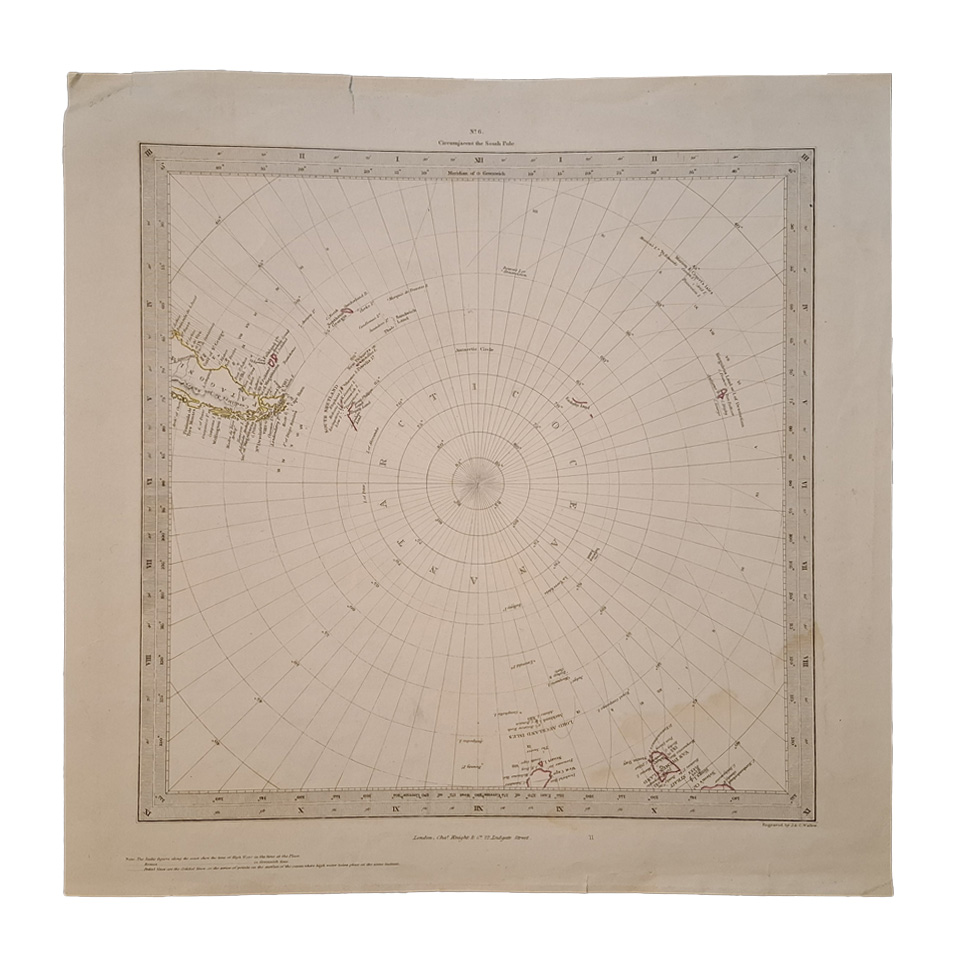
NO 6 – CIRCUMJACENT THE SOUTH POLE
The Society For The Diffusion Of Useful Knowledge & J & C Walker
£125.00
Availability: In stock
Product Description
NO 6 – CIRCUMJACENT THE SOUTH POLE
Engraver: J & C Walker
Publisher: C Knight & Co
Price: £125
Publication Date: Not dated but c.1842
Edition: Not stated
Format: Copper engraving
Condition: In very good condition, unframed
Sheet Size: 33cm x 33.6cm
Condition:
Original hand-colouring. Edition up to 1842 as Graham Land, Enderby Land, Sabrina land, La Terre Adele, Emerald Island and Balleny Island are shown. Ref: Tooley: 97. Short closed tears to upper and lower margins, not affecting the plate surface. Minor staining to bottom right hand corner. In very good condition overall. Scarce.
Location: Map Drawer C: FS: Folder M2000 002552
The Antarctic in 1842: A Short Account
In 1842, the Antarctic region was still largely unexplored and enigmatic, marked by a few bold expeditions and the growing interest of European powers in scientific exploration and geographical discovery. Key events and developments surrounding the Antarctic in that period include:
Exploration
- United States Exploring Expedition (1838–1842):
- Led by Lieutenant Charles Wilkes, this was a significant American venture into Antarctic waters.
- In January 1840, Wilkes claimed to have discovered a portion of the Antarctic mainland, now known as Wilkes Land. This contributed to the debate over whether Antarctica was a continent or a series of islands.
- James Clark Ross Expedition (1839–1843):
- A British expedition commanded by Captain James Clark Ross, famous for his exploration of the polar regions.
- In 1842, Ross was navigating Antarctic waters aboard the ships HMS Erebus and HMS Terror. His expedition mapped significant parts of the Antarctic coastline.
- Ross discovered the Ross Sea, the Ross Ice Shelf (which he called the “Victoria Barrier”), and Mount Erebus, an active volcano named after one of his ships.
- The Ross expedition was critical for its detailed scientific observations, including geomagnetic studies.
Scientific Interest
- The mid-19th century saw increasing emphasis on scientific inquiry. Expeditions were no longer solely focused on territorial claims or navigation but also sought to study magnetism, geology, and biology.
- Observations of the Earth’s magnetic field in polar regions were a particular focus, as part of the broader “Magnetic Crusade” linked to global scientific collaboration.
Challenges and Dangers
- Expeditions in the Antarctic were perilous, with ships battling extreme cold, icebergs, and pack ice.
- Navigators relied on rudimentary maps and instruments, making the icy waters treacherous.
Public Perception
- The Antarctic remained mysterious and forbidding in the public imagination. Accounts of these expeditions captured the attention of readers back home, fueling fascination with the icy wilderness and tales of adventure.
The year 1842 fits within a broader narrative of Antarctic exploration during the “Heroic Age,” preceding the well-known expeditions of figures like Ernest Shackleton and Robert Falcon Scott in the early 20th century.
The Society For The Diffusion Of Useful Knowledge: A Short History
The Society for the Diffusion of Useful Knowledge (SDUK) was a British organization established in 1826 with the mission to make affordable and accessible educational content available to the general public. It played a pivotal role in promoting literacy, self-education, and the spread of practical knowledge during a time of growing industrialization and social change.
Founding and Objectives
- Founded by Henry Brougham, a lawyer, politician, and later Lord Chancellor, the SDUK aimed to educate the working and middle classes.
- The society sought to provide reliable information on a variety of topics, including science, history, geography, and practical skills, to combat ignorance and improve societal conditions.
Publications
The SDUK is best known for its inexpensive and widely distributed publications, including:
- Penny Cyclopaedia (1833–1843):
- A cheap and concise encyclopaedia designed for the working class.
- Covered a wide range of subjects in an accessible format.
- Maps and Atlases:
- The SDUK produced highly regarded maps and atlases, offering geographical knowledge to a broad audience.
- Their maps were known for their accuracy and detail, even being sold well into the 19th century.
- Tracts and Pamphlets:
- Pamphlets on practical subjects such as mechanics, agriculture, and public health.
- Aimed to empower readers with knowledge for self-improvement and economic advancement.
Impact
- The society was instrumental in fostering a culture of education and self-improvement in Britain.
- It addressed the growing demand for knowledge among a population increasingly affected by industrialization and urbanization.
Challenges and Decline
- The SDUK faced financial difficulties due to the high cost of production and competition from other publishers.
- By the mid-19th century, its influence waned, and the society was dissolved in 1848.
- However, its legacy persisted in the form of similar educational initiatives and the broader movement for accessible education.
The SDUK reflects a broader 19th-century trend towards social reform and the democratization of knowledge, a precursor to modern public libraries and educational institutions.
SHOP WITH CONFIDENCE AT HORNSEYS
At Hornseys, we are dedicated to offering items that uphold the highest standards of quality and authenticity. Our collection of artwork is carefully curated to ensure that each item we offer is authentic, collated, and complete.
Here’s what sets us apart:
- Authenticity and Provenance: Each map is researched and verified for authenticity.
- Expert Curation: We wholly own all our artworks. We trust our taste and have invested heavily in it. We have confidence in all artwork that we offer for sale.
- Customer Satisfaction: We strive to provide an exceptional customer experience, from detailed descriptions and provenance to secure and prompt delivery of your purchase.
- Returns Policy: We offer an unconditional guarantee on every item. If, however, you wish to make a return, artworks may be sent back to us within fourteen days of receipt for whatever reason. We request that we are notified in advance if you wish to do so. They must be returned to us in the same condition as they were sent for a full refund.
OUR COMMITMENT TO QUALITY AND SERVICE
Understanding the value and rarity of these items, we ensure that every aspect of your purchase meets the highest standards of quality and service. This includes:
- Free Expedited, Tracked, and Insured Delivery within the UK: Ensuring that your artwork arrives safely and promptly.
- Fully-Insured Worldwide Delivery: Offering peace of mind for international collectors with reliable and secure shipping options.
EXPLORE OUR COLLECTION
Visit Hornseys today to explore our fine collection of maps and other artworks. Whether you are an avid collector or looking for a special gift, our selection offers something truly unique. Located since 1976 in Ripon in the picturesque Yorkshire Dales, we are recognised as a destination gallery for tastefully curated artwork, rare maps, design, and fine books.
Related products


You may also like…

PLAN DE LA BAIE DE LA CONCEPTION SITUEE DANS LE CHILI – ORIGINAL COPPER ENGRAVED MAP
£80.00de Galaup, Jean-François, Comte de La Pérouse


