
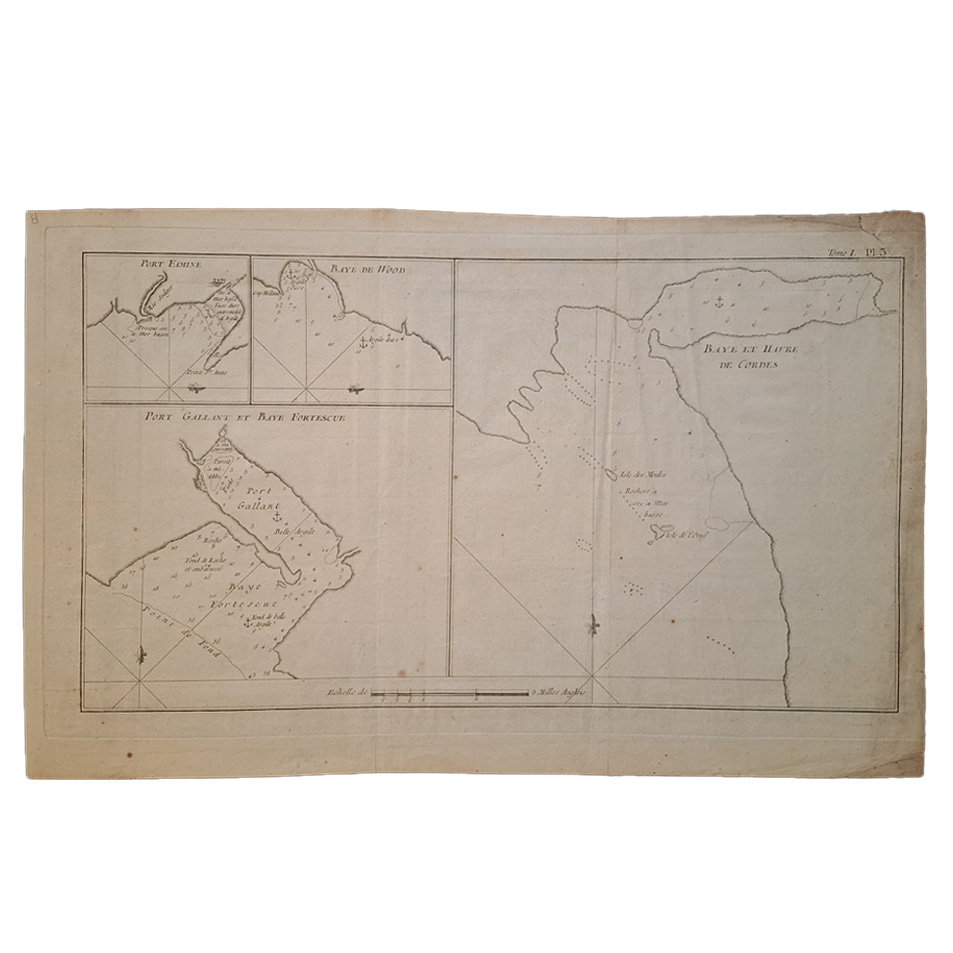
PORT FAMINE – BAYE DE WOOD – PORT GALLANT ET BAYE FORTESCUE – BAYE DE HAVRE DE CORDES – TOME I – PLATE 3
Byron, John
£30.00
Availability: In stock
Product Description
PORT FAMINE – BAYE DE WOOD – PORT GALLANT ET BAYE FORTESCUE – BAYE DE HAVRE DE CORDES – TOME I – PLATE 3
Cartographer: John Byron
Publisher: Not stated
Price: £30
Publication Date: circa 1774
Edition: 1st edition
Format: Copper engraving
Condition: In very good condition, unframed
Sheet Size: 41.3cm x 25.8cm
Condition:
Printed on undated water-marked paper. Original fold lines. Very minor age-spots. Archive repair to the top right-hand corner. Reverse is blank with very minor age toning and marks. In very good, original condition.
Location: Map Drawer C: FS: Folder M2000 002523
Chile in 1774: A Short Account
In 1774, Chile was part of the Spanish Empire, governed as a Captaincy General under the Viceroyalty of Peru. Its society, economy, and politics reflected the broader colonial structures of the Spanish Americas, shaped by indigenous heritage, European influence, and the challenges of maintaining control over distant territories.
Political Structure
Chile was administered by a Royal Governor, who acted as the representative of the Spanish Crown. The Captaincy General of Chile had a degree of autonomy due to its geographical isolation, but it was still subordinate to the Viceroy of Peru in Lima. Santiago was the administrative and cultural capital, where most political and economic decisions were made.
Geography and Strategic Importance
Chile’s rugged geography, characterised by the Andes Mountains to the east and the Pacific Ocean to the west, presented challenges to communication and transportation. Its long coastline made it strategically significant for Spain’s Pacific maritime interests, including the protection of valuable trade routes between South America, the Philippines, and Spain. Key ports, such as Valparaíso, were hubs of naval activity and commerce.
Indigenous Peoples
By 1774, the Mapuche people of southern Chile remained largely unconquered by the Spanish, despite centuries of conflict known as the Arauco War. The Mapuche’s resistance hindered Spanish expansion into the south and shaped the political and military dynamics of the colony. The Spanish authorities engaged in intermittent peace treaties, like the Parliament of Negrete in 1771, to stabilise relations with the Mapuche, although tensions persisted.
Economy
Chile’s economy in 1774 relied heavily on agriculture, mining, and trade. Large haciendas produced wheat, which was exported to Peru and other parts of the Spanish Empire. Mining, particularly of gold and silver, was an important industry, though on a smaller scale compared to the massive operations in Peru and Mexico. The wine industry was also growing, with Chilean wines gaining recognition across the empire.
Society
Colonial Chilean society was stratified, with Spaniards and Creoles (people of Spanish descent born in the Americas) at the top of the social hierarchy. Mestizos (of mixed European and indigenous heritage) and indigenous peoples formed the lower classes, often working as labourers or in servitude on haciendas. African slaves, though present, played a smaller role in Chile compared to other colonies.
The Catholic Church was a dominant force, shaping cultural and social norms while acting as an intermediary between the Crown and the local population. Missionaries played a crucial role in the spiritual and cultural assimilation of indigenous peoples, though this process often met with resistance.
Global Context
In 1774, the world was on the cusp of significant geopolitical shifts. While Chile was relatively insulated from these changes, the broader Spanish Empire was feeling the pressures of colonial administration, economic challenges, and rising tensions with other European powers, especially Britain. These strains would eventually affect all of Spain’s American colonies, including Chile, paving the way for independence movements in the 19th century.
Chile in 1774 was a colony balancing the challenges of indigenous resistance, geographical isolation, and its role in Spain’s global empire, while slowly evolving towards the unique identity that would define it in the centuries to come.
Port Gallant And Fortescue Bay: A Short Description
In 1774, Port Gallant and Fortescue Bay were significant natural landmarks along the Strait of Magellan, a crucial maritime passage linking the Atlantic and Pacific Oceans. Both locations were characterised by their rugged landscapes, marked by steep, forested cliffs and sheltered waters, providing vital harbours for explorers and seafarers navigating the challenging conditions of the strait.
Port Gallant in 1774
Port Gallant, located on the northern shore of the Strait of Magellan, was known for its natural harbour, offering a safe anchorage amidst the unpredictable weather of the region. The port’s sheltered waters and surrounding terrain made it an essential stop for ships seeking respite from storms or provisions during long voyages. In 1774, this area remained remote and largely unexplored, with limited Spanish presence despite the strategic importance of the strait. The Spanish Crown’s focus was primarily on securing and fortifying key points along the southern coasts to assert control over potential incursions by other European powers.
The region’s natural beauty and untamed wilderness made a strong impression on the few explorers and sailors who ventured there, with the surrounding snow-capped mountains and dense forests providing a dramatic backdrop.
Fortescue Bay in 1774
Fortescue Bay, situated west of Port Gallant, was another natural harbour along the strait. Known for its rich marine life, it was an area where early explorers and indigenous peoples could find abundant fish and other resources. In 1774, the bay would have been recognised primarily as a strategic point of shelter and resource collection for ships travelling through the strait. The bay’s location provided a natural waypoint for those navigating the complex waterways of the Patagonian coast.
Strategic Context
During this period, the Strait of Magellan was a contested and vital route for European powers. While Spain officially controlled the region, its remote and inhospitable environment made permanent settlement or extensive control challenging. British and other European exploratory expeditions occasionally ventured into the strait, probing its potential for trade routes and strategic advantage. The Spanish, aware of the potential threats, sought to maintain their claim over these waters through sporadic patrols and the establishment of key outposts further north.
The areas around Port Gallant and Fortescue Bay remained primarily untouched, their isolation preserving the pristine natural environments and challenging any consistent human presence. For sailors, these locations represented both the dangers and the rewards of navigating one of the world’s most treacherous waterways.
Vice Admiral The Hon. John Byron: A Brief Biography
Vice Admiral The Hon. John Byron, RN (1723–1786), was a distinguished officer in the Royal Navy and a prominent figure in 18th-century maritime history. Born on 8 November 1723, he was the second son of William Byron, 4th Baron Byron, and Lady Frances Berkeley. His noble lineage and naval career marked him as a man of significant standing, both in society and within the British military.
Early Life and Naval Career
John Byron entered the Royal Navy as a young boy, a common path for sons of the aristocracy seeking adventure and prestige. His early service was marked by rapid learning and adaptability, key traits in an era of expanding British naval power. In his teens, Byron served during the War of the Austrian Succession, gaining valuable experience in fleet operations and naval combat.
The Wager Mutiny and Survival
Byron’s name became widely known after his harrowing experiences as a midshipman aboard HMS Wager, part of Commodore George Anson’s squadron sent to circumnavigate the globe in 1740. After Wager was shipwrecked off the coast of Chile, Byron endured a catastrophic mutiny, extreme deprivation, and eventual capture by Spanish forces. His survival and return to England, recounted in his later memoirs, earned him the moniker “Foul-Weather Jack,” a nod to his apparent misfortune in encountering storms and disasters at sea.
Advancements in the Navy
Byron’s career continued despite the early setbacks. Promoted to lieutenant in 1746 and to captain by 1748, he commanded various vessels, showcasing his skill in navigation and leadership. His voyages took him across the Atlantic and the Caribbean, theatres of persistent conflict during Britain’s imperial expansion.
The Seven Years’ War
During the Seven Years’ War, Byron served with distinction, participating in operations that bolstered Britain’s maritime dominance. Notably, he commanded HMS America and took part in actions that secured vital colonies and trade routes. His tactical acumen and ability to maintain discipline under challenging conditions were widely respected.
Exploration and Discovery
In the early 1760s, Byron was appointed commander of an ambitious voyage of exploration in HMS Dolphin. Tasked with circumnavigating the globe, he charted territories in the Pacific, including the Tuamotu Archipelago and the Gilbert Islands. This expedition contributed significantly to Britain’s geographical knowledge and laid the groundwork for future explorers like James Cook. Byron’s charts and reports were crucial in asserting British influence in the Pacific.
Later Naval Service
Byron’s career culminated in senior appointments during the American War of Independence. As Vice Admiral, he commanded fleets in the Americas, where he contended with formidable opponents such as the French Admiral d’Estaing. While some operations were hindered by logistical challenges and adverse weather, Byron’s strategic efforts underscored Britain’s commitment to retaining its colonial holdings.
Personal Life and Legacy
John Byron married Sophia Trevanion in 1748, and the couple had several children, including George Gordon Byron, who would become the celebrated Romantic poet Lord Byron. The naval officer’s tales of peril and endurance undoubtedly influenced his grandson’s fascination with heroism and adventure.
Byron retired from active service in the mid-1780s, enjoying his remaining years in England. He passed away on 10 April 1786, leaving behind a legacy of exploration, resilience, and dedication to duty. Vice Admiral The Hon. John Byron’s life epitomised the spirit of 18th-century naval officers who navigated uncharted seas, faced overwhelming odds, and advanced Britain’s global standing.
SHOP WITH CONFIDENCE AT HORNSEYS
At Hornseys, we are dedicated to offering items that uphold the highest standards of quality and authenticity. Our collection of artwork is carefully curated to ensure that each item we offer is authentic, collated, and complete.
Here’s what sets us apart:
- Authenticity and Provenance: Each map is researched and verified for authenticity.
- Expert Curation: We wholly own all our artworks. We trust our taste and have invested heavily in it. We have confidence in all artwork that we offer for sale.
- Customer Satisfaction: We strive to provide an exceptional customer experience, from detailed descriptions and provenance to secure and prompt delivery of your purchase.
- Returns Policy: We offer an unconditional guarantee on every item. If, however, you wish to make a return, artworks may be sent back to us within fourteen days of receipt for whatever reason. We request that we are notified in advance if you wish to do so. They must be returned to us in the same condition as they were sent for a full refund.
OUR COMMITMENT TO QUALITY AND SERVICE
Understanding the value and rarity of these items, we ensure that every aspect of your purchase meets the highest standards of quality and service. This includes:
- Free Expedited, Tracked, and Insured Delivery within the UK: Ensuring that your artwork arrives safely and promptly.
- Fully-Insured Worldwide Delivery: Offering peace of mind for international collectors with reliable and secure shipping options.
EXPLORE OUR COLLECTION
Visit Hornseys today to explore our fine collection of maps and other artworks. Whether you are an avid collector or looking for a special gift, our selection offers something truly unique. Located since 1976 in Ripon in the picturesque Yorkshire Dales, we are recognised as a destination gallery for tastefully curated artwork, rare maps, design, and fine books.
Related products

St Helena – G.S.G.S. No. 1853A – Second Edition dated 1941 – Ordnance Survey Printing of 500 Copies – 1959
£495.00War Office / Geographical Section, General Staff & The Ordnance Survey


You may also like…
PLAN DE LA BAIE DE LA CONCEPTION SITUEE DANS LE CHILI – ORIGINAL COPPER ENGRAVED MAP
£80.00de Galaup, Jean-François, Comte de La Pérouse


