
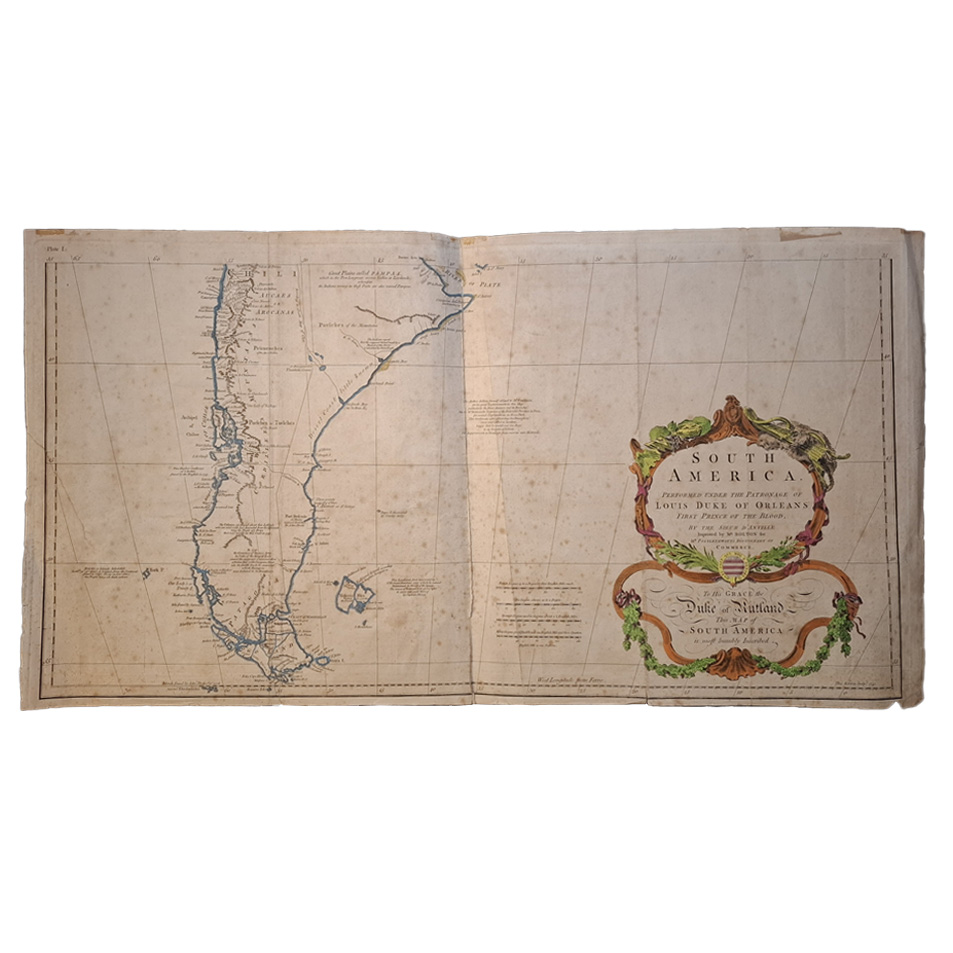
SOUTH AMERICA PERFORMED UNDER THE PATRONAGE OF THE DUKE OF ORLEANS FIRST PRINCE OF THE BLOOD BY THE SIEUR D’ANVILLE – PLATE I
Kitchin, Thomas
£50.00
Availability: In stock
Product Description
SOUTH AMERICA PERFORMED UNDER THE PATRONAGE OF THE DUKE OF ORLEANS FIRST PRINCE OF THE BLOOD BY THE SIEUR D’ANVILLE – PLATE I
Cartographer: Thomas Kitchin
Publisher: Not stated
Price: £50 (post-free in the UK)
Publication Date: 1755
Edition: Not stated
Format: Copper engraving
Condition: Good condition, unframed
Sheet Size: 80.2cm x 40.8cm
Condition:
Arguably the most accurate map of South America in the mid 18th century. Plate I only of three focussing on Chile, Patagonia and the Falkland Islands. Original fold lines. Age-spots, age-toning, minor wear and foxing to the plate. Early hand-colouring. Reverse is blank with age toning, marks and archive repairs. In good only condition overall.
Location: Map Drawer C: FS: Folder M2000 002559
Patagonia and Chile in The Mid 18th Century: A Brief Description
In the mid-18th century, Patagonia and Chile were remote and rugged regions at the southern tip of South America, marked by sparse population, challenging geography, and the influence of colonial ambitions. The territories were shaped by the interactions between indigenous peoples, Spanish colonial authorities, and European explorers, creating a complex tapestry of cultural and geopolitical dynamics.
Patagonia
- Geography and Environment:
- Patagonia, a vast region encompassing the southern parts of present-day Argentina and Chile, was characterised by its dramatic landscapes, including windswept plains, rugged mountains, and icy fjords. Its harsh climate and remoteness made it one of the least explored and settled regions during this period.
- Indigenous Peoples:
- Indigenous groups such as the Tehuelche and Mapuche inhabited Patagonia. They were semi-nomadic, relying on hunting guanacos, gathering, and fishing to sustain their livelihoods. The Tehuelche, in particular, were renowned for their knowledge of the land and their ability to adapt to its harsh conditions.
- While European contact with these groups was minimal in the mid-18th century, Spanish missionaries and explorers made sporadic attempts to engage with them, often with limited success due to resistance and the region’s inaccessibility.
- Exploration and European Interest:
- European explorers were intrigued by Patagonia’s location near key maritime routes, such as the Strait of Magellan. However, the region’s inhospitable environment and lack of obvious wealth dissuaded intensive colonisation.
- Stories of Patagonia’s “giants,” stemming from earlier European accounts, still persisted in the mid-18th century, contributing to the region’s mystique.
Chile
- Spanish Colonial Rule:
- Chile was an integral part of the Spanish Empire, governed as a captaincy general under the Viceroyalty of Peru. Santiago served as the administrative and cultural centre of the colony.
- The economy was largely agrarian, based on wheat farming, cattle ranching, and small-scale mining. Exports of wheat and other goods to Peru helped sustain the colony.
- Indigenous Resistance:
- The Mapuche people, who inhabited the region south of the Biobío River, fiercely resisted Spanish encroachment. The mid-18th century was a period of relative stability following the bloody Arauco War, which had defined earlier centuries.
- Peace accords between the Spanish and Mapuche leaders created a tenuous boundary at the Biobío River. While this arrangement allowed for some coexistence, tensions and skirmishes were ongoing.
- Cultural Life:
- Spanish colonial society in Chile was hierarchical, with peninsulares (Spanish-born elites) and criollos (colonial-born descendants of Spaniards) dominating the upper class. Mestizos and indigenous peoples formed the lower strata of society.
- Catholicism played a central role in daily life, with missions, churches, and religious festivals reinforcing the faith throughout the colony.
- Exploration and Maritime Interest:
- The Spanish were keen to secure Chile’s coastline, given its strategic importance near Cape Horn and the Pacific trade routes. Coastal settlements and fortifications were established to defend against potential threats, including incursions by other European powers.
Connections and Challenges
- Geopolitical Importance:
- The mid-18th century saw increasing European interest in South America, with rivalries between Spain, Britain, and other powers shaping regional dynamics. Patagonia and Chile were viewed as critical areas for maintaining Spanish dominance in the southern hemisphere.
- Harsh Environment:
- The challenging geography and climate of Patagonia and the southern reaches of Chile limited large-scale settlement and economic development. Only the hardiest explorers, settlers, and indigenous groups thrived in these environments.
- Scientific Exploration:
- The mid-18th century was part of the Age of Enlightenment, and European scientists and explorers began to show interest in studying Patagonia and Chile’s unique landscapes, flora, and fauna. These efforts laid the groundwork for future scientific expeditions in the region.
Legacy
By the mid-18th century, Patagonia remained a remote and sparsely populated frontier, while Chile was a more established colony under Spanish control. The interplay between indigenous resilience, colonial ambitions, and the challenges of the natural environment defined the region’s trajectory during this period. These dynamics would set the stage for future developments, including greater European exploration, the expansion of colonial boundaries, and eventual movements towards independence.
The Duke of Orleans, First Prince Of The Blood: A Short Biography
Louis Philippe I, Duke of Orléans (1725–1785) was a significant figure in 18th-century French aristocracy, known for his patronage of the arts and his role within the Bourbon dynasty. A scion of the House of Orléans, he held the title of First Prince of the Blood, placing him just below the direct heirs to the French throne in rank and privilege.
Early Life and Background
- Birth: Louis Philippe I was born on 12 May 1725 to Louis d’Orléans, Duke of Orléans, and Johanna of Baden-Baden. He was a member of one of the most prominent cadet branches of the French royal family, directly descended from Philippe I, Duke of Orléans, the younger brother of Louis XIV.
- Education: Like many nobles of his rank, he received a classical education befitting a prince of the blood, preparing him for a life of influence and cultural leadership.
Role at Court
- As Duke of Orléans, Louis Philippe I held significant ceremonial and social influence. However, by the mid-18th century, the power of the nobility had been curtailed under Louis XV and Louis XVI, leaving him with a primarily symbolic role.
- Despite this, he remained an important figure at court, engaging in diplomatic and cultural affairs and upholding the grandeur of his family’s status.
Cultural Patronage
- Louis Philippe I was an enthusiastic patron of the arts, continuing the tradition of his family. His court in Paris and at his estates was a centre of cultural activity, attracting artists, writers, and intellectuals of the Enlightenment.
- He supported architectural projects and artistic commissions, contributing to the flourishing of French culture during this period.
- The Duke was also an advocate for education and science, aligning himself with the progressive intellectual currents of his time.
Personal Life
- Marriage: Louis Philippe I married Louise Henriette de Bourbon-Conti in 1743, a union that further solidified ties within the extended Bourbon family. The marriage produced several children, including Louis Philippe II (later known as Philippe Égalité).
- Character: Known for his relatively private nature, Louis Philippe I avoided the political machinations and scandals that characterised many of his contemporaries.
Later Years and Legacy
- As the political climate in France became increasingly strained in the latter half of the 18th century, Louis Philippe I’s role remained largely ceremonial. However, his legacy was shaped through his son, Louis Philippe II, Duke of Orléans, who would play a controversial role during the French Revolution.
- Louis Philippe I died on 18 November 1785. He was succeeded by his son, Louis Philippe II, whose political actions and eventual execution during the Revolution profoundly affected the fortunes of the House of Orléans.
Significance
Louis Philippe I embodied the traditional role of an aristocrat during the waning years of the Ancien Régime. While he did not engage deeply in political affairs, his cultural contributions and the continuation of the Orléans line ensured that his family remained prominent during one of the most transformative periods in French history. His legacy was carried forward by his descendants, particularly his grandson, Louis Philippe, who became King of the French during the July Monarchy (1830–1848).
Thomas Kitchin: A Short Biography
Thomas Kitchin (1719–1784) was a highly regarded English cartographer and engraver of the 18th century, whose work greatly contributed to the period’s understanding of geography and cartographic techniques. Known for his precise engraving and innovative maps, Kitchin’s work encompassed a wide range of publications, including atlases, travel guides, and nautical charts.
Early Life and Training
Born in Southwark, London, Kitchin began his career as an apprentice to Emanuel Bowen, a renowned map engraver. Under Bowen’s mentorship, he developed the technical and artistic skills that would define his career. Kitchin’s apprenticeship laid a strong foundation for his future as one of the most prolific mapmakers of his time.
Professional Career
Kitchin quickly established himself as a leading cartographer and engraver. He collaborated with other notable figures in cartography, such as Thomas Jefferys, producing detailed and comprehensive maps and atlases. His works were celebrated for their clarity, precision, and decorative artistry, reflecting the Rococo style popular in 18th-century cartography.
Among his most influential collaborations was the production of “The Large English Atlas”, a detailed and ambitious project that charted the counties of England with remarkable accuracy. He also created maps for travel guides, such as “Kitchin’s Post-Chaise Companion,” which provided practical road maps and distances for travellers, enhancing accessibility to geographic information.
In 1773, Kitchin’s expertise was recognised when he was appointed hydrographer to King George III. In this role, he was responsible for creating nautical charts and contributing to Britain’s maritime navigation capabilities, a crucial endeavour during a time of expanding exploration and trade.
Artistic and Technical Contributions
Kitchin’s maps were notable for their intricate engraving, clear lettering, and elaborate cartouches. While his work often prioritised accuracy, it also included decorative elements that elevated his maps from functional tools to works of art. His style reflected the transition from earlier decorative traditions to the more scientific cartographic approaches of his time.
Personal Life
Kitchin married Sarah Bowen, the daughter of his mentor Emanuel Bowen, solidifying his ties within the cartographic community. In his later years, he lived in St Albans, where he continued his engraving work until his death in 1784.
Legacy
Thomas Kitchin’s work remains a significant contribution to the field of cartography, reflecting the scientific and artistic aspirations of the Enlightenment era. His maps and atlases not only provided practical navigation tools but also served as enduring examples of 18th-century cartographic artistry. Today, his works are highly valued by collectors and historians for their historical significance and aesthetic appeal.
SHOP WITH CONFIDENCE AT HORNSEYS
At Hornseys, we are dedicated to offering items that uphold the highest standards of quality and authenticity. Our collection of artwork is carefully curated to ensure that each item we offer is authentic, collated, and complete.
Here’s what sets us apart:
- Authenticity and Provenance: Each map is researched and verified for authenticity.
- Expert Curation: We wholly own all our artworks. We trust our taste and have invested heavily in it. We have confidence in all artwork that we offer for sale.
- Customer Satisfaction: We strive to provide an exceptional customer experience, from detailed descriptions and provenance to secure and prompt delivery of your purchase.
- Returns Policy: We offer an unconditional guarantee on every item. If, however, you wish to make a return, artworks may be sent back to us within fourteen days of receipt for whatever reason. We request that we are notified in advance if you wish to do so. They must be returned to us in the same condition as they were sent for a full refund.
OUR COMMITMENT TO QUALITY AND SERVICE
Understanding the value and rarity of these items, we ensure that every aspect of your purchase meets the highest standards of quality and service. This includes:
- Free Expedited, Tracked, and Insured Delivery within the UK: Ensuring that your artwork arrives safely and promptly.
- Fully-Insured Worldwide Delivery: Offering peace of mind for international collectors with reliable and secure shipping options.
EXPLORE OUR COLLECTION
Visit Hornseys today to explore our fine collection of maps and other artworks. Whether you are an avid collector or looking for a special gift, our selection offers something truly unique. Located since 1976 in Ripon in the picturesque Yorkshire Dales, we are recognised as a destination gallery for tastefully curated artwork, rare maps, design, and fine books.
Related products

CARTA DELL’AMERICA MERIDIONALE PER LA STORIA D’AMERICA – ORIGINAL COPPER ENGRAVED MAP
£75.00Kitchin, Thomas


You may also like…
(The Congo, Angola) Carte Des Royaumes De Congo, Angola Et Benguela Avec Les Pays Voisins Tire de L’Anglois
£65.00Bellin, Jacques Nicolas

