
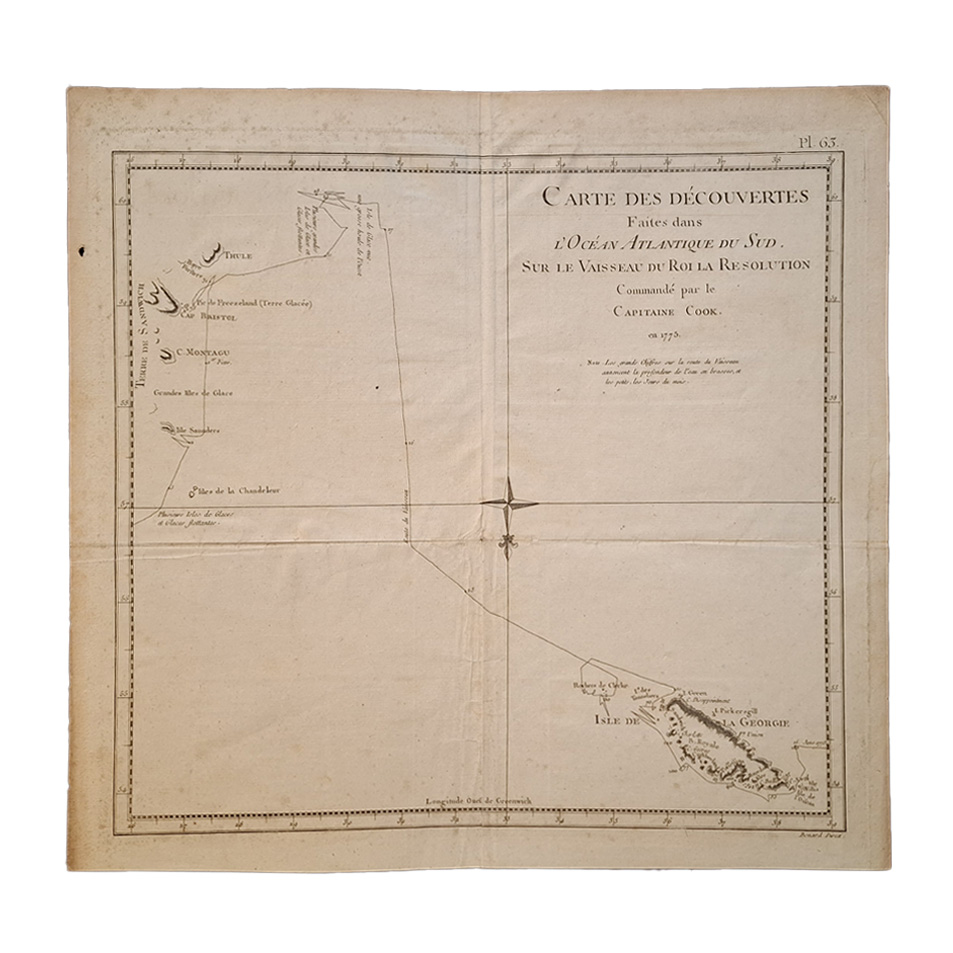
CARTE DES DÉCOUVERTES FAITES DANS L’OCÉAN ATLANTIQUE DU SUD SUR LE VAISSEAU DU ROI LA RÉSOLUTION COMMANDÉ PAR LE CAPITAINE COOK EN 1775: PLATE 63
Bénard, Robert
£145.00
Availability: In stock
Product Description
CARTE DES DÉCOUVERTES FAITES DANS L’OCÉAN ATLANTIQUE DU SUD SUR LE VAISSEAU DU ROI LA RÉSOLUTION COMMANDÉ PAR LE CAPITAINE COOK EN 1775: PLATE 63
Engraver: Robert Bénard
Publisher: Not stated
Price: £145
Publication Date: circa 1780
Edition: Presumed 1st edition
Format: Copper engraving
Condition: In very good condition, unframed
Sheet Size: 37.5cm x 35.9cm
Condition:
Shows The Sandwich Islands and South Georgia. Original fold lines. Minor age-spots and foxing. Remnants of old tabs to the upper margins of the reverse. Small hole to the left hand margin not affecting the map. Reverse is blank with very minor age toning and marks. In very good, original condition. Scarce.
Location: Map Drawer C: FS: Folder M2000 002524
South Georgia And The Sandwich Islands In 1775: A Short Description
In 1775, South Georgia and the South Sandwich Islands were officially discovered and charted during Captain James Cook’s second voyage aboard HMS Resolution. These remote islands, located in the South Atlantic Ocean, became significant not only for their geographic and scientific interest but also as key milestones in Cook’s exploration of the Southern Hemisphere.
South Georgia
South Georgia was sighted on 17 January 1775, during Cook’s return from the southern polar regions. He named the island in honour of King George III and claimed it for Britain. South Georgia is a rugged and inhospitable landmass, characterised by towering, glacier-clad mountains, deep fjords, and a harsh climate dominated by strong winds and freezing temperatures.
Cook’s expedition explored the northern coastline of the island, documenting its jagged shores and observing the abundant wildlife, including seals and seabirds. The detailed maps and descriptions made during this expedition provided valuable navigational information for future voyages.
South Georgia’s strategic location and rich marine resources, such as seals and whales, later made it a hub for whaling and sealing industries in the 19th and early 20th centuries. However, in 1775, it was recognised primarily as a remote and uninhabited island of great natural beauty and scientific curiosity.
South Sandwich Islands
Shortly after departing South Georgia, Cook sighted a series of smaller islands, which he named the South Sandwich Islands. These volcanic islands lie to the southeast of South Georgia and are even more remote and inhospitable. Cook observed their stark, icy landscapes and their active volcanic features, noting the challenges of navigating their treacherous waters.
Although the South Sandwich Islands were only partially charted due to poor weather conditions, Cook’s records provided the first documentation of this isolated archipelago. The volcanic nature of the islands hinted at the dynamic geological forces shaping the southern regions of the Atlantic Ocean.
Significance of the Discoveries
The discovery of South Georgia and the South Sandwich Islands was a major achievement of Cook’s second voyage, marking the northern extent of his exploration of the southern polar regions. These findings helped to disprove the myth of a vast, temperate southern continent (Terra Australis) and confirmed the existence of isolated landmasses surrounded by icy, inhospitable seas.
Cook’s meticulous observations and mapping of these islands were significant contributions to maritime navigation, aiding future explorers and whalers. Additionally, the wildlife Cook encountered underscored the rich biodiversity of the Southern Ocean, foreshadowing its importance in later ecological studies.
Robert Bénard: A Short Biography
Robert Bénard (1734–1777) was a prominent French engraver renowned for his meticulous work in the 18th century. Beyond his significant contributions to Diderot and d’Alembert’s Encyclopédie, Bénard played a crucial role in bringing Captain James Cook’s voyages to a French-speaking audience.
Engravings of Captain Cook’s Voyages
Bénard was responsible for re-engraving numerous maps and illustrations based on Captain Cook’s original works for the French editions of Cook’s travel journals. These editions included the Continuation de l’Histoire Générale des Voyages, where Bénard’s engravings provided detailed visual representations of the lands and peoples encountered during Cook’s expeditions.
Notable Works
Among his notable engravings are depictions of indigenous peoples from various regions explored by Cook. For example, Bénard created an engraving of a man from Tanna Island in Vanuatu, based on drawings by William Hodges, which was published in the 1778 French edition of Cook’s second voyage.
Additionally, Bénard’s engravings included detailed maps, such as the depiction of Port Praya on St. Jago Island, visited by Cook in 1772 during his second voyage.
Legacy
Through his engravings, Robert Bénard significantly contributed to the dissemination of knowledge about Captain Cook’s voyages among the French-speaking public. His work provided visual context to Cook’s narratives, enhancing the understanding of the diverse cultures and geographies encountered during these historic expeditions.
Captain Cook’s Second Voyage: A Brief Description
Captain James Cook’s second voyage (1772–1775) aboard HMS Resolution, accompanied by HMS Adventure under Commander Tobias Furneaux, was a groundbreaking expedition commissioned to explore the Southern Hemisphere. Its primary objective was to search for the hypothesised southern continent, Terra Australis, a landmass long believed by European geographers to exist in the southern regions to balance the Earth’s landmass. While this voyage disproved the existence of such a temperate continent, it yielded a wealth of discoveries that significantly advanced the knowledge of geography, oceanography, and natural sciences.
Key Discoveries and Achievements
- Antarctic Exploration:
- Cook’s expedition became the first to cross the Antarctic Circle, achieving this milestone on 17 January 1773. Despite encountering formidable ice barriers that prevented a clear view of the Antarctic mainland, the journey confirmed the harsh and inhospitable nature of the southern polar regions.
- Cook circumnavigated Antarctica without sighting the continent itself but provided conclusive evidence that no habitable southern continent existed beyond the latitudes he explored.
- South Georgia and South Sandwich Islands:
- In 1775, Cook discovered and charted the island of South Georgia, providing a detailed description of its icy, mountainous terrain. He claimed it for Britain, naming it in honour of King George III.
- Shortly after, he sighted the South Sandwich Islands, a group of uninhabited volcanic islands. These were partially surveyed due to poor weather, but Cook’s records marked their existence, contributing to later exploration.
- New Zealand and Polynesia:
- Although New Zealand had been charted during Cook’s first voyage, his second expedition revisited the area to refine the maps and better understand the region’s geography.
- Cook spent considerable time in Polynesia, where his interactions with indigenous peoples continued. He made further observations on their culture, navigation, and society, deepening European knowledge of Polynesian networks and migration.
- Exploration of the Pacific:
- Cook revisited regions such as Easter Island and the Marquesas Islands, documenting their geography with greater precision.
- He also explored the Friendly Islands (Tonga), which became one of the most detailed regions mapped during the voyage.
- Natural History and Scientific Contributions:
- The expedition carried a team of naturalists, including Johann Reinhold Forster and his son, Georg Forster, who documented the flora, fauna, and geology of newly explored regions.
- These observations enriched European knowledge of biodiversity and contributed to Enlightenment science, particularly the study of ecosystems and the classification of species.
- Navigation and Cartography:
- Cook’s second voyage advanced navigation through the use of the recently developed marine chronometer, which allowed for accurate longitudinal measurements. This innovation greatly improved the precision of maps and charts produced during the voyage.
- The meticulous mapping of islands, coastlines, and navigational hazards made the South Pacific safer for subsequent exploration and trade.
- Cultural Encounters:
- Cook’s interactions with indigenous communities in Polynesia, particularly in Tonga and Tahiti, provided insights into their social systems, customs, and traditions. These encounters were documented extensively by Cook and the Forsters, shaping European perceptions of these cultures.
Impacts of the Voyage
- Disproving Terra Australis: Cook’s second voyage dispelled the long-standing myth of a vast, temperate southern continent, a belief rooted in European geographical theories. Instead, it confirmed the existence of a largely uninhabitable Antarctic region surrounded by scattered islands and vast ocean.
- Geopolitical Implications: The discoveries reinforced British naval dominance and expanded British claims in the Southern Hemisphere. South Georgia and the South Sandwich Islands became significant for whaling and sealing industries in later years.
- Scientific Legacy: The expedition’s findings were celebrated for their contribution to Enlightenment science. The Forsters’ works on natural history, combined with Cook’s detailed charts and logs, became seminal references in both geography and biology.
- Navigational Advances: Cook’s use of advanced instruments, including the marine chronometer, set new standards for maritime navigation, influencing subsequent explorations.
Captain James Cook’s second voyage remains a testament to the spirit of exploration and scientific curiosity of the 18th century. It marked a turning point in understanding the Southern Hemisphere, combining courage, innovation, and meticulous observation to expand the boundaries of human knowledge.
SHOP WITH CONFIDENCE AT HORNSEYS
At Hornseys, we are dedicated to offering items that uphold the highest standards of quality and authenticity. Our collection of artwork is carefully curated to ensure that each item we offer is authentic, collated, and complete.
Here’s what sets us apart:
- Authenticity and Provenance: Each map is researched and verified for authenticity.
- Expert Curation: We wholly own all our artworks. We trust our taste and have invested heavily in it. We have confidence in all artwork that we offer for sale.
- Customer Satisfaction: We strive to provide an exceptional customer experience, from detailed descriptions and provenance to secure and prompt delivery of your purchase.
- Returns Policy: We offer an unconditional guarantee on every item. If, however, you wish to make a return, artworks may be sent back to us within fourteen days of receipt for whatever reason. We request that we are notified in advance if you wish to do so. They must be returned to us in the same condition as they were sent for a full refund.
OUR COMMITMENT TO QUALITY AND SERVICE
Understanding the value and rarity of these items, we ensure that every aspect of your purchase meets the highest standards of quality and service. This includes:
- Free Expedited, Tracked, and Insured Delivery within the UK: Ensuring that your artwork arrives safely and promptly.
- Fully-Insured Worldwide Delivery: Offering peace of mind for international collectors with reliable and secure shipping options.
EXPLORE OUR COLLECTION
Visit Hornseys today to explore our fine collection of maps and other artworks. Whether you are an avid collector or looking for a special gift, our selection offers something truly unique. Located since 1976 in Ripon in the picturesque Yorkshire Dales, we are recognised as a destination gallery for tastefully curated artwork, rare maps, design, and fine books.
Related products

NO 6 – CIRCUMJACENT THE SOUTH POLE
£125.00The Society For The Diffusion Of Useful Knowledge & J & C Walker
THE CARACAS – ORIGINAL COPPER ENGRAVED MAP
£250.00Drawn under the direction of Pinkerton, Mr John by L. Hebert.


You may also like…
PLAN DE LA BAIE DE LA CONCEPTION SITUEE DANS LE CHILI – ORIGINAL COPPER ENGRAVED MAP
£80.00de Galaup, Jean-François, Comte de La Pérouse


