
Related products

The Handy Series Of Pocket Maps – London And Four And Half Miles Round Charing Cross
£300.00George Philip & Son
Drayton, Michael
£145.00
Availability: In stock
Cartographer: Michael Drayton
Publisher: Marriott, Grismand and Dewe
Price: £145 including postage in the UK
Publication Date: 1622
Edition: First edition
Sheet Size: 34.2cm x 27.0cm
Condition: Good
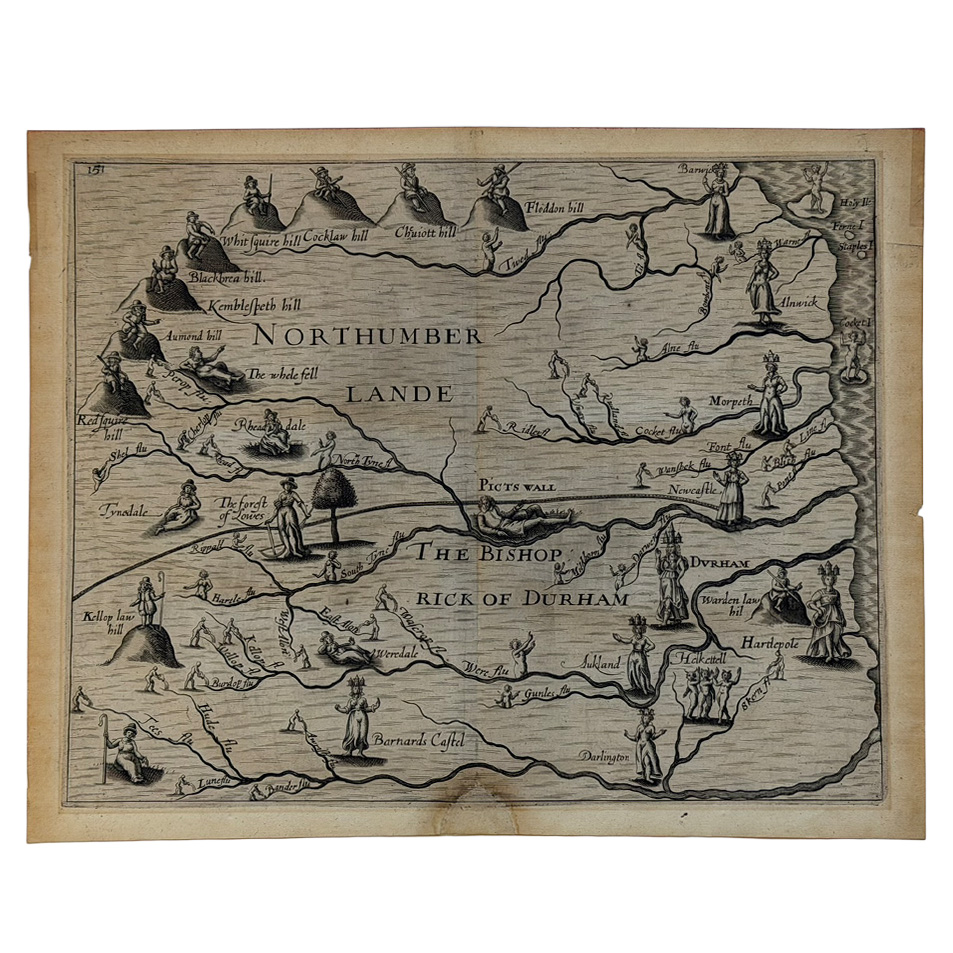
Original copper-engraved map from Poly-Olbion, one of the longest epic poems in the English language. Sheet size: 34.2cm x 27.0cm. Blank to the verso. Good margins but with some age toning and browning which is mainly confined to the margins. Archive restoration to the base of the central fold line which has been done some time ago. Scarce in any form and in good, clean condition overall.
Introduction
Michael Drayton was one of the most prolific and intellectually ambitious English poets of the late Elizabethan and early Stuart periods. A contemporary of Shakespeare, Ben Jonson, and Edmund Spenser, Drayton devoted his career to celebrating English history, landscape, and cultural identity. Although he never achieved sustained financial security, his body of work—particularly the monumental Poly-Olbion—represents one of the most comprehensive literary engagements with England as both a historical and geographical entity.
Early Life and Education
Michael Drayton was born in 1563, probably in Hartshill, Warwickshire, a rural area whose rivers, woods, and legends left a lasting imprint on his imagination. He came from modest circumstances, but his evident intellectual promise enabled him to benefit from aristocratic patronage, a necessity for literary advancement in the period.
As a young man, Drayton was educated in the household of Sir Henry Goodere of Polesworth, where he received a grounding in classical literature, rhetoric, and history. This informal but rigorous education fostered his lifelong ambition to create poetry that would rival classical epic while remaining rooted in English subject matter.
Early Literary Career
Drayton began publishing poetry in the late 1580s and early 1590s. His early works reveal both versatility and restlessness, as he experimented with a range of genres including pastoral poetry, historical verse, and narrative romance.
Among his early publications were:
From the outset, Drayton demonstrated a consistent interest in England’s past, seeking to legitimise English history as a subject worthy of sustained poetic treatment.
The Sonnet Sequence Idea
One of Drayton’s most enduring achievements is the sonnet sequence Idea, which he revised and expanded throughout his life. Unlike many Elizabethan sonneteers, Drayton did not abandon the form after its initial vogue; instead, he continually refined it.
The Idea sonnets are notable for:
Drayton’s approach reflects a classical sensibility, favouring craftsmanship and intellectual clarity over rhetorical excess.
Poly-Olbion and National Ambition
Conception and Scope
Drayton’s most ambitious work, Poly-Olbion, was published in two parts in 1612 and 1622. It consists of thirty lengthy “songs”, each devoted to a different region of England or Wales. The title suggests a vision of Britain as a land “richly blessed” in history, fertility, and cultural inheritance.
Method and Vision
In Poly-Olbion, Drayton fuses:
Rivers, hills, forests, and counties are personified and given voices, recounting battles, dynasties, local traditions, and ancient origins. The poem transforms landscape into narrative, presenting England as a living archive of memory.
Although demanding for readers, Poly-Olbion is unmatched in its scale and intellectual ambition. It represents one of the earliest attempts to imagine England as a coherent national space through literature.
Later Poetry and Changing Style
After the limited commercial success of Poly-Olbion, Drayton increasingly turned towards shorter lyric forms, producing some of his most admired late poetry. These works often focus on nature, imagination, and emotional reflection, displaying a lighter touch and greater accessibility.
His later poems show:
This phase demonstrates Drayton’s adaptability and confirms his mastery across poetic forms.
Personal Life and Character
Little is known with certainty about Drayton’s private life. He never married and remained financially dependent on patronage and literary income. Contemporary accounts suggest that he was widely respected for his learning, integrity, and dedication to his craft, even if he lacked the courtly flair of some of his peers.
Despite professional disappointments, Drayton maintained a strong sense of vocation. His career reflects sustained intellectual commitment rather than opportunism, and his revisions of earlier works indicate a lifelong pursuit of excellence.
Death and Burial
Michael Drayton died in 1631 in London. He was buried in Westminster Abbey, an honour that signifies his recognition as a national poet, even if his reputation later waned in comparison to some of his contemporaries.
Reputation and Legacy
Drayton’s standing declined after the seventeenth century, partly due to changing literary tastes and the formidable scale of Poly-Olbion. In modern scholarship, however, he is increasingly valued for:
Michael Drayton remains a singular figure: a poet who sought not merely to describe England, but to contain it—past, present, and imagined—within poetry itself.
At Hornseys, we are committed to offering items that meet the highest standards of quality and authenticity. Our collection is meticulously curated to ensure that each item is a valuable and authentic piece of history. Here’s what sets us apart:
Visit Hornseys to explore our fine collection of rare and signed books, maps, artwork and objects. Whether you are an avid collector or looking for a special gift, our selection offers something truly unique. Located in the picturesque Yorkshire Dales, our Ripon gallery has been a haven for book lovers, art enthusiasts, and collectors since 1976.
Thank you for looking.


George Philip & Son



| Cookie | Duration | Description |
|---|---|---|
| cookielawinfo-checkbox-analytics | 11 months | This cookie is set by GDPR Cookie Consent plugin. The cookie is used to store the user consent for the cookies in the category "Analytics". |
| cookielawinfo-checkbox-functional | 11 months | The cookie is set by GDPR cookie consent to record the user consent for the cookies in the category "Functional". |
| cookielawinfo-checkbox-necessary | 11 months | This cookie is set by GDPR Cookie Consent plugin. The cookies is used to store the user consent for the cookies in the category "Necessary". |
| cookielawinfo-checkbox-others | 11 months | This cookie is set by GDPR Cookie Consent plugin. The cookie is used to store the user consent for the cookies in the category "Other. |
| cookielawinfo-checkbox-performance | 11 months | This cookie is set by GDPR Cookie Consent plugin. The cookie is used to store the user consent for the cookies in the category "Performance". |
| viewed_cookie_policy | 11 months | The cookie is set by the GDPR Cookie Consent plugin and is used to store whether or not user has consented to the use of cookies. It does not store any personal data. |