Paul Bommer – Phrenology Head – Original Signed Limited Edition Screenprint – Number 12/45
Bommer, Paul
£200.00
Availability: In stock
Product Description
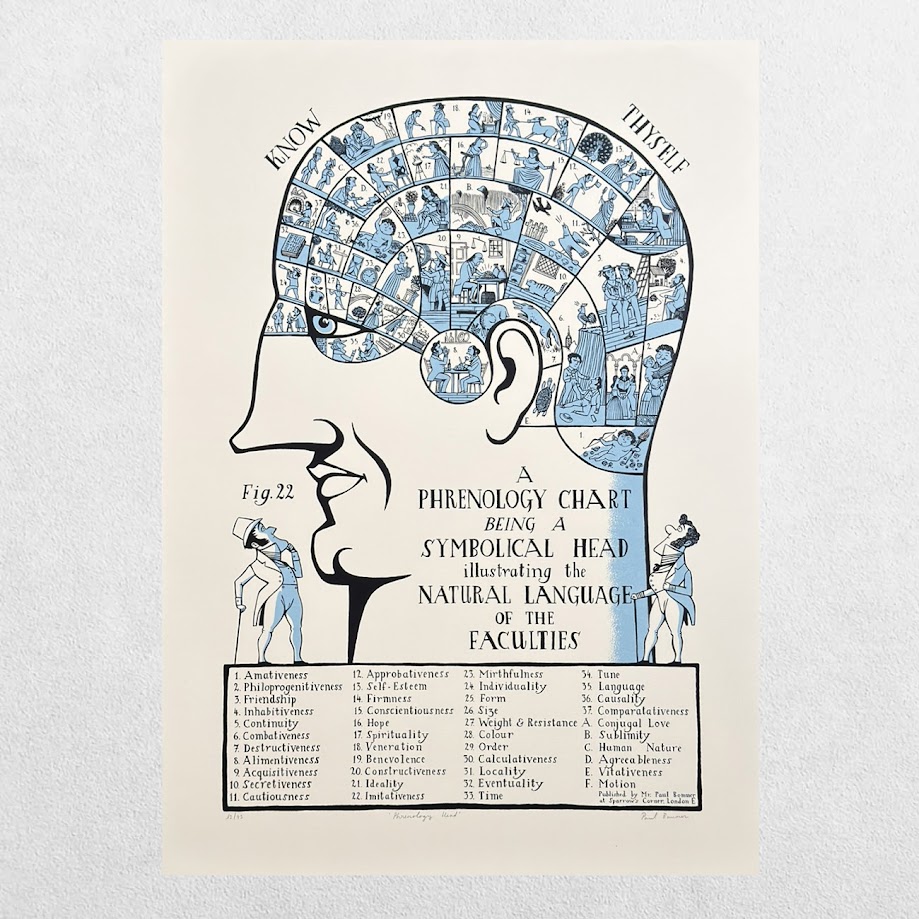
Paul Bommer – Phrenology Head – Original Signed Limited Edition Screenprint – Number 12/45
Artist: Paul Bommer
Title: Phrenology Head
Medium: Original two-colour screenprint
Paper: 300 gsm China White Colorplan paper
Edition: Limited edition of 45 impressions
This example: Number 12/45, signed by Paul Bommer
Sheet size: 50 × 70 cm (B2)
Format: Unframed; supplied carefully rolled for dispatch
Description
An original, signed and numbered limited-edition screenprint by British artist and illustrator Paul Bommer, inspired by the historical practice of phrenology and the elaborate anatomical diagrams that became popular during the nineteenth century. Entitled Phrenology Head, this striking original artwork presents Bommer’s distinctive interpretation of a traditional phrenological chart, combining historical scientific imagery with his characteristic graphic style, decorative precision and fascination with the visual culture of the past.
This example is number 12 of a strictly limited edition of just 45 impressions and is signed by the artist.
Printed in two colours on heavyweight 300 gsm China White Colorplan paper, the screenprint measures 50 × 70 cm (B2). Bommer draws upon the familiar visual conventions of antique phrenological illustrations, reinterpreting a historical subject through contemporary printmaking. The work belongs to his wider artistic exploration of traditional illustration, historical curiosities, folklore and the often eccentric beliefs and customs of previous generations.
Phrenology: The History Behind the Artwork
Phrenology was a system of thought that emerged in Europe during the late eighteenth century and became particularly fashionable during the nineteenth century. Developed principally from the theories of the German physician Franz Joseph Gall (1758–1828), phrenology proposed that different parts of the brain were responsible for distinct intellectual, emotional and behavioural characteristics. Its practitioners believed that these characteristics could be assessed by examining the external shape of the skull, including its supposed prominences and depressions. During the nineteenth century, phrenological charts became familiar images in books, lectures, advertisements and educational publications. Typically depicting a human head divided into numerous labelled regions, they purported to identify the physical locations of such qualities as benevolence, ambition, imagination, courage and memory. These illustrations became some of the most recognisable images associated with Victorian popular science.
Although phrenology was subsequently discredited and is now regarded as a pseudoscience, its diagrams remain important historical artefacts. They reveal much about nineteenth-century attempts to understand the human mind, categorise personality and connect physical appearance with behaviour. Phrenology also played a troubling role in the promotion of social and racial prejudices, reflecting the misuse of supposedly scientific theories to justify unequal treatment. Today, historical phrenological charts are studied principally for their significance in the history of medicine, psychology, popular science, graphic design and visual culture.
Paul Bommer’s Interpretation
Paul Bommer describes Phrenology Head as his own interpretation of a traditional phrenological chart.
The subject is particularly appropriate to his artistic practice, which frequently draws inspiration from historical engravings, early printed illustrations, folklore, mythology and traditional decorative design. Phrenological diagrams possessed a highly distinctive graphic character, combining anatomical representation with lettering, divisions and carefully arranged information. Their balance of visual complexity and apparent scientific order provides an intriguing starting point for Bommer’s work. By returning to this imagery through the medium of original screenprinting, Bommer creates a contemporary artwork that also recalls the aesthetic traditions of nineteenth-century illustrated books, educational charts and popular prints.
About Paul Bommer
Paul Bommer is a British artist, illustrator and printmaker recognised for his distinctive combination of historical references, intricate draughtsmanship, decorative imagery and irreverent humour. A graduate of the National College of Art and Design in Dublin, Bommer has developed an individual style informed by traditional illustration, British folklore, mythology, social history and the visual culture of everyday life. His work often incorporates animals, historical characters, elaborate lettering, symbolic imagery and ornamental details. These elements are combined to create compositions that are both visually striking and rich in narrative possibilities. Originally from London and formerly associated with the East End, Bommer subsequently established his studio practice in Norfolk.
His commissioned illustration work has included projects for the City of London’s Guildhall, The Guardian, Wired, Eye magazine and the Poetry Society. Alongside his illustration and design commissions, Bommer produces original limited-edition screenprints that explore subjects ranging from British regional traditions and literary figures to mythology, natural history and historical curiosities.
Condition and Presentation
Fine condition. The print is supplied unframed and will be carefully rolled and securely packaged in a protective postal tube for dispatch.
Why Buy From Hornseys?
Established in 1976, Hornseys is an independent family-run bookseller and gallery based in Ripon, North Yorkshire, with fifty years of experience in carefully selected books, maps, prints and collectable works of art.
Our collection of contemporary prints reflects a longstanding interest in distinctive illustration, original printmaking and artists whose work combines craftsmanship with historical and cultural significance.
When purchasing from Hornseys, you benefit from:
- Established expertise since 1976: Fifty years of independent bookselling, collecting and dealing in works on paper.
- Carefully selected artwork: We choose original prints for their artistic merit, quality, originality and collecting interest.
- Clear edition information: Signatures, edition numbers, printing methods, paper and dimensions are recorded wherever known.
- Research-led descriptions: Our cataloguing explains both the artwork and the historical or cultural subjects that inspired it.
- Individual attention: We aim to describe each item accurately, enabling customers to make informed purchasing decisions.
- Careful professional packaging: Original prints are securely protected and rolled for safe transit.
- Free UK tracked delivery: Included with your purchase.
- 14-day unconditional returns: Buy with confidence through our straightforward returns policy.