
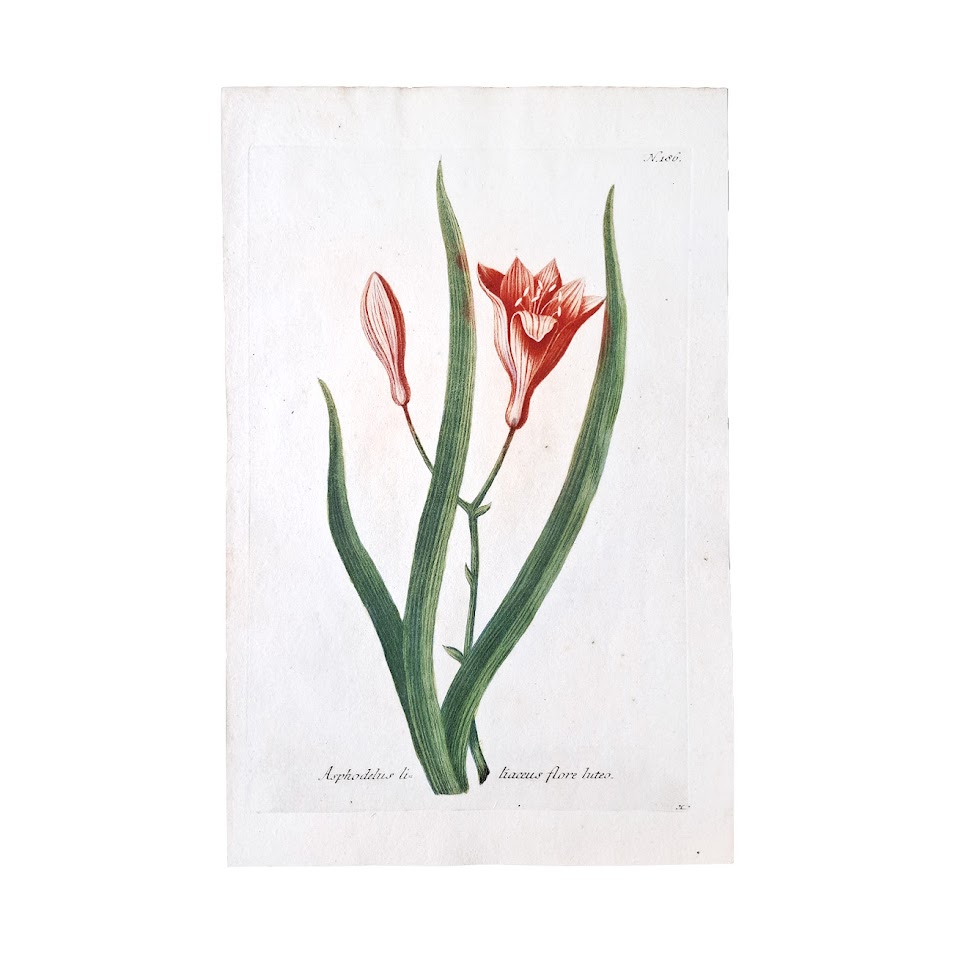
Phytanthoza Iconographia: Plate 186: Asphodelus Liliaceus Flore Luteo – Original Hand-Coloured Copper Engraving
Weinmann, Johann Wilhelm
£145.00
Availability: In stock
Product Description
Phytanthoza Iconographia: Plate 186: Asphodelus Liliaceus Flore Luteo – Original Hand-Coloured Copper Engraving
Publisher: Johann Wilhelm Weinmann
Price: £145
Publication Date: Not dated but 1737-1745
Format: Original hand-coloured copper engraving
Condition: In near fine condition, unframed
Sheet Size: Sheet Size: 37.7cm x 24.2cm
Condition:
Dating from 1737-1745, these are plates from ‘Phytanthoza Iconographia’, one of the most important botanical works of the 18th century. The illustrations for this florilegium were by Georg Dionysius Ehret and the engravings by Seuter and Ridinger. It is widely considered to be the first botanical work to use colour engraved prints. Very minor age toning else in near fine, bright, clean condition. A rare plate from this important work.
Location: Map Drawer B: Weinmann folder: 002056
Asphodelus: A Short Description
Asphodelus is a genus of flowering plants in the family Asphodelaceae, native to the Mediterranean region and parts of Europe. These hardy perennials are known for their tall, slender spikes of star-shaped flowers and long, narrow, grass-like leaves that form a basal rosette. The flowers, typically white, pink, or yellow, bloom in clusters along the spike and appear in spring or early summer.
Key Characteristics:
- Height: Ranges from 30 cm to over 1 metre, depending on the species.
- Flowers: Star-shaped, with six petals, usually white with a central stripe or occasionally pink or yellow.
- Leaves: Narrow, grass-like, and evergreen in mild climates.
Habitat:
Asphodelus species thrive in dry, rocky soils and are often found in meadows, hillsides, and coastal areas. They prefer full sun and well-drained soil, making them ideal for Mediterranean-style gardens or rock gardens.
Uses:
- Often grown as ornamental plants for their dramatic flower spikes.
- Historically significant in ancient Greek and Roman mythology, with associations to the afterlife and the underworld.
Common species include Asphodelus albus (white asphodel) and Asphodelus fistulosus (hollow-stemmed asphodel).
Johann Wilhelm Weinmann: A Short Biography
Johann Wilhelm Weinmann (1683–1741) was a German apothecary and botanical illustrator, best known for his ambitious botanical work “Phytanthoza Iconographia”, one of the first large-scale botanical publications to use colour printing techniques. His contributions to botanical science and art remain significant due to the precision and beauty of the illustrations in this monumental work.
Early Life and Career
Weinmann was born on March 13, 1683, in Gardelegen, Germany. Little is known about his early life and education, but it is believed that he trained as an apothecary. He later moved to Regensburg, where he established himself as a successful pharmacist and herbalist. His deep interest in plants, herbs, and their medicinal properties grew during his time working in this field.
Apothecary and Botanist
In Regensburg, Weinmann became a prominent figure within the city’s apothecary and botanical circles. He was appointed as an apothecary to the city and managed a successful pharmacy. His knowledge of medicinal plants led him to compile information on various species, both local and exotic, and their medicinal uses. His desire to document plants in a comprehensive way led to the creation of his “Phytanthoza Iconographia”, an illustrated botanical text that would become his life’s work and enduring legacy.
Phytanthoza Iconographia
Between 1737 and 1745, Weinmann published “Phytanthoza Iconographia”, a multi-volume botanical work that contains over 1,000 hand-coloured engravings of plants. The project was highly ambitious, and it became one of the first large botanical works to use colour printing methods, specifically mezzotint, to produce vivid, life-like representations of plants.
- The work was executed by multiple artists and engravers under Weinmann’s direction. Notable among them were Georg Dionysius Ehret, who later became one of the most famous botanical illustrators of the 18th century, and Bartholomäus Seuter. Ehret contributed many of the early plates, but after a dispute with Weinmann, he left the project.
- Phytanthoza Iconographia featured plants from Europe as well as species newly discovered in the Americas and Asia, making it a valuable resource for both scientists and horticulturists of the time. The illustrations were praised for their accuracy and artistic quality, helping to advance the knowledge of botany and horticulture during a period of rapid exploration and scientific discovery.
Contributions to Science and Art
Weinmann’s work was notable for its detailed and systematic approach to documenting plants. It provided a comprehensive guide to plant taxonomy, using illustrations to aid in the identification of species. The combination of scientific rigour and artistic achievement in Phytanthoza Iconographia made it a key reference for botanists and gardeners throughout Europe.
The book also marked a significant advancement in the printing industry. The use of colour mezzotint—a technique that allowed for richer and more nuanced colour in printed images—was revolutionary at the time, and the accuracy of the plant depictions influenced botanical illustration for generations.
Personal Life and Legacy
Johann Wilhelm Weinmann passed away on March 1741, before the completion of his magnum opus. However, his work continued to be published posthumously, and it remained highly regarded in both botanical and artistic circles. Weinmann’s legacy lies in his pioneering approach to botanical illustration and his role in advancing the understanding of plant species and their medicinal properties. Phytanthoza Iconographia remains a valuable historical document and is still admired today for both its scientific importance and its aesthetic appeal.
Why Buy from Us?
At Hornseys, we are committed to offering items that meet the highest standards of quality and authenticity. Our collection of rare hand-coloured engravings is meticulously curated to ensure that each piece is both a valuable and authentic addition to your collection. Here’s what sets us apart:
- Authenticity and Provenance: Every engraving is thoroughly researched and verified for authenticity.
- Expert Curation: We select each piece with an eye for historical significance, condition, and visual appeal.
- Customer Satisfaction: We strive to provide an exceptional customer experience, from detailed descriptions to secure and prompt delivery.
- Returns Policy: We offer an unconditional guarantee on every item. If you wish to make a return, any item may be sent back to us within fourteen days of receipt for any reason. We request advance notification of returns, and items must be returned in the same condition as sent for a full refund.
Explore Our Collection:
Visit Hornseys to explore our fine collection of original hand-coloured engravings by Johann Wilhelm Weinmann. Located in the picturesque Yorkshire Dales, our Ripon gallery has been a haven for art lovers and collectors since 1976.
Related products

Phytanthoza Iconographia: Plate 961: Tagetes Indica – Original Hand-Coloured Copper Engraving
£295.00Weinmann, Johann Wilhelm
Phytanthoza Iconographia: Plate 753: Nasturtium Indicum – Original Hand-Coloured Copper Engraving
£295.00Weinmann, Johann Wilhelm
Phytanthoza Iconographia: Plate 418: Convolvulus Siculus And Convolvulus Flore – Original Hand-Coloured Copper Engraving
£145.00Weinmann, Johann Wilhelm


You may also like…
Phytanthoza Iconographia: Plate 834: Primula Alpina – Original Hand-Coloured Copper Engraving
£195.00Weinmann, Johann Wilhelm


