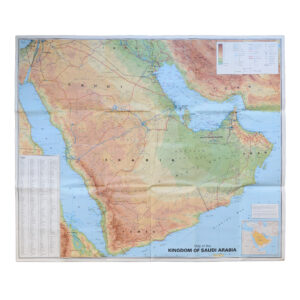
(Saudi Arabia) – The Arabian Peninsula – A Stylized View
Aramco & Thompson, Don
£75.00
Availability: In stock
Product Description
(Saudi Arabia) – The Arabian Peninsula – A Stylized View
Publisher: Aramco
Price: £75 including postage in the UK
Publication Date: 1980
Edition: First Edition
Map Size: 89.3cm x 50.3
Binding: Folding map
Condition: Fine condition
Condition:
Shows Saudi Arabia and the Trucial States. Date: 1980. Folding map. Size: 89.3cm x 50.3cm when opened. Folds to 24.8cm x 18.2cm. Map is vibrant, bright and clean and in fine condition with original fold-lines.
Saudi Arabia In The 1980s: A Brief Overview
The 1980s were a pivotal decade in Saudi Arabia’s modern history. The Kingdom faced shifting oil markets, demographic pressures, the global rise of political Islam, and a rapidly changing regional environment shaped by revolution, war, and geopolitical competition. At the same time, it invested heavily in infrastructure, education, and state-building, laying the foundations for later economic and social developments.
Political Landscape
Monarchy and Governance
The decade was dominated by the reign of King Khalid until his death in 1982, followed by King Fahd, whose rule marked a period of administrative consolidation and modernisation. Though Saudi Arabia remained an absolute monarchy, the state apparatus became increasingly sophisticated, with new ministries, regulatory bodies, and expanded civil service roles.
Internal Security and Stability
The Kingdom was still dealing with the aftershocks of the 1979 Grand Mosque seizure, which had exposed vulnerabilities in internal security and galvanised a new era of religious conservatism. In response, the state strengthened its security forces, enhanced surveillance, and deepened its partnership with the religious establishment.
This event also reinforced a more restrictive social climate, with an empowered religious police and increasing emphasis on public morality.
Regional and International Context
The Iran–Iraq War (1980–1988)
The protracted conflict defined the Gulf region for nearly the entire decade. Saudi Arabia’s priorities were:
- Containing revolutionary Iran
- Supporting Iraq financially and diplomatically
- Protecting oil shipping routes in the Gulf
The “Tanker War” phase, in which oil carriers were attacked, raised concerns about the security of global energy supply.
The Rise of Political Islam
The Iranian Revolution in 1979, the Afghan–Soviet conflict, and the global revival of Islamic consciousness all shaped Saudi foreign policy. The Kingdom intensified religious outreach, provided financial support for Islamic institutions abroad, and funded the Afghan resistance against Soviet forces. This bolstered its leadership within the Muslim world but also contributed to complex long-term security challenges.
Relations with the United States
Saudi–American relations strengthened during the decade through security cooperation, major defence purchases, and coordinated responses to regional crises. Although the relationship remained strategically important, it also sparked domestic debate among conservative groups uneasy about Western military and cultural influence.
Oil, Economy, and Development
Oil Market Volatility
After the oil boom of the 1970s, the Kingdom entered the 1980s flush with revenue. Early in the decade, ambitious development plans continued at scale. However:
- Global oil demand declined
- Production quotas were reduced
- Prices collapsed dramatically in 1985–1986
The result was a period of fiscal strain and budget deficits.
Economic Management
Saudi Arabia responded by:
- Cutting public expenditure
- Postponing infrastructure mega-projects
- Reducing subsidies and adjusting state salaries
- Reasserting influence within OPEC to stabilise prices
These measures signalled the beginning of a more disciplined financial era.
Industrial and Infrastructure Growth
Despite economic turbulence, the Kingdom completed significant projects:
- Expansion of petrochemical complexes at Jubail and Yanbu
- Growth of national airlines, ports, highways, and telecommunications
- Continued urban modernisation in Riyadh, Jeddah, and the Eastern Province
These developments accelerated the Kingdom’s transformation into a modern state with advanced industrial capabilities.
Society and Demographic Change
Population Growth
Saudi Arabia’s population grew rapidly due to a high birth rate and an expanding immigrant workforce, particularly from Asia, the Arab world, and later Africa.
Urbanisation
Massive migration from rural areas into major cities reshaped social structures. Riyadh surged in size, becoming a major regional capital. Jeddah and Dammam expanded as commercial and industrial hubs.
Conservative Social Climate
The response to the 1979 Grand Mosque incident heightened religious conservatism in public life:
- Stricter gender segregation
- Tightened entertainment regulations
- Increased authority of religious institutions
While education expanded significantly, curricula reflected conservative values.
Education and Workforce Development
The 1980s saw:
- Rapid growth of universities and technical institutes
- Greater participation of women in higher education
- Continued reliance on expatriate labour in technical fields
The state sought to grow a skilled national workforce, though progress was uneven.
Religion and Ideology
The Role of the Religious Establishment
The ulema—the religious scholars—maintained significant influence in law, education, and social policy. Their authority increased after 1979, with greater scrutiny of public behaviour and stricter enforcement of conservative norms.
Promotion of Islam Abroad
Saudi Arabia funded mosques, schools, and religious organisations worldwide. This was part of:
- Countering revolutionary Shi’a ideology
- Strengthening Sunni institutions
- Enhancing the Kingdom’s global leadership
This outreach was effective in expanding influence but later raised questions about unintended ideological consequences.
Security and Defence
Military Modernisation
The Kingdom invested heavily in:
- Air defence systems
- Advanced aircraft
- Surveillance technologies
- Internal security forces
These initiatives aimed to deter threats from Iran, secure oil infrastructure, and enhance border control.
Terrorism and Radicalisation Concerns
Although large-scale terrorism did not manifest domestically during the decade, the ideological climate of the region—including the Afghan jihad—created future security challenges, as some Saudis joined conflicts abroad and returned with militant experiences.
Urban and Cultural Life
Everyday Life in the 1980s
Saudi daily life blended traditional norms with increasingly modern amenities:
- Shopping malls and modern supermarkets emerged
- Satellite communication was limited but growing
- Domestic travel expanded due to improved transport
- Cultural expression remained closely regulated
Family life centred on strong communal ties, with tribal and regional identities still influential.
Role of Women
Women’s public roles remained limited by law and custom. However:
- More women entered universities
- Certain professional fields, such as education and healthcare, expanded for women
- Urban middle-class families increasingly valued higher education for daughters
These shifts were early precursors to later social change.
Environmental and Agricultural Initiatives
The Kingdom pursued ambitious projects such as:
- Large-scale desert agriculture
- Groundwater extraction and irrigation systems
- Food security programmes
Although these initiatives demonstrated engineering capability, they raised concerns about water sustainability, which would become more pronounced in the following decades.
Conclusion
Saudi Arabia in the 1980s was a nation navigating the tension between unprecedented economic development and strict social conservatism, between regional insecurity and growing global engagement. It emerged from the decade with:
- A more complex state apparatus
- A deeply conservative social climate
- Economic vulnerability due to oil market swings
- Strengthened international partnerships
- Significant industrial and infrastructural achievements
The decade set the stage for the challenges and transformations of the 1990s and early 21st century, influencing every aspect of the Kingdom’s political, economic, and social trajectory.
Why buy from us?
At Hornseys, we are committed to offering items that meet the highest standards of quality and authenticity. Our collection is meticulously curated to ensure that each item is a valuable and authentic piece of history. Here’s what sets us apart:
- Authenticity and Provenance: Every item is researched, collated, and verified for authenticity.
- Expert Curation: Each item is selected with a keen eye for significance, condition, and rarity, ensuring a collection that is both diverse and distinguished.
- Customer Satisfaction: We strive to provide an exceptional customer experience, from detailed descriptions and provenance to secure and prompt delivery of your purchase.
- Returns Policy: We offer an unconditional guarantee on every item. If you wish to make a return, items may be sent back to us within fourteen days of receipt for any reason. We request advance notification of returns, and items must be returned in the same condition as sent for a full refund.
Explore Our Collection:
Visit Hornseys to explore our fine collection of rare and signed books, maps, artwork and objects. Whether you are an avid collector or looking for a special gift, our selection offers something truly unique. Located in the picturesque Yorkshire Dales, our Ripon gallery has been a haven for book lovers, art enthusiasts, and collectors since 1976.
Thank you for looking.
Related products


You may also like…

Saudi Arabia With City Maps Of Riyadh Jeddah And Dammam – Second Edition
£250.00GEOprojects Arab World Map Library
Map Of Cairo – United Arab Republic Tourist Administration
£40.00United Arab Republic Tourist Administration