
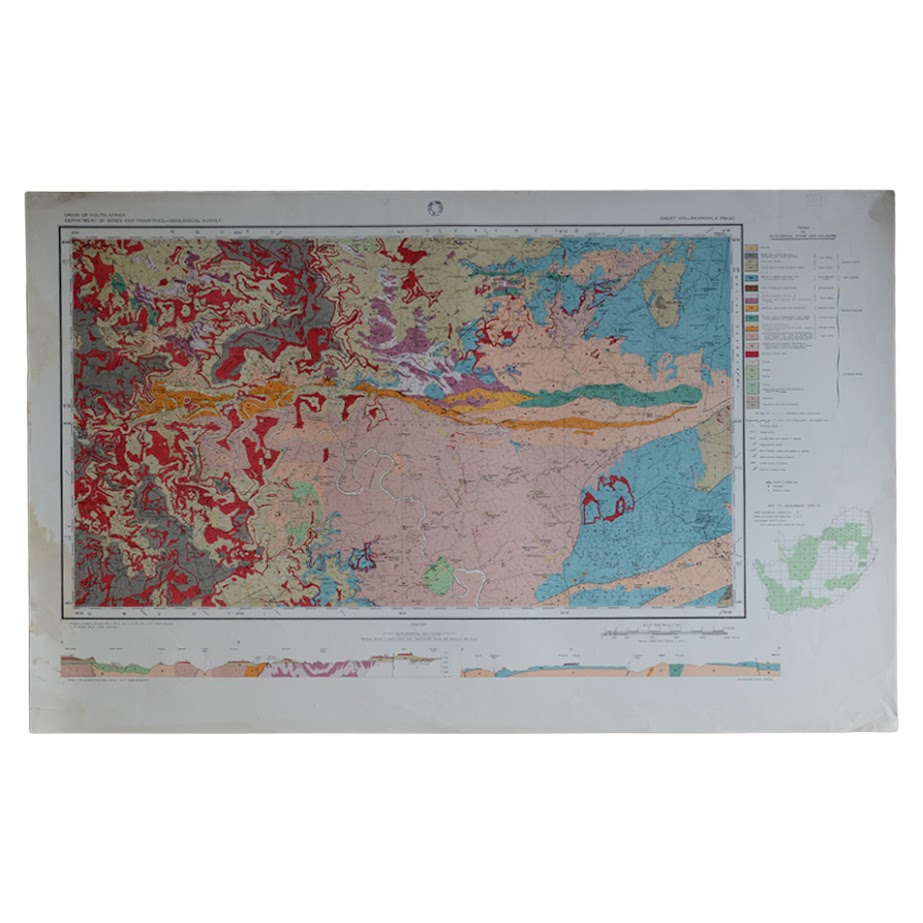
Sheet 109 – Nkandla – Natal – Union Of South Africa Department Of Mines And Industries – Geological Survey
Banks, Eric H
£95.00
Availability: In stock
Product Description
Sheet 109 – Nkandla – Natal – Union Of South Africa Department Of Mines And Industries – Geological Survey
Cartographer: Eric H Banks
Publisher: Union Of South Africa Department Of Mines And Industries – Geological Survey
Price: £95 (post-free in the UK)
Publication Date: 1919
Edition: 1st edition thus
Format: Colour printed
Condition: In good condition
Sheet Size: 86.2cm x 56cm
Condition:
Sheet Size: 86.2cm x 56cm. Small Institutional stamp to upper margin. Minor pencil marks to margins which could be easily removed. Marks to left hand margin. A little creased, marked, dusty and rubbed but this is mainly confined to the margins. Colouration very bright and clean. A good copy. Very scarce.
Location: Pocket RSAGEOL: SR: 002841
Nkandla (Natal) District: An Historical Overview
Geographical and Cultural Setting
Nkandla is a rural area situated in the north-central region of KwaZulu-Natal, in what was historically part of the Zululand heartland. Set amid undulating hills, indigenous forests, and grassland ridges, Nkandla lies inland from the coastal belt, bounded by traditional chiefdoms and scattered homesteads.
The region is known for its strong cultural heritage, predominantly Zulu-speaking population, and deep-rooted ties to ancestral land and chieftainship. Nkandla has also become synonymous with broader national political discourse, though its local history stretches back centuries before its modern associations.
Precolonial History and Zulu Origins
Nkandla’s history is intertwined with the formation and expansion of the Zulu Kingdom during the early 19th century. Prior to the rise of King Shaka, the area was home to small Nguni-speaking chiefdoms, including clans such as the Ntuli, Biyela, and Mchunu.
By the 1820s, under the leadership of Shaka Zulu, the region became part of the centralised Zulu polity. Nkandla held strategic importance due to its proximity to:
- Royal kraals and military outposts
- Forests used for concealment and ritual
- The broader uThungulu and Mthonjaneni districts, which served as key support bases
The indigenous Nkandla Forest, a dense tract of afro-montane woodland, was used by the Zulu kings for initiation rituals, refuge, and strategic retreats, particularly during times of political unrest or warfare.
Colonial Encroachment and British Rule (Mid-19th Century)
By the mid-1800s, Nkandla and the surrounding Zululand region came under increasing pressure from British colonial interests, who sought to control land and suppress Zulu authority. Following the Anglo-Zulu War of 1879, the British dismantled the central Zulu monarchy and divided the kingdom into thirteen chiefdoms.
Nkandla was included in the reorganisation, and British administrators attempted to install compliant chiefs and magistrates. However, the area remained a hotbed of resistance, with many Zulu leaders—such as Chief Sigananda Shezi—opposing British manipulation and maintaining allegiance to the legacy of Shaka and his successors.
Throughout the late 19th century, Nkandla was a site of uprisings and rural tension, often sparked by:
- Forced taxation and labour policies
- Land dispossession and boundary demarcation
- Intrusion into sacred forest areas
Despite colonial attempts to establish administrative control, Nkandla remained culturally autonomous and steeped in Zulu nationalist sentiment.
Early 20th Century: Rural Tradition and Political Awakening
In the early 1900s, Nkandla continued to function as a predominantly rural, subsistence-farming area, with traditional governance under local izinduna (headmen) and amakhosi (chiefs).
At the same time, there was increasing exposure to Christian mission activity, colonial education, and migrant labour, which introduced new ideas and tensions. Many men from Nkandla worked in the mines of Johannesburg or on sugar estates in Natal and the Transvaal, returning home periodically with wages and political insights.
This period saw the beginning of local African political organisation, including the growth of church-based literacy and the influence of early Zulu intellectuals advocating land rights and cultural preservation.
Apartheid Era (1948–1994)
Under apartheid, Nkandla was designated part of the KwaZulu “homeland”, a nominally self-governing territory created to enforce racial segregation and limit black South Africans’ land rights and political representation.
This led to:
- Underinvestment in infrastructure, health, and education
- Forced removals and boundary changes designed to concentrate black communities
- A heavy reliance on subsistence agriculture and migrant remittances
- Reinforcement of chiefly authority, often co-opted by apartheid structures
Despite systemic marginalisation, Nkandla retained its role as a stronghold of Zulu cultural identity, with many residents resisting apartheid policies through traditional structures, church networks, and covert political activism.
The area was also affected by the broader violence and political rivalry of the 1980s and early 1990s, particularly between Inkatha Freedom Party (IFP) supporters and African National Congress (ANC) activists.
Post-1994 Developments
After the end of apartheid in 1994, Nkandla became part of a democratic South Africa, incorporated into the KwaZulu-Natal province under the new municipal system. The area falls under the King Cetshwayo District Municipality, with local governance by the Nkandla Local Municipality.
Since then, efforts have been made to:
- Expand basic services, including electrification, water supply, and road access
- Support rural development projects focused on agriculture, education, and health
- Recognise the cultural and ecological value of the Nkandla Forest, now partially protected as a conservation area
Nevertheless, Nkandla remains one of the poorest regions in the province, facing challenges such as:
- High youth unemployment
- Limited access to secondary and tertiary education
- Pressures from rural-urban migration
Contemporary Associations and Public Attention
In the 21st century, Nkandla has received widespread public attention due to its association with former South African President Jacob Zuma, who was born and maintains a homestead in the area.
This connection brought a national spotlight onto Nkandla, especially during controversies surrounding the state-funded upgrades to the Zuma residence, which sparked intense political and legal scrutiny.
While these issues have dominated media coverage, it is important to recognise that the broader Nkandla region is more than a political symbol. It remains a place of:
- Cultural continuity, where traditional leadership coexists with democratic governance
- Environmental significance, particularly in terms of forest biodiversity and water sources
- Social resilience, as local communities navigate development, poverty, and identity
Conclusion
Nkandla is a region of historical depth and cultural richness, rooted in the legacy of the Zulu kingdom, shaped by colonial and apartheid oppression, and marked by modern struggles for development and representation. Its story is both local and national, reflecting the broader themes of land, leadership, and resilience in South African history.
SHOP WITH CONFIDENCE AT HORNSEYS
At Hornseys, we are dedicated to offering items that uphold the highest standards of quality and authenticity. Our collection of artwork is carefully curated to ensure that each item we offer is authentic, collated, and complete.
Here’s what sets us apart:
- Authenticity and Provenance: Each map is researched and verified for authenticity.
- Expert Curation: We entirely own all our artworks. We trust our taste and have invested heavily in it. We have confidence in all artwork that we offer for sale.
- Customer Satisfaction: We strive to provide an exceptional customer experience, from detailed descriptions and provenance to secure and prompt delivery of your purchase.
- Returns Policy: We offer an unconditional guarantee on every item. If, however, you wish to make a return, artworks may be sent back to us within fourteen days of receipt for whatever reason. We request that we are notified in advance if you wish to do so. They must be returned to us in the same condition as they were sent for a full refund.
OUR COMMITMENT TO QUALITY AND SERVICE
Understanding the value and rarity of these items, we ensure that every aspect of your purchase meets the highest standards of quality and service. This includes:
- Free Expedited, Tracked, and Insured Delivery within the UK: Ensuring that your artwork arrives safely and promptly.
- Fully-Insured Worldwide Delivery: Offering peace of mind for international collectors with reliable and secure shipping options.
EXPLORE OUR COLLECTION
Visit Hornseys today to explore our fine collection of maps and other artworks. Whether you are an avid collector or looking for a special gift, our selection offers something truly unique. Located since 1976 in Ripon in the picturesque Yorkshire Dales, we are recognized as a destination gallery for tastefully curated artwork, rare maps, design, and fine books.
Related products


You may also like…

Geological Map Of The Country Around Salisbury – Rhodesia – 1958 – First Edition
£245.00R. M. Tyndale-Biscoe
Geologic Map of California Olaf P Jenkins Edition Los Angeles Sheet
£195.00Jennings, Charles W & Strand, Rudolph G
Geological Map Of Israel – Revised Edition – 1976 – Map On Two Sheets
£450.00Picard, L. Y, Golani, U, Bentor, Y. K, Vroman, A & Zak, I
Tectonic Map Of Australia – First Edition – Map On Four Sheets
£650.00Bureau of Mineral Resources, Geology and Geophysics
Geological Map Of The People’s Republic Of China – Presentation Copy From Geologist Shihe Lei
£125.00Published in Beijing


