
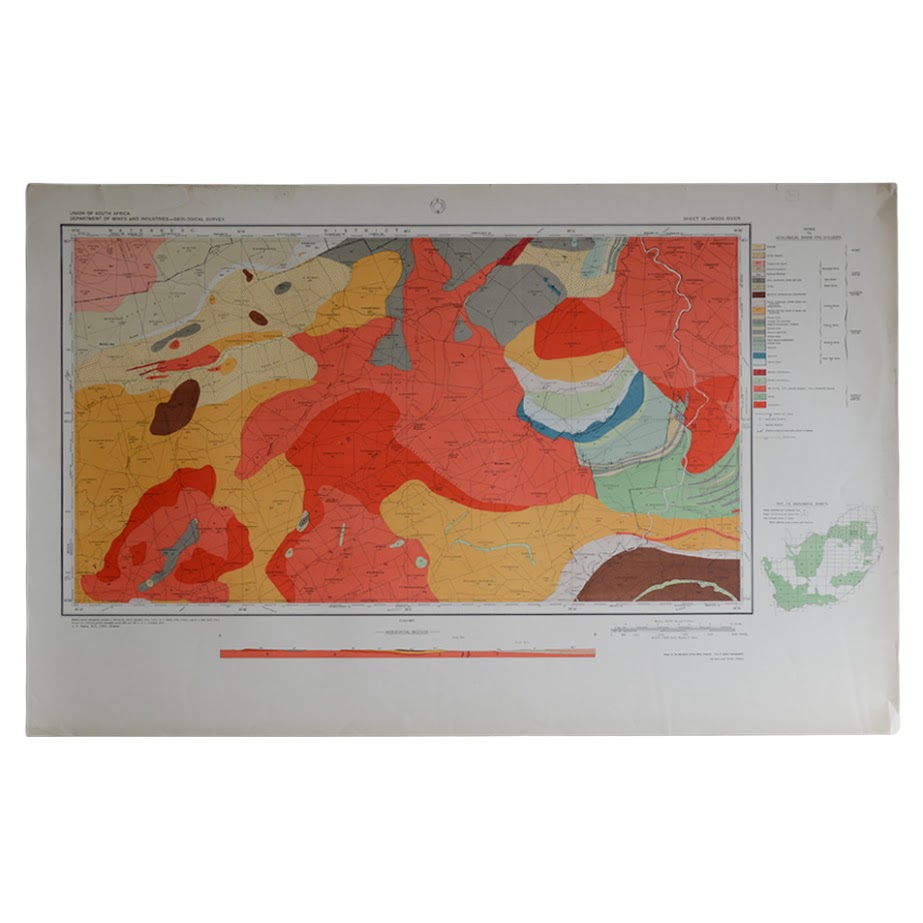
Sheet 18 – Moos River – Union Of South Africa Department Of Mines And Industries – Geological Survey
Banks, Eric H
£125.00
Availability: In stock
Product Description
Sheet 18 – Moos River – Union Of South Africa Department Of Mines And Industries – Geological Survey
Cartographer: Eric H Banks
Publisher: Union Of South Africa Department Of Mines And Industries – Geological Survey
Price: £125 (post-free in the UK)
Publication Date: 1930
Edition: 1st edition thus
Format: Colour printed
Condition: In very good condition
Sheet Size: 89.6cm x 56.9cm
Condition:
First edition thus. New series. Sheet Size: 89.6cm x 56.9cm. Small Institutional stamp to upper margin. A little creased, marked, dusty and rubbed. Colouration very bright and and clean. A very good copy. Very scarce.
Location: Pocket RSAGEOL: SR: 002838
Moos River: A Historical Overview
Overview
The Moos River is a relatively minor but regionally significant watercourse located in the KwaZulu-Natal province of South Africa, within the broader catchment of the Tugela River system. Although not widely known outside of hydrological and local contexts, the Moos River plays an important role in supporting agriculture, biodiversity, and rural livelihoods in its immediate environment.
It flows through a part of the KwaZulu-Natal Midlands, an area characterised by rolling grasslands, highveld plateau features, and seasonal rainfall patterns. The river contributes to both surface water systems and ecological connectivity in a landscape shaped by farming, forestry, and traditional communal land use.
Geographical Setting
The Moos River rises in the upland regions of western KwaZulu-Natal, typically within the Drakensberg foothills, and follows a generally eastward course before joining larger tributaries that eventually flow into the Tugela River—South Africa’s largest river system within KwaZulu-Natal.
Its catchment area encompasses a combination of:
- Grassland plateaus and wetland patches
- Subsistence farmlands and commercial agricultural holdings
- Small villages and rural homesteads, many associated with Zulu-speaking communities
The river’s flow regime is seasonal, responding primarily to summer rainfall (October to March), with diminished levels during the dry winter months. Flash floods and seasonal high flows are common during periods of heavy rain.
Hydrology and Environmental Role
As part of the greater Tugela basin, the Moos River contributes to:
- Groundwater recharge
- Irrigation for crops and livestock
- Sediment transport and nutrient cycling
- The ecological functioning of riparian and wetland habitats
Although relatively modest in size, the river supports a number of perennial pools, oxbow wetlands, and grassy floodplains, which provide habitat for:
- Birdlife, including waders and seasonal migrants
- Amphibians and reptiles, reliant on semi-aquatic environments
- Freshwater invertebrates and small fish
Efforts to monitor and preserve water quality are crucial, particularly in areas where overgrazing, erosion, and informal settlements place strain on the ecosystem.
Human Interaction and Land Use
Communities along the Moos River rely on it for domestic water needs, small-scale irrigation, and livestock watering. Its banks are often used for:
- Grazing cattle, goats, and sheep
- Crop cultivation, especially maize and vegetables
- Cultural and ritual practices, particularly in rural Zulu contexts where rivers are often viewed as spiritually significant
Land tenure in the catchment is typically mixed, comprising:
- Communal land systems under traditional authorities
- Privately owned farms, often engaged in mixed farming or forestry
- Pockets of government land, including conservation or reforestation areas
Conflicts occasionally arise where access to water or land is contested, particularly during times of drought or pressure from development.
Environmental Pressures and Management Concerns
Like many rural watercourses in South Africa, the Moos River faces a range of environmental challenges, including:
- Soil erosion from overgrazing and poor land management
- Pollution from agricultural runoff and inadequate sanitation
- Invasive alien vegetation, such as black wattle and lantana, which reduce indigenous plant cover and affect flow
- Climate variability, with increasingly erratic rainfall patterns
Local and provincial authorities, often in coordination with catchment management agencies, are involved in:
- Promoting sustainable land use
- Encouraging community-based conservation
- Restoring degraded riparian zones through reforestation and erosion control
Educational campaigns and agricultural extension services have also been introduced to promote better water stewardship in the region.
Cultural and Regional Significance
Although not a major river by South African standards, the Moos River holds cultural and regional importance:
- It features in local oral traditions, particularly in Zulu folklore where rivers are associated with ancestral spirits and ritual cleansing.
- The river forms part of the cultural landscape of the Midlands, with its crossings and tributaries marking boundaries, pathways, and settlement zones.
- In some areas, it is used for community baptisms, seasonal festivals, and traditional healing ceremonies.
Place names and stories linked to the river reflect the deep connection between land, water, and identity in rural KwaZulu-Natal.
Conclusion
The Moos River may be small in scale, but it is a lifeline to the communities and ecosystems within its catchment. It exemplifies the intricate interplay between natural systems and rural livelihoods, characteristic of South Africa’s interior valleys.
Its future sustainability rests on community engagement, sensible land-use practices, and ongoing conservation efforts, ensuring that this modest yet meaningful watercourse continues to support both people and nature in the years to come.
SHOP WITH CONFIDENCE AT HORNSEYS
At Hornseys, we are dedicated to offering items that uphold the highest standards of quality and authenticity. Our collection of artwork is carefully curated to ensure that each item we offer is authentic, collated, and complete.
Here’s what sets us apart:
- Authenticity and Provenance: Each map is researched and verified for authenticity.
- Expert Curation: We entirely own all our artworks. We trust our taste and have invested heavily in it. We have confidence in all artwork that we offer for sale.
- Customer Satisfaction: We strive to provide an exceptional customer experience, from detailed descriptions and provenance to secure and prompt delivery of your purchase.
- Returns Policy: We offer an unconditional guarantee on every item. If, however, you wish to make a return, artworks may be sent back to us within fourteen days of receipt for whatever reason. We request that we are notified in advance if you wish to do so. They must be returned to us in the same condition as they were sent for a full refund.
OUR COMMITMENT TO QUALITY AND SERVICE
Understanding the value and rarity of these items, we ensure that every aspect of your purchase meets the highest standards of quality and service. This includes:
- Free Expedited, Tracked, and Insured Delivery within the UK: Ensuring that your artwork arrives safely and promptly.
- Fully-Insured Worldwide Delivery: Offering peace of mind for international collectors with reliable and secure shipping options.
EXPLORE OUR COLLECTION
Visit Hornseys today to explore our fine collection of maps and other artworks. Whether you are an avid collector or looking for a special gift, our selection offers something truly unique. Located since 1976 in Ripon in the picturesque Yorkshire Dales, we are recognized as a destination gallery for tastefully curated artwork, rare maps, design, and fine books.
Related products

(The Congo, Angola) Carte Des Royaumes De Congo, Angola Et Benguela Avec Les Pays Voisins Tire de L’Anglois
£65.00Bellin, Jacques Nicolas


You may also like…
Geological Map Of The Country Around Salisbury – Rhodesia – 1958 – First Edition
£245.00R. M. Tyndale-Biscoe
Geologic Map of California Olaf P Jenkins Edition Los Angeles Sheet
£195.00Jennings, Charles W & Strand, Rudolph G
Geological Map Of Israel – Revised Edition – 1976 – Map On Two Sheets
£450.00Picard, L. Y, Golani, U, Bentor, Y. K, Vroman, A & Zak, I
Tectonic Map Of Australia – First Edition – Map On Four Sheets
£650.00Bureau of Mineral Resources, Geology and Geophysics
Geological Map Of The People’s Republic Of China – Presentation Copy From Geologist Shihe Lei
£125.00Published in Beijing


