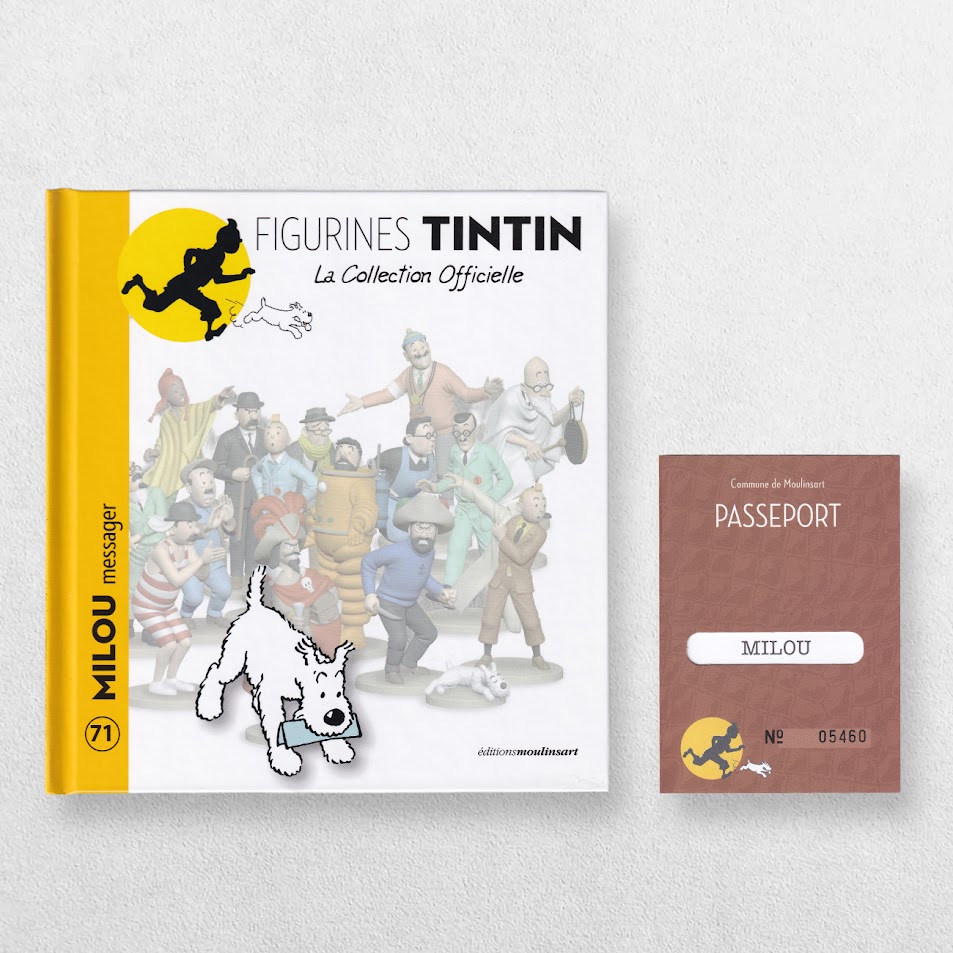
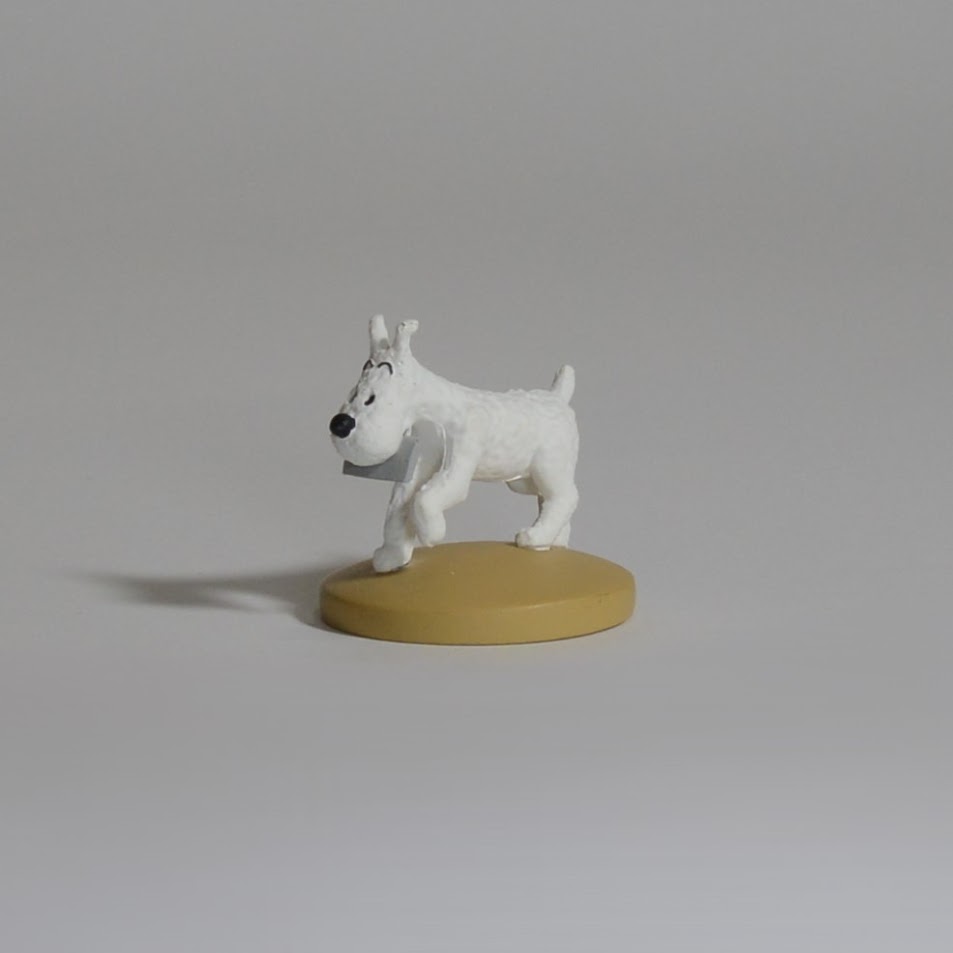
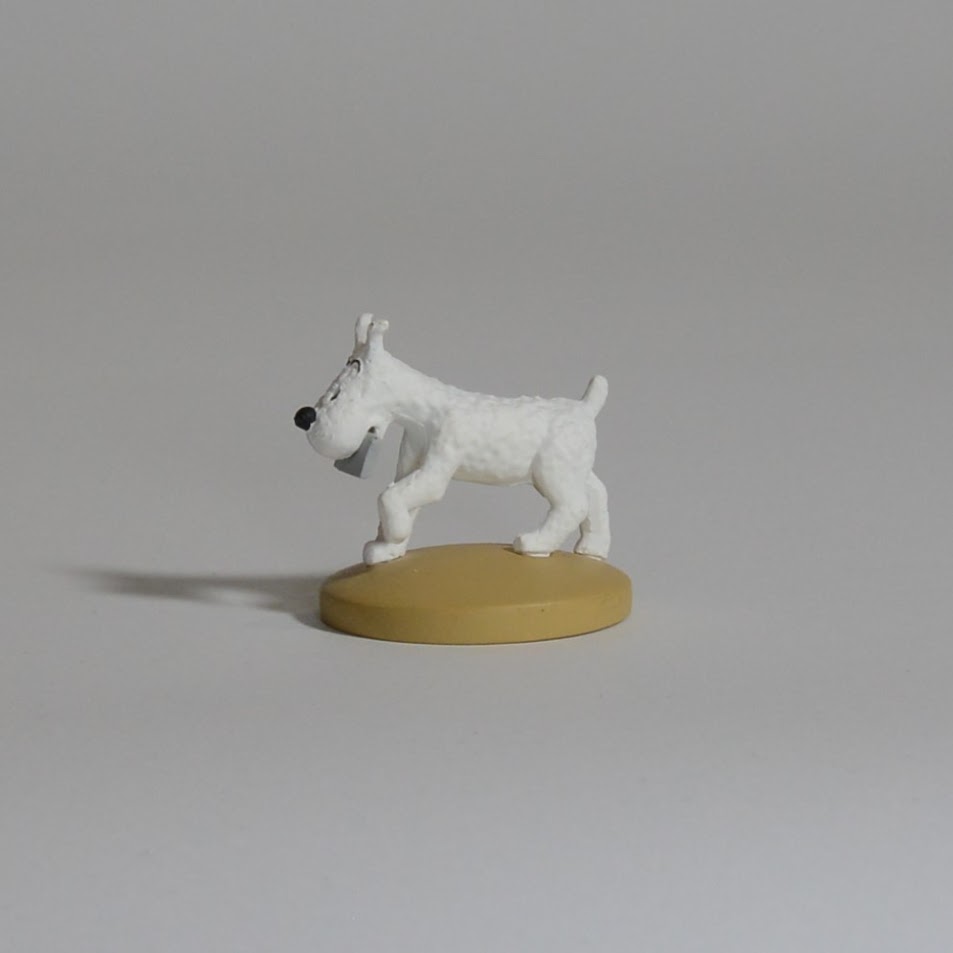
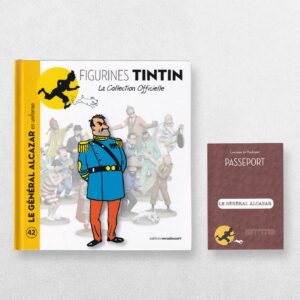
Snowy The Messenger – Figurines Tintin La Collection Officielle – 71 – Milou Messager
Author: Hergé & Editions Moulinsart
Price: £65.00
Publisher: Editions Moulinsart
Publication date: 2014
Format: Original pictorial boards with passport and figurine
Condition: In near fine condition
Illustrations: Illustrated throughout
Description:
Original pictorial boards. Includes passport loosely inserted. Text in French. Includes the accompanying figurine. One from the collection of 111 books and figurines. Very slight wear. In very near fine, clean condition overall.
Snowy: A Short Biography
Snowy — Milou in the original French — is Tintin’s loyal white fox terrier, constant companion, and confidant throughout Hergé’s entire series. From the very first story, Tintin in the Land of the Soviets (1929)*, Snowy has been at Tintin’s side, sharing his perils, rescues, and moments of reflection.
He is far more than a pet: Snowy is Tintin’s partner, conscience, and sometimes comic foil. His courage, loyalty, and humour provide emotional depth to the stories, anchoring Tintin’s adventures in a relationship that is at once human and symbolic.
Origins and Creation
Hergé introduced Snowy in the very first panel of Tintin in the Land of the Soviets. Inspired by the artist’s own fox terrier, Snowy became the prototype for a new kind of comic-strip companion — intelligent, expressive, and morally engaged.
The name Milou was derived from Hergé’s early love, Marie-Louise Van Cutsem, whose nickname was Milou. By immortalising her name in Tintin’s dog, Hergé gave the character a personal and affectionate origin.
Character Overview
Species and Appearance
Snowy is a wire fox terrier — small, energetic, and instantly recognisable by his bright white coat, pointed ears, and quizzical expression. His simple design allows for a wide range of emotion; Hergé gives him human-like expressiveness through posture, eyes, and gesture rather than exaggeration.
Personality
Snowy is spirited, brave, quick-witted, and devoted to Tintin, but also prone to fear, vanity, and occasional selfishness. These flaws make him both endearing and believable.
He acts as Tintin’s alter ego: while Tintin represents moral purity and reason, Snowy expresses the instinctive, emotional, and sometimes mischievous side of humanity.
Role in the Narrative
- Companion and Mirror
Snowy is Tintin’s constant companion — the one character who never leaves his side. Their bond is profound: Tintin talks to him as to a trusted friend, and Snowy’s reactions (sometimes conveyed through thought bubbles) reveal an independent intelligence.
Where Tintin is fearless, Snowy is wary; where Tintin is altruistic, Snowy occasionally grumbles. Yet when danger comes, Snowy’s loyalty always triumphs over fear.
- Comic Relief
Snowy’s sarcastic observations — particularly in the earlier albums — provide wry humour and a touch of self-awareness. His dry wit contrasts with Tintin’s earnestness, giving the reader a more human perspective on their adventures.
- Heroism and Agency
Far from a passive sidekick, Snowy often saves Tintin’s life: biting ropes, fetching help, or outwitting villains. His resourcefulness elevates him to a full participant in the action rather than a mascot.
- Moral and Emotional Balance
In the absence of family or romantic relationships, Snowy gives Tintin emotional grounding. He listens, comforts, and shares Tintin’s loneliness, especially in reflective moments — a silent companion who humanises the hero.
Evolution of the Character
In Hergé’s early works, Snowy speaks frequently through thought balloons, displaying wit and irony. As the series matured, these asides became rarer, and his role shifted from commentator to silent moral presence — a change that mirrored Hergé’s growing realism and restraint.
Yet Snowy’s essential personality never altered. Whether battling gangsters or trudging through snow in Tintin in Tibet, he remains Tintin’s unwavering companion — a constant amid Hergé’s evolving artistic and psychological landscapes.
Key Appearances and Highlights
Tintin in the Land of the Soviets (1929)
Snowy debuts as Tintin’s outspoken partner, full of quips and courage. His sarcasm and quick thinking establish the tone for their partnership.
The Blue Lotus (1936)
Snowy plays a subtler role, but his presence helps convey Hergé’s growing sensitivity to tone and realism. He is a witness to Tintin’s moral awakening.
The Black Island (1938)
A particularly heroic outing: Snowy fights villains, survives peril, and helps save Tintin more than once.
The Crab with the Golden Claws (1941)
Snowy introduces Captain Haddock to Tintin — indirectly changing the entire course of the series. His actions aboard the Karaboudjan demonstrate both bravery and comic anxiety.
The Calculus Affair (1956)
Snowy is again a loyal and active participant, showing protectiveness toward both Tintin and Professor Calculus.
Tintin in Tibet (1960)
This is Snowy’s most emotionally powerful appearance. His exhaustion, courage, and loyalty during the Himalayan trek reinforce the theme of unconditional devotion. When Tintin risks everything to find Chang, Snowy mirrors that same loyalty, pushing through hardship for the sake of friendship.
Personality and Traits
- Bravery: He repeatedly faces danger — wild animals, explosions, storms — without hesitation.
- Loyalty: His devotion to Tintin is absolute; he refuses to leave his master’s side even in mortal peril.
- Curiosity: He often triggers events through exploration or mischief.
- Humour: His irony, particularly in the early albums, offers comic relief.
- Fearfulness: He dislikes water, thunderstorms, and particularly cats — details that humanise him.
- Fondness for whisky: Like Captain Haddock, Snowy occasionally succumbs to the temptation of drink — most memorably in The Crab with the Golden Claws.
Relationship with Tintin
The Tintin–Snowy partnership is among the most enduring in modern literature. Their relationship is based on mutual dependence rather than hierarchy. Tintin trusts Snowy’s judgement, often talking to him as an equal; Snowy responds with affection, humour, and fierce protectiveness.
This bond humanises Tintin, who otherwise lives without family or romantic attachments. In Snowy, Hergé gives his hero both a friend and a moral sounding board. Their exchanges — whether comic or heartfelt — reveal the emotional dimension behind Tintin’s stoicism.
Symbolism and Interpretation
- The Conscience of Tintin
Snowy often articulates (especially in early stories) thoughts that Tintin cannot — doubts, fears, or moral hesitations. He serves as Tintin’s subconscious voice, expressing the anxieties behind the hero’s calm façade.
- Companion of the Hero Archetype
In mythological terms, Snowy is the faithful animal ally — a figure found in many heroic traditions. He bridges the human and natural worlds, representing instinct, loyalty, and purity of heart.
- Symbol of Constancy
As Tintin moves between political upheavals and changing worlds, Snowy remains unchanging — a symbol of continuity and unconditional friendship amid flux.
- Echo of Hergé’s Inner World
Hergé once described Snowy as representing “the little voice that comments on everything I do.” He is, in effect, the artist’s conscience — part companion, part commentator, part alter ego.
Artistic Portrayal
Hergé drew Snowy with extraordinary economy of line. His shape — simple curves, minimal detailing — allows for clear emotional expression through posture and gesture rather than facial features.
Snowy’s visual rhythm — bounding, sniffing, jumping — adds energy to the composition of panels. His small form contrasts with vast landscapes, highlighting Tintin’s vulnerability and courage.
In quieter moments, Snowy’s silhouette beside Tintin’s evokes companionship and calm — a visual shorthand for loyalty and affection.
Psychological Reading
Snowy embodies the emotional life that Tintin suppresses. Where Tintin is rational and idealistic, Snowy is instinctive and emotional. He reacts to fear, pleasure, and pain with unfiltered honesty, serving as Tintin’s emotional surrogate.
Hergé’s own introspective nature found expression in this dynamic. Snowy’s humour and scepticism temper Tintin’s purity, ensuring that the stories remain grounded in recognisable humanity.
Cultural and Literary Significance
Snowy helped define the archetype of the intelligent animal companion in modern storytelling. His relationship with Tintin anticipates later literary and cinematic partnerships between humans and expressive animals, setting a benchmark for emotional subtlety in illustrated fiction.
Unlike the talking animals of children’s literature, Snowy’s intelligence feels credible: he communicates through instinct, expression, and body language rather than fantasy. This balance of realism and empathy reflects Hergé’s mature artistry.
Legacy
Snowy remains one of the most beloved dogs in world literature. His image — bounding beside Tintin, tail raised — has become a universal emblem of loyalty and courage.
He appears in every Tintin adventure, the sole character to share Tintin’s entire journey from the 1920s to the 1970s. Statues, figurines, and adaptations consistently feature him as Tintin’s inseparable partner.
In modern popular culture, Snowy stands alongside literary dogs such as Lassie and Toto, yet his personality is more nuanced — witty, flawed, and morally aware.
Summary
- Name: Snowy (Milou in French)
- Species: Wire fox terrier
- First appearance: Tintin in the Land of the Soviets (1929)
- Personality: Brave, loyal, witty, sarcastic, occasionally fearful
- Symbolism: Conscience, constancy, and the instinctive side of human nature
- Relationship: Lifelong companion to Tintin; occasional comic foil
- Defining trait: Courage and devotion balanced with humour and imperfection
Conclusion
Snowy is far more than Tintin’s pet: he is his shadow, conscience, and emotional double. Through Snowy, Hergé gave his stories warmth, wit, and heart — grounding epic adventure in the simple truth of friendship.
Whether braving deserts, mountains, or high seas, Snowy stands as a symbol of unconditional loyalty — a reminder that courage often comes in small, white, four-legged form.
In Hergé’s universe, heroes may travel the world and confront every peril, but true companionship is what makes them human. Snowy is that companionship made visible — the enduring soul of The Adventures of Tintin.
Why Buy from Us?
At Hornseys, we are committed to offering items that meet the highest standards of quality and authenticity. Our collection of objects and rare books are carefully curated to ensure each edition is a valuable piece of bibliographical history. Here’s what sets us apart:
- Authenticity and Provenance: Each item is meticulously researched and verified for authenticity and collation.
- Expert Curation: Our selection process focuses on significance, condition, and rarity, resulting in a collection that is both diverse and distinguished.
- Customer Satisfaction: We aim to provide an exceptional customer experience, from detailed descriptions to secure and prompt delivery of your purchase.
- Returns Policy: We offer an unconditional guarantee on every item. If you wish to return an item, it may be sent back to us within fourteen days of receipt. Please notify us in advance if you wish to do so. The item must be returned in the same condition as it was sent for a full refund.
Cataloguer: Daniel Hornsey
Daniel Hornsey has specialised in fine and rare books, ephemera, and collectors’ editions for over thirty years. As a long-standing member of the antiquarian book trade, he has advised private collectors, curated catalogues, and sourced works for leading dealers, libraries and institutions across the world.
Hornseys’ exhibit regularly at book and map fairs in London and throughout the UK and are members of the Provincial Booksellers Fairs Association, the PBFA.
His fascination with Hergé’s work — especially ‘The Adventures of Tintin’ — began in childhood. Daniel recalls reading Tintin in original European editions and quickly recognising that these were not merely children’s books, but finely illustrated narratives crafted with artistic depth and wit.
As noted by the Musée Hergé in Louvain-la-Neuve, Hergé’s ‘ligne claire’ style has influenced generations of European comic artists and his original drawings and paintings command very high prices with his painting of ‘The Blue Lotus’ jar fetching £2.8m at auction in 2021.
By presenting these works through Hornseys’, he hopes to contribute to the continued appreciation of one of the 20th century’s most influential illustrators, helping new generations discover the artistry and legacy of Hergé.