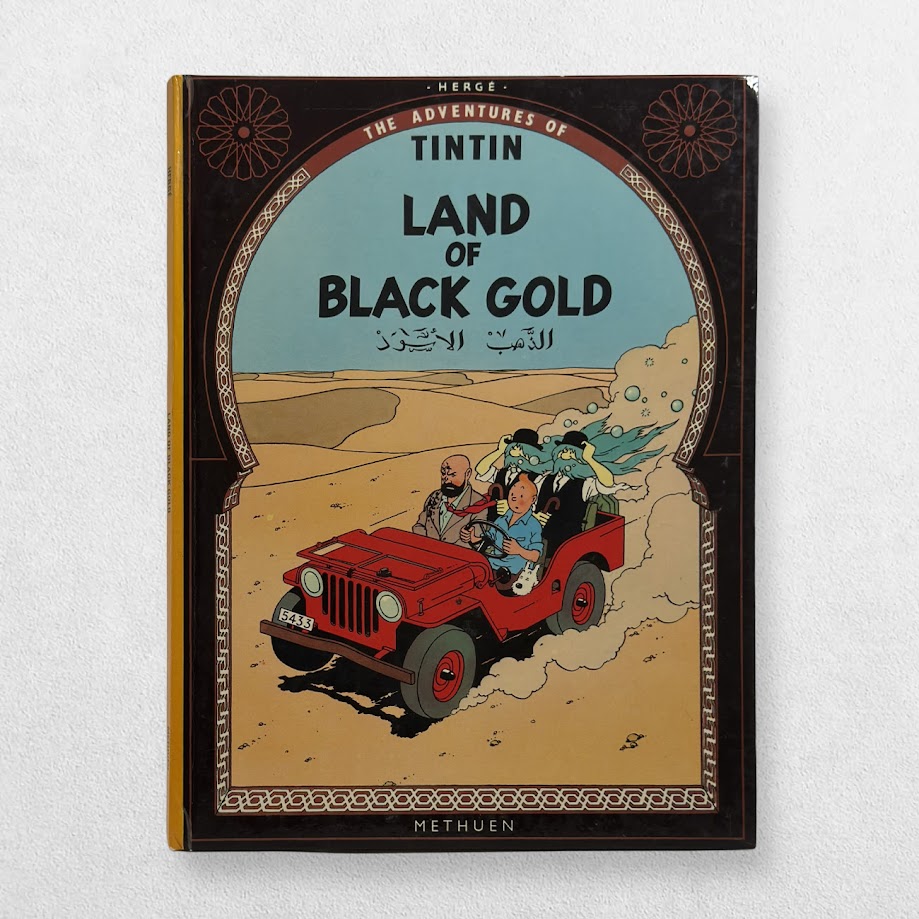
The Adventures Of Tintin – Land Of Black Gold – First Edition – 1972
Hergé
£225.00
Availability: In stock
Product Description
The Adventures Of Tintin – Land Of Black Gold – First Edition – 1972
Author: Hergé
Price: £225.00
Publisher: Methuen, London, UK
Publication date: 1972
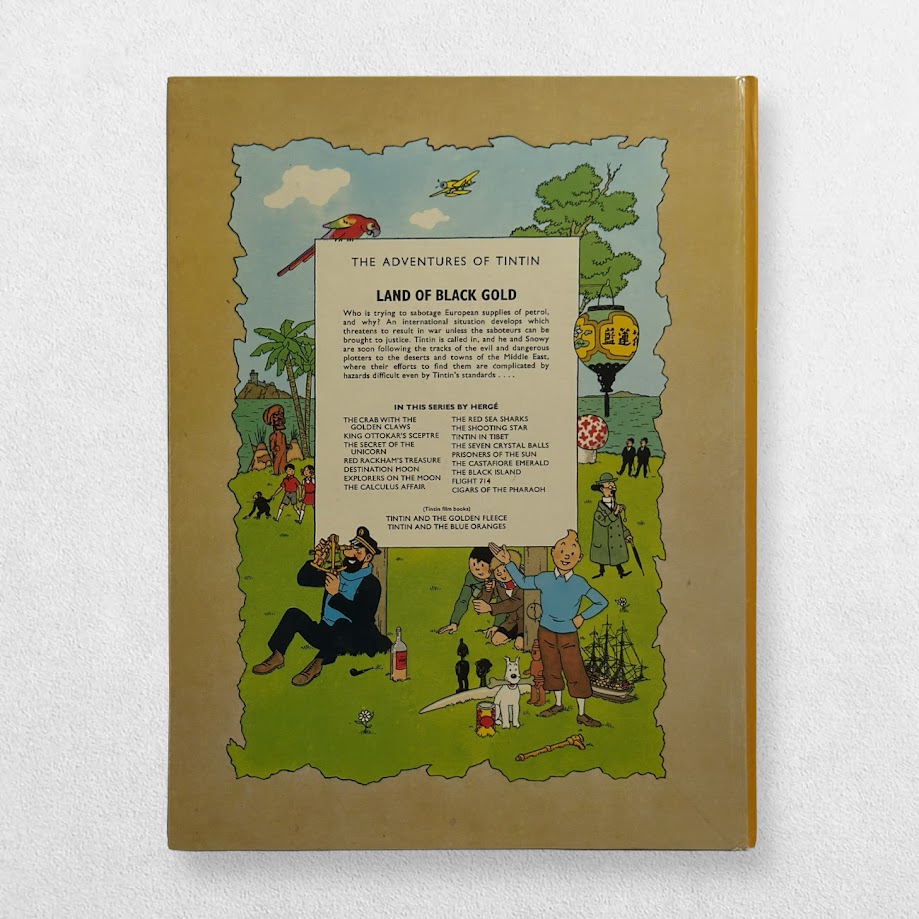
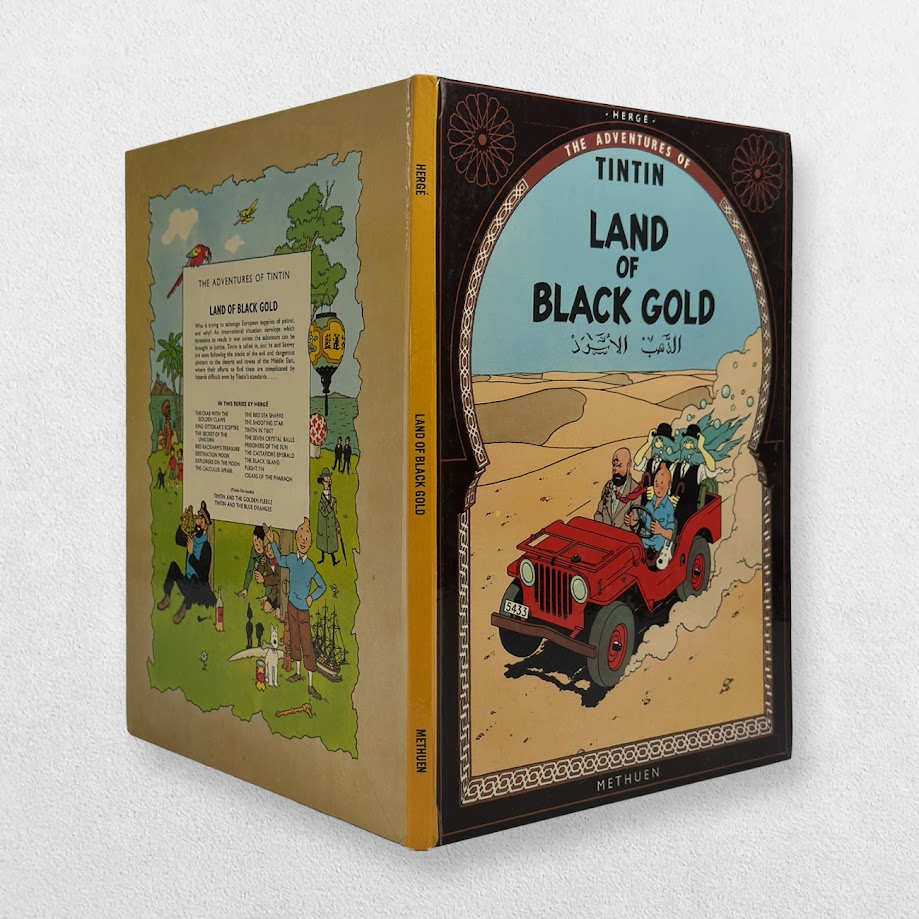
Format: Original pictorial boards with pictorial endpapers
Condition: Very good
Pages: 62
Illustrations: Illustrated throughout in colour by the author
Description:
Published by Methuen, London, UK, 1972. 1st UK edition. Original pictorial boards. Pictorial endpapers. Pp. 62. Illustrated throughout in colour by the author. Boards very slightly rubbed and creased but with no cracking to the spine. Binding nice and tight. Pages very nice and clean with only very occasional minor age spots. A very good indeed, tight, bright, clean copy. Scarce.
‘Land Of Black Gold’: A Brief Summary
Tintin in the Land of Black Gold is one of the more politically charged and geographically expansive adventures in The Adventures of Tintin by Hergé. It combines detective fiction, international intrigue, satire, and desert adventure, while reflecting the anxieties of the late 1930s and the post-war Middle East. The story revolves around mysterious sabotage in the global oil market, a growing threat of war, and Tintin’s eventual journey to the fictional Arab state of Khemed.
The album exists in more than one version because Hergé first began serialising it in 1939, but the outbreak of the Second World War interrupted publication. He later rewrote and completed it in the post-war period, adjusting the political setting and certain national references.
Opening Crisis: Explosions in Engines
The story begins in Europe with a strange and alarming phenomenon: motor cars across the continent are suddenly exploding without warning. Engines malfunction violently, causing panic, accidents, and widespread suspicion. Petrol appears to be the common factor.
At the same time, international political tensions are escalating. Newspapers report the possibility of war between nations, and the instability of oil supplies makes the situation even more dangerous. Since oil is essential for transport, military power, and industry, any tampering with fuel becomes a matter of national security.
Tintin, always drawn to mysteries with global consequences, becomes interested in the matter. His dog Snowy accompanies him as usual.
The authorities discover that the cause is not poor fuel quality but deliberate adulteration: someone is secretly introducing an unknown substance into petrol, making engines unstable and explosive.
This points towards industrial sabotage rather than accident.
The Shadowy Figure: Doctor Müller
Suspicion soon falls upon Doctor Müller, a sinister and highly intelligent criminal scientist previously encountered by Tintin. Müller is involved in espionage and international conspiracy, and he appears to be connected to the sabotage.
Tintin investigates and is repeatedly targeted. Attempts are made on his life, surveillance follows him, and he becomes entangled in a network of spies and smugglers.
Müller is working for interests that wish to destabilise the oil market and increase political unrest. The sabotage is not merely commercial crime—it is intended to create strategic chaos.
The atmosphere is one of approaching war, and Hergé uses this to build tension from the very first pages.
Journey to Khemed
The investigation leads Tintin to the fictional Middle Eastern kingdom of Khemed, one of Hergé’s invented political landscapes. Khemed is rich in oil and strategically important, making it a centre of foreign interest and internal rivalry.
Two political factions dominate the country:
- Emir Mohammed Ben Kalish Ezab, the legitimate ruler
- Sheikh Bab El Ehr, a rebel leader seeking power
Foreign powers and criminal agents manipulate both sides because whoever controls Khemed controls access to oil.
Tintin travels there to uncover the truth behind the fuel sabotage and Doctor Müller’s role in the conspiracy.
The setting shifts dramatically from European cities to deserts, palaces, oil installations, and military compounds.
Arrival and Immediate Danger
Upon arrival, Tintin quickly finds himself under threat. Khemed is unstable, and everyone seems to be spying on everyone else.
He becomes involved with the Emir and gains access to the royal palace. There he meets the Emir’s deeply troublesome young son, Abdallah.
Abdallah is one of the most chaotic recurring child characters in the series. He delights in practical jokes, explosions, water pistols, hidden fireworks, and general torment of adults. Much of the comic relief in the album comes from his relentless mischief.
Even while dealing with espionage and political danger, Tintin must endure Abdallah’s constant pranks.
Political Intrigue and Kidnapping
Tintin learns that Doctor Müller is secretly supporting Sheikh Bab El Ehr’s rebellion. Müller’s sabotage of petrol is part of a broader strategy to destabilise the region and gain influence over Khemed’s oil resources.
The Emir’s position is under threat.
Then Abdallah is kidnapped by rebel forces, creating both a personal and political crisis. The kidnapping is not simply ransom—it is a move designed to weaken the Emir and strengthen the rebellion.
Tintin takes responsibility for rescuing the boy.
This launches the central desert adventure of the album.
Captain Haddock’s Limited Role
Unlike many Tintin stories, Captain Haddock plays only a relatively small part in this album. He appears later and is not central to the investigation.
This gives the story a stronger resemblance to the earlier, more solitary Tintin adventures, where Tintin acts primarily as an independent reporter-detective rather than part of a comic ensemble.
The focus remains on espionage and pursuit rather than on Haddock’s personality.
Desert Pursuit
Tintin sets out across the desert to rescue Abdallah. This section contains many classic adventure elements:
- pursuit by armed enemies
- survival in extreme heat
- military patrols
- disguises and escapes
- sabotage and ambushes
- encounters with aircraft and vehicles in the desert
The desert becomes both a physical and symbolic battlefield—empty, dangerous, and controlled by shifting loyalties.
Tintin must navigate tribal politics, armed rebellion, and Müller’s network while trying to keep Abdallah safe.
Snowy also plays a significant role, often providing warnings, comic interruptions, and unexpected assistance.
Discovery of the Sabotage Method
Eventually Tintin uncovers the technical method behind the exploding petrol.
A chemical additive has been secretly introduced into fuel supplies. This substance destabilises petrol under heat and pressure, causing engines to fail catastrophically.
Doctor Müller’s scientific knowledge makes him the ideal architect of the scheme.
The purpose is twofold:
- create international panic and economic disruption
- manipulate oil politics in Khemed for strategic gain
This combination of science and geopolitics makes the plot more sophisticated than a simple treasure hunt or criminal chase.
It reflects real-world anxieties about oil dependency and the fragility of international peace.
Rescue of Abdallah
Tintin successfully tracks down Abdallah and rescues him, though not without enormous difficulty. The boy remains as troublesome during the rescue as he was in the palace, often worsening dangerous situations through childish behaviour.
Still, Tintin protects him and returns him safely.
This restores the Emir’s position and weakens the rebels’ leverage.
The personal rescue and the political stabilisation happen together.
Defeat of Doctor Müller
Doctor Müller’s plans ultimately collapse.
Tintin exposes the petrol sabotage, disrupts Müller’s alliances, and helps prevent the rebel takeover. Müller is defeated and his operations are dismantled.
As in many Tintin albums, justice is restored not through formal institutions alone but through Tintin’s persistence, courage, and refusal to be intimidated.
The immediate threat to Khemed ends, and the wider danger of engineered instability is neutralised.
Themes
Oil and Modern Power
Unlike earlier adventures focused on treasure or exploration, this story centres on oil—modern industrial power itself.
Control of fuel means control of war, economics, and political influence. Hergé presents oil not merely as a commodity but as the foundation of twentieth-century power.
Approaching War
The original 1939 conception reflects Europe’s fear of another world war. Sabotage of petrol becomes symbolic of a civilisation on the edge of collapse.
Even in the revised edition, the atmosphere of international tension remains central.
Colonial and Orientalist Representation
Modern readers often note that Khemed reflects European fantasy versions of the Arab world rather than cultural realism. Like several Tintin albums, it contains stereotypes and simplified political structures.
However, it is generally less aggressively caricatured than some earlier works and focuses more on strategic politics than racial caricature.
Childhood and Disorder
Abdallah represents chaos within order. Even inside a palace or a political crisis, he introduces uncontrollable disruption.
He also provides contrast to Tintin’s discipline and seriousness.
Importance Within the Tintin Series
Tintin in the Land of Black Gold is important because it marks a bridge between early adventure serials and the more politically layered later works.
It is less fantastical than The Seven Crystal Balls and less emotionally intimate than Tintin in Tibet, but it is one of the clearest examples of Tintin operating within modern geopolitics.
It also shows Hergé becoming increasingly interested in international systems—oil, diplomacy, rebellion, and intelligence networks—rather than simple villains seeking money.
Its blend of thriller structure and comic interruption makes it distinctive within the canon.
Conclusion
Tintin in the Land of Black Gold is fundamentally a story about instability: unstable fuel, unstable governments, and unstable peace.
Tintin begins by investigating exploding cars and ends by confronting the political struggle over oil and power in Khemed. Along the way he faces sabotage, kidnapping, espionage, desert pursuit, and Doctor Müller’s calculated criminality.
The result is one of the series’ strongest political adventures—less about treasure than about modern power, and more relevant to twentieth-century reality than many of Tintin’s earlier journeys.
Why Buy from Us?
At Hornseys, we are committed to offering items that meet the highest standards of quality and authenticity. Our collection of rare books is carefully curated to ensure each edition is a valuable piece of bibliographical history. Here’s what sets us apart:
- Authenticity and Provenance: Each book is meticulously researched and verified for authenticity and collation.
- Expert Curation: Our selection process focuses on significance, condition, and rarity, resulting in a collection that is both diverse and distinguished.
- Customer Satisfaction: We aim to provide an exceptional customer experience, from detailed descriptions to secure and prompt delivery of your purchase.
- Returns Policy: We offer an unconditional guarantee on every item. If you wish to return a book, it may be sent back to us within fourteen days of receipt. Please notify us in advance if you wish to do so. The book must be returned in the same condition as it was sent for a full refund.