
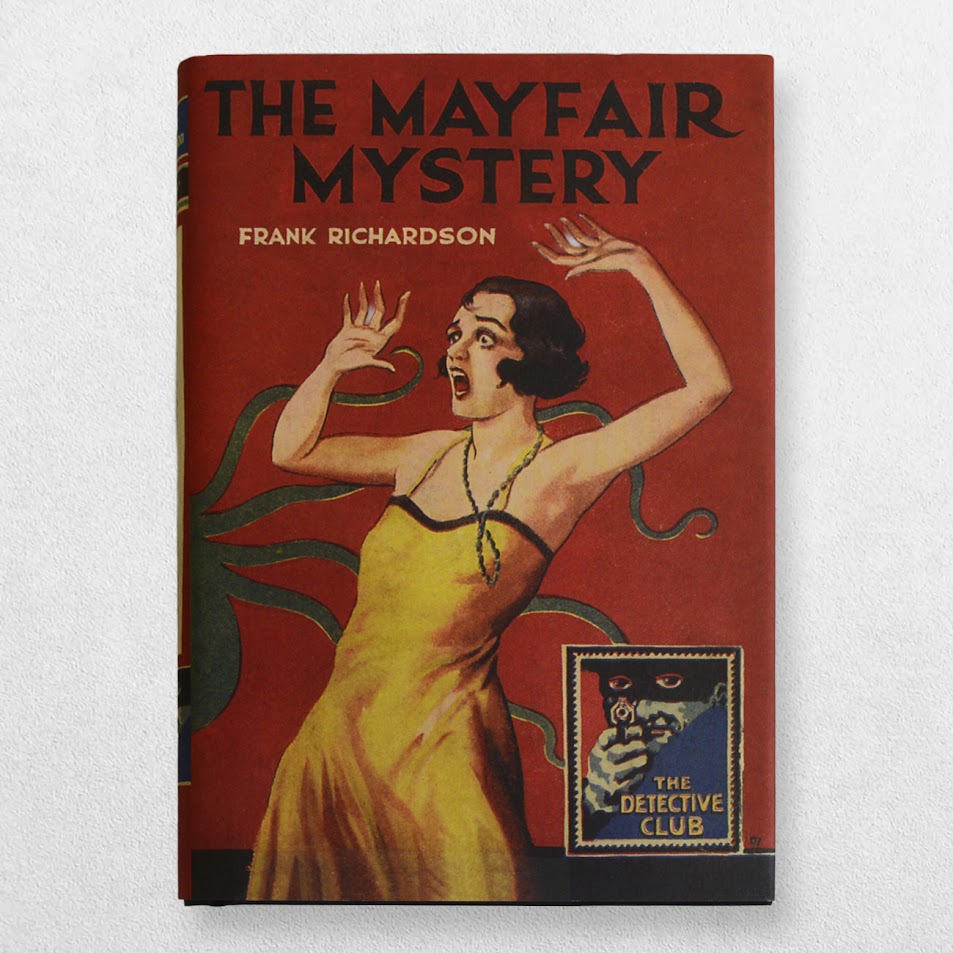
The Mayfair Mystery – The Detective Club – First Edition Thus
Richardson, Frank
£20.00
Availability: In stock
Product Description
The Mayfair Mystery – The Detective Club – First Edition Thus
Author: Richardson, Frank
Price: £20
Publisher: Collins Crime Club, London, UK
Edition: First edition thus
Publication Date: 2015
Format: Original cloth. Dustwrapper
Condition: New in new dustwrapper
Description:
First thus. One in the series. A new copy in dustwrapper.
The Collins Crime Club: A Short History
The Collins Crime Club was a distinguished imprint of the British publishing house William Collins, Sons & Co. Ltd., and played a seminal role in shaping twentieth-century crime fiction. Launched in 1930, the Club became a cornerstone of detective literature, offering readers a curated and consistent supply of mystery novels at a time when the genre was reaching its zenith.
Foundation and Purpose
The Collins Crime Club was not a club in the traditional sense but rather a marketing label and editorial list. It was conceived during the Golden Age of Detective Fiction, when public appetite for intricate mysteries and charismatic sleuths was at its peak. The primary aim of the imprint was to bring together high-quality crime novels under one recognisable brand, helping readers identify works of consistent merit. From its inception, the Club published three new titles each month, providing a steady flow of material to a loyal readership.
Association with Leading Authors
One of the defining strengths of the Collins Crime Club was its association with several of the most renowned crime writers of the period. Chief among these was Agatha Christie, whose relationship with Collins began in 1926 and continued for decades. Virtually all of Christie’s novels from 1930 onwards were published under the Crime Club imprint, and her work quickly became synonymous with its success.
Other prominent authors published by the Club included John Dickson Carr, Ngaio Marsh, Margery Allingham, Freeman Wills Crofts, and Nicholas Blake. Each brought a distinct voice and perspective to the genre, yet all conformed to the Club’s standards of narrative rigour, logical plotting, and engaging storytelling.
Editorial Influence and Style
The Collins Crime Club developed a strong editorial identity. Its list was overseen by a succession of capable editors, who maintained high literary and structural standards. The selection criteria were stringent, favouring authors who could offer more than mere sensationalism. Stories were expected to be intellectually stimulating, with fair-play clues and coherent resolutions.
Although the novels published ranged in tone—from the cerebral and intricate to the fast-paced and thrilling—there was a consistent editorial hand guiding the output. This ensured that even less well-known authors benefitted from the Club’s reputation for quality.
Cultural Impact
The Collins Crime Club exerted a significant cultural influence in Britain and beyond. Its monthly selections became eagerly anticipated, and its distinctive branding—often a small black and red motif on the spine—became a mark of reliability for readers. The Club also contributed to the standardisation of crime fiction conventions, such as the “closed circle of suspects”, the “country house mystery”, and the trope of the amateur detective.
Moreover, the imprint helped to elevate crime fiction from its pulp origins to a more respected literary status. By publishing work that balanced entertainment with intelligence, the Crime Club appealed to a broad audience and maintained its popularity throughout the 1930s and 1940s.
Wartime and Post-War Years
Despite the disruptions caused by the Second World War, the Collins Crime Club continued to publish throughout the conflict, albeit in reduced quantities due to paper rationing. The war years saw a shift in tone among many titles, with darker themes and greater psychological depth emerging in response to the global crisis.
In the post-war period, the Club retained its prominence but faced increasing competition. New imprints, shifting tastes, and the rise of American hardboiled fiction altered the landscape. Nonetheless, the Club remained a bastion of traditional detective storytelling well into the 1960s.
Decline and Closure
By the 1970s, the appeal of Golden Age-style mysteries had begun to wane, giving way to grittier and more modern crime narratives. Though Collins continued to publish under the Crime Club banner, the imprint gradually lost its distinctiveness. The rise of paperback publishing, changes in readership, and a diversifying crime genre contributed to the decline.
The final titles under the Collins Crime Club imprint appeared in 1994, marking the end of an era that had lasted over six decades. The closure was quiet but symbolic, signifying the fading of a once-dominant force in British publishing.
Legacy
Today, the Collins Crime Club is remembered with great affection by collectors, historians, and aficionados of detective fiction. First editions from the imprint are highly sought after, especially those by Agatha Christie and other major authors. The brand’s contribution to the legitimisation and popularity of crime fiction cannot be overstated. It provided a platform for writers to flourish and set a benchmark for quality that influenced generations of publishers.
Its legacy continues in reprint series, critical studies, and the enduring popularity of authors it once championed. While the Collins Crime Club may no longer exist as a publishing imprint, its spirit remains deeply woven into the fabric of British literary culture.
Why buy from us?
At Hornseys, we are committed to offering items that meet the highest standards of quality and authenticity. Our book collection is meticulously curated to ensure that each edition is a valuable and authentic piece of bibliographical history. Here’s what sets us apart:
- Authenticity and Provenance: Every book is researched, collated, and verified for authenticity.
- Expert Curation: Each book is selected with a keen eye for significance, condition, and rarity, ensuring a collection that is both diverse and distinguished.
- Customer Satisfaction: We strive to provide an exceptional customer experience, from detailed descriptions and provenance to secure and prompt delivery of your purchase.
- Returns Policy: We offer an unconditional guarantee on every item. If you wish to make a return, books may be sent back to us within fourteen days of receipt for any reason. We request advance notification of returns, and books must be returned in the same condition as sent for a full refund.
Explore Our Collection:
Visit Hornseys to explore our fine collection of rare and signed books. Whether you are an avid collector or looking for a special gift, our selection offers something truly unique. Located in the picturesque Yorkshire Dales, our Ripon gallery has been a haven for book lovers, art enthusiasts, and collectors since 1976.
Related products


You may also like…
-

-
The David Brown Aston Martin DB4 Sales Brochure And Retail Price List, 1958 & 1959
£295.00Aston Martin Lagonda Ltd