
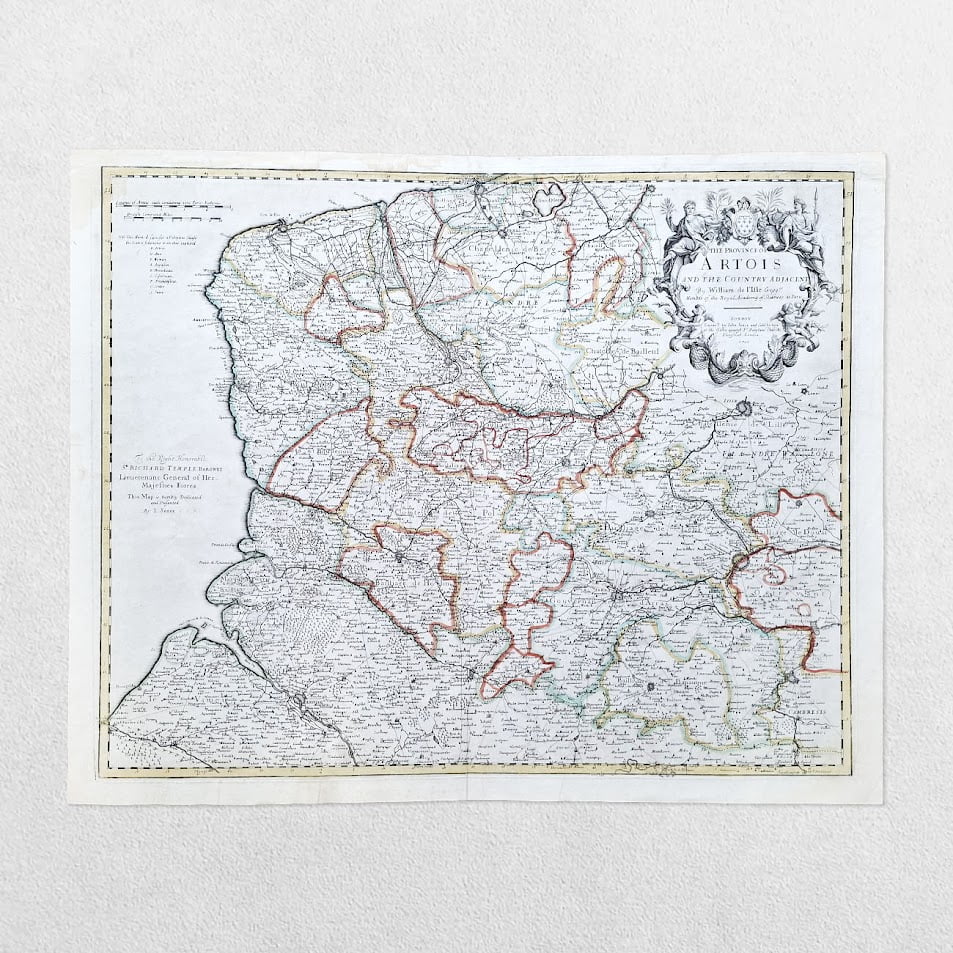
THE PROVINCE OF ARTOIS AND THE COUNTRY ADJACENT
William De Lisle & John Senex
£125.00
Availability: In stock
Product Description
THE PROVINCE OF ARTOIS AND THE COUNTRY ADJACENT
Cartographer: William de Lisle & John Senex
Price: £125.00
Publisher: John Senex, London
Publication Date: 1713
Format: Original copper engraving with early hand-colouring
Condition: Very good
Edition: Not stated
Sheet Size: 64.7cm x 51.9cm
Condition:
Minor staining to the upper margin, which slightly affects the map. Minor age-toning, spotting and creasing but generally very bright and clean with very good margins. A very good, strong impression. Overall in very good, bright, clean condition. Location: Map Drawer C: FS: Folder 1009: 002293
Description:
A rare and finely detailed map of the Province of Artois and its surrounding areas, published in 1713 by the esteemed London cartographer John Senex. Based on the work of William de Lisle, one of the leading French cartographers of the 18th century, this map reflects the high standard of cartographic detail and artistry for which both de Lisle and Senex were known. The map covers the region of Artois, a historic province in northern France, and includes detailed depictions of towns, rivers, and other geographical features. This first edition map, produced at the height of the War of the Spanish Succession, is an excellent example of early 18th-century cartography and would be an interesting addition to any collection of antique maps.
John Senex: A Short Biography
John Senex (1678–1740) was an influential English cartographer, engraver, and publisher, recognized for his contributions to the field of mapmaking during the early 18th century. Senex’s work is particularly noted for its accuracy, artistic quality, and the role it played in the advancement of geographical knowledge during his time.
Early Life and Career:
- Birth: John Senex was born in 1678 in Ludlow, Shropshire, England. Little is known about his early life and education, but by the early 1700s, he had moved to London, where he began his career as an engraver and publisher.
- Initial Work: Senex initially worked in partnership with Charles Price and James Maxwell, two other engravers and mapmakers. Their collaboration produced several notable maps and globes, laying the foundation for Senex’s later success.
Major Contributions:
- Map Publishing: Senex became a leading figure in the London mapmaking community. He was known for his detailed and meticulously crafted maps, many of which were based on the latest geographical discoveries. His works often combined scientific accuracy with artistic embellishments, making them both informative and visually appealing.
- Atlases: Among his notable works is “A New General Atlas,” first published in 1721, which was one of the most comprehensive atlases of its time. This atlas included maps of various parts of the world, reflecting the expanding knowledge of geography during the Age of Enlightenment.
- Celestial Cartography: Senex also made significant contributions to celestial cartography. He published star charts and celestial globes, which were highly regarded for their precision and elegance. His celestial globe, produced in 1719, is particularly well-known and is still considered a masterpiece of early 18th-century craftsmanship.
- Collaborations: Throughout his career, Senex collaborated with other prominent figures in the cartographic world, including William de Lisle, a leading French cartographer. This collaboration resulted in the production of several high-quality maps that combined the latest geographical data from both England and France.
Professional Recognition:
- Fellow of the Royal Society: In recognition of his contributions to the advancement of geographical knowledge, John Senex was elected a Fellow of the Royal Society in 1728. This prestigious honour reflected the importance of his work in both the scientific and cartographic communities.
Legacy and Impact:
- Influence on Cartography: Senex’s maps and atlases were widely used and respected during his lifetime and continued to be influential after his death. His work helped to set standards for accuracy and quality in mapmaking, and his atlases were used as references by explorers, scholars, and navigators.
- Collectability: Today, John Senex’s maps and globes are considered valuable artefacts of the early 18th century. They are prized for their historical significance, artistic merit, and the insight they provide into the geographical knowledge of the time.
Death:
- Passing: John Senex passed away in 1740 in London, leaving behind a rich legacy of cartographic works that continue to be celebrated by historians and collectors alike.
John Senex’s contributions to cartography were instrumental in the dissemination of geographical knowledge during a period of great exploration and scientific inquiry. His maps, atlases, and globes remain important examples of the craftsmanship and intellectual curiosity of the Enlightenment era.
William De Lisle: A Short Biography
Guillaume Delisle (commonly anglicised as William De Lisle) (1675–1726) was a prominent French cartographer, widely regarded as one of the most influential figures in the history of cartography. Delisle’s work marked a significant shift towards more scientifically accurate and detailed maps, setting new standards in the field during the early 18th century.
Early Life and Education:
- Birth: Guillaume Delisle was born on February 28, 1675, in Paris, France, into a family of artists and scholars. His father, Claude Delisle, was a respected historian and geographer, which had a profound influence on Guillaume’s early education and interests.
- Education: Delisle was a child prodigy in geography and cartography. He studied under the tutelage of his father and was exposed to the latest geographical data and scientific methods from an early age. His education was further enriched by his studies in astronomy, which played a crucial role in his approach to mapmaking.
Career and Major Contributions:
- Early Work: Delisle began producing maps as a teenager, with his first map published when he was only 16 years old. His early work demonstrated a remarkable level of detail and accuracy, which quickly gained him recognition.
- Scientific Approach: Delisle is best known for his rigorous and scientific approach to cartography. Unlike many of his predecessors, who often relied on hearsay and speculative information, Delisle insisted on using empirical data collected from explorers, astronomers, and other reliable sources. This commitment to accuracy led to significant improvements in the depiction of geographical features, including coastlines, mountain ranges, and political boundaries.
- Notable Maps: Some of Delisle’s most famous maps include:
- “Carte du Monde” (1700): A world map that corrected many of the errors found in earlier maps, particularly in the depiction of North America.
- “Carte d’Amérique Septentrionale” (1703): A highly detailed map of North America, which for the first time showed the Mississippi River correctly flowing into the Gulf of Mexico.
- “Carte de la Louisiane et du Cours du Mississipi” (1718): This map was one of the earliest detailed representations of the Mississippi River and the surrounding territories.
- Royal Appointment: In 1718, Delisle was appointed “Premier Géographe du Roi” (First Geographer to the King) by King Louis XV. This prestigious position allowed him to work closely with the French court and provided him access to the latest geographical information from French explorers and diplomats.
Legacy and Impact:
- Influence on Cartography: Guillaume Delisle’s work had a profound impact on the field of cartography. His maps were used as references by explorers, scholars, and mapmakers throughout Europe. His influence extended to later generations of cartographers, including his nephew, Philippe Buache, who also became a renowned geographer.
- Accuracy and Detail: Delisle’s emphasis on accuracy and detail set new standards for mapmaking. His maps were known for their clarity, precision, and the use of latitude and longitude based on astronomical observations, which was relatively new at the time.
- Educational Role: Delisle’s maps were not only tools for navigation and exploration but also valuable educational resources. They were used in universities and by scholars to teach geography and to understand the world’s political and physical landscapes.
Death and Legacy:
- Passing: Guillaume Delisle passed away on January 25, 1726, in Paris, at the age of 50. Despite his relatively short life, his contributions to cartography left an enduring legacy.
- Posthumous Influence: After his death, Delisle’s maps continued to be widely used and reproduced. His cartographic methods influenced many subsequent mapmakers, and his work remains highly respected in the history of geography and cartography.
Guillaume Delisle is remembered as a pioneer who brought a new level of accuracy and scientific rigor to mapmaking, helping to shape the way the world was understood during the Age of Enlightenment. His maps are still studied and admired today for their precision, artistry, and historical significance.
SHOP WITH CONFIDENCE AT HORNSEYS
At Hornseys, we are dedicated to offering items that uphold the highest standards of quality and authenticity. Our collection of artwork is carefully curated to ensure that each item we offer is authentic, collated, and complete.
Here’s what sets us apart:
- Authenticity and Provenance: Each map is researched and verified for authenticity, guaranteeing that you receive a genuine signature from the artist.
- Expert Curation: We wholly own all our artworks. We trust our taste and have invested heavily in it. We have confidence in all artwork that we offer for sale.
- Customer Satisfaction: We strive to provide an exceptional customer experience, from detailed descriptions and provenance to secure and prompt delivery of your purchase.
- Returns Policy: We offer an unconditional guarantee on every item. If, however, you wish to make a return, artworks may be sent back to us within fourteen days of receipt for whatever reason. We request that we are notified in advance if you wish to do so. They must be returned to us in the same condition as they were sent for a full refund.
OUR COMMITMENT TO QUALITY AND SERVICE
Understanding the value and rarity of these items, we ensure that every aspect of your purchase meets the highest standards of quality and service. This includes:
- Free Expedited, Tracked, and Insured Delivery within the UK: Ensuring that your artwork arrives safely and promptly.
- Fully-Insured Worldwide Delivery: Offering peace of mind for international collectors with reliable and secure shipping options.
EXPLORE OUR COLLECTION
Visit Hornseys today to explore our fine collection of maps and other artworks. Whether you are an avid collector or looking for a special gift, our selection offers something truly unique. Located since 1976 in Ripon in the picturesque Yorkshire Dales, we are recognized as a destination gallery for tastefully curated artwork, rare maps, design, and fine books.
Related products


You may also like…

ISOLE DI MAJORCA D’IVICA E DI FORMENTERA DI NUOVA PROJEZIONE (BALEARIC ISLANDS)
£225.00Antonio Zatta


