
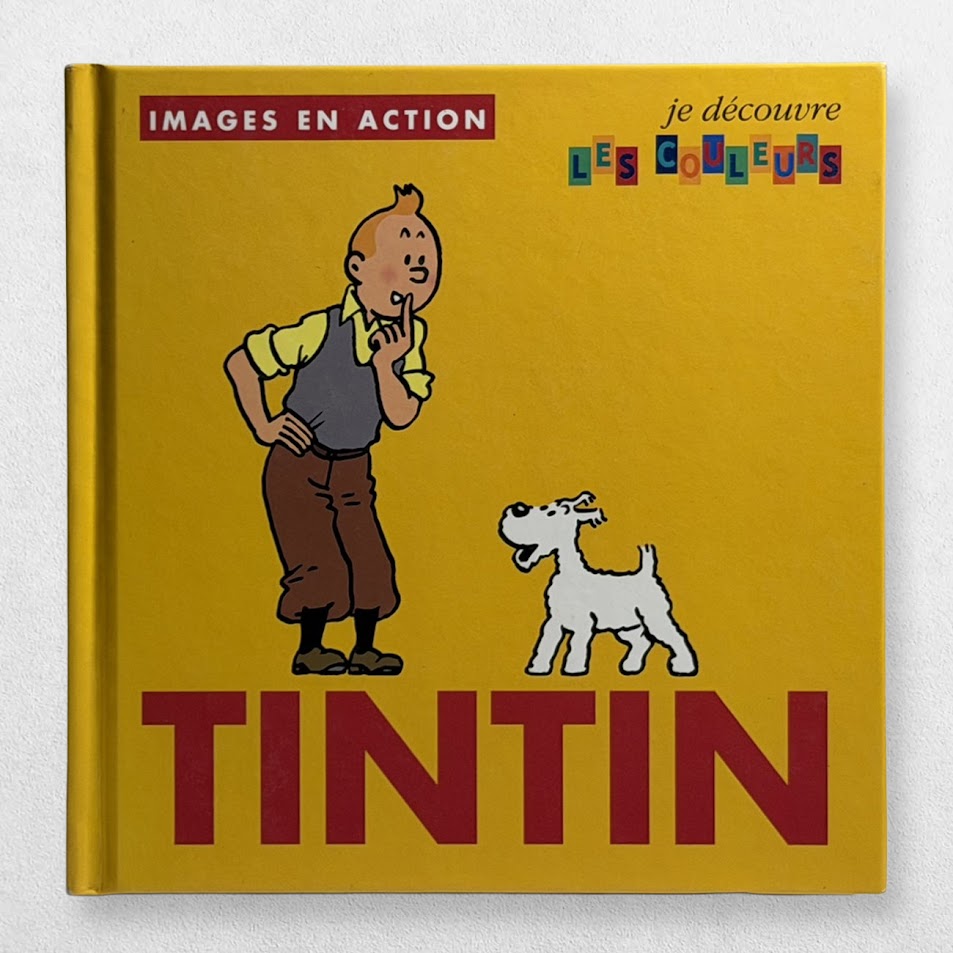

Tintin Images En Action – 9782930284118 – Je Découvre Les Couleurs – First Edition – 2013
Hergé
£23.00
Availability: In stock
Product Description
Tintin Images En Action – 9782930284118 – Je Découvre Les Couleurs – First Edition – 2013
Author: Hergé
Price: £23.00
Publisher: Moulinsart
Publication date: 2013
Format: Original pictorial boards
Condition: Fine
Size: 18.6cm x 18.6cm
Pages: Unpaginated
Illustrations: Illustrated throughout in colour
Description:
Test in French. Fine condition. A brand new copy with minor shelf-wear and slight creasing. Includes folding plates.
‘The Adventures Of Tintin’: A Brief Summary
The Adventures of Tintin is a seminal European comic series created by the Belgian cartoonist Hergé (Georges Remi). First appearing in 1929, the series comprises 24 completed albums published between 1930 and 1976, with a final unfinished work released posthumously. Centred on the exploits of a young reporter, Tintin, the series blends adventure, investigative journalism, political satire, humour, and later, rigorous technical realism.
Over nearly five decades, Tintin evolved from a newspaper strip with topical political aims into one of the most influential bodies of work in twentieth-century popular culture, translated into dozens of languages and adapted for radio, television, theatre, and cinema.
Tintin as Protagonist
Tintin is a Belgian reporter whose profession provides a narrative justification for global travel, investigation, and intervention. Notably, he rarely writes articles; journalism functions instead as a moral framework. Tintin is characterised by integrity, courage, rational thinking, and an unwavering sense of justice. He is neither cynical nor naïve, and unlike many adventure heroes of his era, he relies more on intelligence and persistence than physical dominance.
As the series develops, Tintin becomes less a national or ideological figure and more a universal moral actor, increasingly detached from explicit political agendas.
Core Supporting Characters
Snowy (Milou)
Tintin’s fox terrier companion is integral to the series. Snowy often provides ironic commentary through thought balloons and is both a source of comic relief and genuine intervention. His intelligence, loyalty, and susceptibility to temptation—particularly alcohol—make him a fully realised character rather than a simple mascot.
Captain Haddock
Introduced in The Crab with the Golden Claws, Captain Archibald Haddock becomes the emotional and linguistic counterweight to Tintin. Volatile, alcoholic, deeply humane, and capable of both cowardice and heroism, Haddock’s evolution from compromised seaman to aristocratic landowner mirrors the series’ increasing psychological depth. His inventive insults are a defining feature of the work.
Professor Calculus (Professeur Tournesol)
A brilliant but deaf scientist, Calculus embodies the ambivalence of modern technology. His inventions drive some of the series’ greatest achievements—notably the Moon expedition—while also posing ethical risks. His absent-mindedness conceals formidable intellectual authority.
Thompson and Thomson
The near-identical detectives serve as satirical figures, representing bureaucratic incompetence and institutional inertia. Their literal-mindedness and confidence in their own errors provide sustained comic structure while critiquing officialdom.
Bianca Castafiore
The opera singer introduces themes of celebrity, misinterpretation, and social disruption. Unlike other recurring characters, she resists narrative control, often appearing unexpectedly and destabilising events without malicious intent.
Narrative Development and Themes
Early Period: Ideology and Satire
The earliest albums are overtly political, reflecting the interwar European climate. They are marked by clear ideological positions, simplified moral binaries, and caricatured representations of foreign cultures. While historically significant, these works are increasingly contextualised as products of their time rather than definitive statements of the series’ values.
Middle Period: Adventure and Craft Mastery
From the mid-1930s onwards, Hergé refined his narrative technique, introducing complex plotting, recurring characters, and fictional countries such as Syldavia and Borduria. These settings allowed political allegory without direct reference, enabling greater narrative freedom and durability.
Later Period: Psychological and Moral Complexity
The later albums address themes of guilt, identity, colonial legacy, scientific responsibility, and personal loyalty. Works such as Tintin in Tibet and The Castafiore Emerald shift away from conventional adventure towards introspection and social observation. Action gives way to atmosphere, misunderstanding, and ethical ambiguity.
The Lunar Adventures
The paired albums Destination Moon and Explorers on the Moon represent a peak of technical and narrative ambition. Hergé undertook extensive research to depict space travel with unprecedented realism for the early 1950s. The story addresses secrecy, espionage, scientific risk, and human fallibility, culminating in a rare moment of explicit tragedy. These albums are widely regarded as among the most influential depictions of space travel in popular media prior to real lunar landings.
Artistic and Technical Achievement
Hergé’s distinctive ligne claire style—clean lines, flat colours, and precise backgrounds—prioritises clarity and readability. This approach allows complex action and detailed settings to remain accessible without visual clutter. Over time, Hergé increasingly relied on documentation, photographic reference, and specialist advisors, particularly in architecture, aviation, and science.
The series’ visual discipline supports its narrative authority, contributing significantly to its credibility and longevity.
Cultural Impact and Legacy
The Adventures of Tintin has had a profound influence on comics, graphic novels, and visual storytelling worldwide. Its balance of entertainment, research-driven realism, and ethical inquiry established a benchmark for the medium. The series continues to be studied academically, adapted commercially, and debated critically—particularly in relation to its early ideological content and later humanist turn.
Tintin endures not merely as a fictional character, but as a lens through which twentieth-century European anxieties, aspirations, and moral questions can be examined.
Why Buy from Us?
At Hornseys, we are committed to offering items that meet the highest standards of quality and authenticity. Our collection of rare books is carefully curated to ensure each edition is a valuable piece of bibliographical history. Here’s what sets us apart:
- Authenticity and Provenance: Each book is meticulously researched and verified for authenticity and collation.
- Expert Curation: Our selection process focuses on significance, condition, and rarity, resulting in a collection that is both diverse and distinguished.
- Customer Satisfaction: We aim to provide an exceptional customer experience, from detailed descriptions to secure and prompt delivery of your purchase.
- Returns Policy: We offer an unconditional guarantee on every item. If you wish to return a book, it may be sent back to us within fourteen days of receipt. Please notify us in advance if you wish to do so. The book must be returned in the same condition as it was sent for a full refund.
Related products

When We Were Very Young – Winnie The Pooh – Now We Are Six – The House At Pooh Corner – The Collectors’ Facsimile Edition – Four Volumes In Slipcase
£85.00Milne, A. A. & Shepard, Ernest H


