
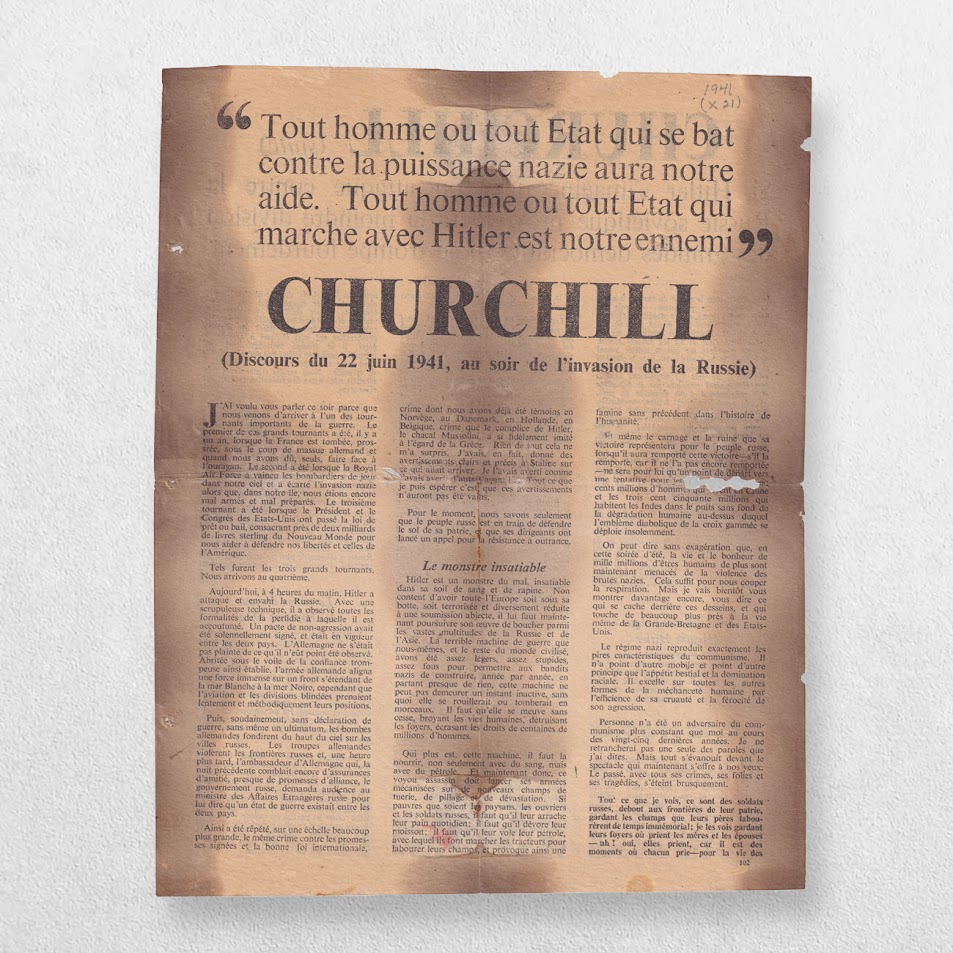
Tout Homme Ou Tout Etat Qui Se Bat Contre La Puissance Nazie Aura Notre Aide – Tout Homme Ou Tout Etat Qui Marche Avec Hitler Est Notre Ennemi – Any Man Or Any State That Fights Against Nazi Power Will Have Our Help – Any Man Or Any State That Sides With Hitler Is Our Enemy
Churchill, Winston Spencer
£150.00
Availability: In stock
Product Description
Tout Homme Ou Tout Etat Qui Se Bat Contre La Puissance Nazie Aura Notre Aide – Tout Homme Ou Tout Etat Qui Marche Avec Hitler Est Notre Ennemi – Any Man Or Any State That Fights Against Nazi Power Will Have Our Help – Any Man Or Any State That Sides With Hitler Is Our Enemy
Author: Churchill, Winston Spencer
Price: £150
Publisher: Published in London
Editions: 1st edition
Publication Date: 1941
Format: Original single octavo sheet
Condition: Very good
Size: Quarto
Description:
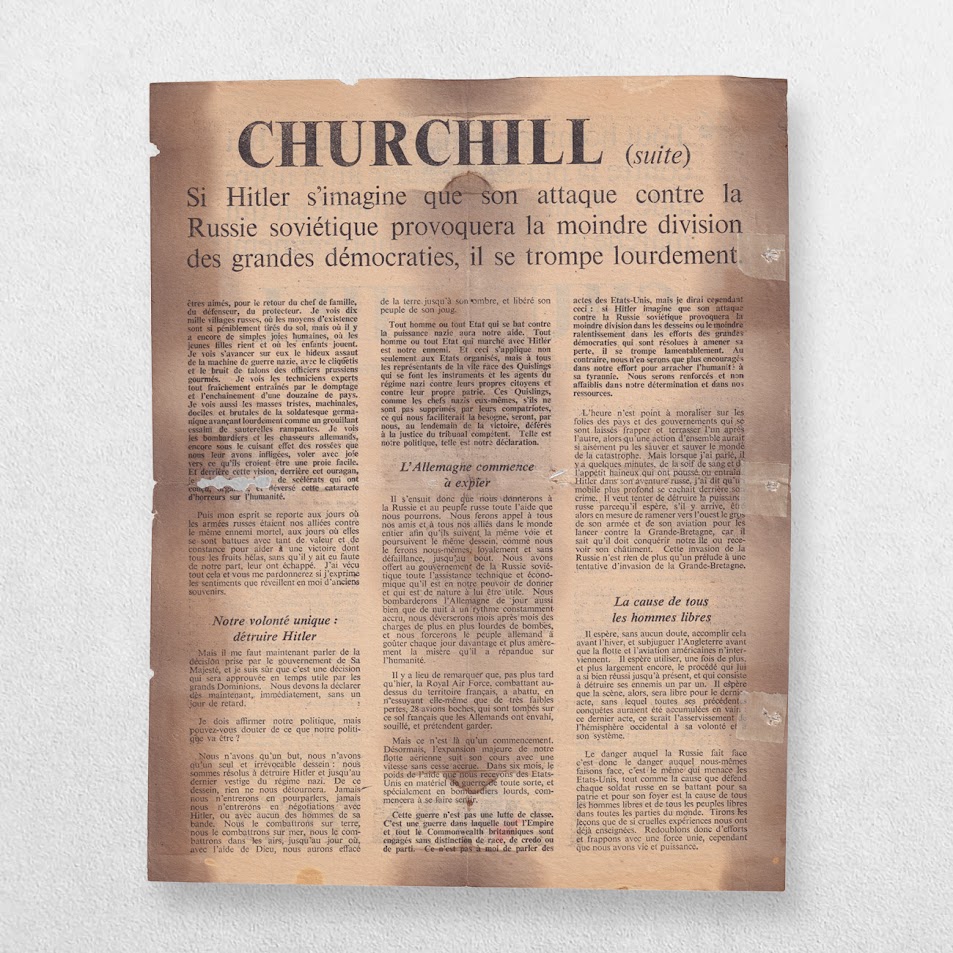
Single quarto sheet. Printed on both sides. Propaganda leaflet dated 1941 which reprints the speech of Winston Churchill on the night of the invasion of Russia. Text in French. Old fold lines. Puncture holes to left hand margin with strengthening tabs verso. Uneven toning and marks to the paper. Chipping to the margins and with a small amount of loss to the text. In good only condition. Very fragile and now housed in a clear, removable folding acetate sleeve. From the collection of Steve Forbes, chairman of Forbes Magazine, who formed arguably the finest ever collection of Churchilliana.
Adolf Hitler And The German Invasion Of Russia: A Brief Summary
In the early hours of 22 June 1941, Adolf Hitler launched Operation Barbarossa, a massive military campaign that would become the largest land invasion in history. This surprise assault on the Soviet Union marked a turning point in the Second World War and revealed both the strategic overreach of Nazi Germany and the resilience of the Soviet war machine.
Background and Motives
Hitler had long viewed the Soviet Union as both an ideological enemy and a territorial prize. His contempt for communism and his belief in Lebensraum — the notion that Germany required living space in the East — convinced him that war with the USSR was inevitable. Despite the Molotov–Ribbentrop Pact of 1939, which had temporarily neutralised Soviet-German tensions, Hitler saw Stalin’s regime as a temporary obstacle to be removed.
Strategically, Hitler also believed that Britain continued to resist German domination in the hope of Soviet or American intervention. By defeating the USSR swiftly, he aimed to remove that hope and compel Britain to sue for peace.
The Launch of Operation Barbarossa
Operation Barbarossa was colossal in scale. Around three million German troops, supported by hundreds of thousands of Axis allies, surged across an 1,800-mile front. They were organised into three major army groups:
- Army Group North, tasked with advancing through the Baltic states towards Leningrad;
- Army Group Centre, focused on the drive towards Moscow;
- Army Group South, aimed at capturing Ukraine and the rich agricultural lands beyond.
The attack caught the Soviets by surprise. Despite numerous warnings from foreign governments and intelligence sources, Stalin had refused to believe that Hitler would violate their non-aggression pact. As a result, Soviet forces were poorly positioned and inadequately prepared when the assault began.
Initial German Successes
In the first weeks of the campaign, German forces made rapid gains. Entire Soviet divisions were encircled and destroyed. The Luftwaffe quickly gained air superiority, and vast tracts of Soviet territory were overrun. Kiev, Smolensk, and Minsk fell in quick succession. The Red Army suffered catastrophic losses in men and equipment.
However, despite these tactical victories, strategic cracks began to show. The vastness of the Russian landscape, combined with underdeveloped infrastructure, hampered German logistics. The scorched earth policy adopted by retreating Soviet forces further complicated supply efforts.
Soviet Resistance and Strategic Depth
One of Germany’s greatest miscalculations was its underestimation of Soviet capacity for resistance and recovery. Stalin, initially paralysed by the invasion, soon regrouped. He mobilised the nation through a mix of terror, propaganda, and patriotism, calling for a “Great Patriotic War.”
The Soviet Union’s immense manpower reserves began to tell. Despite horrific losses, new armies were raised and deployed. Soviet industry, much of which had been relocated east of the Urals, began to produce tanks, aircraft, and munitions at scale.
Moreover, the Germans were not prepared for the sheer depth of Soviet territory. As they pushed deeper into the USSR, supply lines became dangerously extended, and attrition began to take its toll.
The Turning Point: Moscow and the Onset of Winter
By autumn 1941, Hitler shifted focus to capturing Moscow. The German High Command launched Operation Typhoon, a concentrated assault on the Soviet capital. Though initial progress was promising, the advance slowed as autumn rains turned roads to mud. Then came the Russian winter — earlier and harsher than expected.
German troops, ill-equipped for freezing temperatures, faced deteriorating conditions, fuel shortages, and fierce Soviet resistance. In December, Soviet forces launched a counter-offensive, pushing the Germans back from the outskirts of Moscow. For the first time, the Wehrmacht had failed to achieve its objectives — and had been forced to retreat.
Consequences and Legacy
Operation Barbarossa failed to deliver the swift victory Hitler had anticipated. Instead, it opened a brutal and prolonged Eastern Front that would drain German resources and lead to millions of deaths on both sides. The ideological nature of the conflict led to unprecedented cruelty, including mass executions, starvation, and the Holocaust in the occupied territories.
Strategically, the invasion marked a fatal over-extension of German power. By engaging in a two-front war, Germany placed itself in an unwinnable position. The failure to defeat the Soviet Union in 1941 laid the groundwork for the eventual collapse of the Third Reich.
Sir Winston Churchill: A Brief Biography
Early Life and Education
Sir Winston Leonard Spencer Churchill was born on 30 November 1874 at Blenheim Palace in Oxfordshire. He was the elder son of Lord Randolph Churchill, a prominent Conservative politician, and Jennie Jerome, an American socialite. From an early age, Churchill was immersed in the worlds of politics and aristocracy, yet his formative years were marked by academic inconsistency and a yearning for recognition.
Educated at Harrow School, Churchill struggled in traditional subjects but excelled in English and history. He went on to attend the Royal Military College, Sandhurst, where he graduated eighth in his class and was commissioned into the 4th Queen’s Own Hussars in 1895. His military service provided the foundation for his lifelong engagement with strategy, empire, and leadership.
Military Service and Early Writings
Churchill’s early career was defined by adventurous military postings in Cuba, India, the Sudan, and South Africa. He served as both a soldier and a war correspondent, gaining fame for his daring escape from a Boer prison camp in 1899. These exploits not only elevated his public profile but also helped to establish his reputation as a man of action and eloquence.
His early writings, including The Story of the Malakand Field Force and The River War, combined first-hand experience with historical reflection, showcasing a command of language and a talent for narrative that would characterise his later works. These publications also hinted at his imperial convictions and deep-seated belief in Britain’s global mission.
Political Ascent
Churchill entered Parliament in 1900 as the Conservative MP for Oldham but soon defected to the Liberal Party, advocating social reform and free trade. As President of the Board of Trade (1908–1910) and Home Secretary (1910–1911), he promoted progressive policies such as labour exchanges, national insurance, and prison reform.
In 1911, he was appointed First Lord of the Admiralty, a role in which he modernised the Royal Navy in anticipation of global conflict. His strategic vision and reformist zeal were evident, but his judgement would come under scrutiny during the First World War.
The Dardanelles and Political Repercussions
Churchill played a central role in the ill-fated Dardanelles campaign of 1915, a failed naval operation intended to open a new front against the Ottoman Empire. The catastrophic outcome led to his removal from the Admiralty, a political setback that haunted him for years.
In response, Churchill re-joined the army and served on the Western Front. This period of introspection and humility contributed to a deeper understanding of the burdens of leadership, tempering his ambition with a renewed sense of purpose.
Return to Government and Interwar Years
Churchill returned to politics with determination, serving in a range of ministerial posts, including Secretary of State for War and Chancellor of the Exchequer. By the late 1920s, he had rejoined the Conservative Party, but his opposition to Indian self-rule and his handling of the General Strike made him a polarising figure.
During the 1930s, as Hitler rose to power, Churchill warned repeatedly of the growing threat of fascism. Though out of office, his speeches in Parliament and articles in the press demonstrated a prescient understanding of Nazi ambitions. He became increasingly isolated — yet when the moment came, his voice would prove indispensable.
Leadership in the Second World War
In May 1940, following the resignation of Neville Chamberlain, Churchill was appointed Prime Minister. His premiership during the Second World War remains one of the most consequential in modern history. At a time when Britain stood alone against Nazi Germany, Churchill’s oratory galvanised the nation. Phrases such as “We shall fight on the beaches” and “Their finest hour” became emblematic of British resistance.
He forged crucial alliances with the United States and the Soviet Union, coordinating the Allied war effort while maintaining morale at home. Despite the strain of prolonged conflict, Churchill remained a resolute leader, presiding over military decisions, diplomacy, and civil defence.
His relationship with President Franklin D. Roosevelt was central to Britain’s wartime survival, and though complex, his interactions with Stalin helped shape the post-war balance of power. Churchill’s leadership was instrumental in securing ultimate victory in Europe in 1945.
Post-War Politics and the Iron Curtain
In the 1945 general election, Churchill’s Conservative Party was defeated, a result reflecting public demand for social reform rather than a repudiation of his leadership. Nonetheless, he continued as Leader of the Opposition and remained a prominent voice on global affairs.
In 1946, Churchill delivered his famous “Iron Curtain” speech, warning of Soviet expansionism and marking the beginning of the Cold War. This speech underscored his continued relevance on the world stage and his enduring commitment to defending democratic values.
He returned to power as Prime Minister in 1951 at the age of 76, serving until 1955. Although his final term was marked by declining health and limited domestic reform, he remained a revered statesman and a symbol of British resilience.
Literary Achievements and Honours
Churchill was not only a politician and soldier but also a prolific writer and historian. His six-volume work The Second World War and four-volume A History of the English-Speaking Peoples established him as one of the leading historical writers of the 20th century. In 1953, he was awarded the Nobel Prize in Literature for his mastery of historical and biographical narrative.
He was also made a Knight of the Garter and granted honorary citizenship of the United States — a rare honour for a foreign national.
Final Years and Legacy
Churchill retired from active politics in 1955 but remained a member of Parliament until 1964. He died on 24 January 1965 at the age of 90. His state funeral, the first for a non-royal since the Duke of Wellington, was a national event, attended by leaders from across the world.
Churchill’s legacy is profound and complex. He is remembered as the indomitable leader who helped save Western civilisation from tyranny, a gifted writer, and a tireless defender of Britain’s interests. Yet he was also a man of controversy — his views on empire, race, and class have provoked ongoing debate.
Nevertheless, few figures have so deeply shaped the course of modern British and global history. Churchill’s life, marked by courage, intellect, and eloquence, remains a compelling example of leadership in times of both triumph and trial.
Why buy from us?
At Hornseys, we are committed to offering items that meet the highest standards of quality and authenticity. Our book collection is meticulously curated to ensure that each edition is a valuable and authentic piece of bibliographical history. Here’s what sets us apart:
- Authenticity and Provenance: Every book is researched, collated, and verified for authenticity.
- Expert Curation: Each book is selected with a keen eye for significance, condition, and rarity, ensuring a collection that is both diverse and distinguished.
- Customer Satisfaction: We strive to provide an exceptional customer experience, from detailed descriptions and provenance to secure and prompt delivery of your purchase.
- Returns Policy: We offer an unconditional guarantee on every item. If you wish to make a return, books may be sent back to us within fourteen days of receipt for any reason. We request advance notification of returns, and books must be returned in the same condition as sent for a full refund.
Explore Our Collection:
Visit Hornseys to explore our fine collection of rare and signed books. Whether you are an avid collector or looking for a special gift, our selection offers something truly unique. Located in the picturesque Yorkshire Dales, our Ripon gallery has been a haven for book lovers, art enthusiasts, and collectors since 1976.
Related products


You may also like…
-

Army (Military Savings Banks) Statement Of The Amount Due By The Public To Depositors In Military Savings Banks On The 31st March 1917…
£40.00Churchill, Winston Spencer
-

What Kind Of A People Do They Think We Are? Two Historic Speeches Made By The Rt. Hon. Winston Spencer Churchill – Second Issue
£25.00Churchill, Winston Spencer
-

-

King George VI – The Prime Minister’s Broadcast Thursday February 7 1952
£25.00Churchill, Winston Spencer
-

The Days Ahead – Speech By The Rt. Hon. Winston Churchill O.M., C.H., M.P At The Ibrox Park Stadium, Glasgow 20th May 1949
£135.00Churchill, Winston Spencer
-

The National Policy – As Set Forth By Mr Asquith, Sir Edward Grey, Mr Churchill, Mr Lloyd George, Mr Austen Chamberlain, Mr Balfour, Mr Bonar Law, Mr Arthur Henderson And Others
£35.00Churchill, Winston Spencer Contributes
-

-

The Naval Memoirs Of Admiral Of The Fleet Sir Roger Keyes: Scapa Flow To The Dover Straits, 1916-1918 Inscribed By Keyes To Commander J H Owen
£225.00Keyes, Admiral Sir Roger & (Churchill, Winston S.)