
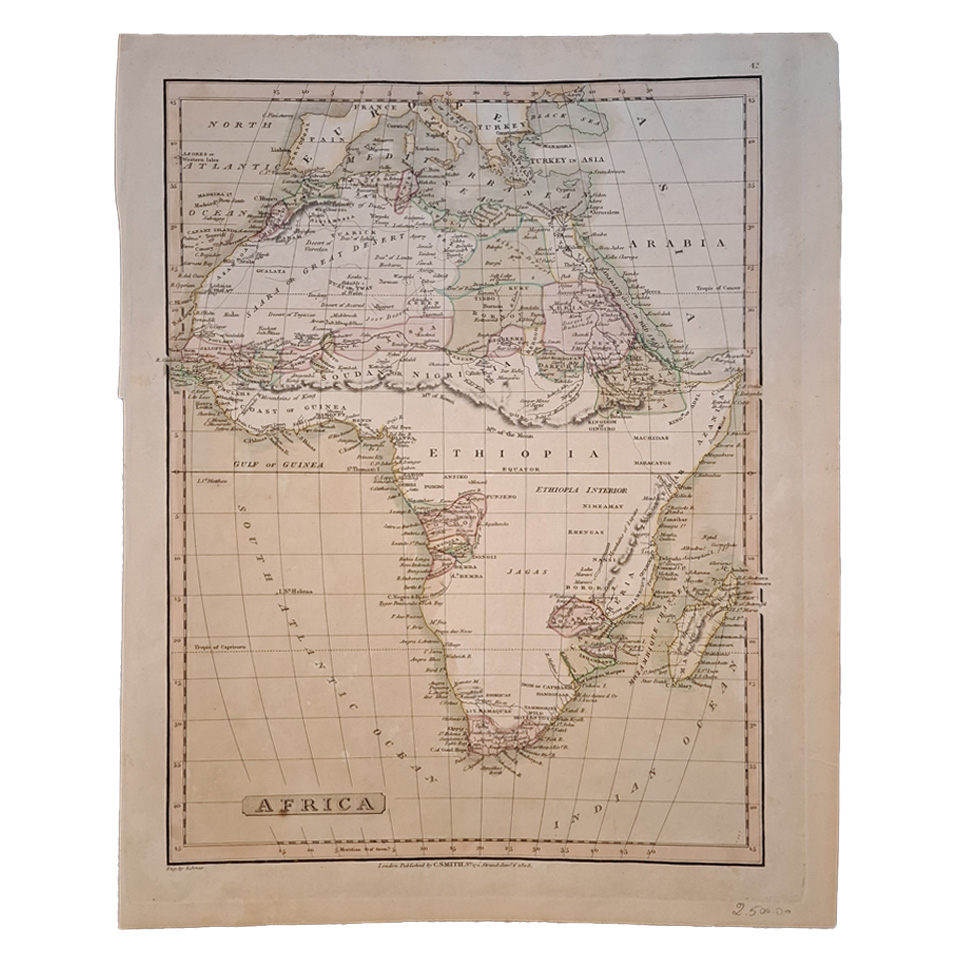
AFRICA PUBLISHED BY CHARLES SMITH
Smith, Charles
£50.00
Availability: In stock
Product Description
AFRICA PUBLISHED BY CHARLES SMITH
Publisher: C. Smith
Price: £50
Publication Date: 1808
Edition: Presumed 1st edition
Format: Copper engraving
Condition: In very good condition, unframed
Sheet Size: 31.4cm x 39.7cm
Condition:
Plate 42 from Smith’s New General Atlas Containing Distinct Maps Of All The Principle Empires, Kingdoms & States Throughout The World. Minor age-spots and foxing. Original hand-colouring. Reverse is blank with very minor age toning and marks. In very good, original condition.
Location: Map Drawer C: FS: Folder M2000 002575
Africa At The Beginning Of The 19th Century: A Short History
At the beginning of the 19th century, Africa was a vast and diverse continent characterised by a rich tapestry of cultures, languages, and civilisations. Politically and socially, it was a patchwork of kingdoms, empires, tribal confederations, and independent communities, each with its unique systems of governance and ways of life. The continent was not yet fully colonised by European powers, though foreign influence was beginning to reshape its dynamics, particularly along the coasts.
Political Landscape
In West Africa, powerful empires such as the Sokoto Caliphate and the Asante Empire were prominent. The Sokoto Caliphate, established in 1804 following the Fulani Jihad, was an Islamic state that expanded through much of what is now northern Nigeria and neighbouring regions. The Asante Empire, located in present-day Ghana, was a dominant force, renowned for its military strength and centralised governance.
In East Africa, the Swahili Coast was a vibrant hub of trade, influenced by centuries of interaction with Arab, Persian, and Indian merchants. The island of Zanzibar was emerging as a central trading port, especially for goods such as ivory and slaves. Inland, kingdoms like Buganda in modern Uganda were consolidating power and expanding their territories.
Southern Africa was dominated by the Zulu Kingdom, which was rising under the leadership of Shaka Zulu. His military innovations and statecraft reshaped the region, leading to widespread migrations and conflicts, a period known as the Mfecane. The Cape Colony, under Dutch control but soon to be ceded to the British, marked the growing European presence in the south.
North Africa, by contrast, remained under the sway of the Ottoman Empire and its vassal states, such as Egypt and the Barbary States. Egypt, under the leadership of Muhammad Ali from 1805, was embarking on significant modernisation efforts, positioning itself as a semi-independent power within the Ottoman realm.
Economic Activity
Africa’s economy was largely subsistence-based, with agriculture, fishing, and pastoralism forming the backbone of many communities. However, trade networks crisscrossed the continent, linking inland areas with coastal ports. West Africa was known for its gold, kola nuts, and textiles, while East Africa exported ivory, spices, and enslaved people. The trans-Saharan trade routes continued to thrive, connecting sub-Saharan Africa with North Africa and the Mediterranean.
The Atlantic slave trade, although in decline by the early 19th century due to abolitionist movements in Europe and the Americas, remained a significant enterprise. Coastal kingdoms and European traders collaborated in capturing and selling enslaved people, leading to profound social disruptions in many regions.
Cultural and Social Structures
Africa’s cultural diversity was immense, with thousands of languages spoken and a wealth of artistic traditions, oral histories, and spiritual practices. Islam and Christianity were well established in certain areas, particularly North and West Africa, while traditional African religions remained dominant in much of the interior.
Societies were organised in a variety of ways, from centralised kingdoms with complex hierarchies to more egalitarian clan-based systems. Social roles were often delineated by age, gender, and lineage, with elders playing key roles in decision-making and maintaining communal traditions.
External Influences
European interest in Africa was growing but largely confined to coastal areas. The British and French were expanding their trading posts and influence, while the Portuguese maintained a stronghold in Angola and Mozambique. The Napoleonic Wars (1799–1815) had disrupted European activities temporarily, but the abolitionist movement was beginning to reshape international trade patterns.
Arab influence was particularly significant along the eastern and northern coasts, with thriving cultural exchanges and intermarriage between Arab traders and local communities. India also played a role, especially in East Africa, where Indian merchants were active in trade.
Challenges and Transitions
The early 19th century was a period of significant transition for Africa. The growing abolitionist movements in Europe and the Americas were beginning to impact the transatlantic slave trade, though the internal African slave trade persisted. The arrival of European missionaries and explorers heralded the gradual encroachment of Western influence, which would accelerate in the latter half of the century.
Africa at this time was not a passive landscape awaiting European domination but a continent teeming with life, complexity, and agency. Its people were actively shaping their destinies amidst the pressures of internal change and external intrusion.
Charles Smith: A Short Biography
Charles Smith (1768–1854) was a distinguished British mapmaker, publisher, and seller of maps and globes, who operated from premises at 172 Strand, London, during the early 19th century. Renowned for his precision and craftsmanship, Smith became a leading figure in British cartography, producing maps and atlases celebrated for their clarity and accuracy.
In 1808, Smith published the second edition of Smith’s New English Atlas, which presented meticulously detailed county maps of England and Wales. This work exemplified his commitment to quality, providing both beauty and utility for those seeking comprehensive geographical information. His maps were highly regarded, often rivalling those of contemporaries such as John Cary, due to their combination of aesthetic appeal and scientific rigour.
Smith’s output extended beyond atlases, encompassing road maps, pocket companions, and other practical cartographic works. These publications were designed to meet the needs of a society increasingly reliant on reliable and accessible geographical information, reflecting the growing mobility and curiosity of the time.
In 1809, Smith’s reputation earned him the prestigious appointment as map seller to the Prince of Wales. This accolade underscored the excellence of his work and his standing in the cartographic world. Smith’s maps were regularly updated to include the latest geographical and infrastructural developments, such as the expanding network of railways, ensuring their relevance and accuracy for contemporary users.
Throughout his career, Charles Smith significantly influenced the field of British cartography. His maps not only served practical purposes but also became valued resources for academic study. By blending artistry with precision, Smith’s work continues to be admired as a hallmark of 19th-century cartographic excellence.
SHOP WITH CONFIDENCE AT HORNSEYS
At Hornseys, we are dedicated to offering items that uphold the highest standards of quality and authenticity. Our collection of artwork is carefully curated to ensure that each item we offer is authentic, collated, and complete.
Here’s what sets us apart:
- Authenticity and Provenance: Each map is researched and verified for authenticity.
- Expert Curation: We wholly own all our artworks. We trust our taste and have invested heavily in it. We have confidence in all artwork that we offer for sale.
- Customer Satisfaction: We strive to provide an exceptional customer experience, from detailed descriptions and provenance to secure and prompt delivery of your purchase.
- Returns Policy: We offer an unconditional guarantee on every item. If, however, you wish to make a return, artworks may be sent back to us within fourteen days of receipt for whatever reason. We request that we are notified in advance if you wish to do so. They must be returned to us in the same condition as they were sent for a full refund.
OUR COMMITMENT TO QUALITY AND SERVICE
Understanding the value and rarity of these items, we ensure that every aspect of your purchase meets the highest standards of quality and service. This includes:
- Free Expedited, Tracked, and Insured Delivery within the UK: Ensuring that your artwork arrives safely and promptly.
- Fully-Insured Worldwide Delivery: Offering peace of mind for international collectors with reliable and secure shipping options.
EXPLORE OUR COLLECTION
Visit Hornseys today to explore our fine collection of maps and other artworks. Whether you are an avid collector or looking for a special gift, our selection offers something truly unique. Located since 1976 in Ripon in the picturesque Yorkshire Dales, we are recognised as a destination gallery for tastefully curated artwork, rare maps, design, and fine books.
Related products


You may also like…

PLAN DE LA BAIE DE LA CONCEPTION SITUEE DANS LE CHILI – ORIGINAL COPPER ENGRAVED MAP
£80.00de Galaup, Jean-François, Comte de La Pérouse


