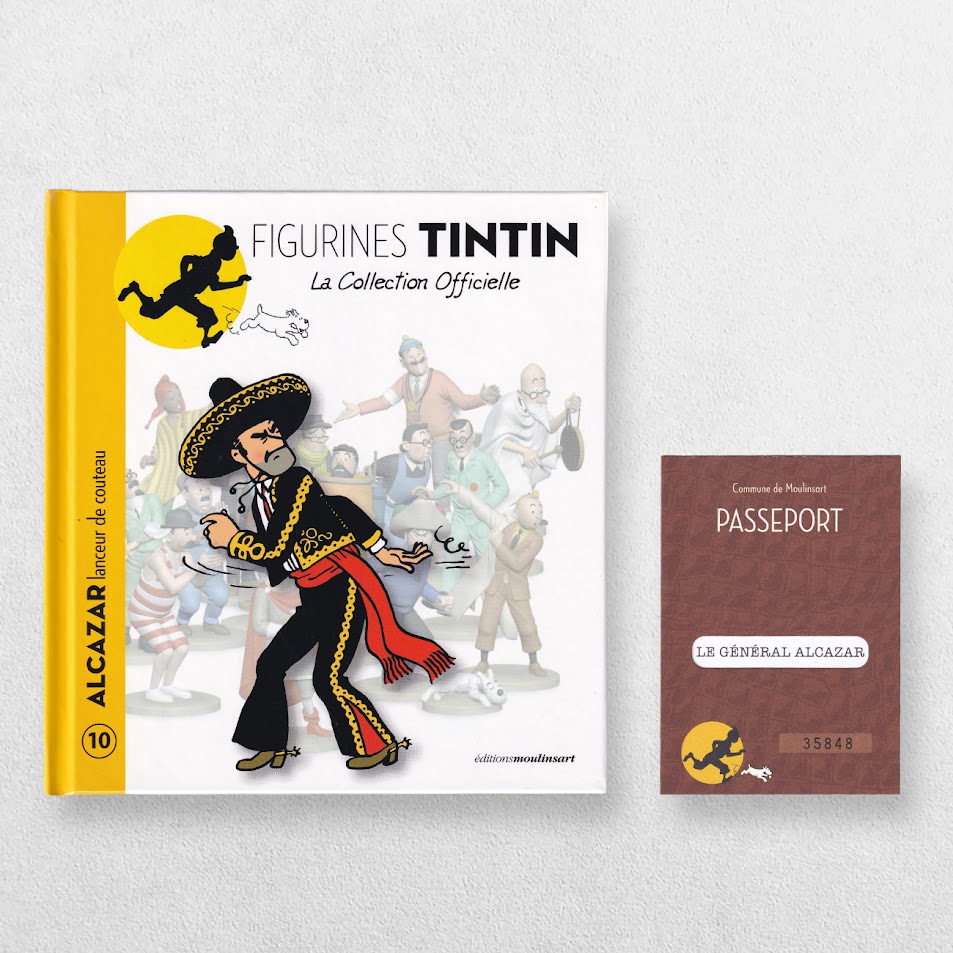
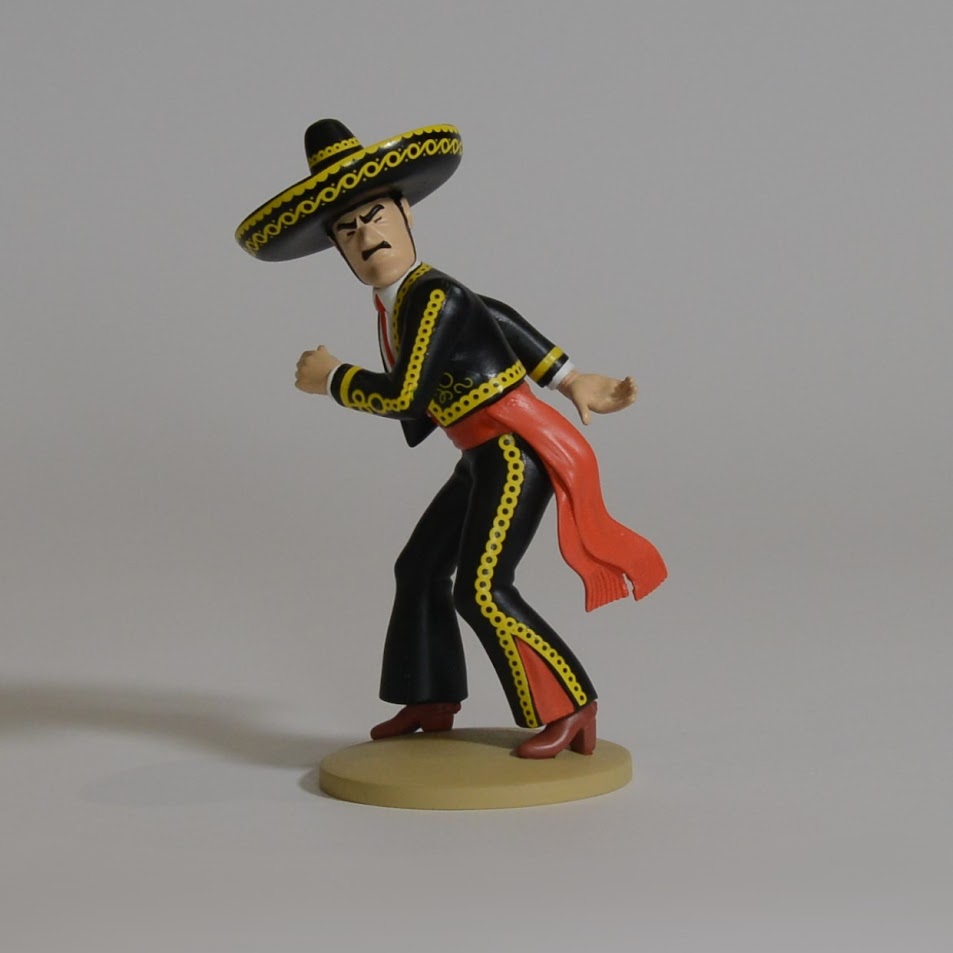
Alcazar The Knife Thrower – Figurines Tintin La Collection Officielle – 10 – Alcazar Lanceur De Couteau
Author: Hergé & Editions Moulinsart
Price: £55.00
Publisher: Editions Moulinsart
Publication date: 2012
Format: Original pictorial boards with passport and figurine
Condition: In new condition
Illustrations: Illustrated throughout
Description:
Original pictorial boards. Includes passport loosely inserted. Text in French. Includes the accompanying figurine. One from the collection of 111 books and figurines. In new condition in original packaging.
Alcazar The Knife Thrower: A Brief Account
General Alcazar, one of Hergé’s recurring figures in The Adventures of Tintin, is best known as a volatile South American leader caught in the endless cycle of coups and counter-coups. Yet, in between his stints of power and exile, Alcazar takes on an unexpected role: that of a knife-thrower in a touring variety act. This striking image of a military strongman turned circus performer is one of Hergé’s most pointed examples of satire, underlining the instability of political ambition while injecting humour into the narrative.
Origins of the Role
Alcazar first appears as the archetype of the flamboyant revolutionary general, complete with uniform, medals, and explosive temper. When the wheel of fortune turns against him, however, he is forced into civilian life. Hergé’s decision to depict him as a knife-thrower highlights both his adaptability and his reduced circumstances. The man who once commanded armies now commands only applause from audiences, exchanging political authority for the spectacle of entertainment.
The Knife as Symbol
The choice of knives is significant. Weapons once associated with violence and political struggle are reimagined as instruments of showmanship. In Alcazar’s hands, the knife retains its danger but is channelled into precision, skill, and display rather than outright aggression. The act symbolises the thin line between violence and performance, reminding readers that the general’s temperament is never far from eruption.
Comic Potential
Much of the humour in Alcazar’s role as knife-thrower comes from incongruity. A man accustomed to coups and proclamations now performs under stage lights, his uniform replaced with showman’s attire. His relationship with his assistant, invariably long-suffering, reinforces the comic absurdity of the situation. Hergé uses these scenes to lampoon both Alcazar’s ego and the fickle nature of politics, where today’s general may be tomorrow’s cabaret act.
Social Commentary
Hergé was attentive to contemporary geopolitics, and Alcazar embodies the caricature of Latin American dictators who cycled in and out of power. By reducing him to a knife-thrower, Hergé comments on the theatricality of such regimes: power struggles presented as performance, bluster masking fragility. The circus stage becomes a metaphor for politics itself, where spectacle, danger, and showmanship overshadow substance.
Psychological Dimension
Despite the humour, Alcazar’s knife-throwing also reflects his resilience. Stripped of political command, he refuses to fade into obscurity. Instead, he reinvents himself, albeit in a diminished form. The knife-throwing routine provides him with a semblance of control—each successful throw a small assertion of precision and authority. It shows that while his circumstances change, his combative spirit endures.
Visual Impact
Hergé’s drawings of Alcazar in this guise are sharp and theatrical. The knives glint, the assistant looks apprehensive, and Alcazar’s concentration is palpable. The visual drama of the act echoes his political life: danger, risk, and the constant potential for catastrophe. By transferring the imagery of conflict onto the circus stage, Hergé ensures that Alcazar remains visually dynamic even in exile.
Legacy of the Image
The portrayal of Alcazar as the knife-thrower remains one of the most memorable reinventions of a Tintin character. It demonstrates Hergé’s gift for blending comedy with satire, turning political commentary into vivid storytelling. For readers, the image is both absurd and poignant: a once-feared general reduced to theatrical spectacle, yet still bristling with energy and danger. It captures the essence of Alcazar—volatile, proud, adaptable, and always on the edge of either triumph or disaster.
Why Buy from Us?
At Hornseys, we are committed to offering items that meet the highest standards of quality and authenticity. Our collection of objects and rare books are carefully curated to ensure each edition is a valuable piece of bibliographical history. Here’s what sets us apart:
- Authenticity and Provenance: Each item is meticulously researched and verified for authenticity and collation.
- Expert Curation: Our selection process focuses on significance, condition, and rarity, resulting in a collection that is both diverse and distinguished.
- Customer Satisfaction: We aim to provide an exceptional customer experience, from detailed descriptions to secure and prompt delivery of your purchase.
- Returns Policy: We offer an unconditional guarantee on every item. If you wish to return an item, it may be sent back to us within fourteen days of receipt. Please notify us in advance if you wish to do so. The item must be returned in the same condition as it was sent for a full refund.