

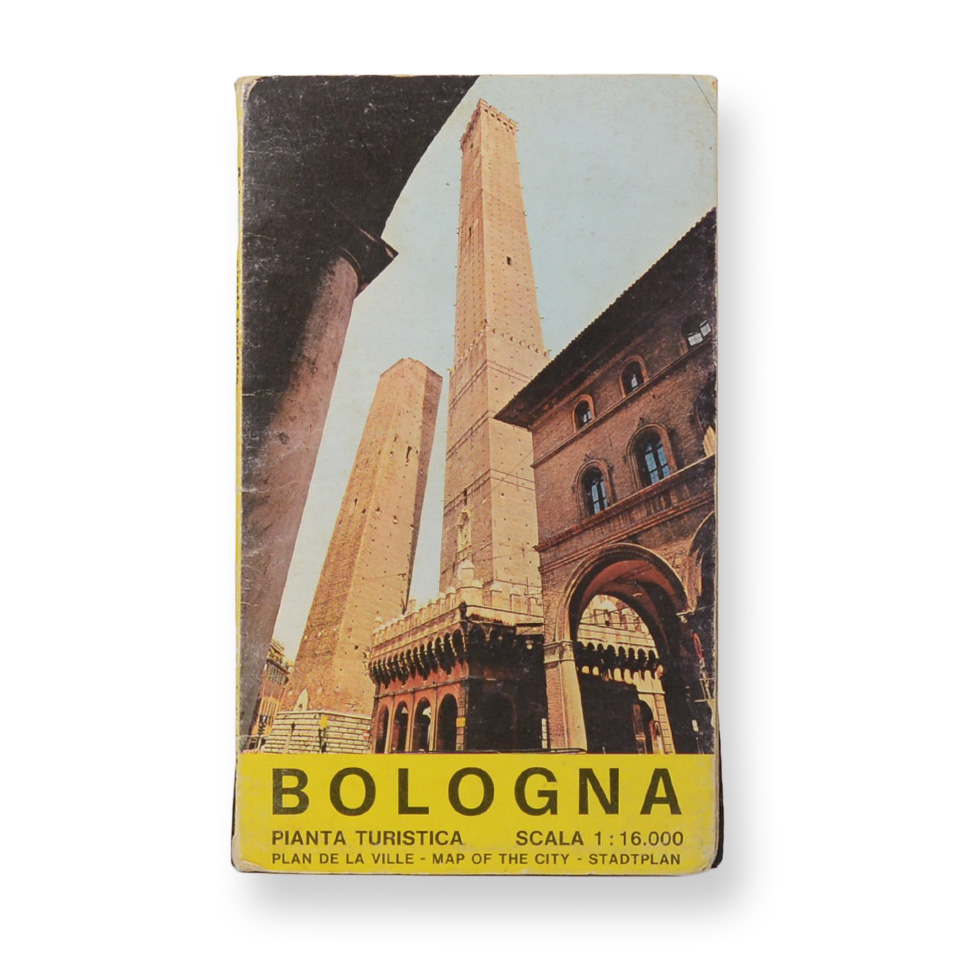

Bologna Pianta Turistica – Map Of The City – Scala 1: 16000
Studio F.M.B
£30.00
Availability: In stock
Product Description
Bologna Pianta Turistica – Map Of The City – Scala 1: 16000
Publisher: Studio F.M.B
Price: £30 including postage in the UK
Publication Date: c. 1965
Edition: Not stated
Map Size: 70cm x 50cm
Binding: Original wrappers
Condition: Very good plus in very good plus binding
Condition:
Date: c.1965. Folding map. Size when opened out: 70cm x 50cm. Map is bright and clean and in lovely condition with only minor age-toning and a short closed tear to one margin. The reverse gives details of the attractions of the city. In very good plus condition overall.
Bologna In The 1960s: A Brief Overview
The 1960s were a transformative decade for Bologna, a city with an ancient medieval core, one of Europe’s most prestigious universities, and a long-established political identity rooted in the left. During this period, Bologna experienced rapid economic growth, significant urban development, and rising social and political activism, all set against the wider backdrop of Italy’s post-war “economic miracle.”
The decade defined Bologna’s modern character — progressive, prosperous, culturally dynamic, and committed to civic improvement.
- Political Context and Governance
A Stronghold of the Italian Left
Throughout the 1960s, Bologna was governed by a stable alliance led by the Italian Communist Party (PCI), which had held power in the city since immediately after the Second World War. Bologna became renowned for:
- High levels of civic participation
- Effective public administration
- Progressive social policies
- Extensive public services and welfare provisions
The city was frequently cited as a model of “good government” within a democratic left-wing framework.
A Climate of Stability
While other Italian cities experienced more volatile political shifts, Bologna enjoyed unusual continuity. This stability allowed the municipality to invest heavily in infrastructure, transport, education, and cultural institutions.
- Economic Transformation
The Italian Economic Miracle
Like much of northern and central Italy, Bologna benefitted from the boom of the late 1950s and 1960s, during which Italy transitioned from a largely agrarian economy to a prosperous industrial power.
Key features of Bologna’s economy in this period included:
- Growth in mechanical engineering and precision manufacturing
- Expansion of the food industry, with Bologna’s longstanding gastronomic traditions contributing to commercial success
- Strengthening of the cooperative movement, which played a crucial role in retail, construction, and services
Rising Living Standards
Economic prosperity translated into:
- Greater consumer spending power
- Widespread home modernisation
- Rising car ownership
- Expansion of middle-class professional life
Bologna was considered one of Italy’s more affluent and well-organised urban centres.
- Urban Development and Planning
Modern Infrastructure
The 1960s saw major investments in transport and city planning:
- Expansion of Bologna’s ring road (tangenziale) and motorway connections
- Modernisation of the central railway station, a key junction in northern Italy
- Improvements to public transport, including new bus routes
Housing and Neighbourhoods
To accommodate population growth and rural-to-urban migration, Bologna developed new residential areas:
- Large housing estates in the suburbs
- Regulated expansion designed to avoid the worst of Italy’s uncontrolled post-war sprawl
- Preservation initiatives within the historical centre (rare in Italy at the time)
Bologna became known for balancing modern planning with heritage protection, maintaining its medieval street plan and porticoed architecture.
- University of Bologna and Student Life
The University’s Growing Influence
The University of Bologna, one of the world’s oldest, expanded significantly during the 1960s:
- Rising enrolments across humanities, law, medicine, and social sciences
- Greater student activism and intellectual debate
- Increasing cultural influence throughout the city
The Seeds of Protest
While the more dramatic student uprisings would erupt in 1968 and the early 1970s, the early and mid-1960s saw:
- Growing discussion of educational reform
- Rising dissatisfaction with overcrowded lecture halls
- Debates over curriculum modernisation and university governance
These intellectual tensions foreshadowed the broader Italian protest movements that soon followed.
- Cultural Life and Identity
A City Close to Its Traditions
Despite rapid modernisation, Bologna in the 1960s retained a strong sense of identity:
- The medieval porticoes, Piazza Maggiore, and historic palaces remained central to everyday life
- Traditional food culture thrived: mortadella, tortellini, tagliatelle al ragù, and market life in the Quadrilatero continued to define the city’s character
- The Teatro Comunale and local music institutions enriched cultural life
The Arts and Intellectual Scene
Bologna enjoyed a vibrant cultural environment:
- A flourishing publishing industry, including politically engaged periodicals
- Cinemas and theatres active with both popular and avant-garde productions
- Artistic experimentation beginning to take root, influenced by national trends in modern art and design
- Social Conditions
A Safe and “Well-Run” City
Bologna developed a reputation during the 1960s as:
- Clean
- Efficiently governed
- Socially cohesive
- Relatively low in crime
Social housing, childcare services, health initiatives, and neighbourhood planning reflected left-wing municipal priorities.
Migration and Social Change
The city absorbed internal migrants from southern and rural Italy who came seeking employment and better living standards. This contributed to social diversity and demographic growth.
- Transport, Lifestyle, and Daily Experience
Daily life in 1960s Bologna was shaped by:
- Increasing use of motor vehicles, though cycling and walking remained common in the compact historic centre
- Bustling markets, cafés, and portico-lined streets
- A strong café culture centred around intellectual discussion
- Expanding nightlife, including student bars and music venues
- A rhythm of life balancing old and new: medieval architecture framing modern habits and aspirations
- Bologna at the End of the 1960s
By the end of the decade, Bologna was:
- Prosperous
- Culturally self-confident
- Politically stable
- Experiencing growing student radicalism and labour activism (which would intensify in the 1970s)
The city stood as an example of Italian modernisation achieved without losing local identity or historical continuity.
Conclusion
Bologna in the 1960s was a city in transition: economically dynamic, politically distinctive, architecturally preserved, and culturally vibrant. It balanced the demands of the modern age with its deep historical roots and emerged as one of Italy’s most admired urban centres. The decade laid the foundations for Bologna’s later reputation as a city of innovation, culture, progressive governance, and exceptional quality of life.
Why buy from us?
At Hornseys, we are committed to offering items that meet the highest standards of quality and authenticity. Our collection is meticulously curated to ensure that each item is a valuable and authentic piece of history. Here’s what sets us apart:
- Authenticity and Provenance: Every item is researched, collated, and verified for authenticity.
- Expert Curation: Each item is selected with a keen eye for significance, condition, and rarity, ensuring a collection that is both diverse and distinguished.
- Customer Satisfaction: We strive to provide an exceptional customer experience, from detailed descriptions and provenance to secure and prompt delivery of your purchase.
- Returns Policy: We offer an unconditional guarantee on every item. If you wish to make a return, items may be sent back to us within fourteen days of receipt for any reason. We request advance notification of returns, and items must be returned in the same condition as sent for a full refund.
Explore Our Collection:
Visit Hornseys to explore our fine collection of rare and signed books, maps, artwork and objects. Whether you are an avid collector or looking for a special gift, our selection offers something truly unique. Located in the picturesque Yorkshire Dales, our Ripon gallery has been a haven for book lovers, art enthusiasts, and collectors since 1976.
Thank you for looking.
Related products

(Scandinavia, Arctic ocean, Greenland, North Atlantic, Baffins Bay, Iceland, Canada) Carte Reduite Des Mers Du Nord
£195.00Bellin, Jaques Nicolas


