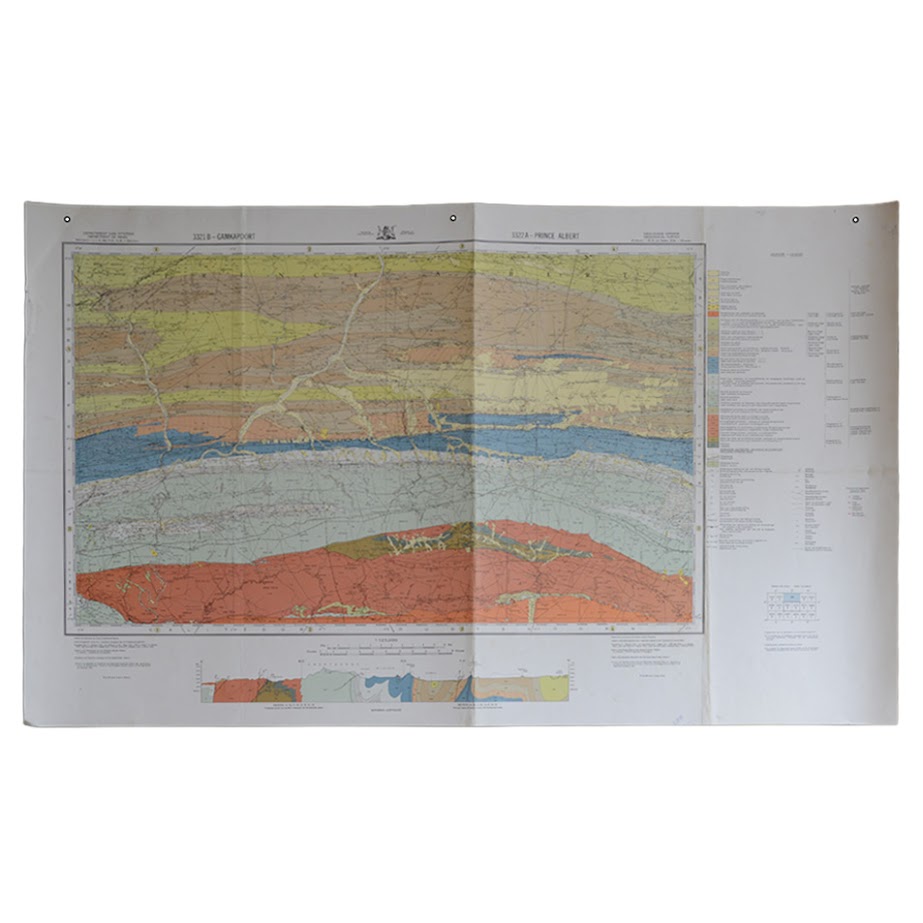
Department Of Mines – 3321 B Gamkapoort – 3222 A Prince Albert – Geological Survey
Cartographer: Besaans, A. J
Publisher: Department Of Mines
Price: £65 (post-free in the UK)
Publication Date: 1965
Edition: 1st edition thus
Format: Colour printed lithograph
Condition: In very good condition
Sheet Size: 104.5cm x 64.2cm
Condition:
Sheet Size: 104.5cm x 64.2cm. Hanging holes to upper margin. Old fold lines. Backed on linen. Minor marks to the margins. Colouration very bright and clean. A very good copy.
Location: Pocket RSAGEOL: SR: 002872
The Geology Of Gamkapoort And Prince Albert Districts: A Brief Overview
- Introduction and Geographic Context
The Gamkapoort and Prince Albert districts, located in the southern Great Karoo region of the Western Cape, lie at the interface of two major South African geological provinces: the Cape Fold Belt and the Karoo Basin. These districts are characterised by rugged mountainous terrain, dramatic fold structures, and deeply incised river gorges, especially along the Swartberg range and the Gamka River.
The geology of the area is notable for its sedimentary sequences, complex structural geology, and rich fossil record, offering insight into the Palaeozoic–Mesozoic evolution of southern Gondwana.
- Tectonic Framework: Cape Fold Belt and Karoo Basin Interface
The region sits along the northern edge of the Cape Fold Belt, where tectonic compression during the late Palaeozoic to early Mesozoic folded earlier sedimentary rocks into a series of east–west trending anticlines and synclines.
The Swartberg Mountains, which dominate the area, mark the boundary between:
- The Cape Supergroup to the south, deformed into tight folds
- The more gently dipping Karoo Supergroup to the north
This tectonic juxtaposition plays a defining role in the region’s geomorphology and geological exposure.
- Cape Supergroup: Palaeozoic Marine Deposition
The Cape Supergroup, exposed predominantly in the Swartberg Range, represents a sequence of Palaeozoic marine sediments deposited along the margin of the ancient Gondwanan continent.
It includes:
- Table Mountain Group: Predominantly quartzitic sandstones, often massively bedded and forming high ridges and cliffs. The Peninsula and Skurweberg formations are well exposed here.
- Bokkeveld Group: Composed of shales and mudstones with interbedded siltstone, representing deeper marine environments. This unit is especially fossiliferous, containing abundant marine invertebrates such as trilobites and brachiopods.
- Witteberg Group: Transitional to near-shore and deltaic sandstones and siltstones, reflecting shallowing conditions.
The Cape Supergroup rocks were folded during the Cape Orogeny, roughly 270 to 220 million years ago, creating the striking anticlinal and synclinal patterns visible in the Swartberg Pass and surrounding terrain.
- Karoo Supergroup: Continental Environments and the Great Karoo Basin
To the north of the Swartberg, the Karoo Supergroup dominates the geology around Prince Albert. These rocks were deposited in the Main Karoo Basin between approximately 300 and 180 million years ago, reflecting a shift from glacial to arid continental conditions.
Key units present include:
- Dwyka Group: Basal glacial diamictites, deposited during a major Permo-Carboniferous glaciation. These can be seen in valley bottoms and lower slopes.
- Ecca Group: Rich in shale, siltstone, and fine-grained sandstone, representing deltaic and lacustrine environments. In places, thin coal seams and dropstones provide palaeoclimatic evidence.
- Beaufort Group: Comprising mudstones and sandstones, this unit is famous for its terrestrial vertebrate fossils, including early mammal-like reptiles. It marks the transition to a drier, floodplain-dominated environment.
The Karoo rocks in this region dip gently to the north and are only mildly deformed, in contrast to the steeply folded Cape Supergroup.
- Intrusive and Igneous Activity
Although the Gamkapoort and Prince Albert districts lie south of the main extent of Karoo volcanic outpourings, dolerite dykes and sills intrude both the Karoo and Cape sediments. These igneous bodies, part of the broader Karoo Large Igneous Province, were emplaced around 183 million years ago.
They are typically:
- More resistant to erosion, forming ridges and koppies
- Responsible for local metamorphism and hardening of surrounding sediments
- Potential aquifers or barriers to groundwater, depending on fracture development
These dolerite intrusions contribute to the complex hydrogeological and geomorphological framework of the region.
- Surface Geology and Landforms
The geomorphology of the districts reflects the interaction of lithology, tectonics, and climate. Key landform features include:
- Steep escarpments formed by quartzitic sandstone of the Table Mountain Group
- Broad pediments and plains underlain by softer Beaufort mudstones
- Karstic features and springs, especially where dolerite intrudes carbonate-rich layers
- Deeply incised gorges such as the Gamkapoort Canyon, carved by the Gamka River through folded Cape rocks
Erosion and weathering have sculpted the dramatic landscapes for which the region is known, such as the vistas from Swartberg Pass.
- Fossil and Palaeontological Significance
The Bokkeveld Group is a significant fossil-bearing unit, especially for Devonian-age marine life. It preserves:
- Brachiopods, trilobites, molluscs, and crinoids
- Palaeoecological evidence of life during the “Age of Fishes”
The Beaufort Group further north contains Permian vertebrate fossils, crucial for understanding pre-dinosaurian terrestrial life. Fossil sites near Prince Albert have yielded important specimens for palaeontological research.
- Hydrogeology and Resources
Groundwater in the region is typically accessed from:
- Fractured quartzites and dolerite margins
- Weathered Karoo sandstones
- Spring zones in structurally controlled settings
Water quality is generally good, though localised salinity and seasonal variability are issues in some boreholes. There are no major mineral resources currently exploited in the districts, but the area’s value lies in water, grazing, and geotourism.
- Economic and Environmental Importance
While not heavily industrialised, the region’s geology supports:
- Agriculture, particularly small-scale farming and grazing, depending on soil type and water availability
- Tourism, with geologically themed destinations including the Swartberg Pass, Meiringspoort, and Gamkapoort Dam
- Conservation areas, such as the Swartberg Nature Reserve, where geology shapes both the scenery and biodiversity
Soils are often thin and stony in the mountainous terrain but more productive on Karoo-derived mudstone plains.
Conclusion
The Gamkapoort and Prince Albert districts represent a remarkable intersection of Palaeozoic marine geology, Mesozoic continental basin evolution, and late tectonic uplift, all laid bare in one of the most scenic parts of the Western Cape. From the fossil-rich Bokkeveld shales to the mineralised dolerite-capped ridges, the area is a living geological archive of southern Gondwana’s sedimentary and tectonic history.
It is not only a landscape of scientific value but also one of natural beauty, where geology underpins ecology, land use, and cultural heritage.
SHOP WITH CONFIDENCE AT HORNSEYS
At Hornseys, we are dedicated to offering items that uphold the highest standards of quality and authenticity. Our collection of artwork is carefully curated to ensure that each item we offer is authentic, collated, and complete.
Here’s what sets us apart:
- Authenticity and Provenance: Each map is researched and verified for authenticity.
- Expert Curation: We entirely own all our artworks. We trust our taste and have invested heavily in it. We have confidence in all artwork that we offer for sale.
- Customer Satisfaction: We strive to provide an exceptional customer experience, from detailed descriptions and provenance to secure and prompt delivery of your purchase.
- Returns Policy: We offer an unconditional guarantee on every item. If, however, you wish to make a return, artworks may be sent back to us within fourteen days of receipt for whatever reason. We request that we are notified in advance if you wish to do so. They must be returned to us in the same condition as they were sent for a full refund.
OUR COMMITMENT TO QUALITY AND SERVICE
Understanding the value and rarity of these items, we ensure that every aspect of your purchase meets the highest standards of quality and service. This includes:
- Free Expedited, Tracked, and Insured Delivery within the UK: Ensuring that your artwork arrives safely and promptly.
- Fully-Insured Worldwide Delivery: Offering peace of mind for international collectors with reliable and secure shipping options.
EXPLORE OUR COLLECTION
Visit Hornseys today to explore our fine collection of maps and other artworks. Whether you are an avid collector or looking for a special gift, our selection offers something truly unique. Located since 1976 in Ripon in the picturesque Yorkshire Dales, we are recognized as a destination gallery for tastefully curated artwork, rare maps, design, and fine books.