
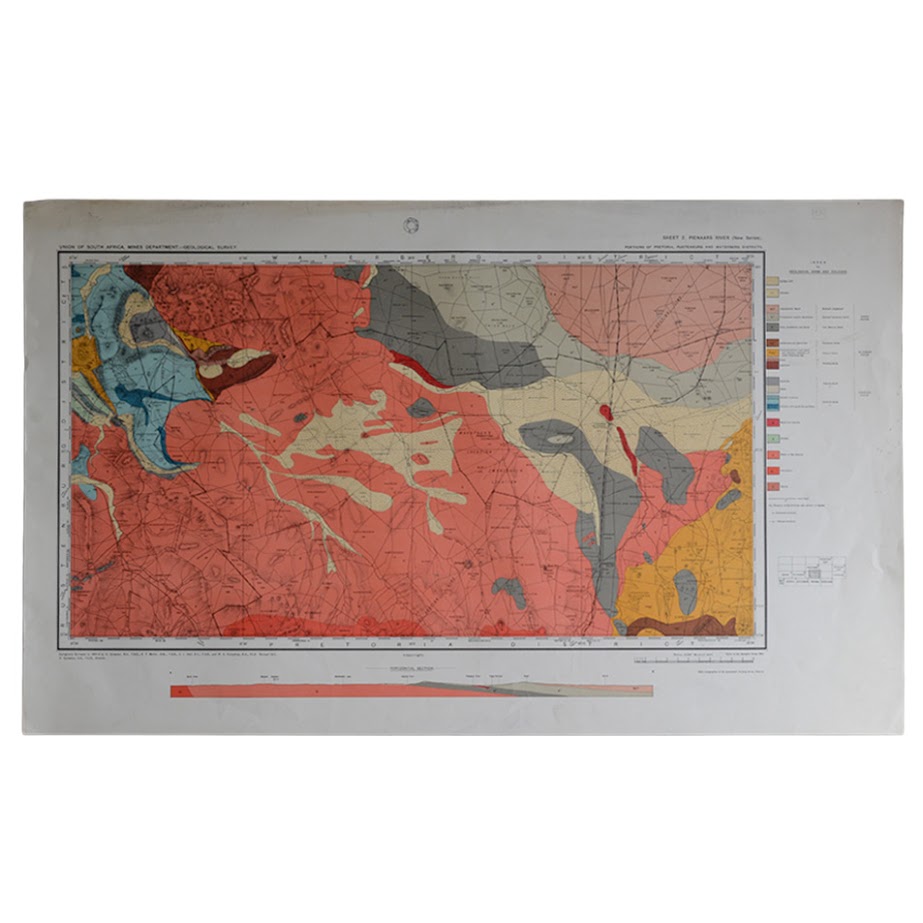
Sheet 2 – Pienaars River – Union Of South Africa Department Of Mines And Industries – Geological Survey
Kynaston, H, Mellor, E. T, Hall, A. L & Humphrey, W. A
£125.00
Availability: In stock
Product Description
Sheet 2 – Pienaars River – Union Of South Africa Department Of Mines And Industries – Geological Survey
Cartographer: Kynaston, H, Mellor, E. T, Hall, A. L & Humphrey, W. A
Publisher: Union Of South Africa Department Of Mines And Industries – Geological Survey
Price: £125 (post-free in the UK)
Publication Date: 1911
Edition: 1st edition thus
Format: Colour printed lithograph
Condition: In very good condition
Sheet Size: 87.8cm x 53.8cm
Condition:
Sheet Size: 87.8cm x 53.8cm. Small Institutional stamp to upper margin. Creased, marked, dusty and rubbed but this is mainly confined to the margins. Colouration very bright and clean. A very good copy. Very scarce.
Location: Pocket RSAGEOL: SR: 002871
The Geology Of The Pretoria, Rustenburg And Waterberg Districts: A Brief Overview
- Introduction and Geographic Context
The Pretoria, Rustenburg, and Waterberg districts span a geologically diverse region in the northern part of South Africa, intersecting parts of Gauteng, North West, and Limpopo provinces. This region encompasses a portion of the Kaapvaal Craton, the Bushveld Igneous Complex, and the Waterberg Basin, offering an unparalleled cross-section through more than 3 billion years of Earth history. The area’s geology underpins its global economic significance and national environmental value, while offering insights into both ancient crustal development and mineral resource formation.
- Geological Foundation: The Kaapvaal Craton
The oldest geological basement across all three districts belongs to the Kaapvaal Craton, a stable continental crust block formed over 3 billion years ago. These basement rocks, although not always visible at the surface, provide the tectonic platform upon which later sedimentary and igneous events were superimposed.
The craton comprises:
- Granitoid gneisses, tonalites, and trondhjemites
- Archaean greenstone belts, remnants of early volcanic and sedimentary environments
- High-grade metamorphic rocks, locally exposed in tectonic windows
This foundation set the stage for the development of subsequent Proterozoic basins and magmatic activity.
- Pretoria District: Transvaal Supergroup and Pretoria Group
In the Pretoria district, the dominant geological units belong to the Transvaal Supergroup, deposited between 2.6 and 2.1 billion years ago in a stable epicratonic setting. The most notable formation here is the Pretoria Group, consisting of:
- Quartzites, shales, and volcanic rocks
- Stratified sequences indicating shallow marine and fluvial deposition
- Periodic volcanic activity, evident in basaltic and rhyolitic lava flows
This group records a time of tectonic quiescence, rising oxygen levels, and early biosedimentary structures, such as stromatolites in the underlying dolomites.
The Timeball Hill and Daspoort formations are particularly well developed, and provide a rich record of continental and volcanic sedimentation.
- Rustenburg District: Bushveld Igneous Complex
The Rustenburg area lies within the western limb of the Bushveld Igneous Complex (BIC), emplaced around 2.05 billion years ago. This massive layered intrusion is the largest of its kind in the world, and hosts globally significant mineral deposits.
Key geological components include:
- Rustenburg Layered Suite: Mafic and ultramafic layers (pyroxenite, gabbro, anorthosite, norite) deposited by fractional crystallisation. It contains the Merensky Reef and UG2 Layer, rich in platinum-group elements (PGEs), chromite, and vanadium.
- Lebowa Granite Suite: Granitic intrusions forming the uppermost levels of the Bushveld Complex.
- Rooiberg Group: Overlying felsic volcanic rocks representing the final magmatic stages.
Structurally, the area exhibits synclinal folding of the Bushveld layers and local faulting. Rustenburg is a global centre for platinum mining, and the geology is studied for both its economic and petrological significance.
- Waterberg District: Waterberg Group and Sedimentary Evolution
The Waterberg district, to the north-west of Pretoria and Rustenburg, is underlain by rocks of the Waterberg Group, a sequence of largely undeformed continental sedimentary rocks deposited around 2.0–1.6 billion years ago.
These rocks include:
- Red and pink sandstones
- Quartzites, often with prominent cross-bedding
- Conglomerates and siltstones, indicating fluvial to alluvial fan environments
Deposited in a stable, arid to semi-arid continental basin, the Waterberg Group represents one of South Africa’s best examples of intracratonic sedimentation, with minimal metamorphism and deformation. Its relative isolation from tectonic activity preserved the original sedimentary textures and structures.
- Post-Bushveld and Surface Processes
Following the emplacement of the Bushveld Complex and deposition of the Waterberg Group, the region experienced:
- Uplift and erosion, exposing deeper Bushveld and Transvaal rocks
- Intrusion of dolerite dykes during later Mesozoic rifting
- Development of deep weathering profiles and laterite formation, especially on mafic rocks
These surface processes contributed to the formation of residual soils, duricrusts, and karst features, particularly in dolomitic terrains of the Pretoria region.
- Hydrogeology
Groundwater across the three districts varies by geological unit:
- Fractured quartzites and shales of the Pretoria Group host moderate-yield aquifers
- Karst aquifers in dolomite are important in the southern Bushveld margins, though prone to contamination
- Bushveld rocks, especially fractured norites and pyroxenites, support local groundwater reserves
- Sandstone aquifers in the Waterberg Group are well developed and sustain rural water supply schemes
Water quality and quantity are highly variable and closely tied to the nature of weathering and fracture development.
- Economic and Environmental Significance
The geology of these districts directly underpins:
- Platinum mining, especially near Rustenburg
- Chromium and vanadium extraction from layered intrusions
- Water supply and agriculture, based on aquifers and fertile residual soils
- Urban development in Pretoria, whose geology influences both engineering design and groundwater management
Environmental challenges include mine tailings management, karst collapse risks, and water pollution—especially where dolomite aquifers are intersected by mining operations.
- Scientific and Educational Importance
Together, the Pretoria, Rustenburg, and Waterberg districts offer:
- A nearly continuous geological record from Archaean basement to Proterozoic sedimentation and magmatism
- A globally important case study in igneous differentiation, mineral resource formation, and basin evolution
- Rich opportunities for academic research, field education, and mineral exploration
The region remains a cornerstone of South African geological training and mining economy, with institutions regularly conducting mapping and research in all three districts.
Conclusion
The Pretoria–Rustenburg–Waterberg corridor is a region of exceptional geological heritage. From the ancient Kaapvaal basement, through the volcanic and sedimentary layers of the Transvaal and Waterberg groups, to the mineral-rich Bushveld Complex, this area reflects over 3 billion years of tectonic, magmatic, and depositional history.
It is not only a scientific archive of early Earth evolution but also a landscape shaped by geology into one of South Africa’s most productive and geologically instructive territories.
SHOP WITH CONFIDENCE AT HORNSEYS
At Hornseys, we are dedicated to offering items that uphold the highest standards of quality and authenticity. Our collection of artwork is carefully curated to ensure that each item we offer is authentic, collated, and complete.
Here’s what sets us apart:
- Authenticity and Provenance: Each map is researched and verified for authenticity.
- Expert Curation: We entirely own all our artworks. We trust our taste and have invested heavily in it. We have confidence in all artwork that we offer for sale.
- Customer Satisfaction: We strive to provide an exceptional customer experience, from detailed descriptions and provenance to secure and prompt delivery of your purchase.
- Returns Policy: We offer an unconditional guarantee on every item. If, however, you wish to make a return, artworks may be sent back to us within fourteen days of receipt for whatever reason. We request that we are notified in advance if you wish to do so. They must be returned to us in the same condition as they were sent for a full refund.
OUR COMMITMENT TO QUALITY AND SERVICE
Understanding the value and rarity of these items, we ensure that every aspect of your purchase meets the highest standards of quality and service. This includes:
- Free Expedited, Tracked, and Insured Delivery within the UK: Ensuring that your artwork arrives safely and promptly.
- Fully-Insured Worldwide Delivery: Offering peace of mind for international collectors with reliable and secure shipping options.
EXPLORE OUR COLLECTION
Visit Hornseys today to explore our fine collection of maps and other artworks. Whether you are an avid collector or looking for a special gift, our selection offers something truly unique. Located since 1976 in Ripon in the picturesque Yorkshire Dales, we are recognized as a destination gallery for tastefully curated artwork, rare maps, design, and fine books.
Related products


You may also like…

Sheet 9 – Marico – Union Of South Africa Department Of Mines And Industries – Geological Survey
£125.00Hall, A. L & Humphrey, W. A
Sheet 10 – Nylstroom – Union Of South Africa Department Of Mines And Industries – Geological Survey
£125.00Mellor, E. T, Kynaston, H & Humphrey, W. A
Sheet 11 – Lydenburg – Union Of South Africa Department Of Mines And Industries – Geological Survey
£95.00Hall, A. L & Mellor, E. T
Sheet 12 – Pilandsberg – Union Of South Africa Department Of Mines And Industries – Geological Survey
£145.00Hall, A. L & Humphrey, W. A


