
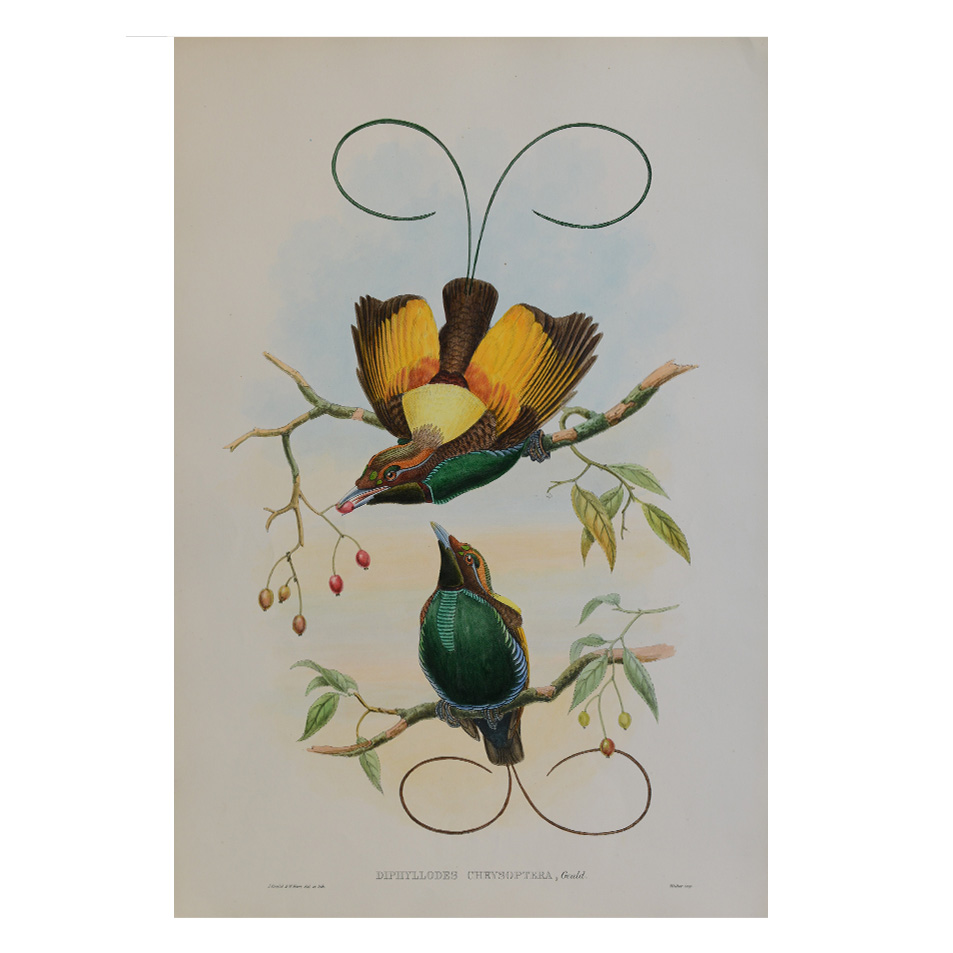
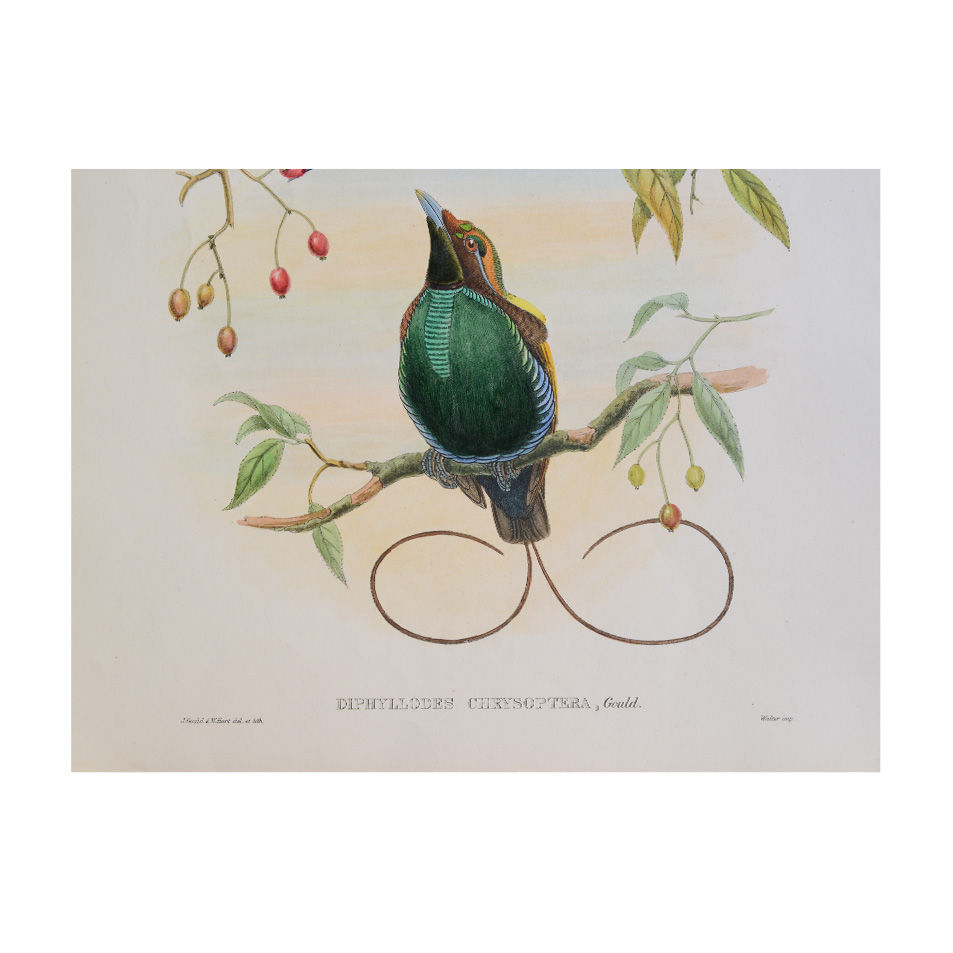
Diphyllodes Chrysoptera – Original Lithograph – John Gould – Golden-Winged Bird-Of-Paradise
Artists: Gould, John & Hart, W
Price: £950.00
Publisher: Taylor and Francis for Henry Sotheran & Co
Publication Date: 1875-1888
Format: Original hand-coloured lithograph heightened with gum arabic
Condition: Very good plus, bright copy with very good margins
Sheet Size: c.54.2cm x 36.8cm
Series: From ‘The Birds of New Guinea and the Adjacent Papuan Islands’
This exquisite original lithograph with contemporary hand-colouring is from John Gould’s magnificent work, ‘The Birds of New Guinea and the Adjacent Papuan Islands,’ produced between 1875 and 1888. It exhibits the meticulous detail and vibrant use of colour that define the Goulds’ lithographs. Very minor age toning and creasing and with none of the usual textual off-setting. A very good plus, bright, copy with very good margins. Location: Map Drawer B: Folder: GBNG. 003314
Diphyllodes chrysoptera: A Brief Account
Overview
Diphyllodes chrysoptera, commonly known as the Golden-winged Bird-of-Paradise, is one of the most striking members of the bird-of-paradise family (Paradisaeidae). Endemic to the rainforests of New Guinea, it is celebrated for its rich golden plumage, elaborate courtship displays, and its role in the evolutionary story of one of the world’s most remarkable avian lineages. Like many birds-of-paradise, it exemplifies extreme sexual selection, with the male’s ornate appearance shaped by generations of female choice.
Taxonomy and Nomenclature
Genus: Diphyllodes
Species: chrysoptera
The species belongs to a small genus that also includes the King Bird-of-Paradise, with which it shares certain structural features but differs markedly in plumage and behaviour. The scientific name reflects the shimmering golden tone of the upperwings: chrysos (gold) and pteron (wing).
Physical Description
Male
Male Diphyllodes chrysoptera are instantly recognisable. Key features include:
- Deep black body plumage with a velvety sheen
- Brilliant golden-yellow wing coverts, forming distinct shoulder patches
- Iridescent greenish-blue breast shield that can catch and refract light during display
- Long, wiry tail wires ending in small ornamental discs, characteristic of several birds-of-paradise
- Glossy head plumage that shifts colour depending on angle and illumination
The overall effect is one of extraordinary contrast and luminosity. In bright forest light, the male appears almost jewel-like.
Female
Females, by contrast, are:
- Brownish, with barred underparts
- Short-tailed and lacking ornamental plumage
- Adapted for camouflage and nesting concealment
Their more subdued colouring reflects the strong sexual dimorphism typical of the family.
Distribution and Habitat
The species is native to lowland and hill forests of northern New Guinea, thriving in:
- Primary rainforest
- Secondary and edge habitats when sufficiently dense
- Canopy levels where display perches and fruiting trees are available
Its range is patchy rather than continuous, reflecting habitat preference and subtle ecological requirements.
Diet
Like many birds-of-paradise, the Golden-winged Bird-of-Paradise is primarily frugivorous. Its diet includes:
- Soft fruits
- Berries
- Occasional arthropods
The mix of fruit and insect matter provides necessary energy during display seasons and supports feather growth.
Behaviour and Courtship
Display Sites
Males maintain display courts—small, cleared areas or favoured perches within the forest where females visit to inspect potential mates.
Courtship Display
The male’s display is highly stylised:
- He positions himself to maximise sunlight on the breast shield.
- The golden wings are flared or lifted to emphasise contrast.
- The tail wires are held forward or vibrated.
- A series of clicking, buzzing, or rasping calls accompany the visual elements.
Female choice plays a central role. Males spend a substantial portion of their time perfecting displays, while only a small proportion achieve regular mating success.
Reproduction and Nesting
As is typical of polygynous birds-of-paradise:
- Males provide no parental care beyond display and mate attraction.
- Females build nests independently, usually small, cup-shaped constructions situated in dense vegetation.
- Clutch size is typically one or two eggs, reflecting the high investment in each offspring.
The female’s cryptic colouring helps reduce predation risk during incubation.
Conservation Status
The species is generally regarded as not currently threatened, owing to:
- Relatively wide distribution
- Presence in remote forests with limited human disturbance
However, like many rainforest species, it is vulnerable to:
- Habitat loss from logging and agriculture
- Fragmentation of forest corridors
- Local declines in fruiting trees
Continued monitoring is important, as pressures on New Guinea’s forests are increasing.
Role in Natural History and Art
Diphyllodes chrysoptera has held a prominent place in natural history illustration, including nineteenth-century works by John Gould and his contemporaries. Its vivid colours and ornate display feathers made it a favourite subject in Victorian ornithology, symbolising the richness and mystery of New Guinea’s forest fauna.
The species has also contributed to scientific discussions on:
- Sexual selection
- Plumage evolution
- Ecological specialisation in island and near-island environments
Conclusion
Diphyllodes chrysoptera epitomises the splendour of the birds-of-paradise: visually extraordinary, behaviourally elaborate, and biologically revealing. Its golden wings, iridescent breast shield, and complex displays are products of evolutionary refinement over thousands of generations. Beyond its beauty, the species provides valuable insight into the mechanics of sexual selection, the ecology of tropical forests, and the evolutionary history of New Guinea’s exceptional avifauna.
John Gould and The Birds of New Guinea: A Brief Account
Introduction
The Birds of New Guinea and the Adjacent Papuan Islands is one of the last and least widely known of John Gould’s monumental ornithological enterprises, yet it stands among his most significant. Produced during the final years of his life and completed posthumously by his collaborators, the work represents a culmination of decades of scientific fieldwork, artistic innovation, and international collaboration. It captures a region then barely known to European naturalists: a vast archipelago of extraordinary avian diversity, including some of the most striking birds on earth.
Context: Gould’s Role in Nineteenth-Century Ornithology
John Gould was the leading British ornithological publisher and illustrator of the nineteenth century. His folio volumes set new standards for natural history illustration in terms of ambition, accuracy, and technical quality. Although not a field collector himself, Gould was an exceptional synthesiser of information. He drew on explorers, colonial officers, museum curators, and professional collectors to gather specimens and field notes from across the world.
By the time he turned his attention to New Guinea, he had already produced major works on the birds of Europe, Asia, Australia, and the Himalayas. His earlier Birds of Australia was particularly influential, establishing many new species and generating an enduring visual record of the continent’s wildlife. New Guinea, by contrast, remained one of the least studied regions, its mountainous interior and dense forests proving difficult and dangerous for Victorian exploration.
Scientific Scope and Ambition
Gould’s New Guinea project aimed to document the region’s avifauna comprehensively at a time when systematic knowledge was fragmentary. The title’s reference to “adjacent Papuan Islands” signals the geographic breadth of the work: it encompassed not only mainland New Guinea but also outlying archipelagos, many of which hosted endemic species with limited distributions.
The volume is particularly notable for its coverage of:
- Birds-of-paradise, whose elaborate plumage and courtship displays had captivated European naturalists since the sixteenth century
- Parrots, pigeons, and kingfishers, many of which were little known or newly described
- Passerines unique to isolated island ecosystems
- Species newly discovered in northern Australia, reflecting the ecological links between the Cape York peninsula and southern New Guinea
The inclusion of recently collected Australian species signals the blurred biological boundary between the two landmasses—an insight consistent with later biogeographical theories, notably the fauna shared across the Torres Strait.
Fieldwork and Specimen Collection
Because Gould was constrained by illness, age, and the distance involved, he relied heavily on others for primary fieldwork. Professional collectors such as Alfred Russel Wallace, Carl Hunstein, Andrew Goldie, and other local and European naturalists provided specimens, skins, eggs, and behavioural notes. Many of these collectors endured extreme conditions, from malarial swamps to mountainous terrain, often working in partnership with Indigenous guides whose deep ecological knowledge was critical to locating elusive species.
The specimens were shipped to London, where Gould and his team prepared them for study. Detailed measurements, observations of plumage, and comparative analysis with existing museum material allowed Gould to identify numerous new species and subspecies.
Artistic Methods and Illustration
The illustrations accompanying the text are among the most vivid depictions of New Guinean birdlife produced in the nineteenth century. Although Gould remained the artistic director, much of the day-to-day work was undertaken by his trusted lithographers and colourists, including Henry Constantine Richter and, later, William Hart.
Key characteristics of the plates include:
- Hand-coloured lithography: each print required skilled colourists to apply washes by hand, resulting in vibrant, textured images.
- Naturalistic poses: Gould’s team increasingly depicted birds in lifelike stances rather than stiff, diagrammatic postures common in earlier natural history art.
- Botanical context: many species are shown with branches, flowers, or fruits native to their habitats, giving ecological context as well as aesthetic richness.
- Accuracy of plumage: birds-of-paradise especially demanded meticulous work to convey iridescence, elongated filaments, and complex ornaments.
These plates played a crucial role in making the New Guinean avifauna known to European science and collectors.
Taxonomic Contributions
The work identified numerous new species, clarified earlier misclassifications, and provided the first detailed descriptions of many Papuan birds. Gould’s taxonomic judgement, though constrained by the limits of Victorian knowledge, was generally respected for its precision and conservative approach to naming.
Among its key contributions:
- Establishment of several new birds-of-paradise species now central to evolutionary studies
- Early recognition of the diversity of Papuan parrots and lories
- Clarification of the affinities between New Guinean and Australian birds
- Documentation of island endemism, contributing to later biogeographical theory
Although some nomenclature has since changed, the scientific groundwork laid in the volume remains historically important.
Publication, Collaboration, and Completion After Gould’s Death
Gould worked on the New Guinea project until his death in 1881. His colleague, Richard Bowdler Sharpe of the British Museum, oversaw the completion of the remaining text and organisation of the plates. This collaboration ensured continuity of scientific method and maintained the high production standards associated with Gould’s name.
The final publication was issued in parts between the late 1870s and mid-1880s, following the subscription model typical of Gould’s earlier works. The folio format, substantial paper, and rich hand-colouring made the volumes expensive and labour-intensive to produce.
Reception and Legacy
At the time of publication, The Birds of New Guinea was celebrated for revealing an ornithological frontier. Victorian scientists valued its combination of lavish illustration and authoritative description. Its influence extended to taxonomy, museum collections, and broader popular interest in the exotic wildlife of the Papuan region.
In modern scholarship, the work is valued for:
- Historical context: it captures a pivotal moment when European natural history was expanding into poorly documented regions.
- Artistic excellence: the plates are prized for their beauty and craftsmanship.
- Scientific data: despite later revisions, the work provides essential baseline descriptions for many species.
- Colonial histories: the book reflects the complex relationships between European naturalists and the Indigenous communities who facilitated access to remote landscapes.
Fine copies of the work remain highly sought after by collectors, libraries, and institutions worldwide. Its plates occasionally appear in exhibitions of Victorian natural history art.
Conclusion
The Birds of New Guinea and the Adjacent Papuan Islands stands as one of Gould’s last great achievements and a vital record of the extraordinary avifaunal diversity of the Papuan region. Combining scientific rigour, artistic mastery, and contributions from a network of collectors and field naturalists, the work embodies the ambition and complexity of nineteenth-century natural history publishing. For modern readers, it offers both a window into Victorian science and an enduring celebration of one of the world’s richest bird habitats.
Cataloguer: Daniel Hornsey of Hornseys, Ripon
Daniel Hornsey, a partner of Hornseys in Ripon, is widely regarded as a trusted specialist in the field of rare and second-hand books. As a long-standing member of the antiquarian book trade, he has advised private collectors, curated catalogues, and sourced works for leading dealers, libraries and institutions across the world.
Hornseys, an established independent bookshop and gallery, is known for its careful curation and its emphasis on quality. Under Daniel Hornsey’s guidance, the shop has become a respected destination for collectors seeking rare, well-preserved, and accurately described volumes. Collectors value his transparency, his attention to detail, and his commitment to presenting books exactly as they are, without exaggeration. This reliability is essential in a field where subtle differences in condition or printing can dramatically influence desirability and value.
Hornseys’ exhibit regularly at book and map fairs in London and throughout the UK and as long-established specialists in fine books, maps, prints and ephemera, Hornseys maintains full professional membership of the Provincial Booksellers Fairs Association (PBFA). The PBFA is one of the most respected trade bodies in the rare and antiquarian book world, with strict standards of expertise, authenticity and ethical trading. Our verified member listing can be viewed here: Hornseys – PBFA Member Profile.


