
Drawn by Hand: A Retrospective of Auto-Lithography Printed at The Curwen Press, Plaistow, 1920–1950 — Curwen Gallery Exhibition Catalogue, 1966
The Curwen Gallery, London
£75.00
Availability: In stock
Product Description
Drawn by Hand: A Retrospective of Auto-Lithography Printed at The Curwen Press, Plaistow, 1920–1950 — Curwen Gallery Exhibition Catalogue, 1966
Title: Drawn by Hand: A Retrospective of Auto-Lithography Printed at The Curwen Press, Plaistow, 1920–1950
Publisher / Institution: The Curwen Gallery, London
Date: 1966
Edition: First edition
Exhibition: Curwen Gallery, 7 Colville Place, off Charlotte Street, London W1, 2 June–2 July 1966
Format: Folding exhibition catalogue
Printing: Privately printed
Stock Code: 004189
Location: Ephemera Drawer, Bookroom
Sleeve: Design A
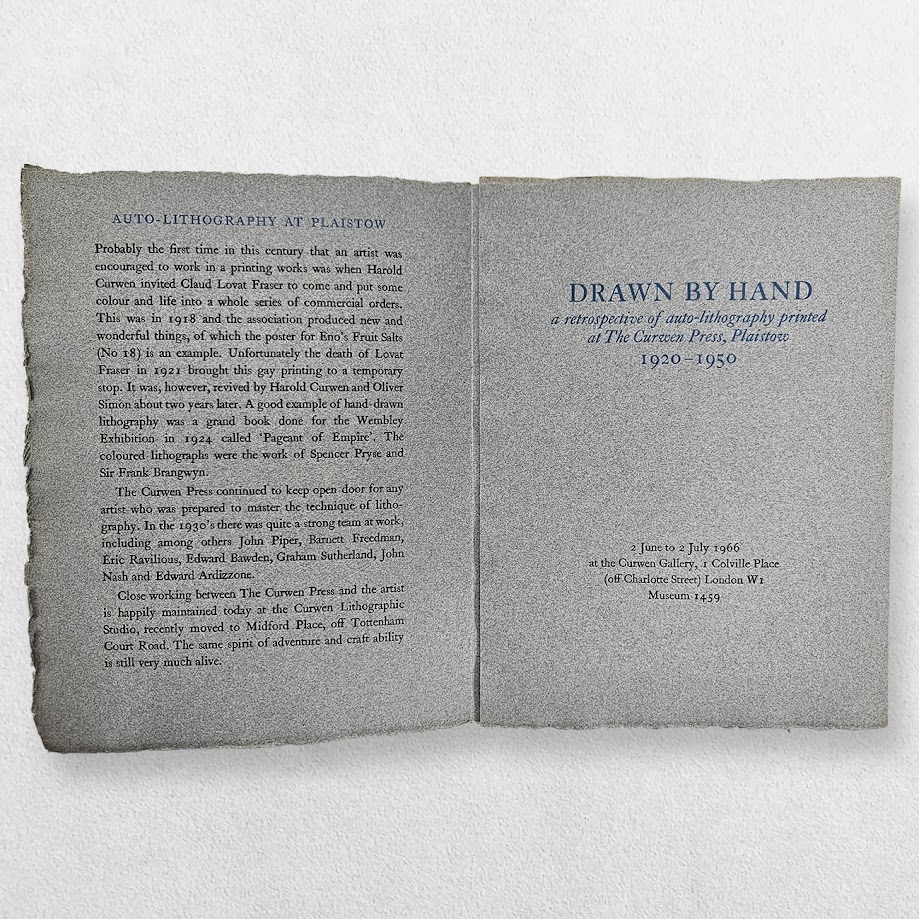
First edition of this attractive and important 1966 Curwen Gallery exhibition catalogue devoted to three decades of auto-lithography at the Curwen Press, one of the most influential British printers of the twentieth century. Entitled Drawn by Hand, the exhibition was held at the Curwen Gallery from 2 June to 2 July 1966 and surveyed work printed at the Curwen Press, Plaistow, between 1920 and 1950, when the Press played a central role in the revival of artist-drawn commercial lithography in Britain.
The catalogue is itself a finely conceived piece of Curwen ephemera, printed in blue and black on textured grey paper with deliberately deckled edges and opening to form a multi-panel display. The introductory essay, “Auto-Lithography at Plaistow”, provides a concise contemporary history of the development of the process at the Curwen Press. It recalls Harold Curwen’s invitation to Claud Lovat Fraser to work directly in the printing works, and describes the subsequent encouragement of artists to master lithographic techniques themselves rather than merely supply designs for translation by craftsmen.
The text identifies the early collaboration between Curwen and artists as an important revival of direct artist involvement in commercial lithography. It notes the interruption caused by Lovat Fraser’s death in 1921, the subsequent revival of gay printing — to use the contemporary terminology of the catalogue — by Harold Curwen and Oliver Simon, and the celebrated lithographs by Spencer Pryse and Sir Frank Brangwyn for the 1924 Wembley Exhibition publication Pageant of Empire. By the 1930s the Curwen Press had developed a particularly distinguished group of artists working directly with lithography, among them John Piper, Barnett Freedman, Eric Ravilious, Edward Bawden, Graham Sutherland, John Nash and Edward Ardizzone.
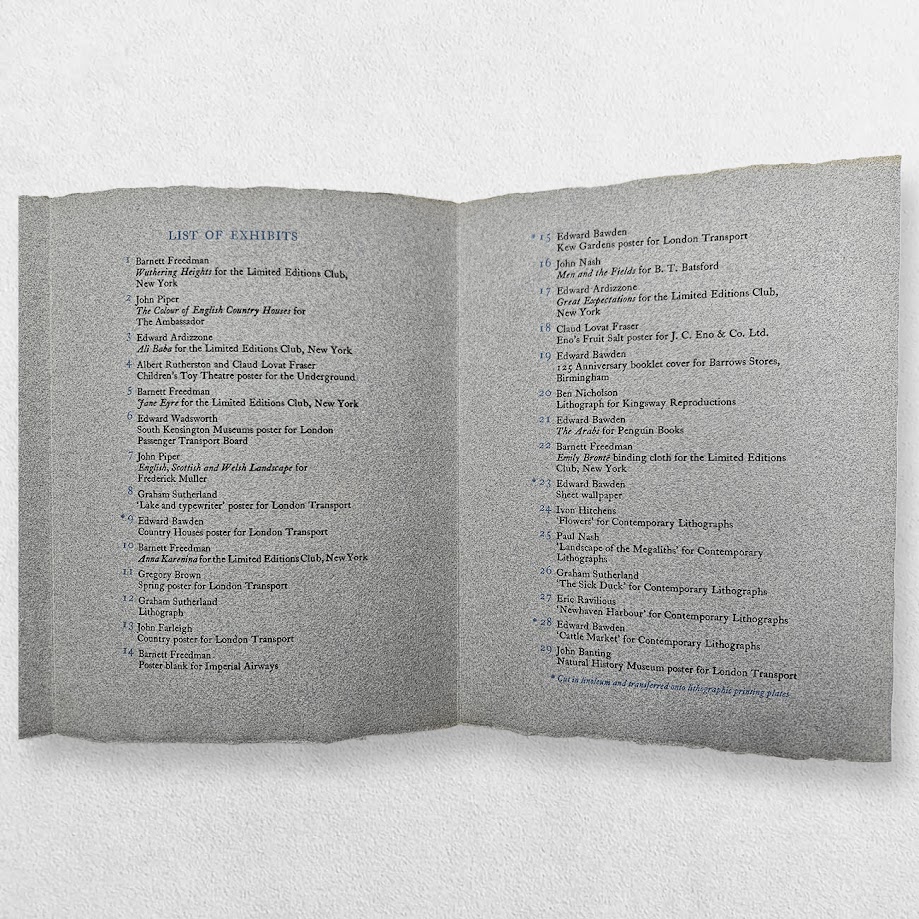
The exhibition comprised 29 works, demonstrating the remarkable range of artists and commercial commissions associated with Curwen during the period. Exhibits included:
Barnett Freedman — Wuthering Heights, Jane Eyre and Anna Karenina for the Limited Editions Club, together with work for Imperial Airways and Emily Brontë binding cloth;
John Piper — The Colour of English Country Houses and English, Scottish and Welsh Landscape;
Edward Ardizzone — Ali Baba and Great Expectations for the Limited Editions Club;
Claud Lovat Fraser — work including the celebrated Eno’s Fruit Salt poster;
Edward Wadsworth — South Kensington Museums poster for the London Passenger Transport Board;
Graham Sutherland — London Transport and Contemporary Lithographs work;
Edward Bawden — London Transport posters including Kew Gardens and Country Houses, as well as book, wallpaper and commercial designs;
John Nash — Men and the Fields for B. T. Batsford;
Ben Nicholson — lithography for Kingsway Reproductions;
Paul Nash — Landscape of the Megaliths for Contemporary Lithographs;
John Hitchens — Flowers for Contemporary Lithographs;
Eric Ravilious — Newhaven Harbour for Contemporary Lithographs;
and John Banting — his Natural History Museum poster for London Transport.
The catalogue is particularly useful as a primary document for the history of British commercial lithography, because it was produced while many of the personalities involved in the Curwen Press’s inter-war flowering remained within living memory and only sixteen years after the chronological end point of the exhibition. The Bodleian Library’s Curwen Press archive records this precise exhibition catalogue among the Press’s surviving exhibition material, confirming its place within the documented history of Curwen printing.
The exhibition also occupied an interesting moment in Curwen history. The Curwen Gallery had opened only shortly before, in 1965, while the revival of fine-art lithography associated with the Curwen Studio was developing into one of the most important British printmaking enterprises of the post-war period. Drawn by Hand therefore looked back deliberately to the Press’s earlier achievements and to the generation of artists whose direct involvement with lithography had helped establish the Curwen reputation.
The catalogue is in fine condition, exceptionally fresh for a fragile folding publication of this type, with the printing sharp and the paper clean and well preserved. Now housed in a clear acetate sleeve, Design A, for protection.
Fine.
A particularly attractive piece of Curwen Press and British modernist printmaking ephemera, documenting an exhibition which brought together work by many of the most important British illustrators, designers and printmakers of the inter-war period, including Edward Bawden, Eric Ravilious, Paul Nash, John Nash, John Piper, Barnett Freedman, Graham Sutherland, Edward Ardizzone, Ben Nicholson and Claud Lovat Fraser.
Stock code: 004189. Location: Ephemera Drawer, Bookroom. Sleeve Design A.
Why Buy from Hornseys?
Established in 1976, Hornseys is an independent specialist bookseller and gallery based in Ripon, North Yorkshire, on the edge of the Yorkshire Dales. For nearly fifty years, we have bought and sold rare books, first editions, signed and inscribed books, manuscripts, historical documents, maps, prints and unusual works on paper to private collectors, libraries, institutions and clients throughout the United Kingdom and internationally.
Our approach is based on careful research, accurate identification, detailed condition assessment and transparent cataloguing. Every item is individually examined before being offered for sale. We believe that rarity alone does not make an object important: the strongest books, manuscripts and historical material combine rarity with provenance, condition, historical context, bibliographical significance and collector appeal.
Research, Expertise and Authenticity
Every book, manuscript, map, print or piece of historical ephemera offered by Hornseys is researched and catalogued individually. We examine the features that determine both authenticity and value, including edition and impression, issue points, bindings, dustwrappers, signatures, inscriptions, annotations, provenance, printing history, completeness and condition.
Where appropriate, we compare items against bibliographical references, institutional catalogues, library holdings, auction records, archival sources and other reliable evidence. Where a point cannot be established with certainty, we distinguish clearly between documented fact and informed interpretation rather than presenting an assumption as fact.
All items are offered with an unconditional guarantee of authenticity.
Accurate and Detailed Descriptions
We aim to describe each item as precisely as possible. Condition is assessed individually, with defects, restoration, incompleteness or other significant characteristics noted where relevant.
For books, this may include collation, edition and impression, dustwrapper state, binding condition and significant ownership marks. For maps and works on paper, we assess the exact edition or state, printing information, dimensions, institutional representation, provenance and physical condition.
Our photographs form an important part of each description and are intended to allow collectors to examine the item closely before purchase.
Provenance and Historical Context
Provenance can transform the significance of a book or document. We therefore place particular emphasis on establishing previous ownership, presentation inscriptions, authorial associations, institutional provenance and connections with historical individuals or events.
Where research allows, we trace these associations through contemporary records, archives and published sources. This can reveal information that is not immediately apparent from the object itself and allows us to catalogue material within its proper historical and bibliographical context.
We are equally careful not to overstate provenance. Documented ownership is distinguished from attribution, possibility or association.
Carefully Curated Stock
Hornseys does not buy simply by category. We select material because we believe it has something distinctive to offer: rarity, condition, design, provenance, historical importance, unusual subject matter or enduring collector interest.
Our stock includes particular strengths in:
Rare and collectible books; literary first editions; signed and inscribed books; children’s and illustrated books; military history; Churchilliana; fine bindings; manuscripts and historical documents; rare and historical maps; travel and exploration; original prints and works on paper; unusual historical ephemera; and specialist collecting areas including Tintin and the Collins New Naturalist series.
This breadth allows us to recognise connections between books, archives, maps and other historical material that might otherwise be overlooked.
Specialist Experience Since 1976
Hornseys has traded since 1976. That longevity matters. The rare-book and collecting markets are built not only on reference works and databases but on experience: understanding how editions differ, recognising unusual states and bindings, judging condition, identifying material that is genuinely difficult to find and distinguishing real scarcity from apparent scarcity.
We combine that long-standing experience with modern research methods and extensive comparison of institutional and commercial records. The result is cataloguing intended to be both scholarly and practical for collectors.
Condition and Completeness
Every item is physically examined before cataloguing. Where relevant, books are checked for completeness, maps and plates are counted, folding material is inspected, and bindings and dustwrappers are assessed separately.
We do not use age alone as an excuse for faults. A seventeenth-century book, a wartime map and a twentieth-century first edition are judged according to the standards appropriate to their type, while significant defects are described clearly.
Customer Service
We aim to make buying from Hornseys straightforward and informed. We are happy to answer questions about condition, provenance, edition, rarity, bibliographical points or collecting significance, and additional photographs can be provided where required.
Orders are carefully packed, with UK delivery tracked and insured and international orders sent by appropriate tracked and insured services.
Collectors are also welcome to visit our gallery in Ripon to view material in person.
Returns Guarantee
All items are offered with our guarantee of authenticity and may be returned within fourteen days of receipt for any reason, provided they are returned in the same condition in which they were supplied.
We simply ask that you contact us before returning an item. If an item has been incorrectly described or supplied in error, we will also cover the appropriate return postage.
Buy with Confidence from Hornseys
Whether you are acquiring a first edition, building a specialist collection, researching a historical association or simply buying an object that fascinates you, our aim is the same: to offer carefully selected material, accurately researched and honestly described.
After nearly fifty years in the trade, Hornseys continues to seek out books, maps, manuscripts, prints and historical material that combine rarity, provenance, condition and genuine cultural or historical interest.
Related products
-

Neither Here Nor There, The Art Of Oliver Jeffers: Signed By The Artist
£145.00Jeffers, Oliver Edited By Seabrooke, Richard
-

-

Diurnes – Decoupage Et Photographies – First Edition – 1962
£7,250.00Picasso, Pablo & Villers, André
-

The Nonsense Verse Of Edward Lear: Signed By The Illustrator
£95.00Lear, Edward Illustrated By Lord, John Vernon
You may also like…
-
T. E. Lawrence – Seven Pillars of Wisdom – Cranwell Edition – Exhibition Notice – 1927
£900.00LAWRENCE, T. E. & Leicester Galleries
-

-

America, Canada & Home – Pictures Of The Prime Minister’s Big Trip And Quotations From His Speeches
£20.00Churchill, Winston S