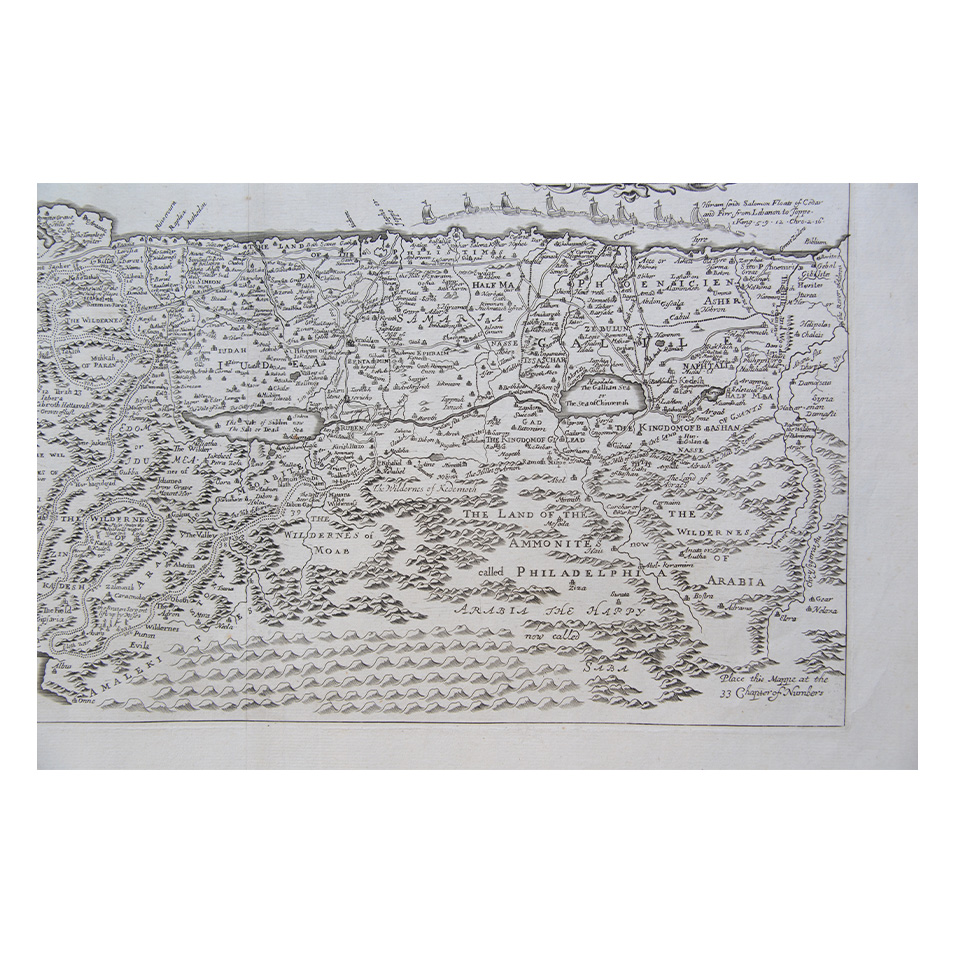
Egypt – Palestine – The Holy Land – The Forty Years Travels Of The Children Of Israel Out Of Egypt
Blome, Richard
£175.00
Availability: In stock
Product Description
Egypt – Palestine – The Holy Land – The Forty Years Travels Of The Children Of Israel Out Of Egypt
Cartographer: Richard Blome
Publisher: Richard Blome
Price: £175 including postage in the UK
Publication Date: 1687
Edition: Not stated
Sheet Size: 51.3cm x 42.3cm
Condition: Near fine
Condition:
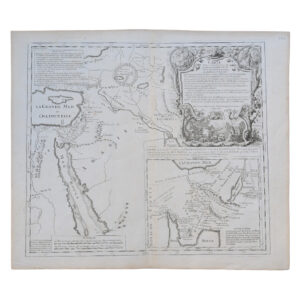
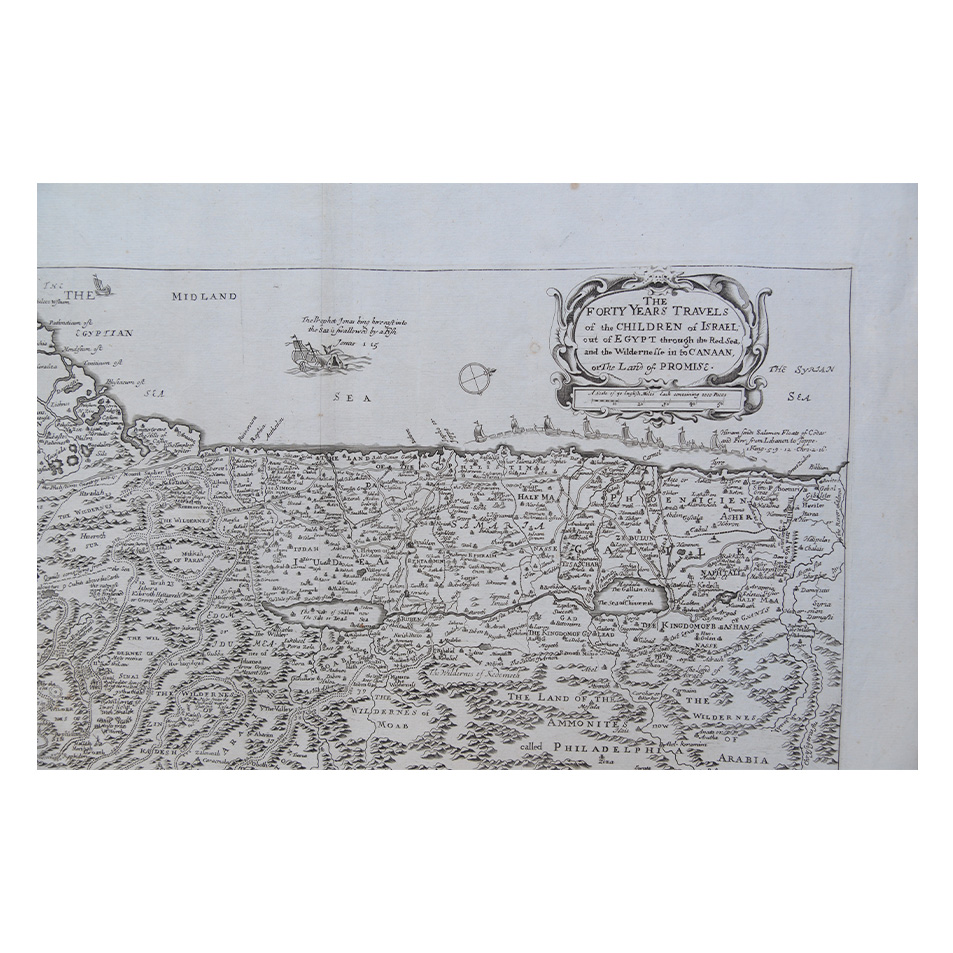
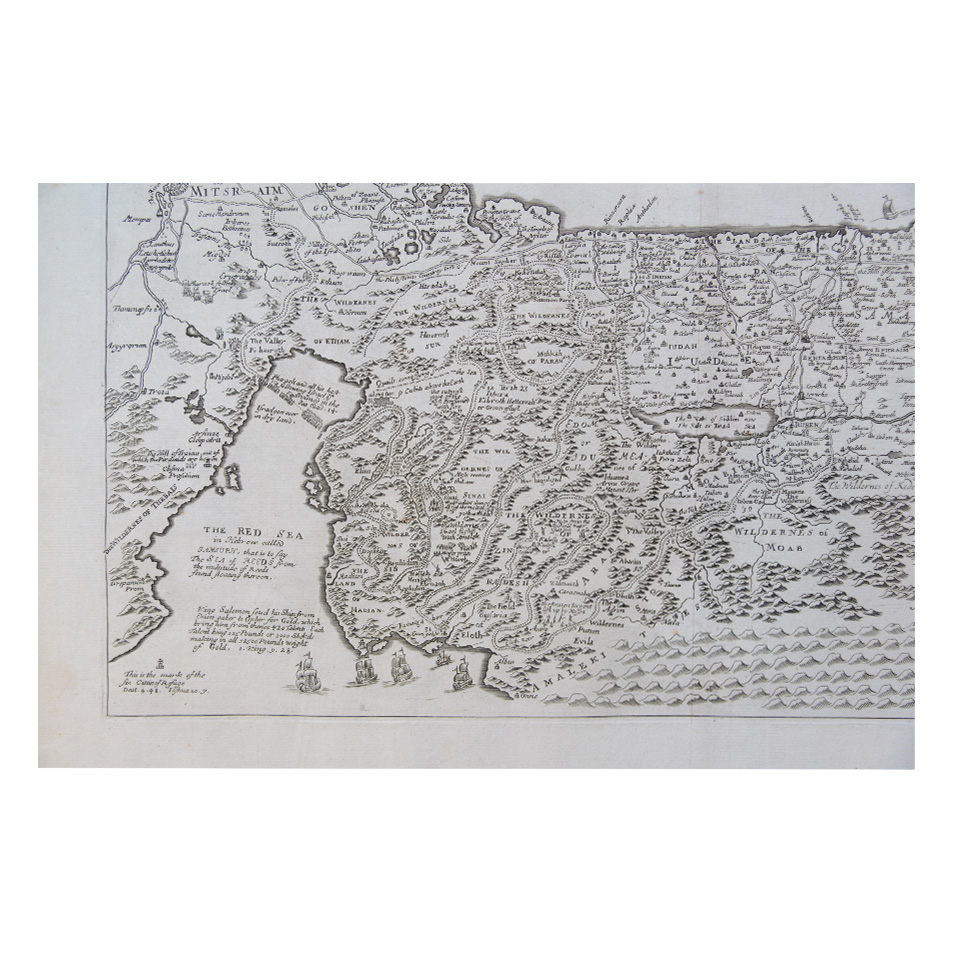
‘Through The Red Sea And The Wildernesse In To Canaan Or The Land Of Promise’. Original copper engraved map. Not dated but 1687. Sheet size: 51.3cm x 42.3cm. A map of Palestine with west at the top of the page, also shows part of Egypt and Phoenicia. The shoreline running from the Nile Delta to Biblium. Probably published in an English Bible at the end of the 17th century. A reduced version of Nicholas Visscher’s map without decoration and engraved by Richard Palmer. Very slight age-toning and blemishes but in near fine condition overall.
The Forty Years’ Travels: A Brief Overview
The forty years of Israel’s wandering in the wilderness form one of the central narrative arcs of the Hebrew Bible. Beginning with the departure from Egypt and ending with the arrival at the borders of Canaan, the journey encompasses moments of crisis, covenant, judgement and renewal. The narrative is both historical tradition and theological drama, depicting a people transformed from enslaved labourers into a covenant-bearing nation.
The account below follows the best-known sequence of events and regional movements.
- Departure from Egypt and the Crossing of the Sea
Escape from Slavery
Israel leaves Rameses in the Nile Delta under Moses’ leadership. The initial route proceeds to Succoth and then to Etham, on the edge of the wilderness. The movement is hasty and communal, marking the birth of the nation.
Crossing of the Sea
Pharaoh’s pursuit forces the Israelites into a dramatic escape across what the biblical text calls the Sea of Reeds. The crossing demonstrates divine deliverance and marks a decisive break with Egypt.
The people then enter the Wilderness of Shur, beginning the long period of desert life.
- Early Wilderness Encounters: Marah, Elim and Rephidim
Marah
Shortly after the crossing, the Israelites reach Marah, where the waters are bitter. The episode introduces the themes of:
- Complaint and testing
- Provision and divine instruction
Elim
A fertile oasis with “twelve springs and seventy palm trees”, Elim provides temporary rest and sustenance.
Rephidim
Before reaching Sinai, the people encounter severe water shortages at Rephidim. Moses strikes the rock to bring water. Here they also face their first external conflict, the battle with Amalek, which Moses oversees from a hilltop while Joshua commands the forces.
This period reveals the emerging organisation of the nation and Moses’ central leadership role.
- Arrival at Mount Sinai and the Covenant
The Ascent to Sinai
The Israelites reach Mount Sinai (Horeb) in the Wilderness of Sinai. This is the theological and structural centre of the forty-year journey.
Covenant Formation
Key events include:
- The giving of the Ten Commandments
- The establishment of laws governing society, worship and justice
- Construction of the Tabernacle, a portable sanctuary
- The ordination of priests
- The golden calf incident, demonstrating the fragility of obedience
The people remain at Sinai for almost a year. They leave not as a disorganised multitude but as a nation with institutions, tribal structures and a defined relationship with God.
- March Toward Canaan: Paran, Kibroth-Hattaavah and Hazeroth
Departure from Sinai
The tribes march in an ordered formation, with the Ark of the Covenant leading them and the Levites carrying the Tabernacle components.
Kibroth-Hattaavah
At this site the people grumble about manna and demand meat. Quail are provided in abundance, followed by a severe plague. This location becomes symbolic of unchecked desire.
Hazeroth
Here, Moses faces internal challenge from Miriam and Aaron. Miriam’s temporary leprosy underscores Moses’ unique prophetic role.
- The Wilderness of Paran and the Crisis of the Spies
Approach to Canaan
The Israelites reach Kadesh-Barnea in the Wilderness of Paran, near the southern border of Canaan. This marks the first opportunity to enter the promised land.
The Twelve Spies
Twelve men are sent to scout Canaan. Their report emphasises both the fertility of the land and the perceived strength of its inhabitants. Only Joshua and Caleb advocate immediate entry.
Judgement and Delay
The people refuse to advance. As a result:
- The current adult generation is condemned to die in the wilderness
- The journey becomes a forty-year wandering
- Only Joshua and Caleb will see the land
This moment is the turning point of the entire narrative.
- The Years of Wandering
The biblical text describes this period sparsely; its significance is theological rather than logistical. The people move through regions including:
- The Wilderness of Paran
- The Wilderness of Zin
This period includes:
- Repeated cycles of complaint and correction
- Growth of the new generation
- Development of legal, ritual and cultural identity
A new community emerges, shaped not by Egyptian oppression but by wilderness discipline.
- Return to Kadesh and the Death of Miriam
Toward the end of the forty years, the Israelites return to Kadesh. Here significant events unfold:
- Miriam dies and is buried
- The people once again suffer from lack of water
- Moses strikes the rock instead of speaking to it, which leads to his exclusion from entering Canaan
This incident reflects both the challenges of leadership and the narrative theme of accountability.
- The Journey Around Edom and Through the Arabah
Refusal of Passage
Edom denies Israel passage through its territory. The Israelites must travel southwards and then turn east, skirting Edom’s borders. This detour deepens the hardship of the journey.
The Bronze Serpent
During this phase, the people complain again and suffer a plague of serpents. Moses raises a bronze serpent as a means of healing, symbolising both judgement and mercy.
Arnon and the Transjordan
The Israelites continue north through the Arabah and enter regions east of the Dead Sea.
- Victories in the Transjordan: Sihon and Og
In the Transjordan (modern Jordan), the Israelites engage in major conflicts:
- King Sihon of the Amorites is defeated
- King Og of Bashan is also defeated
These victories give Israel control over extensive lands east of the Jordan, later allocated to the tribes of Reuben, Gad and half the tribe of Manasseh.
The wins also signal a shift from wandering to territorial settlement.
- Arrival at the Plains of Moab
Encampment Opposite Jericho
The Israelites camp on the plains of Moab, overlooking the Jordan River and the city of Jericho. This is the staging point for entry into Canaan under Joshua.
The Balaam Narrative
Balak, king of Moab, summons the seer Balaam to curse Israel. Balaam instead delivers blessings, affirming Israel’s future success.
Renewal and Final Instructions
The final phase includes:
- A census of the new generation
- Laws regarding inheritance, sacrifice and leadership
- Commissioning of Joshua
- Moses’ farewell speeches in Deuteronomy
- Moses’ Death and the End of the Journey
Moses ascends Mount Nebo, views the promised land and dies there. The narrative ends with Israel poised to cross the Jordan under Joshua’s leadership.
The wandering is complete; the people stand on the threshold of a new national identity.
Conclusion: Meaning of the Forty Years’ Journey
The forty years in the wilderness were not merely a geographical trek but a spiritual formation, producing:
- A covenant-bound nation
- A disciplined and unified community
- A people prepared to inhabit a land and uphold its laws
Themes of faith, obedience, leadership, testing and renewal permeate the narrative. The journey stands as one of the most influential foundational myths in world religious history, shaping Jewish, Christian and Islamic understandings of identity and divine purpose.
Why buy from us?
At Hornseys, we are committed to offering items that meet the highest standards of quality and authenticity. Our collection is meticulously curated to ensure that each item is a valuable and authentic piece of history. Here’s what sets us apart:
- Authenticity and Provenance: Every item is researched, collated, and verified for authenticity.
- Expert Curation: Each item is selected with a keen eye for significance, condition, and rarity, ensuring a collection that is both diverse and distinguished.
- Customer Satisfaction: We strive to provide an exceptional customer experience, from detailed descriptions and provenance to secure and prompt delivery of your purchase.
- Returns Policy: We offer an unconditional guarantee on every item. If you wish to make a return, items may be sent back to us within fourteen days of receipt for any reason. We request advance notification of returns, and items must be returned in the same condition as sent for a full refund.
Explore Our Collection:
Visit Hornseys to explore our fine collection of rare and signed books, maps, artwork and objects. Whether you are an avid collector or looking for a special gift, our selection offers something truly unique. Located in the picturesque Yorkshire Dales, our Ripon gallery has been a haven for book lovers, art enthusiasts, and collectors since 1976.
Thank you for looking.
Related products


You may also like…

Saudi Arabia With City Maps Of Riyadh Jeddah And Dammam – Second Edition
£250.00GEOprojects Arab World Map Library