
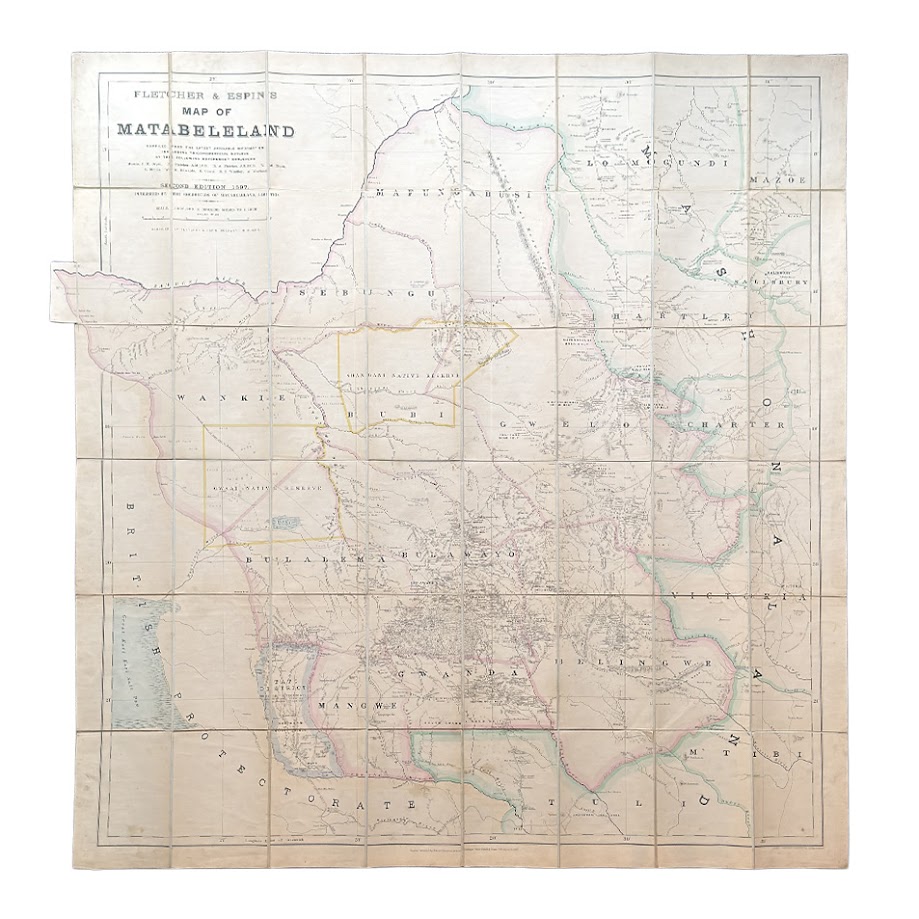
Fletcher & Espin’s Map Of Matabeleland – Second Edition – 1897
Fletcher & Espin
£2,500.00
Availability: In stock
Product Description
Fletcher & Espin’s Map Of Matabeleland – Second Edition – 1897
Bulawayo and London: Goldfields of Matabeleland Ltd. / Edward Stanford, 1897
Second edition, 1897. Monumental folding colour map of Matabeleland and adjoining territories.
An exceptionally rare and historically important large-format colonial map documenting Matabeleland during the formative years of British South Africa Company administration, mineral exploitation and pioneer settlement in present-day Zimbabwe.
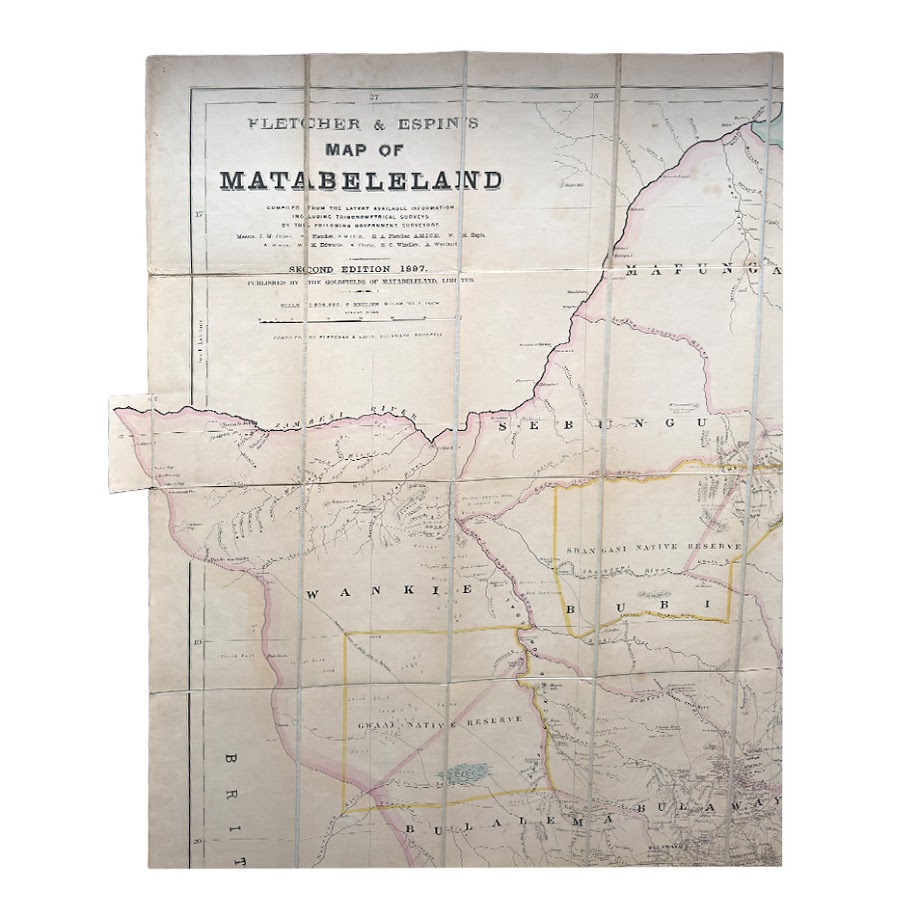
Printed in Bulawayo and published in London by Edward Stanford for the Goldfields of Matabeleland Ltd., the map was compiled by the pioneering surveyors and cartographers Fletcher & Espin using “the latest available information including trigonometrical surveys.” The title additionally records contributions from several surveyors and mining engineers active in the territory during the late nineteenth century.
The map depicts Matabeleland, Mashonaland and adjoining regions in extraordinary detail at a crucial moment in the consolidation of colonial occupation following the First Matabele War (1893–94) and immediately after the Matabele Rebellion of 1896. It captures the rapidly changing political and economic geography of the territory during the height of imperial expansion, mining speculation and infrastructural development.
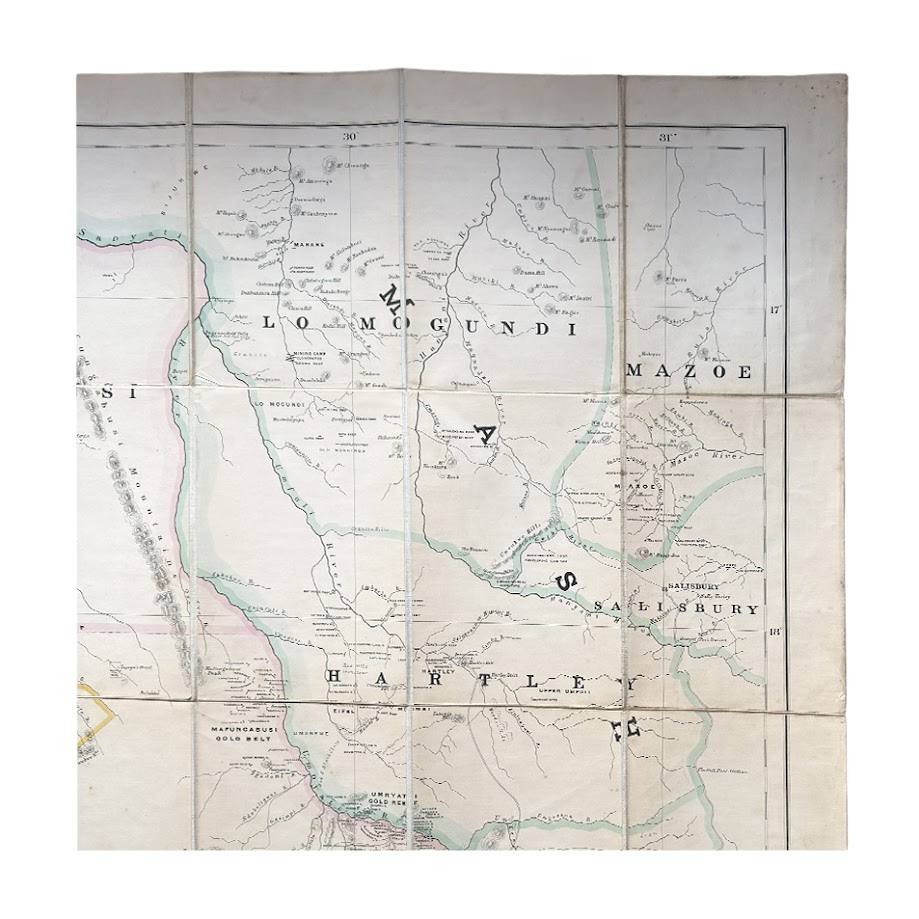
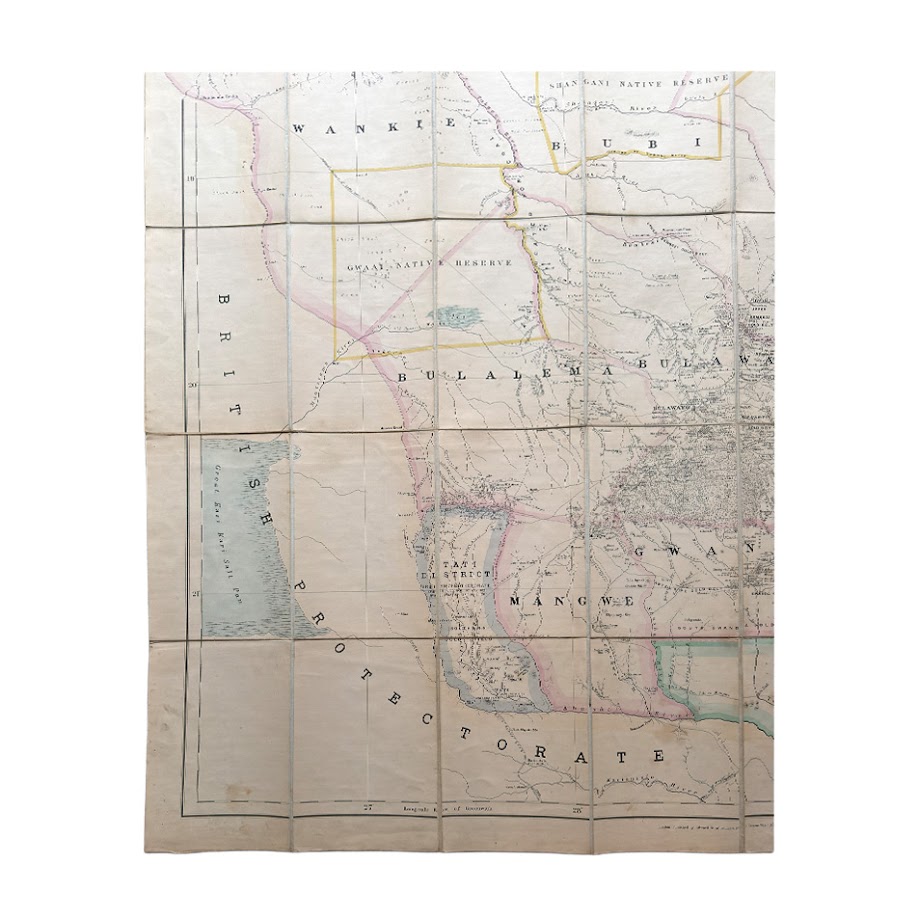
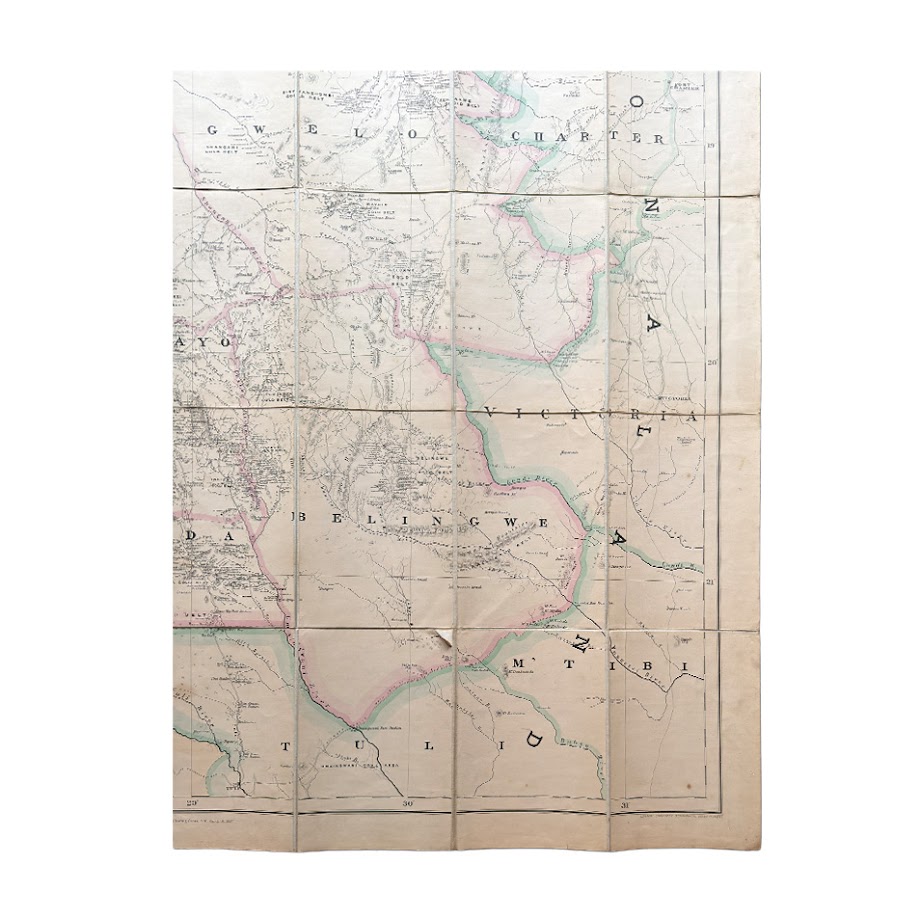
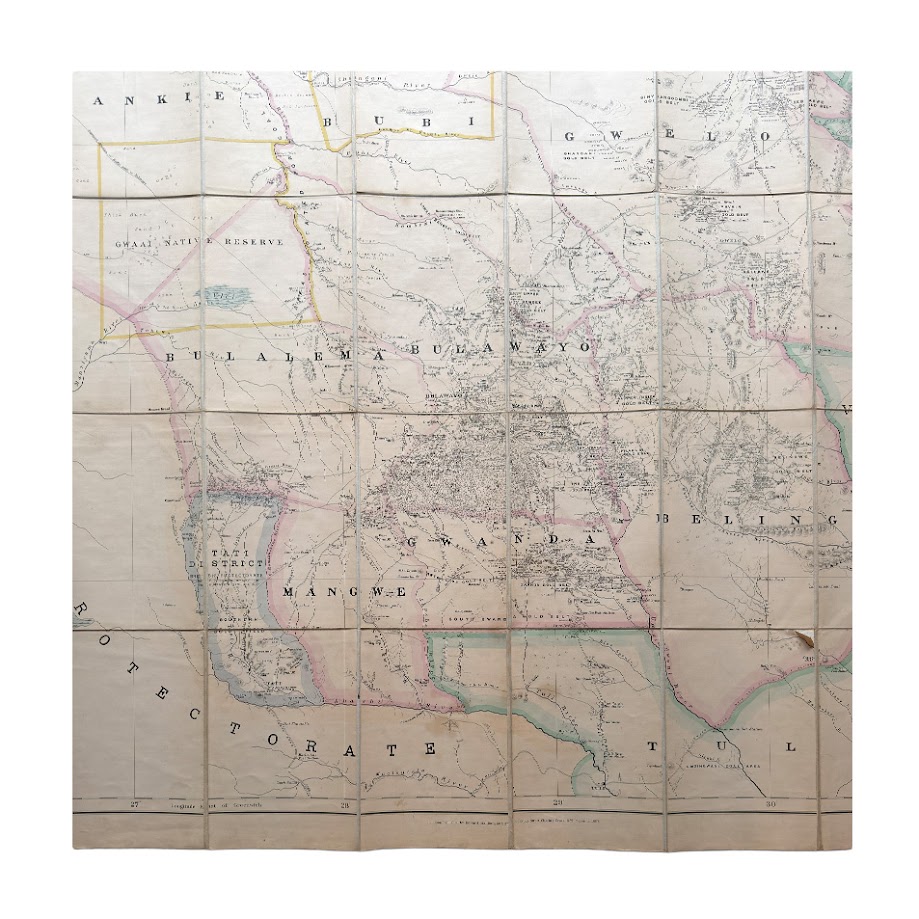
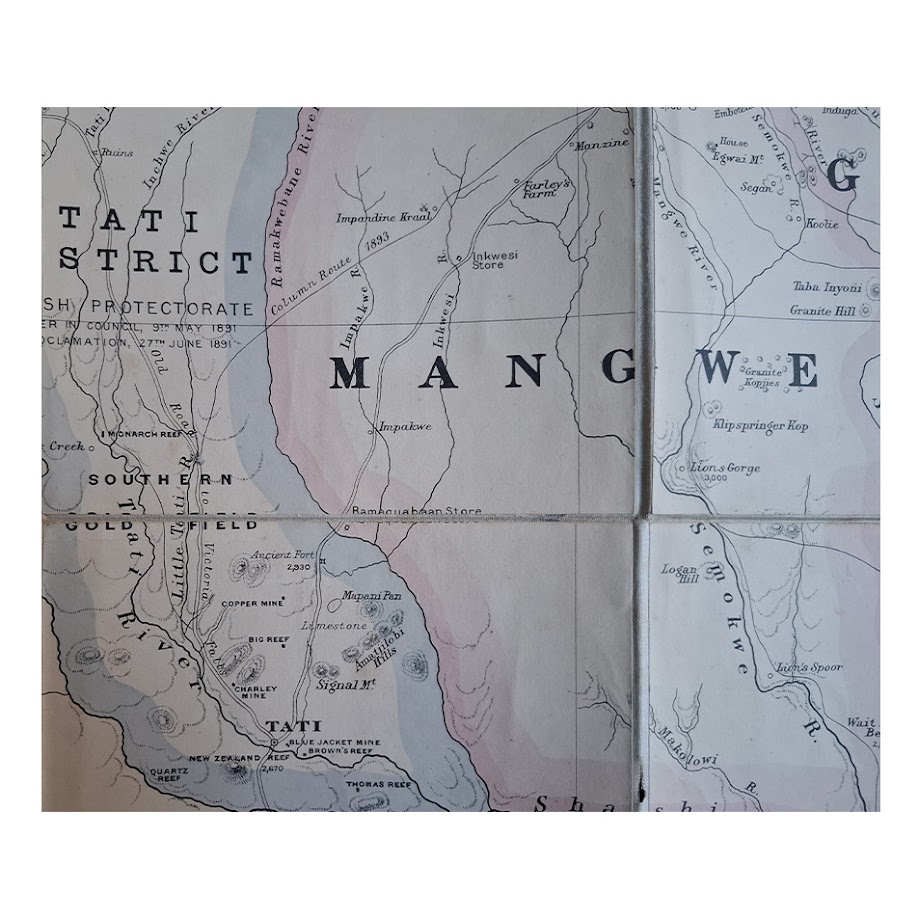
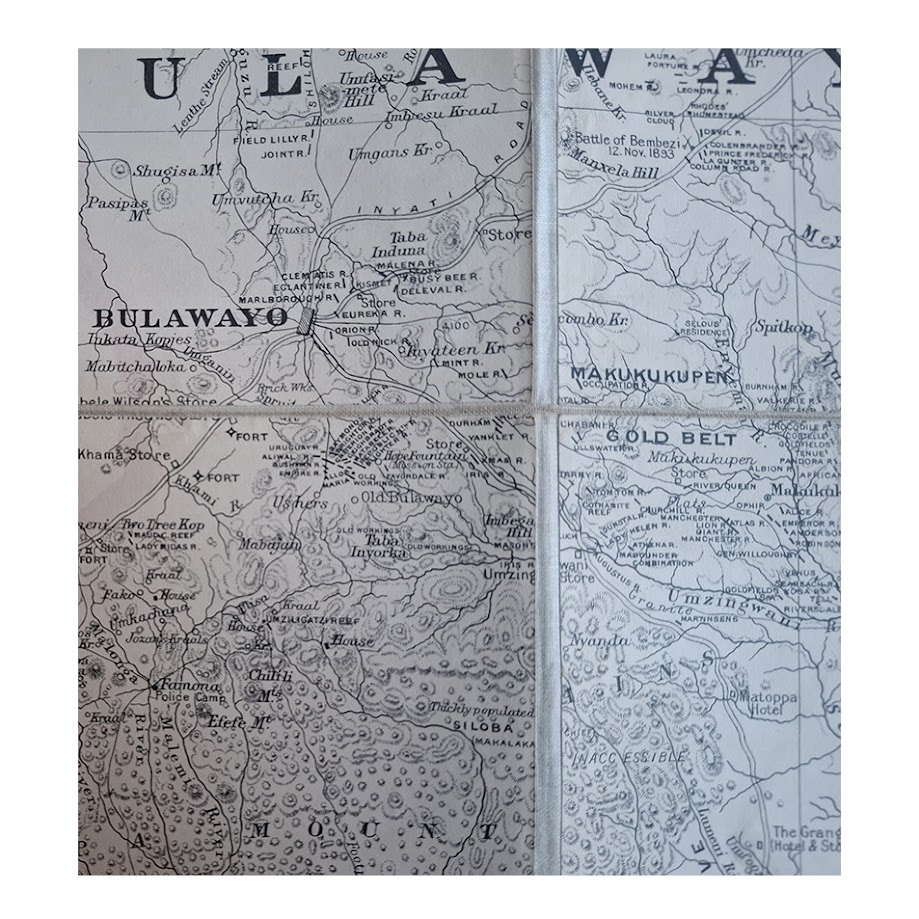
Extending from the Zambezi basin southward toward the Tuli region and Bechuanaland Protectorate, the map records settlements, rivers, tribal territories, wagon routes, mining districts, telegraph lines, surveyed farms, native reserves and administrative boundaries. Bulawayo appears prominently at centre, while Salisbury and other early colonial settlements are carefully plotted to the east. The map additionally identifies extensive mining claims and concessionary territories associated with the speculative gold boom that followed Cecil Rhodes’s expansion into the region.
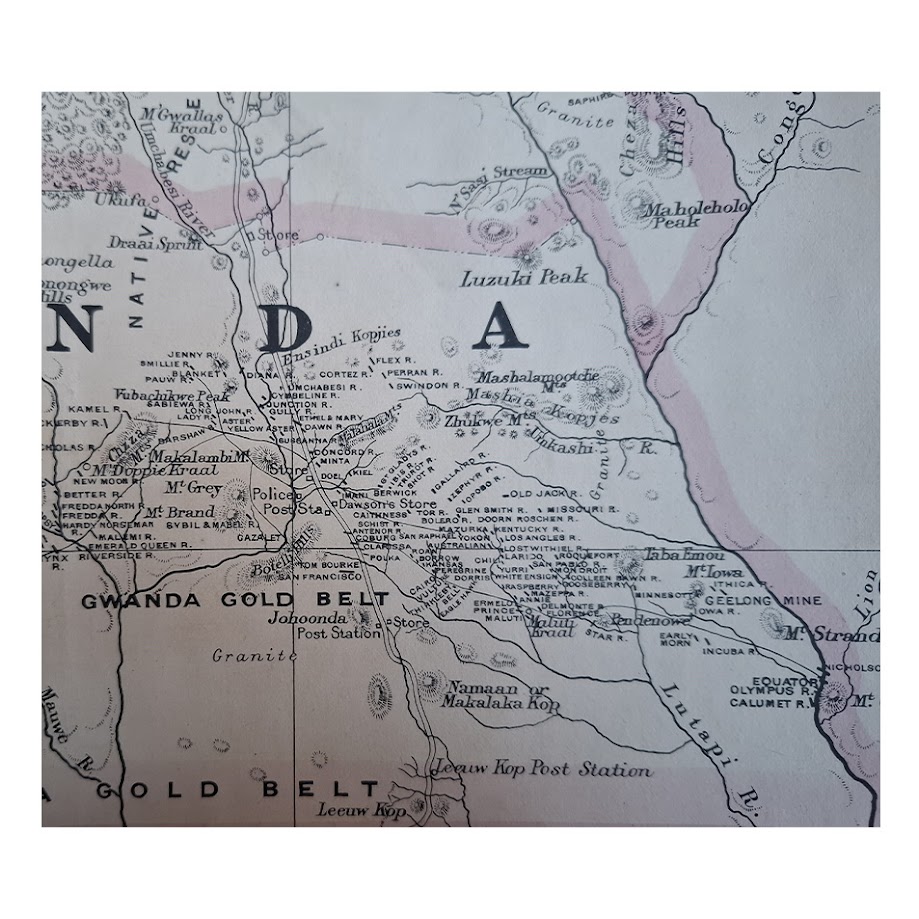
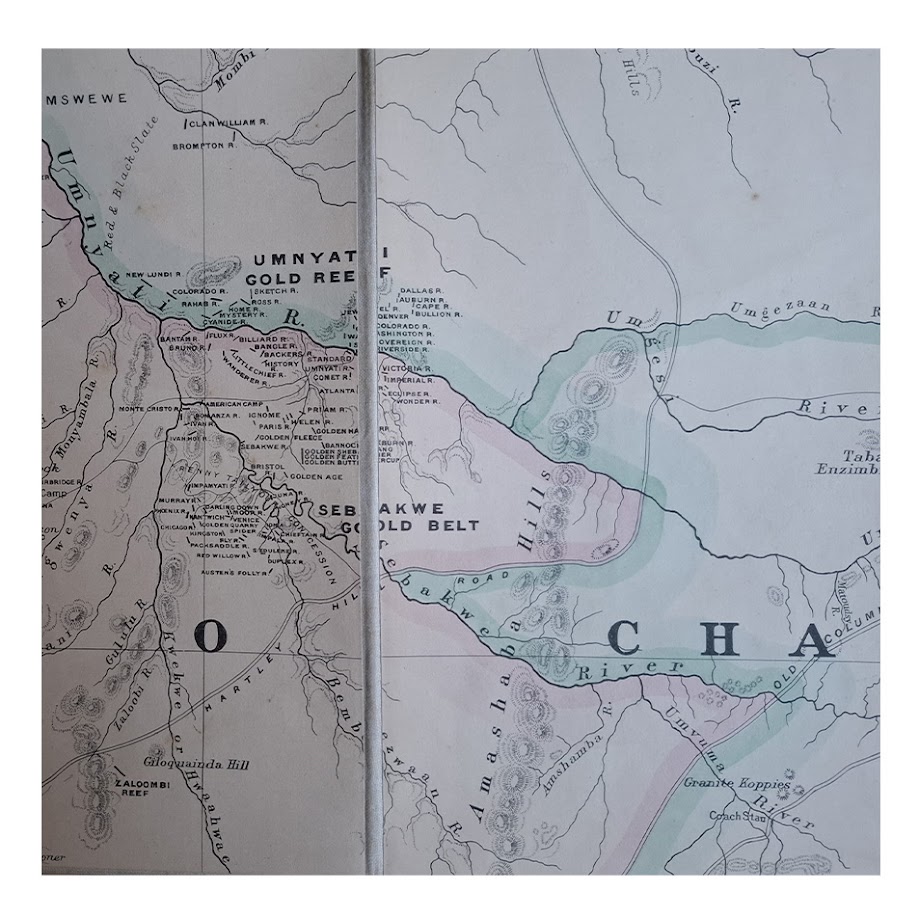
Particularly notable is the astonishing density of mining and survey information throughout the map. Gold belts, reefs, prospecting camps, stores, police posts, wagon roads and individual mining claims are recorded in remarkable detail. Our images show the Gwanda Gold Belt, Sebakwe Gold Belt and Umniati mining regions. These sections vividly document the speculative mining culture of the 1890s and transform the map from a purely geographical document into a major record of colonial economic development and mineral exploration. The Bulawayo region is especially compelling. The map records both the developing colonial settlement and the surrounding military and administrative landscape, including roads, forts, stores and early infrastructural routes. References to Old Bulawayo and nearby strategic sites preserve a remarkable snapshot of the territory during the immediate aftermath of conquest and consolidation. Additionally striking is the precision of the topographical and mining notation. Individual reefs, kopjes, rivers, camps and survey features are rendered with extraordinary clarity, revealing the map’s intended practical use within surveying, prospecting and administrative contexts. The detail visible throughout the sheet demonstrates that this was a serious working map produced for commercial and governmental use rather than merely a decorative or promotional publication.
The present example is the scarce second edition of 1897, revised and updated from the first edition of 1896. Contemporary accounts noted that the revised edition incorporated substantial new survey work and had been corrected and brought up to date. The map therefore preserves a remarkably precise snapshot of Matabeleland during one of the most fluid and consequential moments in southern African colonial history.
Produced at a time when accurate regional mapping remained exceptionally difficult, the map reflects the work of surveyors, prospectors and engineers operating in territory only recently traversed and politically consolidated by colonial authorities. Fletcher & Espin occupy an important place in the cartographic history of early Rhodesia, and their surveys contributed significantly to subsequent geological and administrative mapping of the territory. The map’s association with the Goldfields of Matabeleland Ltd. is equally important. Like many speculative mining enterprises established during the 1890s Rhodesian boom, the company sought to attract investors and prospectors by demonstrating the commercial promise and surveyed infrastructure of the territory. Maps of this type therefore functioned simultaneously as working geographical tools and instruments of colonial and financial promotion.
Examples are now institutionally scarce. Holdings are recorded at institutions including The National Archives in the United Kingdom, Yale University Library and the Bibliothèque nationale de France. Commercial examples appear extremely infrequently on the market, and the present copy appears to be the only publicly traceable recent example of the 1897 second edition identified in modern dealer and auction records.
The map itself is visually striking, printed in black with delicate contemporary outline colouring in pink, yellow and green delineating territorial and administrative divisions. The restrained colouring contrasts beautifully with the dense geographical notation, producing a sheet of exceptional visual clarity despite its immense complexity. Particularly impressive is the scale of the map. Measuring approximately 120 x 129.4 cm when fully extended, it possesses remarkable physical presence and was clearly intended for practical administrative, surveying or mining use rather than casual reference. Large-format African colonial maps of this scale had inherently low survival rates due to constant folding, transportation and field use, making intact examples especially desirable today.
Condition: Large folding map, approximately 120 x 129.4 cm unfolded. Folded as issued. Some staining verso but map generally in very good indeed clean condition. General light age toning and minor handling wear throughout consistent with use. No slipcase present. Contemporary outline colouring fresh and attractive. Overall very good indeed for a large and heavily used colonial working map of the period.
A highly important and visually arresting document of early colonial southern Africa, combining cartographic rarity, mining history, imperial geography and frontier survey work at an exceptional scale.
Edward Stanford: A Brief Description
Edward Stanford was a prominent British mapmaker, publisher, and founder of the renowned cartographic firm Edward Stanford Ltd.. He played a crucial role in the history of cartography in the 19th century, producing maps and atlases of high quality and accuracy that were used by explorers, governments, and the general public. His contributions to cartography and the firm he founded helped shape the way geographical knowledge was disseminated during the Victorian era and beyond.
Early Life and Career
Edward Stanford was born on 27 May 1827, in Bury St Edmunds, Suffolk, England. His early career in the world of cartography began in 1848 when he joined the London-based map and book publishing firm of Trelawney Saunders. Stanford quickly rose through the ranks and, in 1853, took over the business from Saunders, renaming it Edward Stanford Ltd.. This marked the beginning of his long-standing influence in the field of cartography.
The Growth of Edward Stanford Ltd.
Under Edward Stanford’s leadership, the business expanded rapidly and became the leading cartographic firm in Britain by the mid-19th century. Located at 6 Charing Cross in London, Stanford’s shop became a central hub for the production and sale of maps, atlases, and globes.
The company specialised in a wide variety of cartographic products:
- Maps of the British Empire: As the British Empire expanded, there was a growing demand for maps that could aid both in administration and exploration. Stanford produced detailed maps of British colonies and territories around the world, helping travellers, military officers, and government officials navigate and govern these distant lands.
- Exploration Maps: During the Victorian era, exploration of uncharted territories was a significant undertaking, and Stanford played a key role in providing maps to explorers. Famous explorers like Sir Henry Morton Stanley and David Livingstone used Stanford’s maps during their expeditions in Africa, which helped enhance the company’s reputation for accuracy and reliability.
- Commercial Maps and Atlases: Stanford’s shop catered not only to government officials and explorers but also to the general public. The firm published detailed maps of London, the British Isles, Europe, and other regions of the world. Many of these maps were known for their clarity and precision and became popular among travellers, students, and academics. The London Atlas of Universal Geography, first published in 1862, was one of Stanford’s most famous works, known for its comprehensive coverage and beautifully crafted maps.
Contributions to Education and Cartography
Stanford’s influence extended beyond map publishing. His maps were used extensively in schools and universities, helping to educate generations of students in geography. His firm was instrumental in producing educational materials such as atlases, wall maps, and globes, which became standard tools in British classrooms.
In addition to his publishing achievements, Stanford supported the development of cartographic techniques. His firm embraced advances in printing and lithography, enabling the mass production of maps while maintaining high levels of detail and accuracy. The Stanford maps became known for their clear presentation and innovative use of colour to distinguish political boundaries, physical features, and other important details.
Involvement in National and International Projects
Stanford’s maps were not limited to educational or commercial use; they were also utilised by the British government. His firm was contracted to produce maps for official purposes, including for the military, the Post Office, and other government departments. Stanford’s firm was instrumental in creating the first comprehensive mapping of the British railway system, and their maps were used in the planning of various infrastructure projects throughout the UK.
Internationally, Edward Stanford Ltd. produced maps of key geopolitical importance, including for diplomatic conferences and negotiations. As Britain expanded its influence globally, Stanford’s maps were often used by officials and diplomats to navigate international relations and conflicts.
Edward Stanford’s Legacy
Edward Stanford’s personal involvement in the cartographic world lasted until his retirement in 1882. He passed the business on to his son, Edward Stanford Jr., who continued the family legacy of producing high-quality maps. The firm remained at the forefront of cartographic innovation well into the 20th century.
The Stanford name became synonymous with cartographic excellence, and the firm produced maps that covered a vast array of topics, from colonial territories to urban development. The Stanford’s General Map of the World, published in multiple editions, was a particularly influential work, reflecting the latest geographical knowledge and discoveries of the time.
Stanford’s Shop: A Cartographic Landmark
The Edward Stanford Ltd. shop in London, located at various times in different parts of the city, was itself a landmark for cartographers, explorers, and travellers. By the late 19th century, Stanford’s shop had become the go-to place for anyone needing maps or geographical information. Its location in Charing Cross placed it at the heart of London’s intellectual and commercial centre.
Visitors to Stanford’s would find not only a comprehensive selection of maps and atlases but also globes, books, and other geographical materials. The shop became a symbol of British cartography, serving the needs of the imperial administrators, explorers heading off on expeditions, and ordinary people looking to learn more about the world.
Death and Continuing Influence
Edward Stanford died on 3 November 1904, but his contributions to the world of cartography left an enduring legacy. The firm he founded continued to operate as a leading cartographic publisher well into the 20th century, adapting to the changing needs of geography and travel. Today, Edward Stanford Ltd. still exists, having transformed into Stanfords, the iconic map and travel bookshop, which continues to be one of the most famous map shops in the world.
Conclusion
Edward Stanford was a pivotal figure in the history of cartography, whose work and vision transformed the map-making industry in Britain. His firm provided indispensable resources for explorers, government officials, and the general public, shaping the way people understood and navigated the world. Through his innovative maps, atlases, and educational materials, Stanford’s contributions to geography and cartography remain highly respected and his name continues to be synonymous with high-quality, reliable maps even today.
Location: Book room: 003655
SHOP WITH CONFIDENCE AT HORNSEYS
At Hornseys, we are dedicated to offering items that uphold the highest standards of quality and authenticity. Our collection of artwork is carefully curated to ensure that each item we offer is authentic, collated, and complete.
Here’s what sets us apart:
- Authenticity and Provenance: Each map is researched and verified for authenticity.
- Expert Curation: We wholly own all our artworks. We trust our taste and have invested heavily in it. We have confidence in all artwork that we offer for sale.
- Customer Satisfaction: We strive to provide an exceptional customer experience, from detailed descriptions and provenance to secure and prompt delivery of your purchase.
- Returns Policy: We offer an unconditional guarantee on every item. If, however, you wish to make a return, artworks may be sent back to us within fourteen days of receipt for whatever reason. We request that we are notified in advance if you wish to do so. They must be returned to us in the same condition as they were sent for a full refund.
OUR COMMITMENT TO QUALITY AND SERVICE
Understanding the value and rarity of these items, we ensure that every aspect of your purchase meets the highest standards of quality and service. This includes:
- Free Expedited, Tracked, and Insured Delivery within the UK: Ensuring that your artwork arrives safely and promptly.
- Fully-Insured Worldwide Delivery: Offering peace of mind for international collectors with reliable and secure shipping options.
EXPLORE OUR COLLECTION
Visit Hornseys today to explore our fine collection of maps and other artworks. Whether you are an avid collector or looking for a special gift, our selection offers something truly unique. Located since 1976 in Ripon in the picturesque Yorkshire Dales, we are recognized as a destination gallery for tastefully curated artwork, rare maps, design, and fine books.
Related products


You may also like…

(The Congo, Angola) Carte Des Royaumes De Congo, Angola Et Benguela Avec Les Pays Voisins Tire de L’Anglois
£65.00Bellin, Jacques Nicolas


