
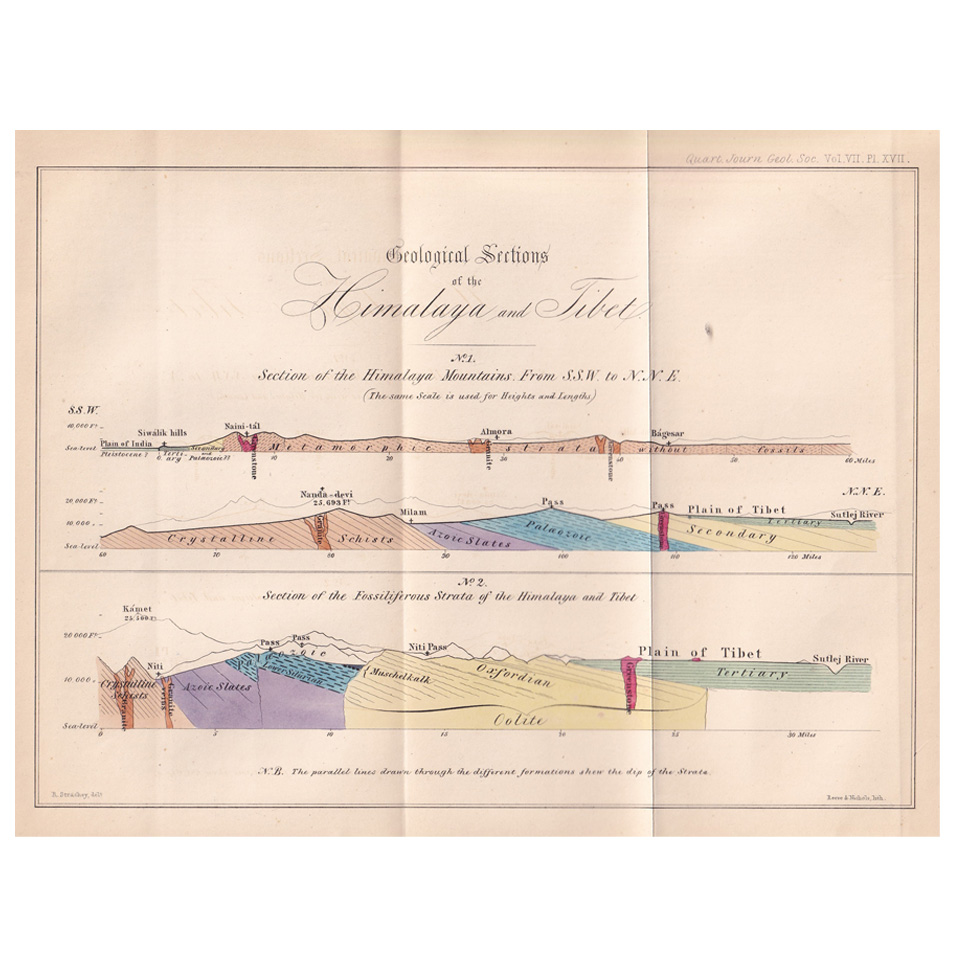
Geological Sections Of The Himalaya And Tibet – 1851
Strachey, R
£95.00
Availability: In stock
Product Description
Geological Sections Of The Himalaya And Tibet – 1851
Cartographer: R Strachey
Publisher: The Geological Society
Price: £95 (post-free in the UK)
Publication Date: 1851
Edition: 1st edition
Format: Colour printed steel engraving
Condition: In near fine condition
Sheet Size: 28.3cm x 22cm
Condition:
Original colour-printed steel engraving. Size: 28.3cm x 22cm. Original fold-lines. Minor marks. In near fine, bright, clean condition. Scarce.
Location: Pocket Map Drawer B : 002894
The Geology Of Tibet And The Himalaya: An Historical Overview
The geology of Tibet and the Himalaya stands as one of the most awe-inspiring and complex natural phenomena on Earth. These regions are not only spectacular in their physical grandeur but are also of immense geological significance. Together, they offer a living record of tectonic forces, continental collisions, and the ever-changing architecture of the planet’s crust. Spanning millions of years, their formation continues to inform current understanding of plate tectonics and mountain-building processes.
The Collision of Continents
At the heart of this geological story lies the dramatic collision between the Indian Plate and the Eurasian Plate. Around 50 million years ago, the Indian subcontinent began its northward journey after breaking away from the ancient supercontinent of Gondwana. Its eventual impact with the Eurasian landmass triggered a colossal tectonic upheaval. Rather than subducting cleanly beneath the Eurasian Plate, as oceanic plates typically do, the buoyant continental crust of the Indian Plate resisted descent. This resistance led to the crust being crumpled, thickened, and thrust upwards, giving rise to the Himalayan mountain range and the vast Tibetan Plateau beyond.
This process, known as continental collision, continues to the present day. The Himalaya are still rising at a measurable rate, making them some of the youngest and most active mountains in the world. Earthquakes in the region bear witness to the ongoing movement and stress within the Earth’s crust.
Stratigraphy and Rock Composition
The Himalaya are composed of a complex assemblage of rock types, each revealing a part of the region’s geological history. Broadly, the mountain range can be divided into several distinct zones running parallel from south to north. These include the Sub-Himalaya, the Lesser Himalaya, the Greater Himalaya, and the Tethyan Himalaya.
The Sub-Himalaya consists primarily of sedimentary rocks that have been folded and faulted due to compressive forces. Moving northwards, the Lesser Himalaya displays a mixture of older sedimentary and metamorphic rocks, often intruded by granitic bodies. The Greater Himalaya, by contrast, is largely composed of high-grade metamorphic rocks, such as gneisses and schists, that have undergone intense pressure and temperature conditions. Further north still, the Tethyan Himalaya comprises marine sedimentary rocks originally deposited in the now-vanished Tethys Ocean.
The Tibetan Plateau, often described as the “Roof of the World,” represents the thickened crust behind the Himalayan front. It is underlain by multiple terranes—fragments of crust with distinct geological histories—that were accreted onto Eurasia during earlier tectonic episodes. Much of Tibet is composed of ancient metamorphic basement rocks, overlain by volcanic sequences and younger sediments. The presence of ophiolites—slivers of oceanic crust uplifted and exposed on land—offers evidence of vanished oceanic realms once separating India from Eurasia.
Tectonic Activity and Mountain Building
The Himalaya and Tibet are a dynamic geological laboratory where orogeny—the process of mountain formation—is occurring in real time. Crustal shortening, thrust faulting, and folding are active mechanisms that continue to shape the landscape. The Main Central Thrust and the Main Boundary Thrust are major fault systems that accommodate much of this deformation. These faults serve as conduits along which rocks from deep within the Earth have been transported towards the surface.
In the Tibetan Plateau, crustal thickening has created an unusually high and broad expanse. Seismic studies have revealed that the crust beneath Tibet may be twice as thick as normal continental crust, a direct result of the compressive forces exerted by the Indian Plate’s relentless northward push.
Additionally, the plateau exhibits signs of extensional tectonics in its interior—a paradoxical process where the crust is being pulled apart even as it is being pushed together along its edges. This has led to the development of large rift valleys and fault systems within Tibet, suggesting a complex interplay of forces at work.
Climatic and Environmental Implications
The rise of the Himalaya and the Tibetan Plateau has had profound effects not only on geology but also on regional and global climate. These high elevations act as a formidable barrier to atmospheric circulation, helping to shape the South Asian monsoon. The orographic lift caused by these mountains enhances precipitation on their southern slopes while creating arid conditions to the north, particularly across the Tibetan Plateau.
Furthermore, the geological uplift has influenced patterns of erosion, river formation, and sediment transport. The Ganges, Indus, and Brahmaputra—three of the major river systems of South Asia—owe their origins and courses to the tectonic and topographic features of the Himalaya.
A Region of Continual Discovery
Ongoing geological research in Tibet and the Himalaya continues to refine understanding of continental dynamics. Satellite geodesy, deep-earth imaging, and field mapping have all contributed to a richer and more nuanced picture of this extraordinary region. The geological complexity—layered in time, scale, and structure—makes the region an invaluable site for studying how continents evolve, interact, and reshape the surface of the Earth.
Conclusion
The geology of Tibet and the Himalaya encapsulates the immense power of tectonic forces and the slow yet relentless processes that shape the planet. From ancient ocean beds now perched atop snow-covered peaks to ongoing crustal collisions beneath the Earth’s surface, the region presents a vivid and continuing narrative of planetary transformation. For geologists, climatologists, and earth scientists alike, it remains one of the most compelling and instructive regions in the world.
SHOP WITH CONFIDENCE AT HORNSEYS
At Hornseys, we are dedicated to offering items that uphold the highest standards of quality and authenticity. Our collection of artwork is carefully curated to ensure that each item we offer is authentic, collated, and complete.
Here’s what sets us apart:
- Authenticity and Provenance: Each map is researched and verified for authenticity.
- Expert Curation: We entirely own all our artworks. We trust our taste and have invested heavily in it. We have confidence in all artwork that we offer for sale.
- Customer Satisfaction: We strive to provide an exceptional customer experience, from detailed descriptions and provenance to secure and prompt delivery of your purchase.
- Returns Policy: We offer an unconditional guarantee on every item. If, however, you wish to make a return, artworks may be sent back to us within fourteen days of receipt for whatever reason. We request that we are notified in advance if you wish to do so. They must be returned to us in the same condition as they were sent for a full refund.
OUR COMMITMENT TO QUALITY AND SERVICE
Understanding the value and rarity of these items, we ensure that every aspect of your purchase meets the highest standards of quality and service. This includes:
- Free Expedited, Tracked, and Insured Delivery within the UK: Ensuring that your artwork arrives safely and promptly.
- Fully-Insured Worldwide Delivery: Offering peace of mind for international collectors with reliable and secure shipping options.
EXPLORE OUR COLLECTION
Visit Hornseys today to explore our fine collection of maps and other artworks. Whether you are an avid collector or looking for a special gift, our selection offers something truly unique. Located since 1976 in Ripon in the picturesque Yorkshire Dales, we are recognized as a destination gallery for tastefully curated artwork, rare maps, design, and fine books.
Related products

(North India, Hindustan) Carte De La Partie Superieure De L’Inde En Deca Du Gange
£45.00Bonne, Rigobert


You may also like…
Geological Map Of The Country Around Salisbury – Rhodesia – 1958 – First Edition
£245.00R. M. Tyndale-Biscoe
Geologic Map of California Olaf P Jenkins Edition Los Angeles Sheet
£195.00Jennings, Charles W & Strand, Rudolph G
Geological Map Of Israel – Revised Edition – 1976 – Map On Two Sheets
£450.00Picard, L. Y, Golani, U, Bentor, Y. K, Vroman, A & Zak, I
Tectonic Map Of Australia – First Edition – Map On Four Sheets
£650.00Bureau of Mineral Resources, Geology and Geophysics
Geological Map Of The People’s Republic Of China – Presentation Copy From Geologist Shihe Lei
£125.00Published in Beijing


