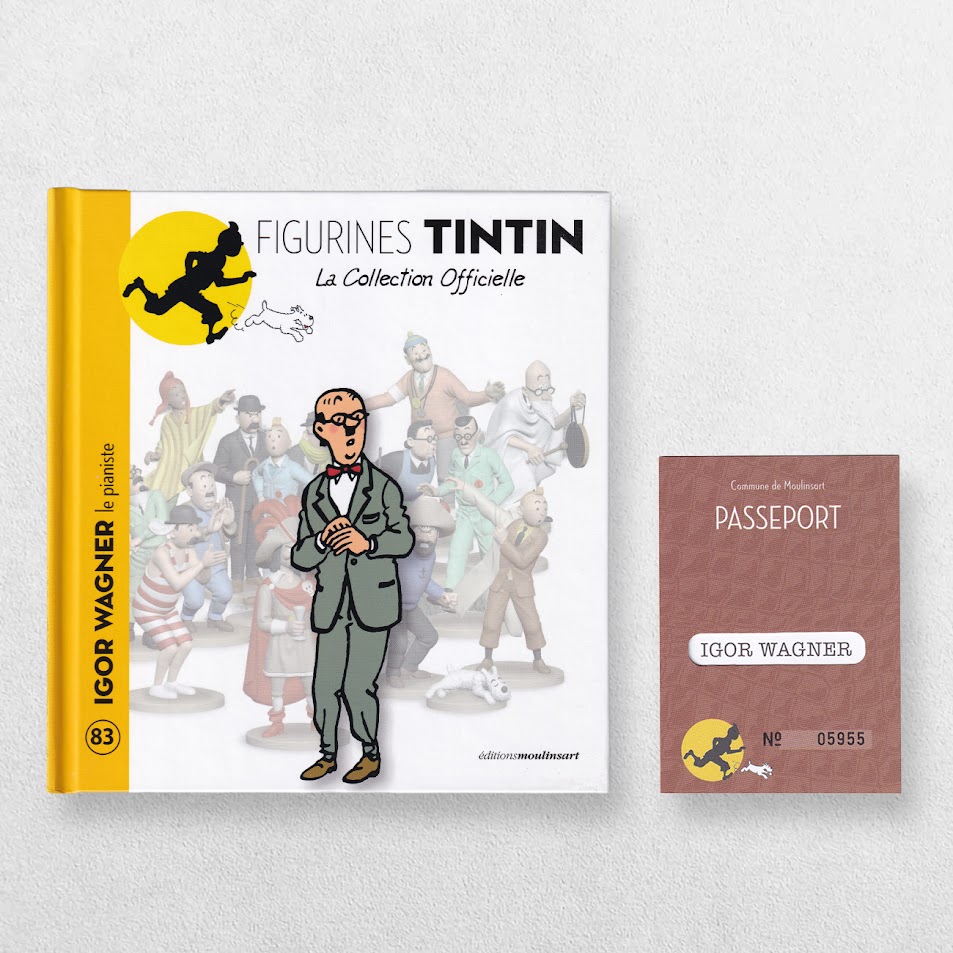
Igor Wagner The Pianist – Figurines Tintin La Collection Officielle – 83 – Igor Wagner Le Pianiste
Author: Hergé & Editions Moulinsart
Price: £65.00
Publisher: Editions Moulinsart
Publication date: 2014
Format: Original pictorial boards with passport and figurine
Condition: In near fine condition
Illustrations: Illustrated throughout
Description:
Original pictorial boards. Includes passport loosely inserted. Text in French. Includes the accompanying figurine. One from the collection of 111 books and figurines. Very slight wear. In very near fine, clean condition overall.
Igor Wagner: A Short Biography
Igor Wagner is a supporting character who appears in The Adventures of Tintin – The Castafiore Emerald (Les Bijoux de la Castafiore, 1963*). He serves as the devoted, somewhat nervous pianist and accompanist to the celebrated opera diva Bianca Castafiore.
Though far from the heroic or villainous extremes that define Tintin’s world, Wagner represents one of Hergé’s finest achievements in character subtlety. His presence brings an authentic note of realism to The Castafiore Emerald — an album notable for its domestic setting, psychological depth, and quiet humour rather than its usual globe-trotting adventure.
Character Overview
- Full Name: Igor Wagner
- Occupation: Classical pianist and accompanist
- Affiliation: Bianca Castafiore (as musical assistant)
- First Appearance: The Castafiore Emerald (Les Bijoux de la Castafiore, 1963*)
- Nationality: Presumably Eastern European (unconfirmed)
- Character Type: Secondary character; comic realist; voice of restraint and anxiety
Role in The Castafiore Emerald
- The Accompanist
Wagner is introduced as the quiet, impeccably polite pianist who travels with the famed soprano Bianca Castafiore, known to Tintin fans as “the Milanese Nightingale.” When Castafiore visits Marlinspike Hall, Captain Haddock’s ancestral home, Wagner accompanies her to provide rehearsal support and musical company.
- Amidst the Chaos
Within the tranquil, almost claustrophobic setting of Marlinspike Hall, a sequence of misunderstandings and rumours erupts — about theft, romance, and scandal. Wagner remains largely in the background, his gentle, anxious demeanour a foil to the diva’s flamboyance and Haddock’s exasperation.
Though he rarely speaks, his facial expressions — drawn by Hergé with exquisite comic precision — tell the story of a man perpetually caught between professional duty and personal discomfort.
- The Mysterious Calm
Throughout the chaos surrounding the missing emerald, Wagner maintains his composure, absorbed in his piano practice and rehearsal duties. His restraint and professionalism contrast sharply with the hysteria of the press and the servants, subtly heightening the album’s satirical tone.
Character Traits and Analysis
- Quiet Professionalism
Wagner’s most striking feature is his calm, almost invisible professionalism. He is devoted to his craft, seemingly indifferent to gossip or melodrama. His role is to support Castafiore’s artistry — and to endure her temperament with patience.
- Comic Restraint
In a book full of exaggerated personalities — Castafiore’s flamboyance, Haddock’s temper, Calculus’s absent-mindedness — Wagner provides balance. His silence becomes humorous in itself: a portrait of polite endurance.
- Subtle Symbolism
Wagner’s surname evokes Richard Wagner, the great German composer associated with epic operas and intense emotion. Hergé’s Igor, by contrast, is modest, timid, and understated — a deliberate irony that adds an extra layer of humour for musically literate readers.
- Cultural Refinement
His musical background brings refinement to The Castafiore Emerald. Hergé uses him to contrast artistic discipline with social chaos: while journalists and household staff panic over the “stolen” jewel, Wagner remains devoted to the measured world of notes and rhythm.
Themes and Interpretation
- Order Amidst Disorder
Wagner symbolises artistic order in a story defined by domestic disorder. He mirrors Hergé’s own love of structure and precision — the calm centre around which confusion swirls.
- The Unsung Worker
Like many of Hergé’s secondary figures, Wagner represents the professionalism behind celebrity. Castafiore’s fame depends on his quiet competence. Yet he receives little credit, echoing Hergé’s sympathy for modest, diligent individuals overshadowed by louder personalities.
- Humour Through Restraint
Wagner’s presence provides deadpan humour. His reactions — a raised eyebrow, a resigned expression — often say more than words. Through him, Hergé demonstrates that comedy need not rely on slapstick; it can arise from understatement and timing.
Artistic and Visual Characterisation
In the ligne claire style, Wagner is drawn with clean, formal lines:
- Appearance: A slender man with neatly combed dark hair, a small moustache, and round spectacles.
- Dress: Always impeccably tailored, usually in a dark suit — a visual cue of discipline and precision.
- Body Language: Stooped slightly at the piano, suggesting humility; gestures restrained, facial expressions controlled but readable.
Hergé’s careful use of posture and expression conveys Wagner’s personality without exposition — an example of his mastery of visual storytelling.
Moral and Emotional Dimension
Though not morally tested in the story, Wagner embodies quiet integrity. His calm professionalism contrasts with the absurdity around him — a gentle reminder of grace under pressure.
Hergé subtly uses him to explore themes of artistic devotion and emotional restraint. Wagner does his work perfectly, not for fame or recognition, but out of genuine respect for his art and his employer.
Relationship with Other Characters
With Bianca Castafiore
Wagner’s relationship with Castafiore is one of loyal subordination mixed with weary tolerance. She praises him when it suits her but often ignores his quiet labour. Their dynamic echoes that between artist and accompanist everywhere: one glamorous and volatile, the other indispensable but invisible.
With Captain Haddock
Haddock, already exasperated by Castafiore’s presence, shows little patience for Wagner’s constant piano practice. Their unspoken tension adds a background layer of humour — two very different temperaments trapped under one roof.
With Tintin and Calculus
Tintin treats Wagner with courtesy, while Calculus, obsessed with his inventions, barely notices him. This indifference reinforces Wagner’s position as a background figure — essential to the social texture of the story, but largely overlooked by those around him.
Narrative and Thematic Function
Wagner’s function in The Castafiore Emerald is less plot-driven and more atmospheric. He helps establish tone — the quiet domesticity, the rhythm of everyday life, and the interplay between art and absurdity.
His steady presence reinforces the album’s key theme: that drama often grows out of nothing, and that the true test of character lies in maintaining composure amid confusion.
Legacy and Interpretation
Though Wagner appears only in The Castafiore Emerald, his presence enhances Hergé’s mature realism. The album’s brilliance lies in its focus on ordinary human behaviour rather than external adventure — and Wagner, calm and disciplined, personifies that inward shift.
Among Tintin enthusiasts, he is remembered with affection as the model accompanist: professional, self-effacing, and long-suffering, forever trapped between music and mayhem.
Summary
- Name: Igor Wagner
- Occupation: Pianist and accompanist to Bianca Castafiore
- First Appearance: The Castafiore Emerald (1963)
- Character Type: Comic realist; minor supporting role
- Traits: Calm, polite, professional, anxious, understated
- Themes: Artistic integrity, composure, humour through restraint, order amidst chaos
- Fate: Presumably continues to accompany Castafiore after the events of the story
Conclusion
Igor Wagner is one of Hergé’s quietest triumphs — a secondary character who enriches The Castafiore Emerald through understatement and authenticity.
In a narrative where nothing overtly dramatic occurs, his soft piano notes become the soundtrack to misunderstanding and farce, embodying Hergé’s mature fascination with the everyday comedy of manners.
Where others bluster, Wagner endures; where others speak, he plays. And in that quiet persistence, he becomes a subtle emblem of dignity — the unsung artist at the heart of Tintin’s most domestic and sophisticated adventure.
Why Buy from Us?
At Hornseys, we are committed to offering items that meet the highest standards of quality and authenticity. Our collection of objects and rare books are carefully curated to ensure each edition is a valuable piece of bibliographical history. Here’s what sets us apart:
- Authenticity and Provenance: Each item is meticulously researched and verified for authenticity and collation.
- Expert Curation: Our selection process focuses on significance, condition, and rarity, resulting in a collection that is both diverse and distinguished.
- Customer Satisfaction: We aim to provide an exceptional customer experience, from detailed descriptions to secure and prompt delivery of your purchase.
- Returns Policy: We offer an unconditional guarantee on every item. If you wish to return an item, it may be sent back to us within fourteen days of receipt. Please notify us in advance if you wish to do so. The item must be returned in the same condition as it was sent for a full refund.
Cataloguer: Daniel Hornsey
Daniel Hornsey has specialised in fine and rare books, ephemera, and collectors’ editions for over thirty years. As a long-standing member of the antiquarian book trade, he has advised private collectors, curated catalogues, and sourced works for leading dealers, libraries and institutions across the world.
Hornseys’ exhibit regularly at book and map fairs in London and throughout the UK and are members of the Provincial Booksellers Fairs Association, the PBFA.
His fascination with Hergé’s work — especially ‘The Adventures of Tintin’ — began in childhood. Daniel recalls reading Tintin in original European editions and quickly recognising that these were not merely children’s books, but finely illustrated narratives crafted with artistic depth and wit.
As noted by the Musée Hergé in Louvain-la-Neuve, Hergé’s ‘ligne claire’ style has influenced generations of European comic artists and his original drawings and paintings command very high prices with his painting of ‘The Blue Lotus’ jar fetching £2.8m at auction in 2021.
By presenting these works through Hornseys’, he hopes to contribute to the continued appreciation of one of the 20th century’s most influential illustrators, helping new generations discover the artistry and legacy of Hergé.