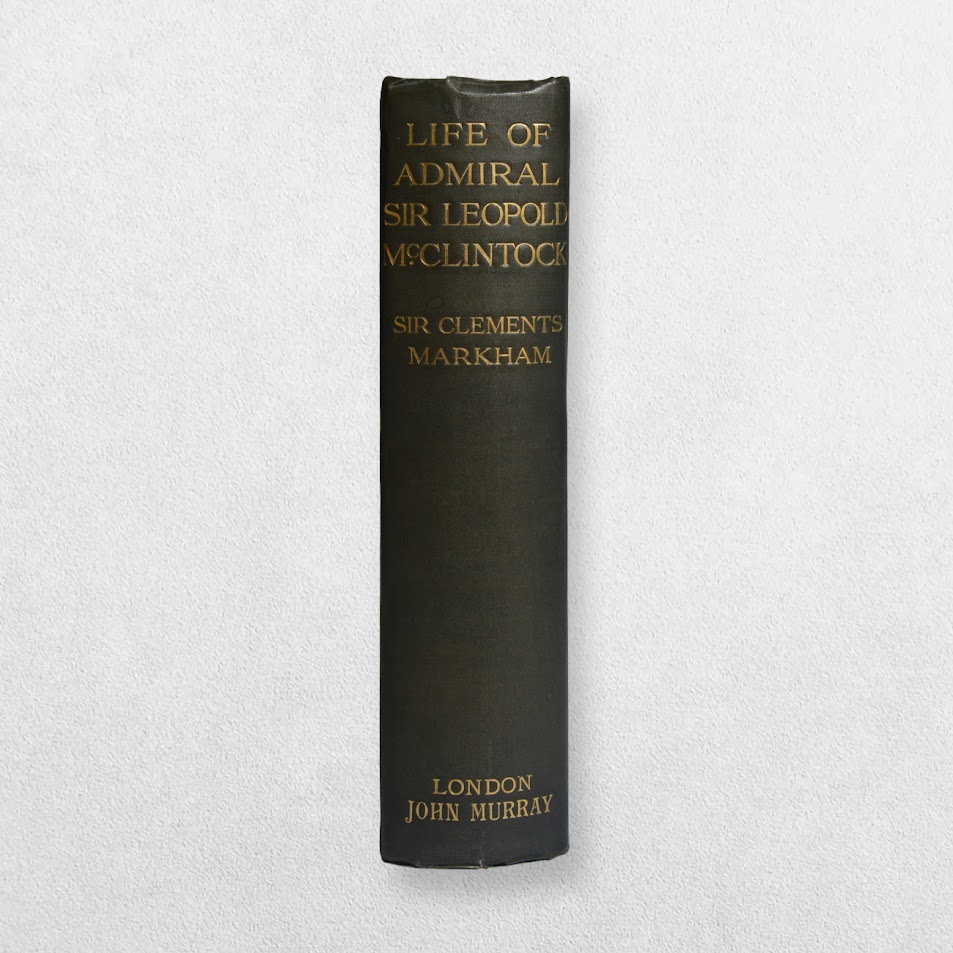
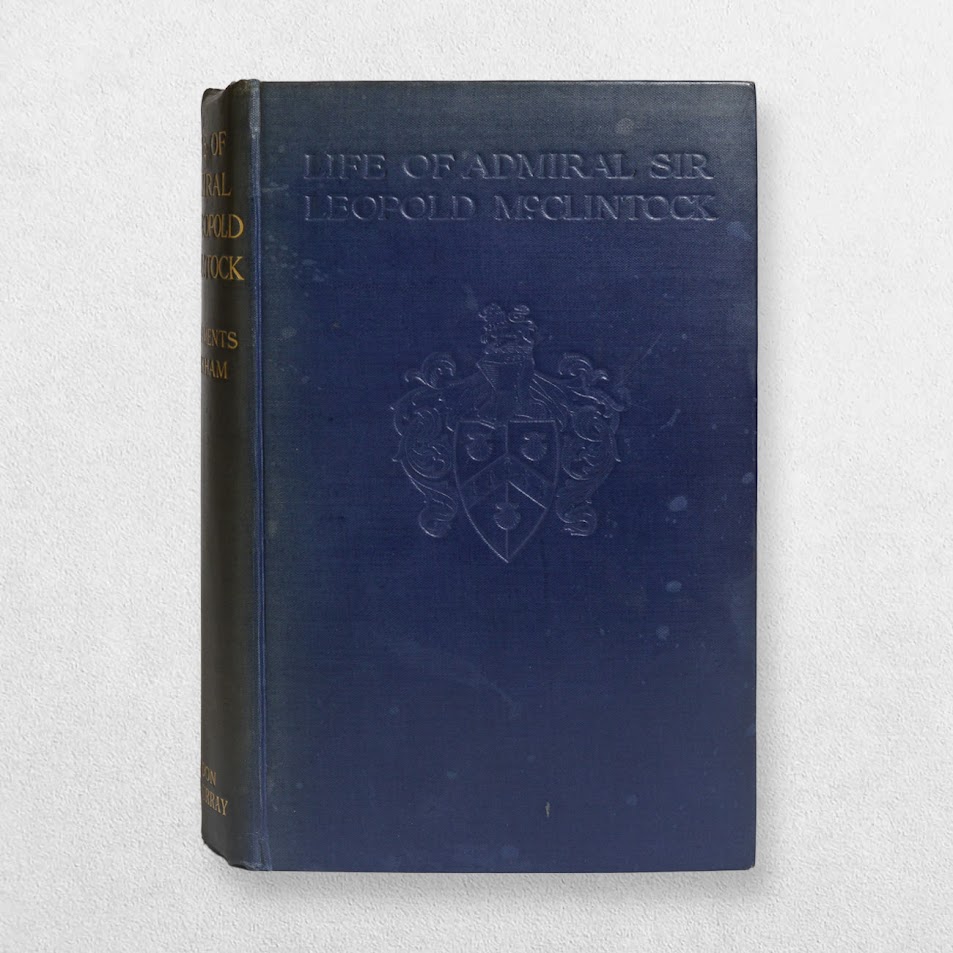
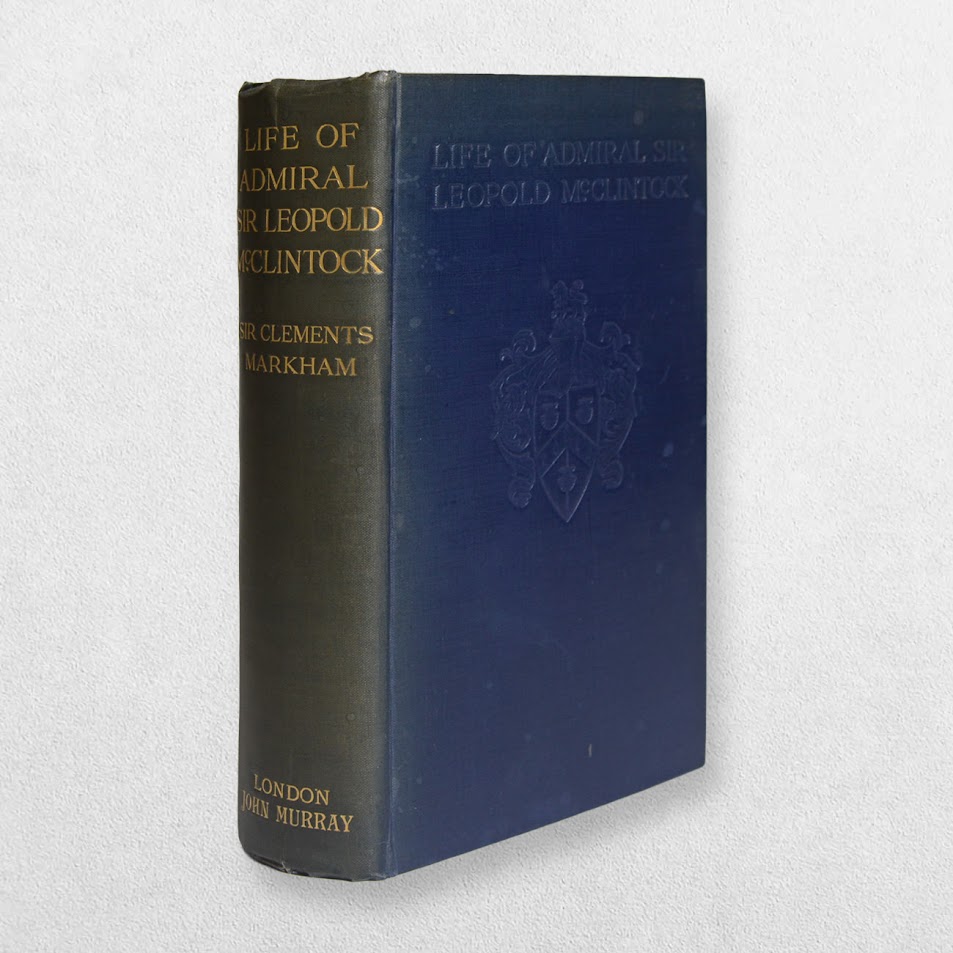
Life Of Admiral Sir Leopold McClintock
Markham, Sir Clements R
£195.00
Availability: In stock
Product Description
Life Of Admiral Sir Leopold McClintock
Author: Markham, Sir Clements R
Price: £195
Publisher: John Murray
Publication Date: 1909
Edition: First edition
Format: Original cloth gilt
Condition: Very good plus
Pages: xx + 370
Description:
First edition. Octavo. Original cloth, A detailed account of his life and explorations with much on his involvement in Arctic expeditions. Neat ink name of ‘R. Roxburgh R.N.’ to the title page along with an inscription to the front free endpaper: ‘Bob, from J. B. R Jan.1914’. Midshipman Robert Roxburgh R.N. of H.M.S. Indefatigable died on May 31, 1916 at the Battle of Jutland and the Robert Roxburgh Memorial Prize at Royal Naval College, Dartmouth was named in his memory by his mother, Mrs J. B. Roxburgh. Cloth slightly faded, marked and rubbed. Minor occasional foxing to the pages else a very good plus, tight, clean copy. Scarce.
Admiral Sir Leopold McClintock: A Short Biography
Sir Francis Leopold McClintock was born on 8 July 1819 in Dundalk, County Louth, Ireland. From a young age he demonstrated both determination and a strong sense of duty, qualities that would define his naval career. He entered the Royal Navy in 1831 at the age of twelve, embarking on a lifelong service at sea during a period when the Navy remained central to Britain’s global influence.
McClintock rose steadily through the ranks, earning a reputation for diligence, seamanship, and resilience. His early postings gave him extensive experience in navigation and leadership, skills that would prove invaluable during the most demanding phase of his career—Arctic exploration.
Arctic Exploration
McClintock first became involved in polar service during the late 1840s, a time when Britain was deeply engaged in searching for Sir John Franklin’s lost expedition. Franklin and his men had vanished in 1845 while attempting to chart the Northwest Passage, sparking one of the greatest mysteries of nineteenth-century exploration.
McClintock took part in several search expeditions under the command of Sir James Clark Ross and later Sir Edward Belcher. His methodical approach to sledging—long overland journeys across the ice with dog or man-hauled sledges—set new standards for Arctic exploration. He demonstrated extraordinary endurance, often covering hundreds of miles in extreme conditions while mapping previously uncharted areas.
The Fox Expedition
McClintock’s greatest achievement came in 1857, when he was appointed commander of the Fox, a privately funded vessel sent to resolve the mystery of Franklin’s fate. The expedition was largely sponsored by Lady Jane Franklin, the admiral’s widow, who was determined to discover the truth about her husband’s final voyage.
Sailing from Aberdeen, McClintock and his crew faced two winters trapped in the ice before they achieved a breakthrough. In 1859, sledge parties led by McClintock and his officers found conclusive evidence of Franklin’s expedition on King William Island. Among the discoveries was a written record left by the survivors of the Erebus and Terror, noting Franklin’s death in 1847 and the subsequent abandonment of the ships.
McClintock’s party also recovered artefacts and testimonies from Inuit communities, providing the first reliable account of the expedition’s tragic end. His meticulous documentation and humane treatment of the Inuit set him apart from many contemporaries, ensuring the credibility of his findings.
Later Naval Career
Following the success of the Fox expedition, McClintock returned to regular naval service, rising to high command. He held posts in the West Indies and elsewhere before being promoted to rear admiral in 1871 and admiral in 1884. His leadership was marked by professionalism and the respect he commanded from colleagues and subordinates alike.
In recognition of his achievements, McClintock was knighted in 1860. He became widely regarded as one of the finest Arctic explorers of his generation, combining bravery with careful scientific observation.
Personal Life
McClintock married Annette Elizabeth Delap in 1870, and the couple had children together. Despite his demanding career, he maintained close ties to his family and his native Ireland. He was remembered by those who knew him as a man of integrity, modesty, and steadfast dedication to duty.
Death and Legacy
Admiral Sir Leopold McClintock died on 17 November 1907 in London. His legacy rests above all on his role in resolving the fate of Franklin’s expedition, a mystery that had gripped Britain and the wider world for over a decade. His discoveries provided closure for the families of the lost sailors and advanced the understanding of the Arctic.
McClintock is commemorated as both a naval officer and an explorer whose work combined courage with scientific and humanitarian values. His methods of Arctic travel influenced subsequent expeditions, while his writings remain a vital source for historians of exploration.
Conclusion
Admiral Sir Leopold McClintock’s life exemplifies the spirit of nineteenth-century exploration and naval service. From his disciplined rise through the ranks of the Royal Navy to his ground-breaking achievements in the Arctic, he embodied resilience, curiosity, and leadership. His resolution of the Franklin mystery secured him an enduring place in the annals of exploration, ensuring that his name remains synonymous with perseverance and discovery in the face of extreme adversity.
H.M.S. Indefatigable At The Battle Of Jutland: A Brief Account
HMS Indefatigable was the lead ship of the Indefatigable-class battlecruisers of the Royal Navy. Launched in 1909, she was designed as an evolution of earlier battlecruisers, combining speed with heavy armament, though at the cost of lighter armour. Her service culminated in the Battle of Jutland in 1916, where she met a catastrophic fate. The story of Indefatigable at Jutland remains a defining moment in the history of naval warfare, illustrating both the strengths and the vulnerabilities of battlecruiser design.
Design and Role
The Indefatigable-class battlecruisers were intended to act as fast capital ships, capable of outrunning heavier battleships while engaging enemy cruisers and scouting forces. Armed with eight 12-inch guns and capable of over 25 knots, Indefatigable was powerful but carried thinner armour than contemporary battleships. This trade-off reflected Admiral Sir John Fisher’s vision of the battlecruiser as a fast, hard-hitting vessel rather than a heavily armoured one.
Commissioned in 1911, Indefatigable initially served in the Mediterranean before transferring to the Grand Fleet at the outbreak of the First World War. By 1916 she was part of the 2nd Battlecruiser Squadron under Rear-Admiral William Pakenham.
Prelude to Jutland
The Battle of Jutland, fought from 31 May to 1 June 1916, was the largest naval battle of the First World War, pitting the British Grand Fleet against the German High Seas Fleet. Indefatigable sailed with Vice-Admiral Sir David Beatty’s Battlecruiser Fleet, forming the vanguard in the encounter with Admiral Franz von Hipper’s German battlecruisers.
As the fleets closed, Indefatigable took station near the rear of Beatty’s line. Her initial exchanges of fire were with the German battlecruiser SMS Von der Tann.
The Battle and Destruction
Shortly after 16:00 on 31 May, Indefatigable engaged Von der Tann. The German ship’s gunnery proved deadly accurate. Within minutes, Indefatigable sustained several heavy hits. Shells from Von der Tann penetrated her inadequately armoured hull, striking near the rear magazines.
At around 16:03, a massive explosion tore through the ship. Witnesses reported that Indefatigable was lifted by a column of flame and smoke before breaking apart. She sank rapidly, with only two survivors out of a crew of over 1,000 men.
Causes of the Loss
The destruction of Indefatigable highlighted the vulnerability of British battlecruisers at Jutland. Their thin armour made them susceptible to catastrophic magazine explosions when struck by heavy shells. Poor flash protection in British ships further exacerbated the risk, as fires from penetrations could travel into magazines, detonating stored propellant charges.
The loss of Indefatigable, followed shortly by similar explosions aboard HMS Queen Mary and HMS Invincible, underscored the limitations of the battlecruiser concept when employed in line-of-battle engagements against heavily armed opponents.
Aftermath and Legacy
The sinking of Indefatigable shocked Britain, as it represented one of the heaviest single-ship losses in naval history up to that point. The fate of the ship became symbolic of the dangers of prioritising speed and firepower over protection. Lessons from her loss and others at Jutland eventually led to improvements in magazine safety, flash protection, and the design of capital ships.
Though only two men survived—Able Seaman Elliot and Leading Signalman Falmer—the crew of Indefatigable were remembered for their service and sacrifice. Memorials and commemorations have honoured their role in the largest clash of dreadnought fleets ever fought.
Conclusion
HMS Indefatigable’s destruction at the Battle of Jutland epitomises both the daring and the tragedy of early twentieth-century naval warfare. Designed to embody speed and striking power, she fell victim to the vulnerabilities inherent in her design when confronted with concentrated enemy fire. Her fate provided stark lessons for naval architects and commanders, shaping the evolution of warship design and tactics in the years that followed. Today, her story stands as a solemn reminder of the sacrifices made during the First World War and the cost of innovation in naval strategy.
Why buy from us?
At Hornseys, we are committed to offering items that meet the highest standards of quality and authenticity. Our book collection is meticulously curated to ensure that each edition is a valuable and authentic piece of bibliographical history. Here’s what sets us apart:
- Authenticity and Provenance: Every book is researched, collated, and verified for authenticity.
- Expert Curation: Each book is selected with a keen eye for significance, condition, and rarity, ensuring a collection that is both diverse and distinguished.
- Customer Satisfaction: We strive to provide an exceptional customer experience, from detailed descriptions and provenance to secure and prompt delivery of your purchase.
- Returns Policy: We offer an unconditional guarantee on every item. If you wish to make a return, books may be sent back to us within fourteen days of receipt for any reason. We request advance notification of returns, and books must be returned in the same condition as sent for a full refund.
Explore Our Collection:
Visit Hornseys to explore our fine collection of rare and signed books. Whether you are an avid collector or looking for a special gift, our selection offers something truly unique. Located in the picturesque Yorkshire Dales, our Ripon gallery has been a haven for book lovers, art enthusiasts, and collectors since 1976.
Thank you for looking.
Related products

EIGER DIRECT – SIGNED BY DOUGAL HASTON – FIRST EDITION ACCOUNT OF THE JOHN HARLIN DIRECT ROUTE ON THE NORTH FACE OF THE EIGER
£495.00Gillman, Peter & Haston, Dougal
The Vesey Club in Switzerland – Some Scattered Recollections of the Vesey Club Tour in Switzerland and Italy, September 1892 – A Souvenir – Henry Sturmey, with original photographs by Sir Benjamin Stone – Privately Printed, c.1893
£200.00(The Vesey Club) Sturmey, Henry & Stone, Sir Benjamin




You may also like…
South Col. One Man’s Adventure On The Ascent of Everest, 1953 Signed By Wilfrid Noyce
£295.00Noyce, Wilfrid