
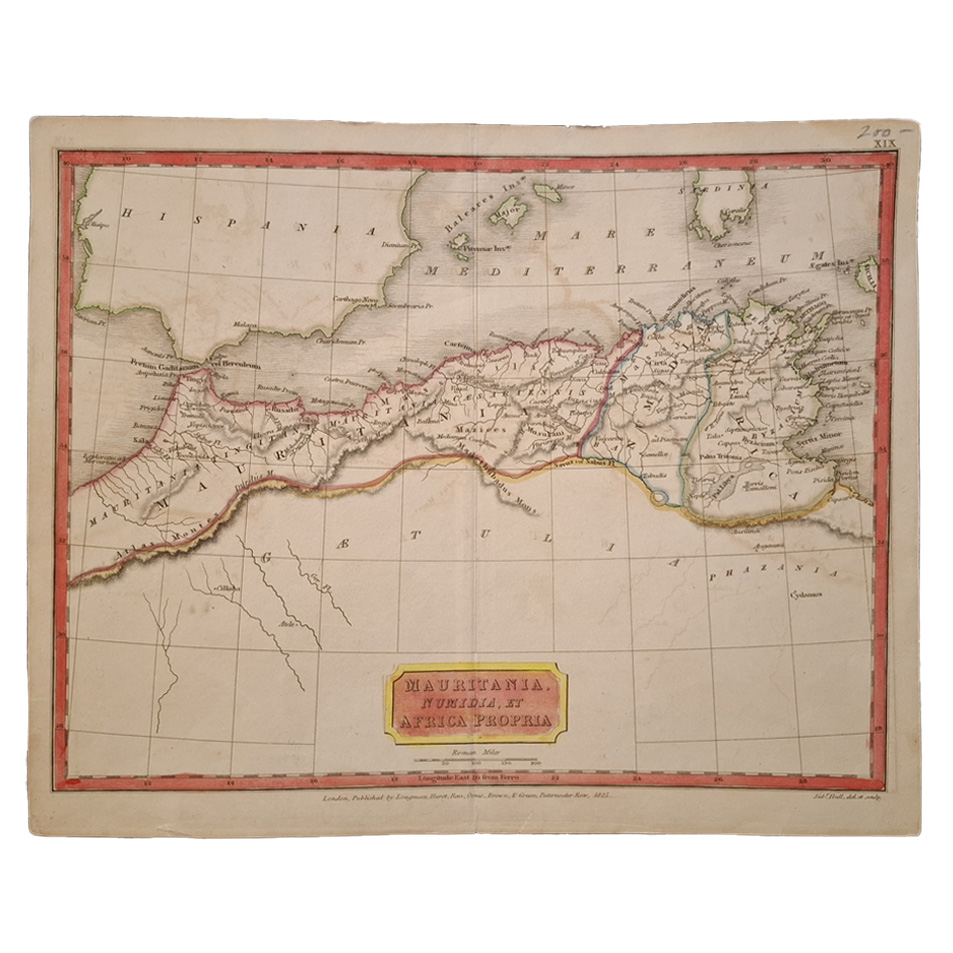
MAURITANIA NUMIDIA ET AFRICA PROPRIA
Hall, Sidney
£20.00
Availability: In stock
Product Description
MAURITANIA NUMIDIA ET AFRICA PROPRIA
Engraver: Sidney Hall
Publisher: Longman, Rees, Orme
Price: £20
Publication Date: 1825
Edition: Not stated
Format: Original engraving
Condition: In very good condition, unframed
Sheet Size: 26.1cm x 21.1cm
Condition:
Original central fold line. Later hand-colouring. Very minor age-spots. Reverse is blank with age toning and minor marks. Short closed tear to the lower margin. In very good condition overall.
Location: Map Drawer C: FS: Folder M2000 002551
Mauritania, Numidia, and Africa Propria: A Short Historical Overview
Mauritania
Mauritania, in ancient times, referred to a region in North Africa that roughly corresponds to modern-day northern Morocco and western Algeria. The region was inhabited by the Berbers, an indigenous people known for their semi-nomadic lifestyle and strong resistance to foreign domination. By the 3rd century BCE, Mauritania had established itself as a significant centre of trade, interacting with both Carthaginians and Romans.
By the late 1st century BCE, Mauritania became a Roman client kingdom under the rule of King Juba II, a Numidian prince who was installed by Augustus. Juba II fostered a Romanised culture, and the kingdom became a vital buffer state for the Roman Empire, protecting its African provinces from tribal incursions. Upon the death of Juba’s son, Ptolemy of Mauretania, the Roman Emperor Caligula annexed Mauritania in 40 CE, dividing it into two provinces: Mauretania Caesariensis and Mauretania Tingitana. Under Roman rule, the region experienced relative stability and economic development, particularly through trade and the establishment of Roman settlements such as Volubilis.
Numidia
Numidia lay to the east of Mauritania and corresponded largely to modern northern Algeria. It was home to the Numidians, a group of Berber tribes who played a crucial role in the Punic Wars between Carthage and Rome. Initially allied with Carthage, the Numidians shifted allegiance to Rome during the Second Punic War, significantly contributing to Hannibal’s eventual defeat.
After the war, Numidia became a Roman client state under King Masinissa, who united the western and eastern Numidian tribes. Masinissa implemented policies that encouraged agriculture and urbanisation, aligning Numidian culture with Roman practices. Following Masinissa’s death, his successors engaged in rivalries, and Numidia was eventually drawn into Roman politics. The Jugurthine War (112–105 BCE), sparked by King Jugurtha’s resistance to Roman interference, resulted in Numidia’s further subjugation and eventual incorporation into the Roman Empire by Julius Caesar.
Under Roman administration, Numidia was integrated into the province of Africa Nova and later merged with the older province of Africa Propria. The region thrived under Roman rule, with cities like Cirta becoming important centres of administration and commerce.
Africa Propria
Africa Propria, also known as Africa Vetus, was a province established following Rome’s victory over Carthage in the Third Punic War (146 BCE). Located in what is now northern Tunisia, Africa Propria originally encompassed the territory surrounding Carthage, which was destroyed and subsequently rebuilt as a Roman colony under Julius Caesar and later Augustus.
The fertile lands of Africa Propria made it a crucial asset to the Roman Empire, particularly for its grain production. The region became known as the “breadbasket” of Rome, with vast estates worked by local farmers and enslaved labourers producing large quantities of wheat and olives. Urban centres like Carthage, Utica, and Thysdrus flourished, becoming hubs of culture, trade, and learning. Carthage, in particular, regained its prominence as a leading city in the Mediterranean world.
Africa Propria also became a bastion of Roman civilisation in North Africa. Temples, theatres, and baths were constructed, showcasing the integration of Roman architectural styles with local influences. However, the province was not without strife; indigenous Berber uprisings, such as the revolt led by Tacfarinas in the early 1st century CE, were significant challenges to Roman authority.
The Later Period
By the late Roman Empire, all three regions—Mauritania, Numidia, and Africa Propria—faced increasing pressure from external forces. The Vandal invasion in the 5th century CE disrupted Roman control, with much of North Africa falling to the Vandals under King Gaiseric. Despite a brief reconquest by the Byzantine Empire in the 6th century, the rise of Islamic caliphates in the 7th century transformed the political and cultural landscape of the region.
The legacy of these ancient provinces is evident in the Roman ruins that dot the landscape, from the aqueducts of Carthage to the triumphal arches of Volubilis. Each region played a vital role in shaping the history of North Africa and its enduring connections to the Mediterranean world.
Sidney Hall: A Short Biography
Sidney Hall (circa 1788–1831) was a distinguished British engraver and cartographer, renowned for his early 19th-century atlases featuring maps of the United Kingdom and the ancient world. His career commenced around 1809, with operations based at 5 Vine Street, Piccadilly, London. By 1814, he had entered into a partnership with Michael Thomson, operating from 14 Bury Street in the Bloomsbury district, later relocating to 18 Bury Street.
Hall’s contributions to cartography were significant, as he is credited with being among the first engravers to utilise steel plates for map engraving—a technique that allowed for finer detail and greater durability compared to the traditional copper plates. He produced engravings for various international atlases during a period when cartography was gaining immense popularity. Notably, he engraved a series of constellation cards, published around 1825 in a boxed set titled “Urania’s Mirror.”
Throughout his career, Hall collaborated with prominent figures in the field, engraving maps for individuals such as William Faden, Aaron Arrowsmith, and the publishing firm Chapman & Hall. His works were well-received, contributing to the widespread dissemination of geographical knowledge during his time.
Tragically, Sidney Hall passed away in 1831 at the age of 42. Following his death, his widow, Selina Hall (née Price), who was also an accomplished engraver, continued the business. She maintained the production of maps under the signature “S. Hall,” ensuring the continuation of the enterprise and the preservation of her husband’s legacy.
Sidney Hall’s innovative techniques and dedication to his craft have left an enduring impact on the field of cartography, with his maps remaining valuable resources for historical and geographical studies.
SHOP WITH CONFIDENCE AT HORNSEYS
At Hornseys, we are dedicated to offering items that uphold the highest standards of quality and authenticity. Our collection of artwork is carefully curated to ensure that each item we offer is authentic, collated, and complete.
Here’s what sets us apart:
- Authenticity and Provenance: Each map is researched and verified for authenticity.
- Expert Curation: We wholly own all our artworks. We trust our taste and have invested heavily in it. We have confidence in all artwork that we offer for sale.
- Customer Satisfaction: We strive to provide an exceptional customer experience, from detailed descriptions and provenance to secure and prompt delivery of your purchase.
- Returns Policy: We offer an unconditional guarantee on every item. If, however, you wish to make a return, artworks may be sent back to us within fourteen days of receipt for whatever reason. We request that we are notified in advance if you wish to do so. They must be returned to us in the same condition as they were sent for a full refund.
OUR COMMITMENT TO QUALITY AND SERVICE
Understanding the value and rarity of these items, we ensure that every aspect of your purchase meets the highest standards of quality and service. This includes:
- Free Expedited, Tracked, and Insured Delivery within the UK: Ensuring that your artwork arrives safely and promptly.
- Fully-Insured Worldwide Delivery: Offering peace of mind for international collectors with reliable and secure shipping options.
EXPLORE OUR COLLECTION
Visit Hornseys today to explore our fine collection of maps and other artworks. Whether you are an avid collector or looking for a special gift, our selection offers something truly unique. Located since 1976 in Ripon in the picturesque Yorkshire Dales, we are recognised as a destination gallery for tastefully curated artwork, rare maps, design, and fine books.
Related products


You may also like…

(The Congo, Angola) Carte Des Royaumes De Congo, Angola Et Benguela Avec Les Pays Voisins Tire de L’Anglois
£65.00Bellin, Jacques Nicolas


