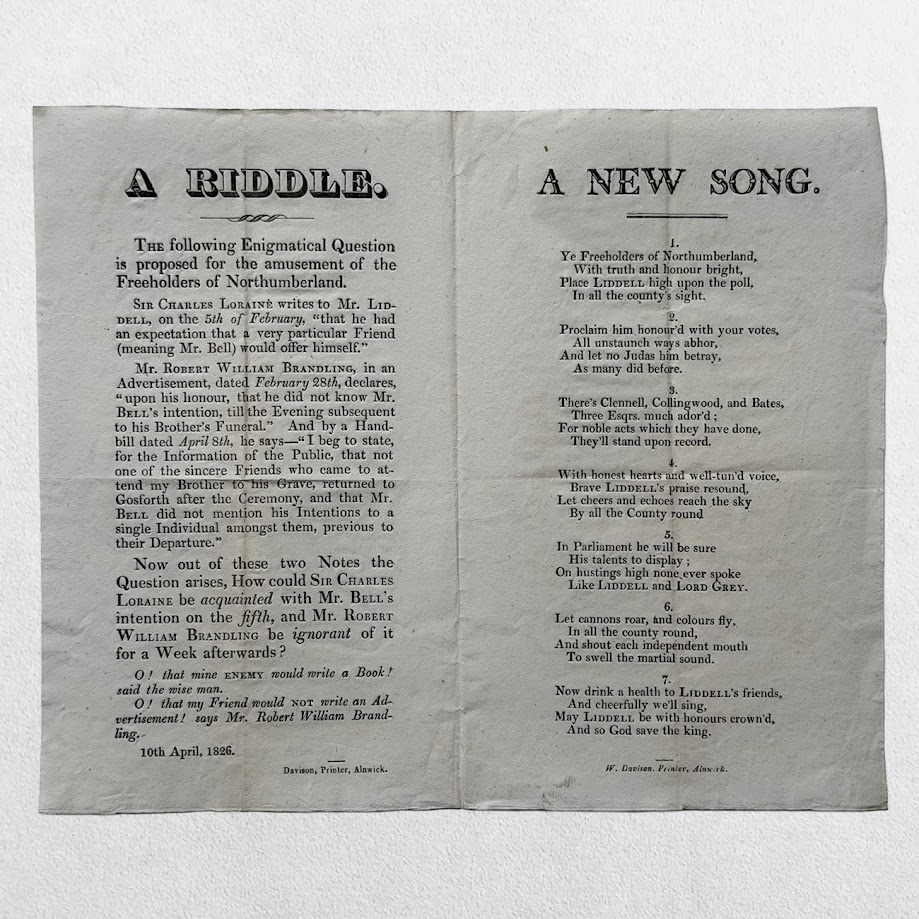
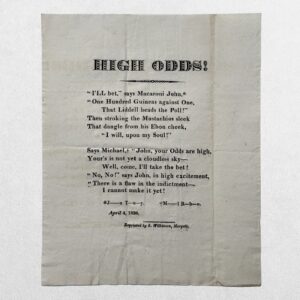
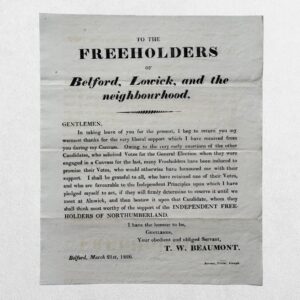
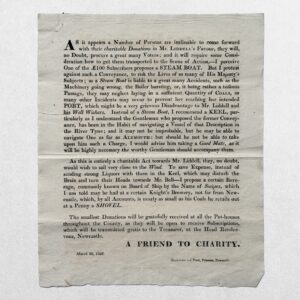
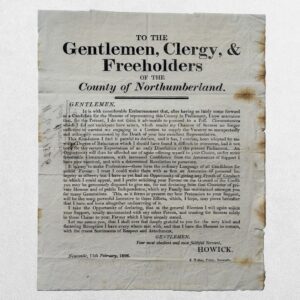
NORTHUMBERLAND ELECTION BROADSIDE – “A RIDDLE” AND “A NEW SONG” – A DOUBLE-SIDED ELECTION HAND-BILL ISSUED IN SUPPORT OF HENRY THOMAS LIDDELL DURING THE GREAT NORTHUMBERLAND CONTEST OF 1826
Alnwick: W. Davison, Printer, 10 April 1826.
Single-sheet letterpress broadside printed on both sides.
Sheet size: 27.4 x 22.4 cm.
Condition: Near fine. Fold creases. Light handling wear and minor age-toning. Strong impressions and excellent legibility throughout.
Description
A scarce and highly interesting survival from the celebrated Northumberland Parliamentary Election of 1826, comprising a double-sided election broadside containing both a political squib entitled “A Riddle” and a campaign song supporting Henry Thomas Liddell, later 1st Earl of Ravensworth.
Printed at Alnwick by W. Davison and dated 10 April 1826, the broadside illustrates the diverse forms of election literature employed during one of the most fiercely contested county elections of the late Georgian era.
The first side, entitled “A Riddle”, presents a political puzzle directed at the freeholders of Northumberland. The text references correspondence attributed to Sir Charles Loraine and statements made by Robert William Brandling, examining apparent contradictions concerning the conduct of Matthew Bell during the election campaign. The broadside invites readers to consider how differing accounts could be reconciled and concludes with a pointed satirical observation directed at Brandling.
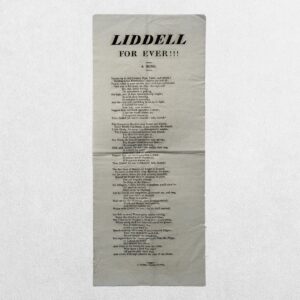
The second side, entitled “A New Song”, is an openly pro-Liddell election ballad intended for public recitation or singing. Consisting of seven stanzas, it urges freeholders to place Liddell at the head of the poll and praises both his character and political abilities. The song also names several prominent supporters, including Clennell, Collingwood, and Bates, while presenting Liddell as the candidate most worthy of county support.
The combination of satire, political commentary and campaign verse within a single surviving broadside offers an excellent illustration of the methods by which electoral opinion was shaped before the Reform Act of 1832.
Historical Context
The Northumberland election of 1826 became one of the most famous county election contests of the Georgian period.
Among the principal candidates and political figures involved were:
- Henry Thomas Liddell (1797–1878), later 1st Earl of Ravensworth.
- Thomas Wentworth Beaumont (1792–1848).
- Matthew Bell (1769–1849).
- Lord Howick (Charles Grey, 1792–1861), future Prime Minister and architect of the Reform Act of 1832.
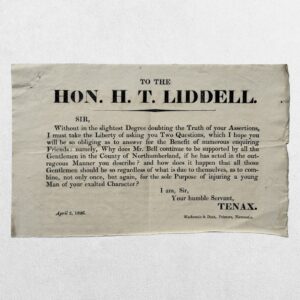
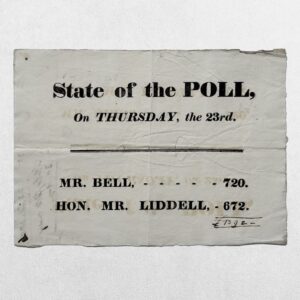
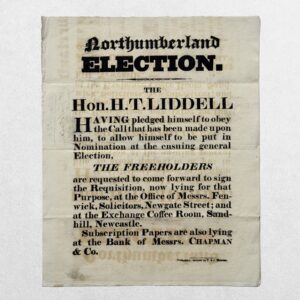
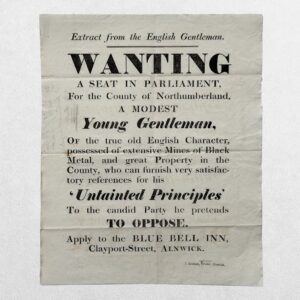
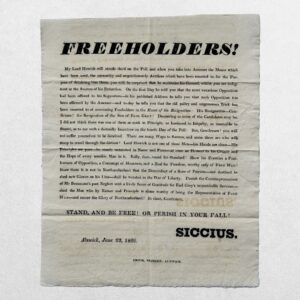
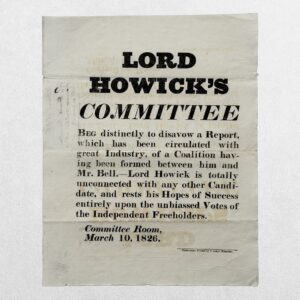
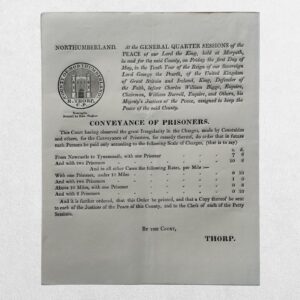
The campaign generated an extraordinary volume of printed material, including addresses, broadsides, songs, squibs, handbills and committee notices. Much of this literature was designed for immediate consumption and was discarded shortly after the election, making surviving examples increasingly scarce.
Unlike formal election addresses, pieces such as the present broadside were intended to entertain as well as persuade. Political songs and satirical riddles formed an important part of Georgian electoral culture and were frequently distributed at meetings, inns, public dinners and hustings.
Political Songs and Electioneering
Election songs occupied an important place in nineteenth-century political campaigning. Before the development of modern mass media, songs provided a means of spreading political messages rapidly amongst supporters and could be performed repeatedly in public settings.
The present broadside preserves one such example, demonstrating how candidates sought to cultivate personal loyalty and public enthusiasm through verse. The accompanying riddle reflects the equally common use of humour and satire as campaign weapons.
Together, the two texts provide a vivid insight into the atmosphere of county elections before parliamentary reform.
Printing
Printed by W. Davison of Alnwick, one of the principal printers associated with the Northumberland election campaign of 1826. Davison produced numerous election addresses, handbills and campaign publications during the contest.
Institutional Holdings
Election literature relating to the Northumberland contests of 1826 survives within a number of archival and library collections documenting the political careers of Beaumont, Bell, Liddell and Grey.
However, ephemeral items such as election songs and satirical handbills are considerably less frequently encountered than formal addresses and poll books.
At the time of cataloguing, no separate institutional catalogue record has been identified for this specific broadside combining “A Riddle” and “A New Song”, printed by W. Davison and dated 10 April 1826.
A scarce and attractive example of Georgian election ephemera, combining political satire, campaign verse and county electoral history from one of the most celebrated parliamentary contests of the pre-Reform era.
Why Buy from Hornseys?
Established in 1976, Hornseys specialises in rare books, signed editions, manuscripts, historical documents and works of enduring cultural importance. From our gallery in Ripon, on the edge of the Yorkshire Dales, we serve collectors, institutions and bibliophiles throughout the United Kingdom and internationally.
Our reputation is built upon careful scholarship, accurate cataloguing and a long-standing commitment to authenticity, provenance and condition. Every item we offer is selected not simply for rarity, but for its significance within the history of literature, art, politics, exploration and collecting.
Expertise and Authenticity
Each book, manuscript or historical item is thoroughly researched and professionally described. We carefully examine points of issue, bindings, dust jackets, inscriptions, provenance and bibliographical references to ensure accuracy and authenticity throughout our catalogue.
Curated Collections
Our stock is individually chosen for rarity, condition, historical importance and collector appeal. We specialise in literary first editions, children’s books, modern literature, signed and inscribed copies, Churchilliana, fine bindings, rare maps and unusual historical ephemera.
Provenance and Scholarship
We place particular importance on provenance and collecting history. Wherever possible, our cataloguing traces ownership, associations and historical context, allowing collectors to acquire objects with genuine bibliographical and historical significance.
Customer Service
We aim to provide a professional and straightforward buying experience, from detailed cataloguing and high-quality photography to secure packaging and prompt worldwide shipping. We are always happy to discuss condition, provenance or collecting advice directly with clients.
Returns Guarantee
All items are offered with an unconditional guarantee of authenticity. Purchases may be returned within fourteen days of receipt for any reason, provided items are returned in the same condition in which they were supplied. We simply request advance notice of any return.
Explore Our Collection
Discover exceptional rare books, manuscripts, signed editions and historical material at Hornseys. With nearly fifty years of experience in the trade, we continue to offer carefully curated material chosen for rarity, condition, provenance and lasting cultural importance.