Poor-Law Commissioners — Letters Addressed by the Poor-Law Commissioners to the Secretary of State, Respecting the Transaction of the Business of the Commission — 1847
Poor-Law Commissioners of Great Britain.
£95.00
Availability: In stock
Product Description
Poor-Law Commissioners — Letters Addressed by the Poor-Law Commissioners to the Secretary of State, Respecting the Transaction of the Business of the Commission — 1847
Corporate Author: Great Britain. Poor-Law Commissioners
Title: Letters Addressed by the Poor-Law Commissioners to the Secretary of State, Respecting the Transaction of the Business of the Commission, &c. &c. &c.
Publisher: Her Majesty’s Stationery Office
Printer: W. Clowes and Sons, Stamford Street, London
Date: 1847
Edition: First edition
Format: Octavo
Pagination: viii, 67 pp.
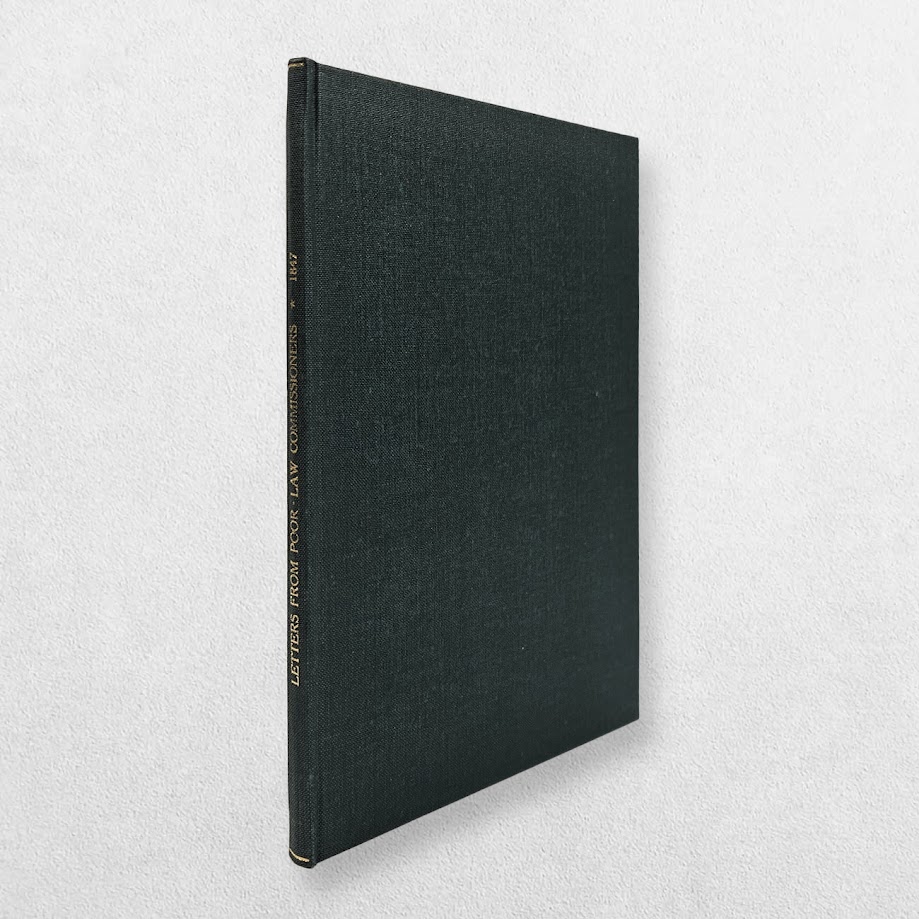
Binding: Later dark green cloth, gilt-lettered spine
Stock Code: 004199
Location: Bookroom
First edition of this important 1847 official defence of the Poor-Law Commissioners, issued at the very moment when the original Poor Law Commission created under the 1834 Poor Law Amendment Act was collapsing under sustained political criticism and was about to be replaced by the Poor Law Board.
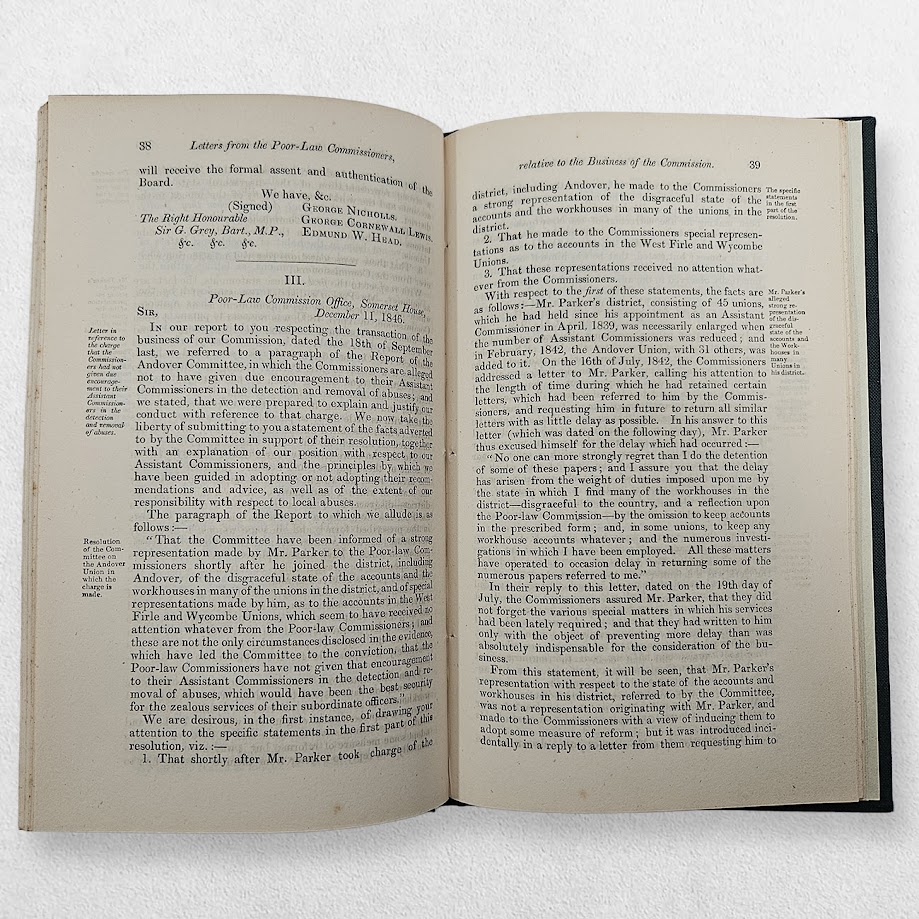
The volume consists of letters addressed by the Commissioners to the Secretary of State, explaining and defending the conduct of the Commission in relation to the administration of the New Poor Law. The text includes correspondence by George Nicholls, George Cornewall Lewis and Edmund W. Head, the three Poor-Law Commissioners then responsible for the central administration of poor relief in England and Wales.
The immediate political context was exceptionally contentious. The Commission had come under fierce attack following the Andover workhouse scandal, which exposed serious abuses in the administration of the workhouse and raised wider questions about the competence, accountability and internal procedures of the central Poor Law authority. Parliamentary debate in May 1847 explicitly identified this publication as the Commissioners’ defence against charges arising from the Andover Union inquiry. Hansard records that the letters had been laid before Parliament and then separately printed and circulated by the Commissioners in a more accessible form than the Parliamentary “blue book”.
The volume therefore has unusual documentary significance. It is not simply a routine Poor Law report but a public institutional defence issued during the final crisis of the Poor Law Commission itself. The controversy was sufficiently intense that MPs criticised the Commissioners for circulating the work under the Royal Arms without prior government sanction, while the Government defended the expense on the grounds that publication of the Commissioners’ reports and correspondence in readable form had long been established practice.
The publication was also issued in the year in which Parliament fundamentally reorganised central Poor Law administration. The Poor Law Board Act 1847 abolished the old Poor Law Commission and transferred its functions to a newly constituted body with direct ministerial involvement, including the Lord President, Lord Privy Seal, Home Secretary and Chancellor of the Exchequer as ex-officio Commissioners. The present volume consequently belongs to the closing months of the original Commission established in 1834.
The correspondence itself provides detailed insight into the workings of the Commission and the allegations levelled against it. Among the matters discussed are the conduct and removal of Assistant Commissioners, administrative responsibility, management of Poor Law unions, failures in accounting and oversight, and the handling of complaints arising from unions such as Andover, West Firle and Wycombe. The printed marginal notes make the volume particularly useful as a contemporary administrative source.
Modern scholarship continues to cite the work as a primary source for the operation of the Victorian administrative state. One recent study of pauper correspondence cites it specifically as British Parliamentary Papers, 1847, in examining how the central Poor Law administration dealt with representations and complaints from paupers and local officials.
The title is also bibliographically identifiable as House of Commons Paper No. 148 of 1847, and later histories of English Poor Law policy cite the Commissioners’ letters directly when discussing the development of policy under the 1834 system
Condition
Bound in later dark green cloth, with gilt lettering to the spine. Binding firm and attractive. The pages are generally very nice and clean, with only occasional light age-related spotting and marking. The text and marginal notes remain clear throughout.
Now housed in an easily removable clear acetate cover.
Very good indeed.
A significant primary document from the final year of the original Poor Law Commission, recording its defence of its own administration at the height of the political controversy that led directly to the institutional reforms of 1847.
Stock code: 004199. Location: Bookroom.
Why Buy from Hornseys?
Established in 1976, Hornseys is an independent specialist bookseller and gallery based in Ripon, North Yorkshire, on the edge of the Yorkshire Dales. For nearly fifty years, we have bought and sold rare books, first editions, signed and inscribed books, manuscripts, historical documents, maps, prints and unusual works on paper to private collectors, libraries, institutions and clients throughout the United Kingdom and internationally.
Our approach is based on careful research, accurate identification, detailed condition assessment and transparent cataloguing. Every item is individually examined before being offered for sale. We believe that rarity alone does not make an object important: the strongest books, manuscripts and historical material combine rarity with provenance, condition, historical context, bibliographical significance and collector appeal.
Research, Expertise and Authenticity
Every book, manuscript, map, print or piece of historical ephemera offered by Hornseys is researched and catalogued individually. We examine the features that determine both authenticity and value, including edition and impression, issue points, bindings, dustwrappers, signatures, inscriptions, annotations, provenance, printing history, completeness and condition.
Where appropriate, we compare items against bibliographical references, institutional catalogues, library holdings, auction records, archival sources and other reliable evidence. Where a point cannot be established with certainty, we distinguish clearly between documented fact and informed interpretation rather than presenting an assumption as fact.
All items are offered with an unconditional guarantee of authenticity.
Accurate and Detailed Descriptions
We aim to describe each item as precisely as possible. Condition is assessed individually, with defects, restoration, incompleteness or other significant characteristics noted where relevant.
For books, this may include collation, edition and impression, dustwrapper state, binding condition and significant ownership marks. For maps and works on paper, we assess the exact edition or state, printing information, dimensions, institutional representation, provenance and physical condition.
Our photographs form an important part of each description and are intended to allow collectors to examine the item closely before purchase.
Provenance and Historical Context
Provenance can transform the significance of a book or document. We therefore place particular emphasis on establishing previous ownership, presentation inscriptions, authorial associations, institutional provenance and connections with historical individuals or events.
Where research allows, we trace these associations through contemporary records, archives and published sources. This can reveal information that is not immediately apparent from the object itself and allows us to catalogue material within its proper historical and bibliographical context.
We are equally careful not to overstate provenance. Documented ownership is distinguished from attribution, possibility or association.
Carefully Curated Stock
Hornseys does not buy simply by category. We select material because we believe it has something distinctive to offer: rarity, condition, design, provenance, historical importance, unusual subject matter or enduring collector interest.
Our stock includes particular strengths in:
Rare and collectible books; literary first editions; signed and inscribed books; children’s and illustrated books; military history; Churchilliana; fine bindings; manuscripts and historical documents; rare and historical maps; travel and exploration; original prints and works on paper; unusual historical ephemera; and specialist collecting areas including Tintin and the Collins New Naturalist series.
This breadth allows us to recognise connections between books, archives, maps and other historical material that might otherwise be overlooked.
Specialist Experience Since 1976
Hornseys has traded since 1976. That longevity matters. The rare-book and collecting markets are built not only on reference works and databases but on experience: understanding how editions differ, recognising unusual states and bindings, judging condition, identifying material that is genuinely difficult to find and distinguishing real scarcity from apparent scarcity.
We combine that long-standing experience with modern research methods and extensive comparison of institutional and commercial records. The result is cataloguing intended to be both scholarly and practical for collectors.
Condition and Completeness
Every item is physically examined before cataloguing. Where relevant, books are checked for completeness, maps and plates are counted, folding material is inspected, and bindings and dustwrappers are assessed separately.
We do not use age alone as an excuse for faults. A seventeenth-century book, a wartime map and a twentieth-century first edition are judged according to the standards appropriate to their type, while significant defects are described clearly.
Customer Service
We aim to make buying from Hornseys straightforward and informed. We are happy to answer questions about condition, provenance, edition, rarity, bibliographical points or collecting significance, and additional photographs can be provided where required.
Orders are carefully packed, with UK delivery tracked and insured and international orders sent by appropriate tracked and insured services.
Collectors are also welcome to visit our gallery in Ripon to view material in person.
Returns Guarantee
All items are offered with our guarantee of authenticity and may be returned within fourteen days of receipt for any reason, provided they are returned in the same condition in which they were supplied.
We simply ask that you contact us before returning an item. If an item has been incorrectly described or supplied in error, we will also cover the appropriate return postage.
Buy with Confidence from Hornseys
Whether you are acquiring a first edition, building a specialist collection, researching a historical association or simply buying an object that fascinates you, our aim is the same: to offer carefully selected material, accurately researched and honestly described.
After nearly fifty years in the trade, Hornseys continues to seek out books, maps, manuscripts, prints and historical material that combine rarity, provenance, condition and genuine cultural or historical interest.
Related products

HARTMANN SCHEDEL – NUREMBERG CHRONICLE – MENORAH, HIGH PRIEST, TABERNACLE & TABLETS OF THE LAW – ORIGINAL LATIN INCUNABLE WOODCUT LEAF – NUREMBERG – 1493
£200.00Hartmann Schedel, Anton Koberger, Michael Wolgemut and Wilhelm Pleydenwurff

![HORTUS SANITATIS [ORTUS SANITATIS] - DE AVIBUS - HARPY, SWALLOW, GYRFALCON AND IBIS - ORIGINAL INCUNABLE WOODCUT LEAF - STRASBOURG, JOHANN PRÜSS - NOT AFTER 21 OCTOBER 1497](https://hornseys.com/wp-content/uploads/2026/08/003988_1-300x300.jpg)
You may also like…
Bosworth, Rev. Joseph — The Necessity of the Antipauper System — First Edition, 1829
£275.00Bosworth, M.A., F.A.S, Rev. Joseph
National Reform League — Propositions of the National Reform League, for the Peaceful Regeneration of Society — [1850]
£200.00National Reform League
Barnett Freedman — Fleece Press Sale Broadsheet for the Artist’s Personal Archive, 2008
£30.00Simon Lawrence & The Fleece Press
T. E. Lawrence – Seven Pillars of Wisdom – Cranwell Edition – Exhibition Notice – 1927
£900.00LAWRENCE, T. E. & Leicester Galleries
![National Reform League — Propositions of the National Reform League, for the Peaceful Regeneration of Society — [1850]](https://hornseys.com/wp-content/uploads/2026/10/004196_1-300x300.jpg)