
HARTMANN SCHEDEL – NUREMBERG CHRONICLE – MENORAH, HIGH PRIEST, TABERNACLE & TABLETS OF THE LAW – ORIGINAL LATIN INCUNABLE WOODCUT LEAF – NUREMBERG – 1493
Hartmann Schedel, Anton Koberger, Michael Wolgemut and Wilhelm Pleydenwurff
£200.00
Availability: In stock
Product Description
HARTMANN SCHEDEL – NUREMBERG CHRONICLE – MENORAH, HIGH PRIEST, TABERNACLE & TABLETS OF THE LAW – ORIGINAL LATIN INCUNABLE WOODCUT LEAF – NUREMBERG – 1493
Description: A particularly desirable and extensively illustrated original incunable leaf, Folium XXXIII, from the first Latin edition of Hartmann Schedel’s Liber Chronicarum, universally known as the Nuremberg Chronicle, printed at Nuremberg by Anton Koberger on 12 July 1493. One of the great achievements of fifteenth-century European printing, the Chronicle combined universal history, biblical narrative, geography and contemporary learning with an unprecedented programme of woodcut illustration. Utrecht University records more than 1,800 printed illustrations in the work and identifies approximately 633 newly produced blocks as originating in the workshop of Michael Wolgemut and Wilhelm Pleydenwurff, while Cambridge describes the Chronicle as one of the most important German incunabula and the most extensively illustrated book of the fifteenth century.
The present leaf belongs to the “Tercia etas mundi” — the Third Age of the World — and is devoted to the sacred architecture, furnishings, ritual objects and priestly costume associated with Moses, Aaron and the Tabernacle, as described principally in Exodus. The combination of large-scale woodcuts and explanatory Latin text makes the sheet effectively a fifteenth-century visual reconstruction of Old Testament worship.
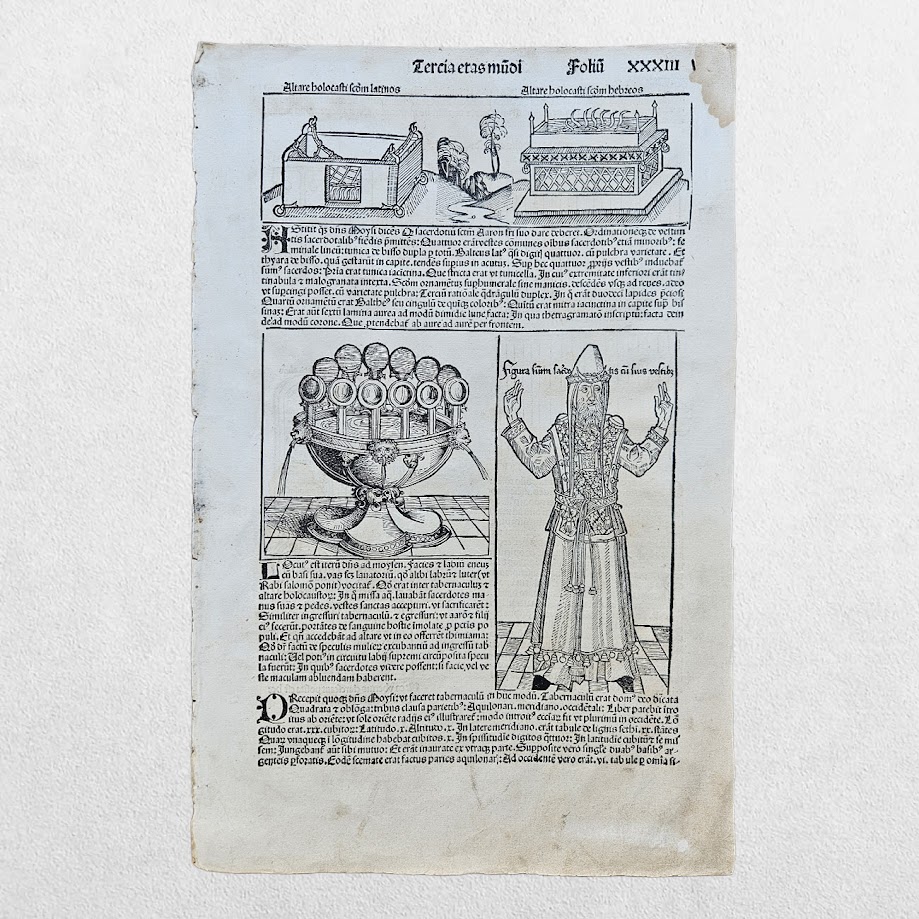
Across the upper recto are two contrasting representations of the Altar of Burnt Offering, explicitly captioned “Altare holocausti secundum latinos” and “Altare holocausti secundum hebreos” — the altar according to Latin authorities and the altar according to Hebrew authorities. Rather than presenting a single unquestioned reconstruction, the Chronicle places alternative learned traditions side by side, an especially revealing example of Schedel’s encyclopaedic method and the late-medieval effort to visualise biblical antiquity.
Below is one of the most visually compelling illustrations on the leaf: a large representation of the seven-branched menorah, the sacred lampstand commanded for the Tabernacle. It is represented as an elaborate Renaissance liturgical vessel, with seven circular lamps rising from a broad ornamental body and pedestal. An exact Folio XXXIII offered at auction in July 2026 was independently described as depicting the “Golden Menorah (seven-branched candlestick)”, together with the altar and High Priest, confirming the subject identification. The menorah is of particular interest within the history of Christian representations of Jewish ritual objects: specialist scholarship specifically discusses the menorah images in Schedel’s 1493 Liber Chronicarum within the wider medieval and Renaissance visual tradition of the seven-branched candelabrum.
Dominating the right-hand side is an impressive full-length woodcut of the Jewish High Priest, captioned in the surrounding text as a representation of the summus sacerdos. He stands frontally in elaborate ceremonial vestments with both hands raised, wearing the high priestly head covering and richly patterned garments derived from the biblical descriptions of Aaron’s vestments. The image is not intended as an archaeological reconstruction in the modern sense; rather, biblical antiquity is translated into the familiar visual vocabulary of late-fifteenth-century European ecclesiastical costume. Nevertheless, it is an important early printed attempt to give material form to the priestly garments described in Exodus.
The surrounding Latin text discusses the sacred vestments and furnishings commanded by God through Moses, including the priestly tunic, girdle, breastplate and associated ceremonial objects, before turning to the construction of the Tabernacle itself.
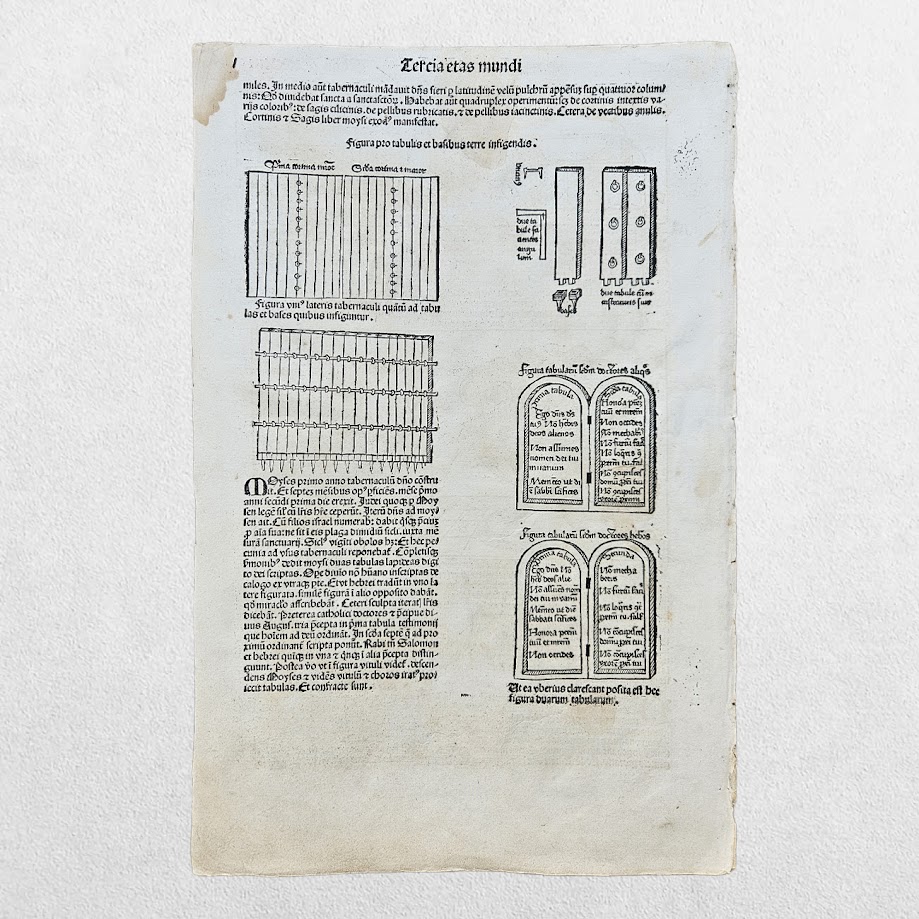
The verso continues this visual reconstruction under the repeated heading “Tercia etas mundi”. Across the upper portion are schematic diagrams showing the curtains, coverings, boards, bars, sockets and structural elements of the Tabernacle. The illustrations are diagrammatic rather than decorative and demonstrate one of the Chronicle’s less frequently appreciated functions: it could operate as an early printed visual reference work, translating difficult architectural passages in Scripture into comprehensible images. The exact Folio XXXIII auction comparison similarly describes the verso as illustrating the Tabernacle of Moses, including its boards, coverings and structural elements.
At lower right are two especially important pairs of woodcuts representing the Tablets of the Law, each drawn as rounded paired tablets filled with abbreviated Latin text. They relate to the Decalogue — the Ten Commandments given to Moses — and present alternative arrangements or textual traditions. Alongside the menorah and High Priest, these images give the leaf particularly strong relevance to collectors of Judaica, biblical illustration and the visual history of Jewish ritual in Christian Europe.
The Nuremberg Chronicle was conceived as a universal history divided into successive Ages of the World, weaving together biblical, classical, ecclesiastical and secular history. The first Latin edition appeared on 12 July 1493, followed by the German edition in December of the same year. The enormous project was financed by Sebald Schreyer and Sebastian Kammermeister and printed by Anton Koberger, one of the most important European printers of the incunable period. The illustration programme was prepared under Michael Wolgemut and Wilhelm Pleydenwurff, whose workshop had also trained the young Albrecht Dürer. Individual Chronicle woodcuts should nevertheless be attributed to the Wolgemut–Pleydenwurff workshop rather than directly to Dürer unless specific documentary evidence exists.
Condition: Good to very good condition overall for an original fifteenth-century folio leaf. The printed area is substantially complete and the principal woodcuts retain strong, dark and well-defined impressions. There is expected general age-toning, scattered light spotting and marking, some marginal soiling and areas of staining, particularly towards the lower portion and upper-right margin. The upper corners show some wear and minor loss, with slight edge irregularity and evidence of removal from binding along one margin. There are faint old creases and handling marks, but no substantial loss affects the principal menorah, High Priest, altar, Tabernacle or Tablets of the Law illustrations. Uncoloured, retaining the original monochrome character of the 1493 impression. Please examine all photographs carefully, as they form an important part of the condition description.
Author: Hartmann Schedel (1440–1514)
Title: Liber Chronicarum – the Nuremberg Chronicle
Leaf: Folium XXXIII
Section: Tercia etas mundi – The Third Age of the World
Printer: Anton Koberger
Artists: Workshop of Michael Wolgemut and Wilhelm Pleydenwurff
Place: Nuremberg
Date: 12 July 1493
Edition: First Latin edition
Format: Original single incunable folio leaf
Sheet Size: 29.8 × 44.7 cm
Language: Latin
Technique: Letterpress with numerous original woodcut illustrations
Principal Subjects: Altar of Burnt Offering; menorah; Jewish High Priest; Aaronic vestments; Tabernacle of Moses; boards, curtains and structural elements of the Tabernacle; Tablets of the Law; Ten Commandments
Period: Incunable – printed before 1501
Every early printed leaf offered by Hornseys is handled, inspected and catalogued individually in-house, with edition, typography, subject matter, illustration and condition assessed directly from the original wherever possible.
Scarcity: Loose leaves from the Nuremberg Chronicle occur commercially because defective copies have historically been dispersed, but subject matter has a major effect upon desirability. Folio XXXIII is considerably stronger than an ordinary portrait or text leaf because of its concentration of recognisable Old Testament and Jewish subjects.
Why buy from us?
At Hornseys, we are committed to offering items that meet the highest standards of quality and authenticity. Our book collection is meticulously curated to ensure that each edition is a valuable and authentic piece of bibliographical history. Here’s what sets us apart:
- Authenticity and Provenance: Every book is researched, collated, and verified for authenticity.
- Expert Curation: Each book is selected with a keen eye for significance, condition, and rarity, ensuring a collection that is both diverse and distinguished.
- Customer Satisfaction: We strive to provide an exceptional customer experience, from detailed descriptions and provenance to secure and prompt delivery of your purchase.
- Returns Policy: We offer an unconditional guarantee on every item. If you wish to make a return, books may be sent back to us within fourteen days of receipt for any reason. We request advance notification of returns, and books must be returned in the same condition as sent for a full refund.
Explore Our Collection:
Visit Hornseys to explore our fine collection of rare and signed books. Whether you are an avid collector or looking for a special gift, our selection offers something truly unique. Located in the picturesque Yorkshire Dales, our Ripon gallery has been a haven for book lovers, art enthusiasts, and collectors since 1976.
Related products

David Hockney – Things Recent And A Catalogue With New Kinds Of Reproduction – December 5 1990 To January 5 1991
£245.00Hockney, David & Andre Emmerich Gallery
Cave Birds – An Alchemical Cave Drama Signed And Dated By Ted Hughes
£250.00Hughes, Ted & Baskin, Leonard



You may also like…
INCUNABLE LEAF – ST AUGUSTINE – EPISTLE 186 ON GRACE, FAITH & FREE WILL – FIRST PRINTED EDITION OF THE EPISTOLAE – JOHANN MENTELIN, STRASBOURG – NOT AFTER 1471
£395.00AUGUSTINUS, Aurelius [St Augustine of Hippo].


![HORTUS SANITATIS [ORTUS SANITATIS] - DE AVIBUS - HARPY, SWALLOW, GYRFALCON AND IBIS - ORIGINAL INCUNABLE WOODCUT LEAF - STRASBOURG, JOHANN PRÜSS - NOT AFTER 21 OCTOBER 1497](https://hornseys.com/wp-content/uploads/2026/08/003988_1-300x300.jpg)


