INCUNABLE LEAF – ST AUGUSTINE – EPISTLE 186 ON GRACE, FAITH & FREE WILL – FIRST PRINTED EDITION OF THE EPISTOLAE – JOHANN MENTELIN, STRASBOURG – NOT AFTER 1471
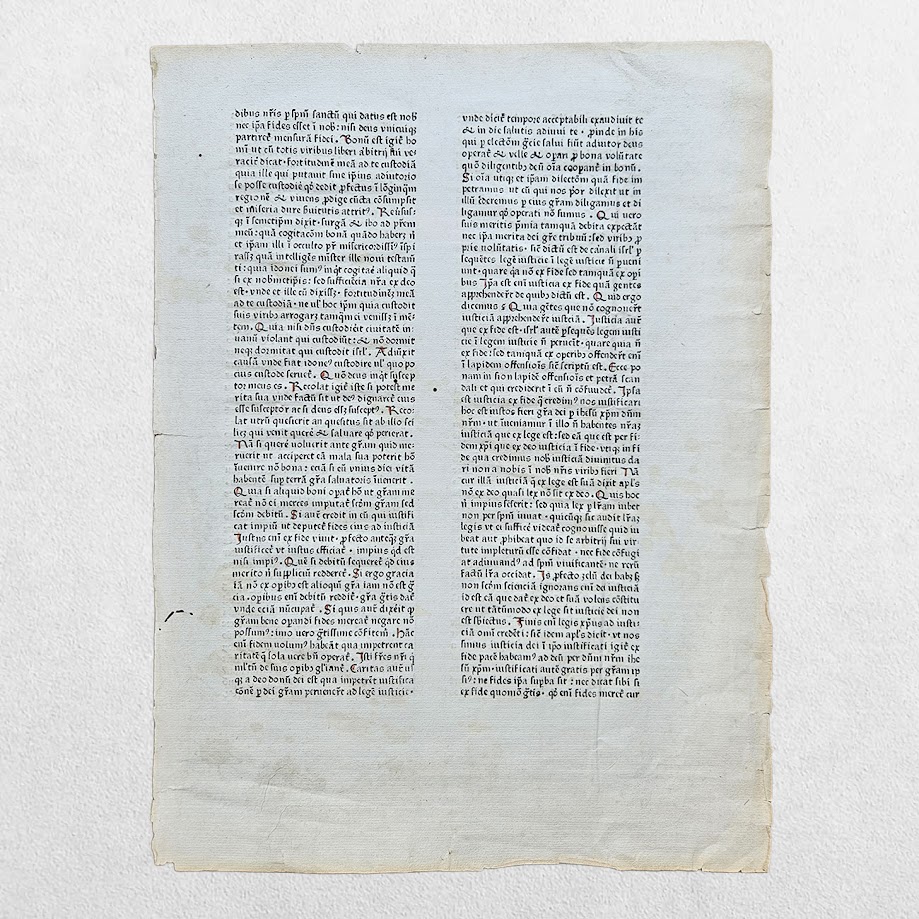
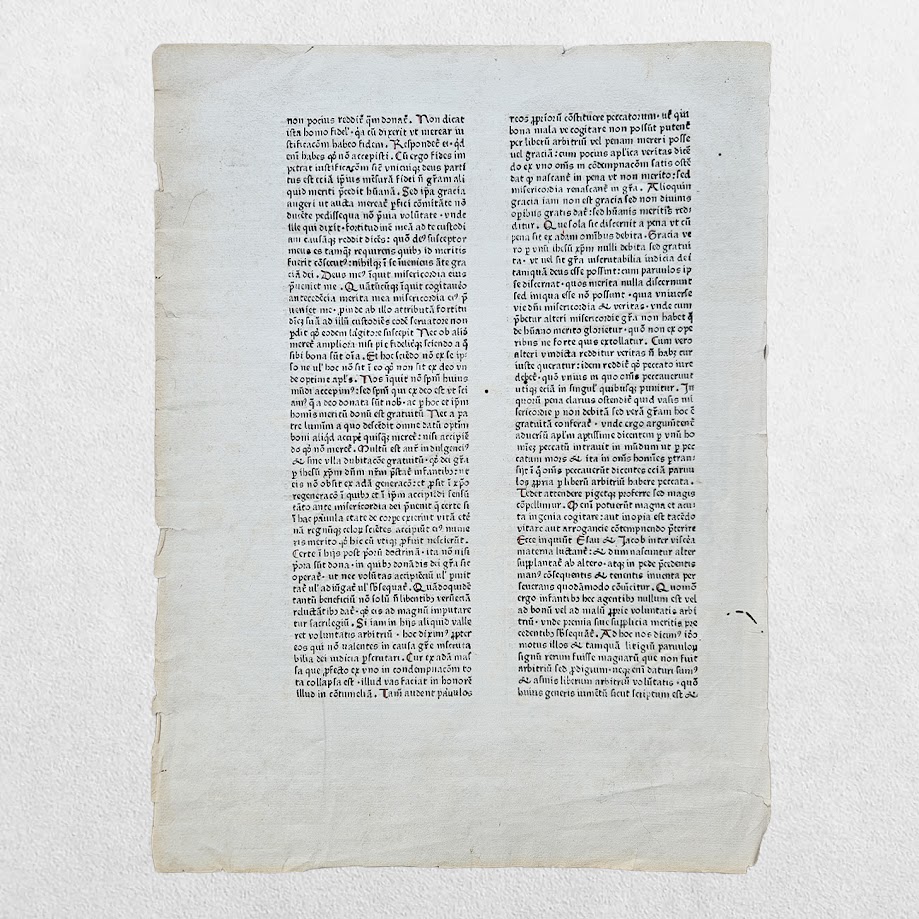
An exceptionally early original incunable leaf from the first printed edition of the collected Epistolae of St Augustine of Hippo, printed at Strasbourg by the pioneering printer Johann Mentelin not after 1471. The present leaf contains part of Epistle 186, written jointly by Augustine and Alypius to Paulinus of Nola around AD 417, and deals with some of the central themes of Augustinian theology: divine grace, faith, merit, justification and free will. The surviving text develops Augustine’s insistence that faith itself is not an independently earned human achievement but a gift received from God, repeatedly invoking the Pauline question Quid enim habes quod non accepisti? — “What do you have that you did not receive?” These ideas became fundamental to medieval Christian theology and would later assume enormous importance during the doctrinal controversies of the Reformation.
The edition is of major importance in the history of printing. Johann Mentelin was one of the earliest printers active outside Mainz and established printing at Strasbourg during the first generation following Gutenberg. His edition of Augustine’s letters is recognised as the editio princeps, or first printed edition, of the collected correspondence. The complete work comprises 264 leaves and was printed in royal folio, in two columns of 50 lines, using Mentelin’s characteristic Gothic type. The present leaf measures 39.1 × 29.1 cm, remarkably close to the dimensions recorded for complete copies, and retains notably broad margins. Its dense Gothic typography, extensive abbreviations and manuscript-like page design vividly preserve the appearance of European printing in its formative decades.
This particular leaf is especially desirable for the importance of the text itself. Augustine’s treatment of grace and free will profoundly shaped Western Christianity, influencing medieval scholastic theology and, centuries later, the debates surrounding Luther, Calvin and the Reformation. The leaf is therefore not simply an early typographical survival but an original printed witness to one of the foundational bodies of theological thought in Western intellectual history.
Condition: Good condition overall for an original incunable leaf more than 550 years old. The principal printed text remains substantially complete and strongly legible on both sides. There is age-related wear to the generous margins, including creasing, small tears and edge losses, together with light staining, spotting and handling marks. The defects are predominantly confined to the margins and do not materially affect the main text block. The paper retains a pleasing early laid texture and the impression remains strong.
Author: St Augustine of Hippo (Aurelius Augustinus, 354–430).
Work: Epistolae.
Text: Epistle 186, Augustine and Alypius to Paulinus of Nola.
Subject: Divine grace, faith, merit, justification and free will.
Printer: Johann Mentelin.
Place: Strasbourg.
Date: Not after 1471.
Edition: First printed edition of the collected letters of St Augustine.
Format: Original single incunable leaf.
Sheet Size: 39.1 × 29.1 cm.
Language: Latin.
Printing: Letterpress in Gothic type, double column, 50 lines to the column.
Bibliographical References
Goff A1267; GW 2905; ISTC ia01267000; BSB-Ink A-887; CIBN A-708.
Importance
A major early printing from one of the pioneering Strasbourg presses and an original leaf from the first printed edition of Augustine’s collected correspondence. The theological content is particularly important, dealing directly with the relationship between divine grace and human free will — ideas that were to influence Western Christian thought for more than a millennium.
Authentication
Handled, inspected and researched in-house. An original fifteenth-century printed leaf, not a later reproduction.
Why buy from us?
At Hornseys, we are committed to offering items that meet the highest standards of quality and authenticity. Our book collection is meticulously curated to ensure that each edition is a valuable and authentic piece of bibliographical history. Here’s what sets us apart:
- Authenticity and Provenance: Every book is researched, collated, and verified for authenticity.
- Expert Curation: Each book is selected with a keen eye for significance, condition, and rarity, ensuring a collection that is both diverse and distinguished.
- Customer Satisfaction: We strive to provide an exceptional customer experience, from detailed descriptions and provenance to secure and prompt delivery of your purchase.
- Returns Policy: We offer an unconditional guarantee on every item. If you wish to make a return, books may be sent back to us within fourteen days of receipt for any reason. We request advance notification of returns, and books must be returned in the same condition as sent for a full refund.
Explore Our Collection:
Visit Hornseys to explore our fine collection of rare and signed books. Whether you are an avid collector or looking for a special gift, our selection offers something truly unique. Located in the picturesque Yorkshire Dales, our Ripon gallery has been a haven for book lovers, art enthusiasts, and collectors since 1976.




![HORTUS SANITATIS [ORTUS SANITATIS] - DE AVIBUS - HARPY, SWALLOW, GYRFALCON AND IBIS - ORIGINAL INCUNABLE WOODCUT LEAF - STRASBOURG, JOHANN PRÜSS - NOT AFTER 21 OCTOBER 1497](https://hornseys.com/wp-content/uploads/2026/08/003988_1-300x300.jpg)


