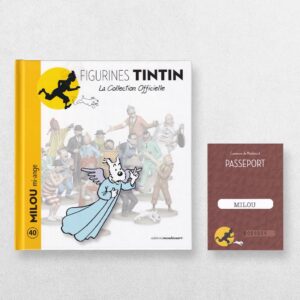
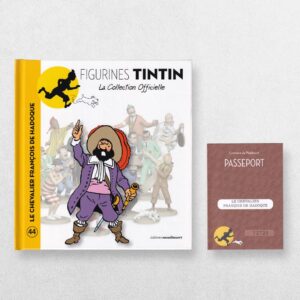
Rastapopoulos With The Whip – Figurines Tintin La Collection Officielle – 45 – Rastapopoulos A La Cravache
Author: Hergé & Editions Moulinsart
Price: £45.00
Publisher: Editions Moulinsart
Publication date: 2013
Format: Original pictorial boards with passport and figurine
Condition: In near fine condition
Illustrations: Illustrated throughout
Description:
Original pictorial boards. Includes passport loosely inserted. Text in French. Includes the accompanying figurine. One from the collection of 111 books and figurines. Very slight wear. In very near fine, clean condition overall.
Roberto Rastapopoulos: A Short Biography
Roberto Rastapopoulos is Tintin’s most persistent and malevolent adversary — a suave, calculating villain whose charm conceals ruthless ambition. Across several albums, Hergé presents him as the embodiment of corruption, greed, and the dark face of modern civilisation. Unlike the comic buffoons or misguided scientists Tintin often encounters, Rastapopoulos is a genuine nemesis: intelligent, powerful, and morally bankrupt.
Character Overview
Rastapopoulos is introduced as a wealthy and influential man of cosmopolitan sophistication — an international businessman, film producer, and socialite. Beneath this polished exterior, however, he is the mastermind behind vast criminal enterprises involving smuggling, drug trafficking, slavery, and arms dealing.
His name, with its elaborate Mediterranean sound, suggests a worldly but ambiguous origin — Greek or Levantine — enhancing his mysterious allure. Hergé designed him to represent a certain type of unscrupulous 20th-century capitalist: outwardly cultured, inwardly corrupt.
Physically, he is portly and imposing, often dressed in fine suits, his expression alternating between charm and menace. His thick eyebrows, neatly combed hair, and self-satisfied smile make him instantly recognisable.
First Appearance: Cigars of the Pharaoh (1934)
Rastapopoulos first appears in Cigars of the Pharaoh as a famous film producer, seemingly a pillar of international society. When Tintin encounters him aboard a Mediterranean cruise ship, Rastapopoulos plays the role of a genial celebrity. Only later does Tintin uncover the truth: he is the shadowy leader of an international opium-smuggling ring, operating under the symbol of the Pharaoh Kih-Oskh.
In this story, Hergé established Rastapopoulos as a master manipulator — a man able to hide behind wealth, respectability, and influence while running a global criminal network.
Development Through the Series
The Blue Lotus (1936)
Rastapopoulos’s name is mentioned again, reinforcing his ongoing role as a global conspirator. His influence lingers even when he does not appear, suggesting a criminal empire too large for Tintin to defeat entirely.
The Red Sea Sharks (1958)
After a long absence, Rastapopoulos returns in The Red Sea Sharks, now operating as the head of an international slave-trading syndicate. Under the alias Marquis di Gorgonzola, he presents himself as a wealthy philanthropist and shipowner. In truth, he oversees a trade in enslaved pilgrims, selling them into forced labour.
This story represents Hergé’s most mature depiction of Rastapopoulos: no longer merely a smuggler, he has become a symbol of institutionalised evil — cruelty masked by power and refinement.
His final confrontation with Tintin and Captain Haddock aboard a sinking ship epitomises his arrogance and downfall. Even in defeat, he remains defiant, refusing to abandon his illusion of grandeur.
Flight 714 to Sydney (1968)
Rastapopoulos makes his final major appearance in Flight 714 to Sydney. Here, he has shifted into full-blown megalomania, plotting to kidnap the wealthy industrialist Laszlo Carreidas for ransom. His plan is elaborate, involving secret agents, brainwashing technology, and a private island base.
However, fate — and, in one of Hergé’s most unusual turns, extraterrestrial intervention — conspires against him. Rastapopoulos is left stranded as Tintin, Haddock, and their allies escape, his final expression one of rage and disbelief.
Personality
Rastapopoulos is defined by three dominant traits:
- Greed: He is motivated entirely by wealth and power, exploiting others without conscience.
- Vanity: His ego is colossal; he delights in luxury, fame, and public adoration.
- Cruelty: Beneath the civilised veneer lies sadism. His temper is violent, and his charm evaporates the moment he is challenged.
He is both intelligent and reckless — capable of intricate schemes yet often undone by arrogance. His disdain for Tintin, whom he views as a meddling child, blinds him to the hero’s resilience and moral strength.
Symbolism
Rastapopoulos is more than a villain; he is the personification of corruption in the modern world. Through him, Hergé satirised the moral decay behind wealth, media, and international commerce.
- In Cigars of the Pharaoh, he represents the criminal underworld behind glamour.
- In The Red Sea Sharks, he becomes the merchant of human misery, trading lives for profit.
- In Flight 714 to Sydney, he evolves into a self-made demigod, deluded by his own ambition.
Hergé designed him as Tintin’s dark mirror: where Tintin seeks truth and justice, Rastapopoulos pursues power and manipulation. Both are clever, determined, and fearless — but one serves humanity, the other exploits it.
Relationship with Tintin
Rastapopoulos’s relationship with Tintin is defined by hatred and fascination. He recognises Tintin as the one force capable of exposing his schemes. Yet, even when defeated, he never truly disappears; his influence lingers, like corruption itself.
Their encounters chart a moral duel between innocence and depravity. Tintin’s youthful idealism contrasts sharply with Rastapopoulos’s cynicism — a battle not of brute strength, but of conscience and conviction.
Artistic Significance
Rastapopoulos stands out as one of Hergé’s most refined creations, blending realism and caricature. His exaggerated expressions — the narrowed eyes, the self-satisfied grin, the sudden outbursts of fury — make him both theatrical and chilling.
Visually and narratively, he represents Hergé’s fascination with power: how easily intellect and sophistication can become instruments of evil.
Legacy
Roberto Rastapopoulos remains Tintin’s greatest recurring enemy, the arch-villain of the series, akin to Moriarty in Sherlock Holmes or Blofeld in James Bond.
His name has become shorthand for the corrupt magnate — polished on the surface, predatory beneath. His recurring reappearances across decades reflect Hergé’s evolving critique of society: from colonial exploitation to modern capitalism’s moral blindness.
Even in defeat, Rastapopoulos endures as a symbol of unrepentant corruption — a reminder that greed, arrogance, and cruelty are evils that resurface in every age.
Summary
- Full name: Roberto Rastapopoulos
- Occupation: Business magnate, film producer, criminal mastermind
- First appearance: Cigars of the Pharaoh (1934)
- Final appearance: Flight 714 to Sydney (1968)
- Aliases: Marquis di Gorgonzola
- Personality: Cultured, vain, manipulative, cruel, and intelligent
- Symbolism: Embodies moral corruption, hypocrisy, and the dark side of modern ambition
- Rival: Tintin — his moral opposite and recurring nemesis
Conclusion
Roberto Rastapopoulos is the consummate Hergé villain: elegant, intelligent, and utterly devoid of morality. His character transcends the confines of comic-book evil to become a study of corruption itself — a man who uses civilisation’s trappings to mask savagery.
Through Rastapopoulos, Hergé reminds readers that the greatest dangers to humanity are not monsters or tyrants in uniform, but the smiling faces of those who exploit power for personal gain.
Why Buy from Us?
At Hornseys, we are committed to offering items that meet the highest standards of quality and authenticity. Our collection of objects and rare books are carefully curated to ensure each edition is a valuable piece of bibliographical history. Here’s what sets us apart:
- Authenticity and Provenance: Each item is meticulously researched and verified for authenticity and collation.
- Expert Curation: Our selection process focuses on significance, condition, and rarity, resulting in a collection that is both diverse and distinguished.
- Customer Satisfaction: We aim to provide an exceptional customer experience, from detailed descriptions to secure and prompt delivery of your purchase.
- Returns Policy: We offer an unconditional guarantee on every item. If you wish to return an item, it may be sent back to us within fourteen days of receipt. Please notify us in advance if you wish to do so. The item must be returned in the same condition as it was sent for a full refund.
Cataloguer: Daniel Hornsey
Daniel Hornsey has specialised in fine and rare books, ephemera, and collectors’ editions for over thirty years. As a long-standing member of the antiquarian book trade, he has advised private collectors, curated catalogues, and sourced works for leading dealers, libraries and institutions across the world.
Hornseys’ exhibit regularly at book and map fairs in London and throughout the UK and are members of the Provincial Booksellers Fairs Association, the PBFA.
His fascination with Hergé’s work — especially ‘The Adventures of Tintin’ — began in childhood. Daniel recalls reading Tintin in original European editions and quickly recognising that these were not merely children’s books, but finely illustrated narratives crafted with artistic depth and wit.
As noted by the Musée Hergé in Louvain-la-Neuve, Hergé’s ‘ligne claire’ style has influenced generations of European comic artists and his original drawings and paintings command very high prices with his painting of ‘The Blue Lotus’ jar fetching £2.8m at auction in 2021.
By presenting these works through Hornseys’, he hopes to contribute to the continued appreciation of one of the 20th century’s most influential illustrators, helping new generations discover the artistry and legacy of Hergé.