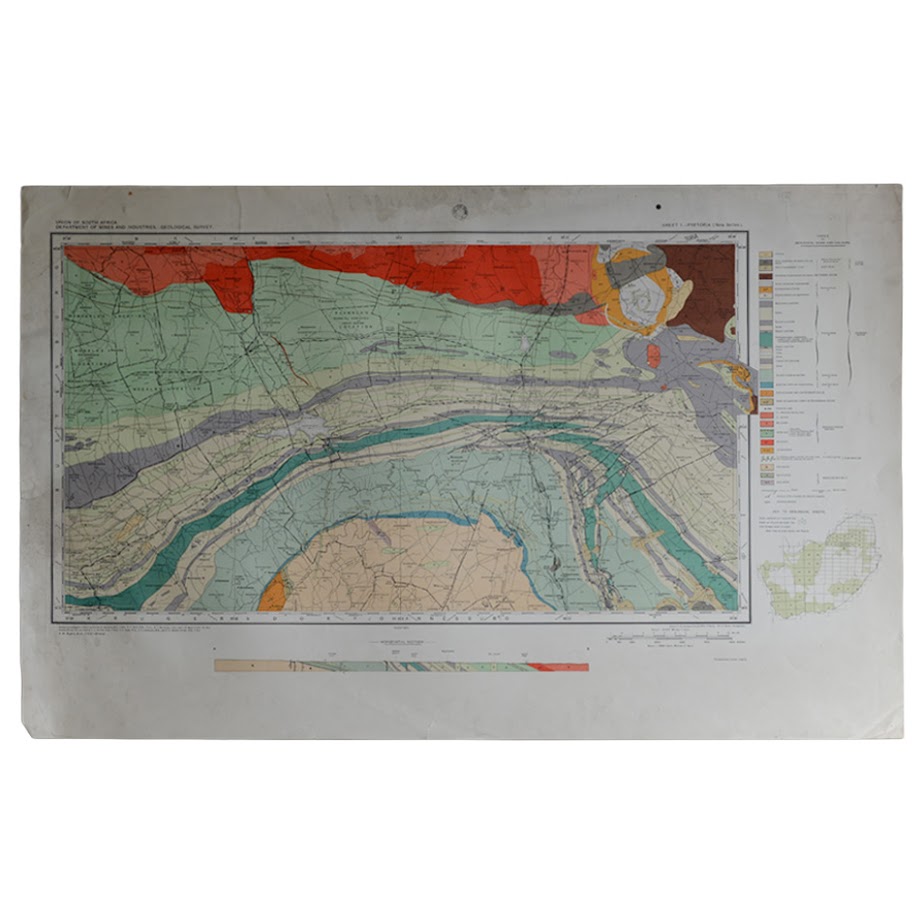
Sheet 1 – Pretoria – Union Of South Africa Department Of Mines And Industries – Geological Survey
Cartographer: Eric H Banks
Publisher: Union Of South Africa Department Of Mines And Industries – Geological Survey
Price: £95 (post-free in the UK)
Publication Date: 1928
Edition: 1st edition thus
Format: Colour printed
Condition: In good condition
Sheet Size: 89.6cm x 56.9cm
Condition:
New series. Sheet Size: 89.6cm x 56.9cm. Small Institutional stamp to upper margin. Short closed tear to upper margin. Creased, marked, dusty and rubbed but this is mainly confined to the margins. Colouration very bright and clean. A good copy. Very scarce.
Location: Pocket RSAGEOL: SR: 002839
The Pretoria Region: An Historical Overview
Overview
The Pretoria region, located in the Gauteng province of South Africa, is a historically rich and strategically significant area that encompasses the country’s administrative capital, Pretoria, and its surrounding suburbs, townships, and rural zones. Nestled in the Apies River valley, north of the Highveld plateau, the region forms part of the wider City of Tshwane Metropolitan Municipality, one of the largest and most diverse metropolitan areas in the country.
The Pretoria region combines a distinctive blend of colonial heritage, African identity, government function, academic influence, and urban-rural interplay, making it central to both the political history and socio-economic development of South Africa.
Geography and Climate
The Pretoria region lies at an elevation of approximately 1,339 metres above sea level, giving it a mild, temperate climate with:
- Hot, wet summers (October to March), often punctuated by thunderstorms
- Cool, dry winters (May to August), with occasional morning frost but little rainfall
Geographically, the area is situated within the bushveld biome, characterised by:
- Acacia-dominated savanna
- Rocky outcrops and dolomitic ridges
- Indigenous grasslands and occasional wetland zones
The Magaliesberg Mountains, which stretch westward from the region, form a dramatic geological and ecological backdrop, while the Apies River runs through the heart of the city and continues northward into the Limpopo drainage system.
Precolonial and Indigenous Heritage
Before colonial expansion, the Pretoria region was inhabited by Tswana-speaking communities, most notably the Ndebele, Bakwena, and Bapedi peoples. These groups developed iron-age settlements, practised mixed farming, and built complex chiefdoms based on lineage, land management, and intertribal diplomacy.
Traces of this precolonial past are found in:
- Archaeological sites with evidence of smelting furnaces, stone tools, and settlement walls
- Oral histories passed down in communities such as Mamelodi and Hammanskraal
- Ceremonial traditions and place names rooted in African cosmology
Despite later displacement, indigenous people remained vital to the region’s identity, contributing labour, language, and cultural resilience.
Boer Republic and Colonial Foundation
Pretoria was formally established in 1855 by Voortrekker settlers, primarily of Dutch descent, and named after Andries Pretorius, a prominent Boer leader. It quickly became the capital of the South African Republic (ZAR), a Boer-ruled territory founded in opposition to British colonial authority.
Key features of this early period include:
- The founding of Church Square, surrounded by civic and religious buildings
- Construction of Kruger House, residence of President Paul Kruger
- Early governance by Volksraad assemblies, law courts, and military commandos
The settlement expanded rapidly, its layout reflecting European planning principles while adapting to the local environment.
Anglo-Boer War and British Rule
During the Second Anglo-Boer War (1899–1902), Pretoria served as the last stronghold of the Boer Republic before it was captured by British forces in June 1900. The war had a profound impact on the region:
- Infrastructure was damaged or repurposed for military use
- British administration imposed new governance structures
- The Pretoria area became a centre for reconstruction and reconciliation following the war
With the formation of the Union of South Africa in 1910, Pretoria was declared the administrative capital, complementing Cape Town (legislative) and Bloemfontein (judicial).
20th Century Development: Apartheid and Urbanisation
Throughout the 20th century, Pretoria evolved into a bureaucratic, educational, and residential hub.
Key developments included:
- The growth of government departments and embassies, particularly along Church Street
- Establishment of major institutions such as the University of Pretoria, CSIR (Council for Scientific and Industrial Research), and UNISA (University of South Africa)
- Racial segregation under the apartheid regime, including the forced relocation of black residents to townships such as Mamelodi, Atteridgeville, and Soshanguve
- Expansion of rail and road networks, reinforcing Pretoria’s position as a transport and administrative nexus
Pretoria also became a symbol of Afrikaner nationalism, with monuments such as the Voortrekker Monument serving as both historical commemoration and political expression.
Post-Apartheid Era and the City of Tshwane
With the end of apartheid in 1994, the Pretoria region entered a new phase of transformation:
- The metropolitan area was renamed the City of Tshwane (after a local chief), although Pretoria remains the name of the inner city
- Government functions were restructured to reflect democratic representation, with national departments and embassies retaining their base in the capital
- Urban renewal programmes sought to integrate previously segregated neighbourhoods and expand access to housing, services, and economic opportunity
Today, the region faces the challenge of balancing its historical legacy with inclusive development, aiming to serve both as a symbol of national unity and a modern African capital.
Cultural and Architectural Landscape
The Pretoria region is notable for its diverse architectural styles, including:
- Victorian and Edwardian public buildings
- Cape Dutch and Neoclassical residences
- Modernist government complexes
- Traditional Ndebele homesteads on the rural outskirts
Noteworthy sites include:
- Union Buildings: Designed by Sir Herbert Baker, these house the offices of the President and form a national landmark
- Freedom Park: A post-apartheid memorial honouring the country’s freedom struggle
- Church Square: The historic centre of colonial and republican Pretoria
- Jacaranda-lined avenues: Giving the city its popular nickname, “Jacaranda City”
Museums, galleries, and performance spaces celebrate the multicultural identity of the region, from Afrikaans literature and visual arts to Tswana and Ndebele traditions.
Current Role and Future Outlook
Pretoria remains the seat of executive government in South Africa and is home to:
- Parliamentarians, civil servants, and legal professionals
- International diplomats and administrative attachés
- Students, researchers, and cultural workers
The region’s future lies in addressing:
- Urban-rural inequality
- Housing backlogs and infrastructure strain
- Preserving cultural heritage while embracing innovation and diversity
Efforts are ongoing to position Pretoria as a green capital, with sustainable transport, biodiversity corridors, and urban planning initiatives enhancing both liveability and economic opportunity.
Conclusion
The Pretoria region stands at the crossroads of history, governance, and transformation. It is a place where precolonial legacies, colonial institutions, and post-apartheid aspirations converge. As South Africa’s administrative heart, it continues to shape the nation’s political direction while reflecting its evolving identity as a democratic, pluralistic society.
SHOP WITH CONFIDENCE AT HORNSEYS
At Hornseys, we are dedicated to offering items that uphold the highest standards of quality and authenticity. Our collection of artwork is carefully curated to ensure that each item we offer is authentic, collated, and complete.
Here’s what sets us apart:
- Authenticity and Provenance: Each map is researched and verified for authenticity.
- Expert Curation: We entirely own all our artworks. We trust our taste and have invested heavily in it. We have confidence in all artwork that we offer for sale.
- Customer Satisfaction: We strive to provide an exceptional customer experience, from detailed descriptions and provenance to secure and prompt delivery of your purchase.
- Returns Policy: We offer an unconditional guarantee on every item. If, however, you wish to make a return, artworks may be sent back to us within fourteen days of receipt for whatever reason. We request that we are notified in advance if you wish to do so. They must be returned to us in the same condition as they were sent for a full refund.
OUR COMMITMENT TO QUALITY AND SERVICE
Understanding the value and rarity of these items, we ensure that every aspect of your purchase meets the highest standards of quality and service. This includes:
- Free Expedited, Tracked, and Insured Delivery within the UK: Ensuring that your artwork arrives safely and promptly.
- Fully-Insured Worldwide Delivery: Offering peace of mind for international collectors with reliable and secure shipping options.
EXPLORE OUR COLLECTION
Visit Hornseys today to explore our fine collection of maps and other artworks. Whether you are an avid collector or looking for a special gift, our selection offers something truly unique. Located since 1976 in Ripon in the picturesque Yorkshire Dales, we are recognized as a destination gallery for tastefully curated artwork, rare maps, design, and fine books.