
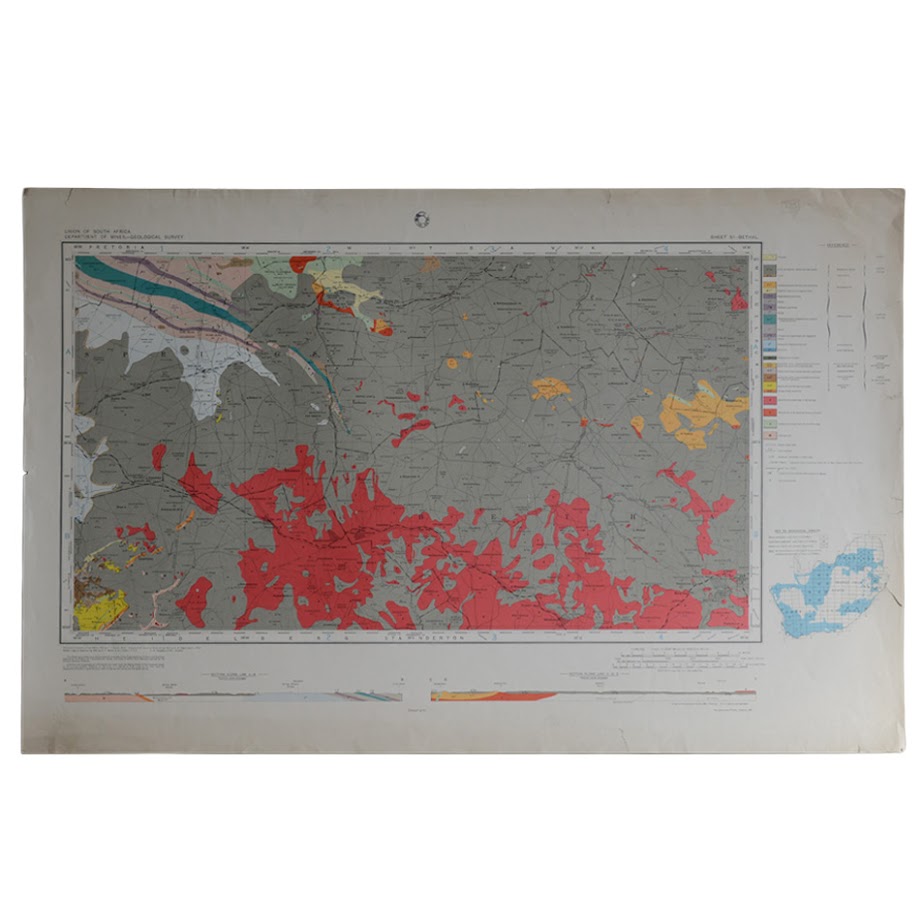
Sheet 51 – Bethal – Union Of South Africa Department Of Mines And Industries – Geological Survey
Banks, Eric H.
£95.00
Availability: In stock
Product Description
Sheet 51 – Bethal – Union Of South Africa Department Of Mines And Industries – Geological Survey
Cartographer: Eric H. Banks
Publisher: Union Of South Africa Department Of Mines And Industries – Geological Survey
Price: £95 (post-free in the UK)
Publication Date: 1932
Edition: 1st edition thus
Format: Colour printed
Condition: In good condition
Sheet Size: 87.9cm x 56.5cm
Condition:
Sheet Size: 87.9cm x 56.5cm. Small Institutional stamp to upper margin. Closed tear to right hand margin and other minor short closed tears. Creased, marked, dusty and rubbed but this is mainly confined to the margins. Colouration very bright and clean. A good copy. Very scarce.
Location: Pocket RSAGEOL: SR: 002849
Bethal District: An Historical Overview
Geographical Context
Bethal is a town situated in the Gert Sibande District of Mpumalanga Province, South Africa. Positioned at the intersection of major routes leading to Ermelo, Secunda, and Middelburg, it lies on the Highveld grasslands, a plateau known for its expansive horizons, fertile soils, and mineral wealth.
The region is part of the Highveld Coal Belt and has historically functioned as both an agricultural service centre and a mining town, with strong links to South Africa’s industrial and energy sectors.
Precolonial Period: Indigenous Peoples and Early Use of Land
Before colonial settlement, the area around present-day Bethal was inhabited by Nguni- and Sotho-speaking communities, including the AmaNdebele, Bapedi, and other groups with pastoral and agricultural traditions.
These communities:
- Practised mixed farming, combining cattle herding with the cultivation of sorghum, millet, and later maize
- Lived in homesteads (kraals) built near water sources and grazing lands
- Maintained cultural practices such as initiation rites, rainmaking ceremonies, and ancestral veneration
- Engaged in trade and diplomacy with neighbouring chiefdoms
The land was held under communal tenure, and the rivers and grasslands provided both subsistence and spiritual sustenance.
19th Century: Boer Expansion and Colonial Settlement
The arrival of Voortrekkers during the Great Trek in the 1830s and 1840s marked the beginning of systematic European settlement in the region. By the mid-19th century, Boer farmers had begun establishing farms and townships across the Highveld, often through land grants from the South African Republic (ZAR) and, in some cases, land acquisition through forced removal or treaties with local chiefs.
Bethal was formally established in 1880 on the farms Blesbokspruit and Die Hoek, and was named after the wives of two prominent settlers—Elizabeth du Plooy and Alida Naude (from Eliza and Alida, forming “Beth-Al”).
The early economy of the region centred on:
- Cattle ranching and sheep farming
- Dryland maize production
- Trade in leather, wool, and basic tools
The town served as a market and church centre, following the typical Dutch Reformed Church layout, with a central square and civic buildings.
Early 20th Century: Infrastructure, Coal Discovery, and Economic Growth
The development of Bethal accelerated with the arrival of the railway line in the early 20th century, connecting it to other parts of the Transvaal and the port at Durban. This greatly facilitated the movement of goods, particularly agricultural produce and later coal.
By the 1930s and 1940s, the discovery of coal deposits in and around Bethal—especially in the Witbank Coalfield—began to change the region’s profile. The coal seams in this part of Mpumalanga were easily accessible and well-suited for power generation and industrial use.
Bethal became:
- A hub for coal transport via rail and road
- A supplier of coal to power stations and factories in Gauteng
- A destination for migrant labour, drawn from rural areas and neighbouring countries
This growth brought both prosperity and inequality, as labour conditions were harsh, and black workers were denied access to land, housing, and citizenship rights under colonial and later apartheid rule.
Apartheid Era (1948–1994): Forced Labour, Segregation, and Resistance
Bethal became nationally notorious during the apartheid era for the exploitative use of forced labour on white-owned farms. In the 1950s and 1960s, investigative journalists and church activists exposed the widespread use of convict labour—whereby black men arrested for pass offences or minor infractions were sent to Bethal prisons and leased out to potato farmers, often under abusive and inhumane conditions.
This system sparked national and international outrage, prompting calls for reform and shining a spotlight on the region’s role in institutionalised racial oppression. At the same time:
- Bethal remained a centre of Afrikaner farming wealth and National Party support
- The town and surrounding areas were racially segregated under the Group Areas Act
- Black and coloured residents were confined to under-resourced townships such as eMzinoni, located on the outskirts of town
- Schools, clinics, and public amenities were reserved for white citizens, while the majority endured poor living standards and political repression
Despite this, Bethal became a site of quiet resistance. Trade unions, church networks, and political activists worked to document abuses and support rural workers, particularly in the wake of the 1960 Sharpeville massacre and the broader crackdown on dissent.
Post-Apartheid Era and Contemporary Challenges
Since the advent of democracy in 1994, Bethal has undergone significant transformation, though structural inequalities persist. The town was incorporated into the Govan Mbeki Local Municipality, within the Gert Sibande District, and efforts have been made to improve:
- Housing and infrastructure in formerly marginalised communities
- Access to public services, including education and healthcare
- Local economic development, particularly for emerging farmers and small businesses
The region continues to rely heavily on agriculture and coal mining, with maize, potatoes, and sunflower farming prominent in the rural economy. However, challenges remain:
- Declining coal markets and growing emphasis on renewable energy threaten the long-term viability of traditional industries
- Youth unemployment and underinvestment in skills development hamper inclusive growth
- Environmental issues such as soil degradation, water pollution, and air quality are of increasing concern due to mining and power generation
Cultural Legacy and Identity
Bethal’s history is marked by tension between settler identity, black dispossession, and rural resistance. The memory of labour abuse on the potato farms remains a symbol of apartheid-era exploitation, yet the region also offers a story of resilience, community organisation, and post-apartheid reconciliation.
Today, Bethal hosts:
- A diverse population speaking isiZulu, Afrikaans, English, and Sesotho
- Annual agricultural expos and community events
- Memorials and oral histories commemorating those who suffered under forced labour and fought for justice
The area continues to evolve as it seeks to balance its industrial legacy with the needs of sustainable development, social inclusion, and historical redress.
Conclusion
The Bethal region offers a compelling lens into South Africa’s broader rural history—from colonial farming and mineral exploitation to the struggles of apartheid and the complexities of democracy. Its rich soils and deep seams of coal have shaped the lives of generations, both enriching and dividing them.
Today, Bethal stands at a crossroads, negotiating its identity between tradition and transformation, and working towards a future grounded in dignity, equity, and renewed opportunity.
SHOP WITH CONFIDENCE AT HORNSEYS
At Hornseys, we are dedicated to offering items that uphold the highest standards of quality and authenticity. Our collection of artwork is carefully curated to ensure that each item we offer is authentic, collated, and complete.
Here’s what sets us apart:
- Authenticity and Provenance: Each map is researched and verified for authenticity.
- Expert Curation: We entirely own all our artworks. We trust our taste and have invested heavily in it. We have confidence in all artwork that we offer for sale.
- Customer Satisfaction: We strive to provide an exceptional customer experience, from detailed descriptions and provenance to secure and prompt delivery of your purchase.
- Returns Policy: We offer an unconditional guarantee on every item. If, however, you wish to make a return, artworks may be sent back to us within fourteen days of receipt for whatever reason. We request that we are notified in advance if you wish to do so. They must be returned to us in the same condition as they were sent for a full refund.
OUR COMMITMENT TO QUALITY AND SERVICE
Understanding the value and rarity of these items, we ensure that every aspect of your purchase meets the highest standards of quality and service. This includes:
- Free Expedited, Tracked, and Insured Delivery within the UK: Ensuring that your artwork arrives safely and promptly.
- Fully-Insured Worldwide Delivery: Offering peace of mind for international collectors with reliable and secure shipping options.
EXPLORE OUR COLLECTION
Visit Hornseys today to explore our fine collection of maps and other artworks. Whether you are an avid collector or looking for a special gift, our selection offers something truly unique. Located since 1976 in Ripon in the picturesque Yorkshire Dales, we are recognized as a destination gallery for tastefully curated artwork, rare maps, design, and fine books.


